

A tower’s height alone doesn’t determine how far your phone can connect. A cellular mast carries antennas and radio equipment that transmit and receive signals between mobile devices and the network; a typical tower may cover between 1 and 25 miles. The usable range depends on factors such as terrain, buildings, antenna position and the frequencies in use.
It’s easy to assume that being near a cellular mast means having a strong signal, but coverage also depends on site design and what lies between the mast and your device. This guide explains how a cellular mast and its antennas support mobile coverage, and why signal range varies by location.
You’ll also learn how different site types serve urban and rural areas, how 4G and 5G fit into the picture, and what can affect signal reach in Australia. With that context, it’s easier to understand why a signal can weaken even when a mast appears nearby.
Key Takeaways
- Understand how tower antennas and transceivers carry signals between mobile devices and the network.
- Identify why terrain, buildings, antenna placement and frequency can affect reception in different locations.
- Learn how macro sites and smaller cells serve coverage needs in rural areas, cities and indoor spaces.
- See how tower structures, antennas and signal-processing equipment work together to support mobile coverage.
- Explore how site planning balances network demand, engineering needs, construction feasibility and landowner considerations in Australia.
Cell site operation and mobile network coverage
A mobile site connects radio coverage in a local area to the wider network. Its equipment and location affect how mobile phones connect for calls and internet access.
How mobile sites provide access
A mobile site uses antennas and radio equipment to send signals between mobile phones and a cellular network. The site’s transceiver, sometimes called a base station, connects with the operator’s core network through fibre or microwave. This link carries information beyond the local radio connection, enabling calls and mobile internet access.
For a phone user, the process is practical: the device communicates by radio with a nearby site, then the network routes calls or data onwards. A site with multiple antennas can support nearby users and 4G and 5G networks. 4G provides broad coverage, while 5G enhances performance where available. Capacity depends on deployed technology, available spectrum and the types of communication being carried.
This distinction helps explain why coverage and performance are not the same. A phone may connect to a site, but the network technology available and the site’s capacity affect the service it can provide. Mobile sites are planned around population, points of interest and transport links, so coverage serves people and activity rather than simply maximising distance from one mast.
Cell site and mast terminology
A cell site is the location containing equipment that connects mobile devices to a network; a cell tower or phone mast is the structure that supports some of that equipment. In Australia, sites may use a tall tower or a smaller pole, depending on the setting and coverage need. The terms describe related parts of a mobile network, not always the same physical component.
A rooftop installation, for example, can function as a mobile site without resembling a freestanding rural tower. In space-constrained urban areas, smaller wooden or metal telecom poles may be used. Antennas can serve different directions, while transceivers and network connections carry communications beyond the structure. When reading a site record, remember that the site is the location, while the mast is one possible supporting structure.
The Radio Frequency National Site Archive lists matching proposed and active mobile sites. Search results include each matching site’s number, address, networks and technologies. A site listed as proposed has not yet been constructed. This is different from proposed technology at an existing site, which is being approved, installed or tested and is not switched on.
Consultation and site approval
The Radio Frequency National Site Archive provides consultation details when consultation is underway for a new site or an upgrade to an existing site. The archive can help you distinguish a site under consideration from technology already operating. Its records also identify networks and technologies, providing context for each site’s planned or active role.
In Australia, site selection weighs subscriber density, radio-frequency engineering, construction feasibility, regulatory requirements and landowner negotiations. Population and transport links indicate where coverage is needed, while engineering and construction factors help determine whether a proposed location can meet that need. A proposed site is different from an active site, where the listed technology is switched on and operating.
When reviewing a proposed record, note the site number, address and listed networks, then look for consultation details if consultation is underway. For an existing location, compare active and proposed technology: active means operating, while proposed means approval, installation or testing is still in progress. These labels clarify the site’s status without suggesting a proposal provides live coverage.
What is a Cell Tower?
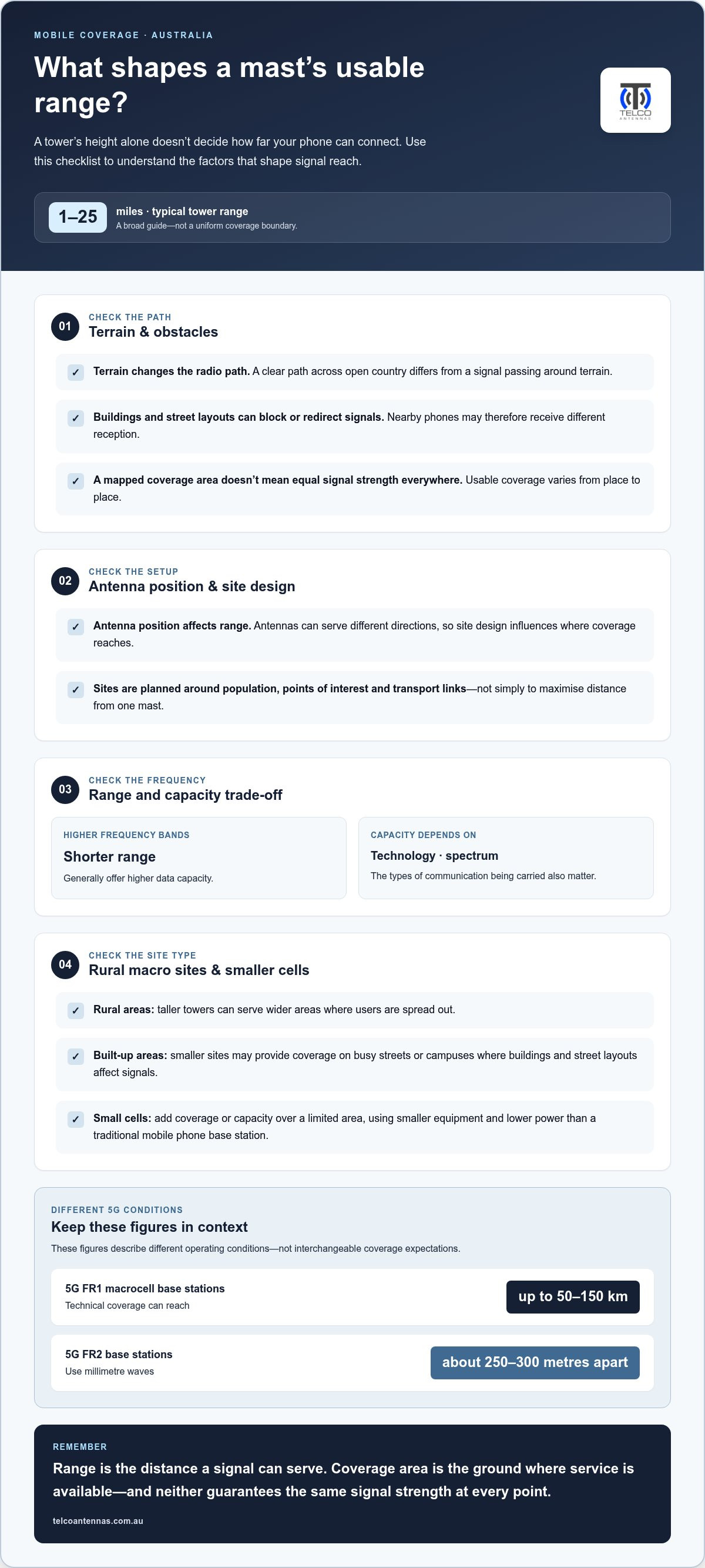
A cellular mast’s coverage depends on more than its height. Terrain, buildings, frequency and site type all affect where a usable signal reaches, which is why nearby phones can receive different reception.
Factors shaping coverage
Geography shapes coverage by affecting the radio path between a site and a mobile device. A clear path across open country differs from a signal passing through buildings or around terrain. A map’s coverage area therefore does not mean every point receives the same signal strength.
In rural Australia, taller towers can serve wider areas where users are spread out. In built-up areas, buildings and street layouts can block or redirect signals, so smaller sites may provide coverage on busy streets or campuses. Antenna position and frequency band also influence signal range and available capacity.
Coverage range and area
A tower’s range is the distance its signal can serve, while its coverage area describes the ground where that service is available. A typical cell tower may have a coverage range of between 1 and 25 miles. That broad span is a guide, not a uniform boundary: terrain, obstacles, antenna placement and frequency affect the usable area.
Frequency creates a practical trade-off. Higher radio frequency bands generally have shorter ranges but higher data capacity. For 5G FR1 macrocell base stations, technical coverage can reach up to 50-150 km; 5G FR2 base stations are about 250-300 metres apart because they use millimetre waves. These figures describe different operating conditions, not interchangeable coverage expectations.
Small cells add coverage or capacity over a limited area in Australia. They use smaller equipment and operate at lower power than a traditional mobile phone base station. A small cell may help address demand in a busy urban location, while a rural macro site is designed to serve a broader outdoor area. Site type and local geography matter as much as nominal range.
Network planning also shapes coverage. Macro cells provide outdoor coverage across wide areas and can reach into buildings, while small cells target local demand. A site’s capacity depends on the technology deployed, available frequency spectrum and the communications it carries. A signal reaching a location does not, by itself, indicate how much capacity is available there.
For projects where site position and coverage requirements need to be considered together, communication tower design is a relevant engineering consideration.
Tower structures, antennas, transceivers and amplifiers
A communications tower combines a supporting structure with radio equipment that carries wireless signals. Its design and maintenance affect how reliably antennas transmit and receive communications.
Tower designs and locations
Monopole, lattice and guyed towers support communications equipment in different ways. A monopole has a single upright structure, while a lattice tower uses a framework of connected members. Guyed towers rely on tensioned cables attached to ground anchors or foundation points to stabilise the structure.
The site determines which structure is practical. Urban areas may use shorter towers or poles where space is constrained; rural areas may use taller structures to serve larger distances. A typical cell tower may be around 25 m high, while urban towers may be as low as 15 m and rural towers may exceed 60 m. Rooftops can also host antennas, sometimes behind concealment panels or chimneys.
The choice affects more than appearance. A guyed structure needs room for its supporting cables, while a monopole can suit a site with limited ground area. Lattice construction provides a framework for mounting equipment. Each structure must support the antennas and related equipment while meeting the location’s engineering and access requirements.
Antennas and signal equipment
Antennas transmit and receive radio-frequency signals, while transceivers and signal-processing units manage communications with mobile devices and adjacent masts. Multiple antennas can be mounted on a tower to serve different directions and network requirements. Their position and orientation help shape the wireless coverage delivered from the site.
A transceiver, sometimes called a base station, handles the radio link and connects the site to the operator’s wider network. Fibre or microwave links can carry that connection onward. Signal amplifiers can enhance cellular signals to help address degradation caused by distance, obstacles or interference. They support the radio path but do not replace the tower’s antennas, transceiver or network connection.
Equipment also varies with the site’s purpose. A mobile site may carry antennas and processing equipment for 4G or 5G, while some towers host other systems, such as high-speed microwave connectivity or utility network monitoring. The equipment installed determines what communications the structure supports, rather than the tower’s height alone.
Construction and ongoing upkeep
Tower construction starts with a structure suited to the location and equipment. Cell tower structures are typically made of steel and fixed to reinforced concrete foundations. A guyed design also needs ground anchors or foundation points for its stabilising cables. The selected height and structure influence the foundation and the space required around the site.
The cost to build, lease or host a cellular mast in Australia depends on its design, height, foundation, site access, power and network connection. Lease or hosting costs also depend on the site arrangement and the equipment it accommodates.
Ongoing upkeep protects the structure and communications equipment. Towers are regularly inspected and treated for corrosion, while overgrowth around the site is cleared to maintain access. These tasks are especially important for steel structures exposed to weather: corrosion can affect structural condition, and vegetation can obstruct maintenance access.
Backup batteries are commonly used to keep tower equipment operating when grid power is unavailable. Weatherproofing, remote monitoring and proactive maintenance also support communications during adverse conditions. Together, the structure, power supply and inspection routine help keep the site functioning as part of the mobile network.
Cellular mast and base station range
A base station’s range is the distance over which its radio link can serve a mobile device. The technical maximum is different from dependable coverage on the ground.
In Australia, radiation safety concerns exposure to radiofrequency energy, not a fixed distance from a mast. ARPANSA’s advice focuses on limiting exposure; distance alone does not determine health risk or signal range.
For GSM, the free-space timing limit is 150 km, with 180 km possible using special equipment. This describes a technical limit under particular conditions, not the expected range of every base station. Real terrain, buildings, antenna height, interference and network settings affect the radio path, so a phone may lose service well inside that distance.
For 3G, 4G and 5G FR1 macrocell base stations, technical coverage can reach 50-150 km. The wide range reflects different site conditions and network configurations. It isn’t a single coverage promise: hills can obstruct the path, while clear terrain can allow a signal to travel farther. A phone’s connection also depends on the device and the network supporting that location.
5G FR2 operates differently. Its millimetre waves support base stations placed about 250-300 metres apart, rather than relying on one station to cover a broad region. Higher frequency bands generally offer greater data capacity over shorter distances. This makes site spacing and local obstructions especially relevant when interpreting 5G availability around streets or buildings.
These figures distinguish three ideas: a theoretical radio limit, a designed network range and usable coverage for an individual. A tower’s coverage area changes with terrain, obstacles, operating frequency and antenna placement. A map may show the planned service area, but it cannot represent every indoor room, road cutting or slope equally. For example, a phone on open ground may connect where a device behind a hill cannot.
Range also differs from capacity. The distance a signal travels does not show how many users a station can serve or the data performance available during busy periods. Capacity depends on deployed technology, available spectrum and the communications carried. A remote site may cover a broad area, while a closer urban site may be designed to handle concentrated demand.
When comparing coverage claims, first identify the network generation and frequency layer. Then check whether the figure refers to technical reach or practical service at a particular location. These distinctions explain why two base stations, or two nearby users, can experience different results without contradicting the stated range.
How are sites selected and approved for new cellular masts in Australia?
In Australia, a proposed mast location is assessed against network demand, radio engineering, construction feasibility, regulatory requirements and landowner negotiations. These factors help determine whether a site can meet a coverage need and support the required infrastructure.
Subscriber density helps show where extra network capacity or coverage is needed. A busy population centre may need infrastructure close to users, while a less populated area may need a site serving a broader region. Points of interest and transport links also inform network planning, since mobile demand follows where people live, work and travel.
Radio-frequency engineering assesses whether a candidate location can serve the intended area. Terrain, nearby buildings, antenna position and available frequencies affect how signals travel. For example, a site positioned to serve a transport link may address a different coverage need from one intended for a town centre. The assessment connects the location with the network’s coverage and performance goals.
Construction feasibility determines whether the site can accommodate the proposed infrastructure. Access, ground conditions, available space and connection to the wider network all influence what can be built and operated. The structure and equipment must suit the site, rather than being selected on coverage objectives alone. Landowner negotiations are another factor in establishing a viable location.
Regulatory requirements are also part of site selection and approval. They must be considered alongside engineering and construction needs, but are not interchangeable with network planning. A candidate may address a coverage gap, yet still needs assessment against these other factors before the site progresses.
The Radio Frequency National Site Archive can help you understand a site’s status. A proposed site has not yet been constructed. A site’s proposed technology is being approved, installed or tested, and is not switched on. Active technology is switched on and operating. These labels distinguish a planned site from an operating one, and proposed equipment from equipment already in service.
The archive’s search results show each matching site’s number, address, networks and technologies. Consultation details appear when consultation is underway for a new site or an upgrade to an existing site. If you find a proposed site, review its listed details and consultation information to understand its status and context. The archive also lists matching active sites, helping distinguish existing network infrastructure from proposals.
For projects that need a designed communications structure, discuss planning a proposed site and its connectivity requirements.
Telco Antennas: Cel-Fi GO Mobile Signal Boosters
Telco Antennas supplies Cel-Fi GO Mobile Signal Boosters for situations where mobile reception needs attention beyond the network’s mast coverage. The right equipment depends on the site and the signal challenge, so consider where reception drops and how you will use the system.
Related options include MIMO Antennas and LMR-400 Coaxial Cables, which form part of the available mobile communications hardware. For a different connectivity requirement, Telco Antennas also supplies Point-to-Point Wireless Bridges. These are distinct equipment categories, and the useful choice depends on whether the need concerns mobile signal or a wireless link between locations.
Contact Telco Antennas to discuss the equipment that fits your mobile communications setup.
Turn signal observations into a practical next step
If reception varies between rooms, work areas or travel routes, note where the signal changes and what connection you need there. This pattern can help clarify whether the issue relates to coverage, equipment or the way a site connects to the network. A cellular mast is part of a wider system, so choosing equipment starts with the conditions where you need service.
For mobile signal requirements, Telco Antennas offers Cel-Fi GO Mobile Signal Boosters, MIMO Antennas and LMR-400 Coaxial Cables. These are distinct components, and the suitable option depends on the setup and the signal challenge. Bringing clear observations about your location and use case can make a technical discussion more focused.
Contact Telco Antennas to discuss your mobile communications requirements and identify a sensible next step. A clear understanding of the site is a practical starting point for making equipment decisions with confidence.
Frequently Asked Questions
What is a mobile mast, and how does a cellular mast work?
A cellular mast supports the radio equipment that links mobile phones with a mobile network. Phones send and receive radio signals through the site’s antennas, while site equipment passes communications into the operator’s network. As you move, your phone may connect through different sites, depending on signal availability and network operation. The mast is the visible structure; its antennas and connected equipment carry the communications.
What types of mobile phone towers are used in Australia?
Australian networks use large outdoor macro sites, smaller urban micro cells, and small cells for local coverage or extra capacity. Indoor pico cells can serve places such as offices, shopping malls and large buildings. The supporting structure may be a freestanding tower, rooftop installation or smaller pole. For example, a macro site suits wider outdoor coverage, while a small cell can address concentrated demand on a busy street.
How tall are cellular masts in Australia, and what equipment do they carry?
There’s no single standard height: urban towers may be as low as 15 m, a typical tower may be around 25 m, and rural towers may exceed 60 m. Equipment can include antennas, radio transceivers and signal-processing units. Some sites also use backup batteries to keep equipment operating if grid power is unavailable. The installed equipment varies with the site’s network role and communications requirements.
What Australian rules govern planning approval, public consultation and environmental impacts of mobile masts?
Site selection considers applicable regulatory requirements alongside radio-frequency engineering, construction feasibility and landowner negotiations. The Radio Frequency National Site Archive provides consultation details when consultation is underway for a new site or an upgrade. Archive records can also include a site map, compliance certificate and site EME report. These records provide site-specific information, while the proposed site’s status indicates whether construction has begun.


