

The stiffer spring isn’t automatically the more durable choice. The gme antenna spring base vs rfi heavy duty spring base durability question comes down to how well each spring suits the antenna’s load and the impacts it may face, not just its “heavy duty” label. A spring that’s too stiff may offer little protection from knocks, while one that’s too flexible for the antenna can sag and strain the mount.
When vibration, branches and rough tracks could damage an antenna or its mounting point, it’s sensible to compare construction and fit. But durability depends on the whole setup: antenna compatibility, spring movement, mounting conditions and how the vehicle is used.
This comparison looks at the GME AS004B and RFI SK953, explains what their published specifications can and can’t tell you, and outlines the mechanical factors that matter in real driving conditions. It also covers how fitting a spring can affect antenna tuning, so you can choose a base that balances impact protection with stability and performance.
Key Takeaways
- Assess durability through fatigue, corrosion, impact resistance and fastening security in your actual setup, not the “heavy duty” label alone.
- For gme antenna spring base vs rfi heavy duty spring base durability, compare exact models: the GME AS004B and RFI SK953, using specifications documented for each.
- Match the spring to the antenna’s dimensions and load, then inspect the full connection from antenna to spring, bracket and vehicle structure.
- Account for road vibration and likely impacts when deciding how much spring movement your installation needs.
- If the mounting arrangement or load path is unusual, an RF engineering assessment can help clarify the technical factors involved.
GME vs RFI Antenna Spring Bases: What Does Durability Actually Mean?
Durability isn’t just whether a spring stays attached after a knock. For an antenna spring base, it means resisting fatigue from repeated flexing, corrosion in its operating environment, impact damage and loosening at connections, while supporting an antenna it’s suited to carry on an appropriate mount. “Heavy duty” may describe intended use, but the label alone doesn’t establish a longer service life or prove that a spring suits every antenna and vehicle.
The spring is only one part of the load path. An impact may leave the spring apparently intact but bend the antenna, loosen fasteners or stress the bracket and vehicle mounting surface. A sound mount can’t compensate for a poorly matched spring that flexes excessively or carries a load outside its intended use. Compare the exact models, their documented specifications and the conditions the complete installation will face.
What does an antenna spring base do?
A spring base sits between the antenna and its mounting point, allowing some movement when the antenna is deflected by contact or vibration. The amount of movement depends on the spring’s design and the forces applied. The antenna is part of a system that transmits and receives radio signals; the Antenna (radio) overview provides useful background on its role. A spring doesn’t replace a secure, structurally suitable mount, and extra movement isn’t automatically extra protection.
Which conditions influence service life?
Repeated vibration cycles the spring through small movements, while a tall whip, greater mass or larger exposed area can increase the forces acting on the spring and mount. Contact with branches or other obstacles creates sharper deflections. Moisture, dirt and corrosion are also worth checking, particularly around joints and fasteners. Confirm a model’s material and finish in its documentation rather than making assumptions.
Spring durability describes how well the component resists wear and damage; antenna-system durability also depends on the antenna, connections, mount and vehicle structure working together.
For the gme antenna spring base vs rfi heavy duty spring base durability comparison, consider both levels. Manufacturer specifications can establish stated compatibility, materials and other published details, but they don’t show exactly how a particular installation will behave on corrugated roads or under repeated impacts. During routine checks, look for changes such as a spring that no longer returns to its usual position, visible damage, corrosion or movement at a fastener. These signs can flag a developing issue, but they don’t replace matching the spring to the antenna and mount.
Operating conditions complete the picture. A vehicle used mainly on smooth roads faces a different vibration and impact profile from one regularly driven on rough tracks beneath overhanging branches. Compare the precise spring models with the intended antenna and mounting arrangement, then assess the whole assembly rather than treating a heavy-duty label as a durability verdict.
How Spring Stiffness, Antenna Load and Vibration Affect Durability
A spring base is designed to move under load, but that movement needs to suit the antenna and its mount. As a vehicle travels over corrugations or uneven surfaces, vibration can make the antenna and spring flex repeatedly. Each cycle adds mechanical stress. Repeated stress may contribute to fatigue over time, particularly if the spring moves through a large range or carries a load outside its intended application.
Antenna dimensions affect those forces. A longer whip can create greater leverage at the base, while a heavier antenna has more inertia as the vehicle moves. A broad exposed area can also catch more airflow. These forces pass through the spring and into the mount, so the bracket and vehicle structure matter as much as the spring itself. Mount position and the support provided by the assembly also affect how movement is transferred.
Spring stiffness should suit the complete antenna and mounting arrangement, allowing it to flex under expected movement without excessive sway or avoidable loads on the antenna and mount. There isn’t one stiffness level that’s best for every installation. Consider whether the spring’s movement suits the antenna’s dimensions and load, its mounting position and the conditions it will encounter.
Can a spring base be too stiff?
It can be a poor match. If a spring deflects very little during an impact, more of the resulting movement or force may transfer to connected components. That doesn’t establish that a particular model is too stiff: the effect depends on the antenna and installation. A short, light antenna on a rigid mount differs from a long whip on a flexible bracket, so don’t judge stiffness by brand label alone.
How do vibration and impacts contribute to wear?
Ongoing vibration creates repeated, smaller loading cycles; an occasional branch strike or other contact can cause a sharper, larger deflection. Both can stress the spring, while movement at joints can affect mounting fasteners. Engineering Design and Testing Corporation explains broader equipment risks in its Impact of Vibration on Equipment and Structures overview. The mechanisms are relevant, but the overview doesn’t establish a service life for either antenna spring.
During routine checks, look for looseness, visible deformation, cracking, unusual movement or changes in how the assembly sits. These are reasons to inspect the system, not proof of a particular failure or its cause. If a fastener has shifted, check the connected bracket and mounting surface as well as the spring. Repeatedly tightening a connection without finding out why it moves may leave the underlying loading issue unresolved.
For the gme antenna spring base vs rfi heavy duty spring base durability comparison, apply the same reasoning to each exact model. Don’t assume that “heavy duty” tells you how a spring will behave under your antenna’s load. Telco Antennas’ RF engineering and site survey expertise provides technical context for assessing antenna loading and mounting conditions as part of a broader system.
GME vs RFI Heavy Duty Spring Base: Compare the Exact Models
A useful comparison needs model numbers, not just brand names. The models considered here are the GME AS004B and RFI SK953. Their product information confirms some details, but doesn’t provide a complete, like-for-like set of measurements or performance results. That limits what can be concluded about comparative service life.
Which specifications belong in a fair comparison?
Compare the exact spring-base model, its stated material and dimensions, compatible antenna types, mounting requirements, load limits and intended application. Use manufacturer information for each field, and treat unpublished details as unknown rather than estimating them. A compatibility statement for one product doesn’t prove compatibility with another antenna or spring.
| Specification | GME AS004B | RFI SK953 | Verification note |
|---|---|---|---|
| Description and finish | Heavy-duty antenna spring; black finish. | Bellied heavy-duty spring; black finish. | Manufacturer product descriptions, verified information current to October 2026. |
| Material | Stainless steel. | Stainless steel. | Verified product information for the two heavy-duty springs. |
| Stated antenna compatibility | GME AE4704B, AE4705B and AE4706B antennas. | Not stated in the reviewed product information. | GME compatibility is stated in product information; no SK953 compatibility claim is inferred. |
| Dimensions and load rating | Not stated in the reviewed information. | Not stated in the reviewed information. | No figures are estimated or treated as equivalent. |
| Warranty | One-year warranty. | Not stated in the reviewed product information. | GME warranty information is documented; no RFI warranty claim is made. |
What evidence can support a durability claim?
A product description shows how a manufacturer presents an item; it isn’t the same as comparative durability testing. Stronger evidence would include documented test methods, load ratings or technical data that can be compared on the same basis. If one manufacturer publishes a figure and the other doesn’t, that gap limits the comparison. It isn’t evidence that the second product performs worse.
The product information and promotional material considered here don’t establish a durability winner between the AS004B and SK953. They identify both as heavy-duty springs but don’t provide comparable test results or a shared measure of service life. For gme antenna spring base vs rfi heavy duty spring base durability, compare their confirmed descriptions and compatibility details, then assess whether the documented information suits your antenna and mount.
Separate stated facts from assumptions before deciding. The AS004B’s listed antenna compatibility is specific, while the SK953 description identifies its heavy-duty designation, bellied form and black finish. Neither description alone establishes how either spring will perform under a particular vehicle’s vibration, impacts or installation loads. Use current manufacturer technical information for additional dimensions, ratings or mounting guidance, and leave undocumented comparisons open rather than declaring a winner.
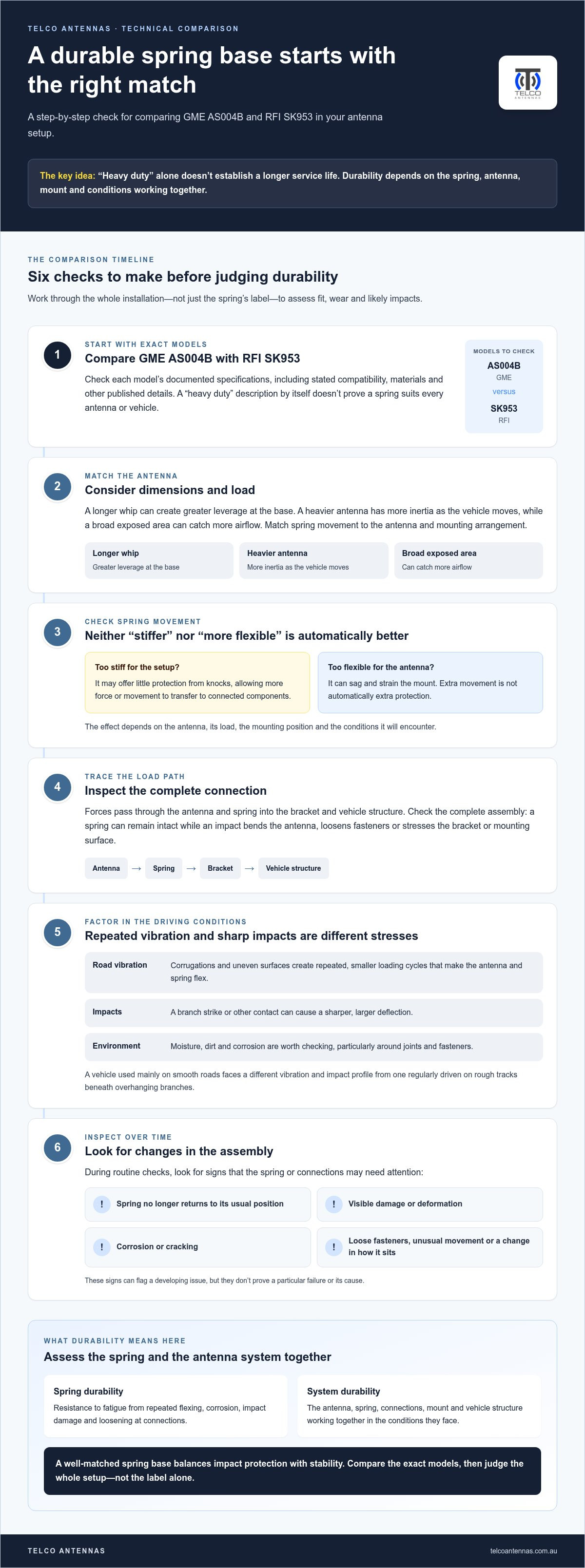
How to Choose a Durable Spring Base for Your Antenna Setup
Choose a spring base by working from the antenna out to the vehicle, rather than selecting by brand or duty label alone. This makes it easier to assess fit and likely stress points before installation. Use this sequence to narrow your options:
- Identify the antenna. Record its type, model, length and mass, then use its manufacturer’s guidance to identify compatible spring bases. Don’t assume one spring suits every UHF CB antenna.
- Describe the mounting point. Note where the antenna is mounted and how the bracket attaches to the vehicle. Position affects leverage and movement, while the bracket and supporting structure need to carry the forces transmitted through the assembly.
- Map the operating conditions. Consider routine road vibration, rough tracks, antenna clearance and likely contact with branches or other obstacles. A setup exposed to frequent overhead contact has different demands from one that rarely encounters obstructions.
- Check model-specific documentation. Compare the exact spring-base model with the antenna manufacturer’s compatibility guidance. Use current manufacturer information for stated fitment, load limits, mounting requirements and intended applications. Don’t fill gaps by estimating.
- Review the complete load path. Trace the connection from antenna to spring base, bracket, fasteners and vehicle structure. A compatible spring can’t compensate for a loose connection or unsuitable mounting point.
For example, an antenna mounted high and exposed to overhead branches needs a different assessment from one mounted where contact is unlikely. Neither situation establishes a universal spring choice; the antenna specifications and the strength and arrangement of the mount still matter. This is the practical basis for judging gme antenna spring base vs rfi heavy duty spring base durability against a real installation, rather than making a brand-wide assumption.
Match the spring base to the antenna and mount
Compare the antenna’s documented compatibility with the spring’s intended application, then consider its length and mass alongside the mounting position. Check that the mount is rigid and secure, and that the antenna has enough clearance where the vehicle will be used. If any part of the combination falls outside the manufacturer’s guidance, don’t treat a heavy-duty label as proof of fit.
Inspect and maintain the installed assembly
Follow the applicable manufacturer care and inspection guidance when setting inspection timing. At each check, look over the spring, antenna connection, fasteners, bracket and mounting surface for looseness, corrosion, deformation or visible damage. Cracks, permanent bending or recurring movement call for an assessment of the whole assembly, not just another turn of the fastener.
If antenna loading or the mounting arrangement is difficult to assess, Telco Antennas provides RF site survey services to help evaluate the installation.
Make a Durable Antenna Spring-Base Decision With the Right Technical Context
Brand name and “heavy duty” wording alone can’t provide a reliable durability verdict. Compare each exact model’s documented specifications with the antenna it will support, the mounting arrangement and the conditions it will face. For the GME AS004B and RFI SK953, use current manufacturer information to establish stated fitment, then assess whether the complete installation can accommodate expected movement and loading.
Start with the load path. Trace it from the antenna through the spring base and fasteners to the bracket and vehicle structure. If a connection is unclear, movement keeps recurring, or the installation differs substantially from the manufacturer’s guidance, treat it as a system-level question rather than choosing a spring by appearance.
When is an engineering assessment useful?
A broader assessment can help with elevated antennas, multi-component installations or mounting arrangements where the forces and connections are difficult to evaluate. Consider the antenna, its support and the wider RF infrastructure together. Telco Antennas provides RF site surveys and communication tower design, applying an engineering perspective to RF installations, particularly where the requirement extends beyond a straightforward vehicle-mounted antenna.
Next steps for comparing GME and RFI
Before deciding, assemble the information needed for a like-for-like review. Keep the comparison tied to documented evidence and your operating conditions:
- Record the exact spring-base model and the antenna’s make, model and relevant dimensions or mass.
- Note the mounting point, bracket, fasteners and vehicle structure, including any uncertainty in the load path.
- Describe typical use, such as regular vibration, rough tracks or likely overhead contact.
- Compare current manufacturer specifications for compatibility, mounting requirements, stated limits and intended application. Mark missing details as unknown rather than estimating.
- Inspect the installed assembly for looseness, corrosion, deformation or visible damage, following applicable manufacturer guidance.
This process separates what’s documented from what depends on the installation. A published compatibility statement can help establish fit, but it doesn’t show automatically how a spring will behave on a different antenna or mount. If the evidence doesn’t resolve a key question, don’t treat the gap as proof that either product is more durable. Base the decision on the actual model, antenna and mounting conditions.
For gme antenna spring base vs rfi heavy duty spring base durability, the soundest conclusion is conditional: choose the model whose verified specifications suit your antenna and installation, and assess the whole load path where conditions are unusual or unclear. Discuss your antenna and RF infrastructure requirements with Telco Antennas for broader technical context.
Plan for the Conditions Your Antenna Will Face
Your installation may change over time. A replacement antenna, a different mounting position or a change in vehicle use can alter the forces acting on the spring base and its support. Review the setup when these conditions change rather than assuming an earlier choice remains suitable.
Keep a simple record of the antenna and spring-base models, the mounting arrangement and anything noticed during inspections. This gives you a useful reference if movement, damage or a fitment question arises later. The gme antenna spring base vs rfi heavy duty spring base durability decision is most useful when it reflects the specific installation, not a general claim about either brand.
If your antenna setup forms part of a broader RF project, Telco Antennas can bring an engineering perspective to the requirements. Discuss your antenna installation and wider RF requirements to plan the next step with the right technical context.
With a clear record and a setup matched to its intended conditions, you can make your decision with greater confidence.
Frequently Asked Questions
Is a GME antenna spring base more durable than an RFI heavy duty spring base?
The available information doesn’t establish that the GME AS004B lasts longer than the RFI SK953. GME lists the AS004B for specific GME antenna models, while the SK953 product information describes it as a bellied heavy-duty spring. Those details aren’t a like-for-like durability test. For gme antenna spring base vs rfi heavy duty spring base durability, compare documented fitment and technical data with your antenna rather than treating brand preference as proof.
Can a heavy-duty antenna spring base damage the antenna mount?
It can add stress to the mount if its stiffness and movement don’t suit the antenna and installation. For example, a spring that deflects very little during contact may pass more force to a bracket or mounting surface. That doesn’t mean every heavy-duty spring will cause damage. After a noticeable strike, inspect the bracket and surrounding vehicle panel for movement or distortion.
What makes a UHF antenna spring base durable?
Durability depends on suitability for the antenna and environment, as well as construction and connection condition. Product information describes both the GME AS004B and RFI SK953 as stainless-steel springs, but that fact alone doesn’t establish comparative service life. Look for published compatibility and technical details, and consider how moisture, dirt and repeated movement may affect the installed assembly.
How do I choose a spring base for my antenna and vehicle?
Start with the antenna’s exact model and manufacturer fitment guidance, then identify the vehicle mounting point and the bracket or adaptor between them. Consider whether the antenna could contact a garage opening, branches or other obstacles on your usual routes. Don’t assume a spring listed for one antenna suits another, even if both are used for UHF CB communications.
Can vibration cause an antenna spring base to fail?
Yes. Repeated vibration can contribute to fatigue or loosen connections over time, although it doesn’t prove that a particular spring will fail. A vehicle used regularly on corrugated roads may expose the antenna assembly to a different vibration pattern from one driven mainly on sealed roads. If the spring’s position changes or a connection begins moving, inspect the whole assembly and follow the manufacturer’s maintenance guidance.
How often should I inspect an antenna spring base?
Follow the inspection guidance supplied by the antenna and spring-base manufacturers. The appropriate interval can depend on the equipment and how it’s used. Include a visual check after an impact or a change in vehicle use, such as starting regular off-road trips. Look for shifted fasteners, corrosion, bending or cracks. If you spot damage or recurring movement, have the assembly assessed before relying on it.
What specifications should I compare between GME and RFI spring bases?
Compare exact model identifiers, dimensions, stated material, compatible antenna models, mounting requirements, load limits, intended application and any published warranty or test information. For example, GME specifies compatibility between the AS004B and AE4704B, AE4705B and AE4706B antennas. Don’t infer equivalent fitment for the RFI SK953 without manufacturer documentation, and record unavailable specifications as unknown rather than estimating them.


