

The lower-priced radio can become the more expensive link once installation, mounting, spectrum arrangements and ongoing maintenance are included. A cambium cnwave 60ghz vs licenced microwave link cost comparison is most useful when it measures the cost of delivering the required capacity and availability over the link’s working life, not just the purchase price of two radios.
Equipment cost is a useful starting point, but it is only one part of the project. Distance, clear line of sight, site access and the required resilience can all affect the design. Spectrum arrangements also differ, so the comparison needs to reflect the specific equipment and proposed band under the applicable Australian requirements.
This article explains how to build a like-for-like comparison without relying on generic price ranges. You’ll learn which deployment and lifecycle costs to include, when 60 GHz or licensed microwave may suit a link, and what information an estimate needs. RF site survey findings, mounting requirements and tower design can help turn an initial technology choice into a project-specific plan.
Key Takeaways
- Use a cambium cnwave 60ghz vs licenced microwave link cost comparison to assess the full link design and lifecycle, not just radio prices.
- Record capacity, distance, availability and path conditions before comparing options, as these requirements shape the design.
- Include spectrum arrangements, hardware, installation and ongoing costs in a like-for-like project comparison.
- Confirm the applicable Australian requirements for the specific equipment and proposed frequency band.
- Use RF site survey findings to clarify mounting, obstructions, access and equipment needs before preparing a project estimate.
Cambium cnWave 60 GHz vs licensed microwave: what the cost comparison must include
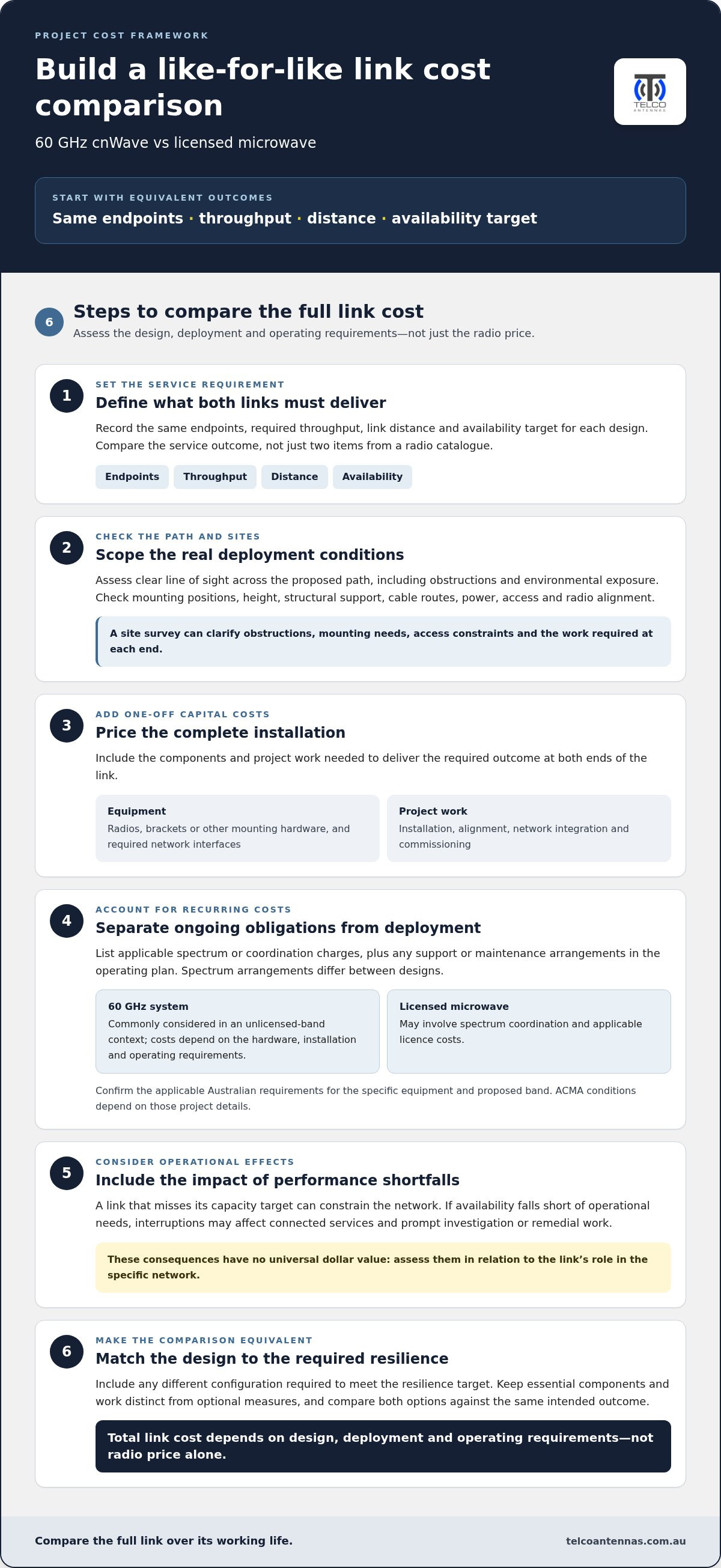
Start with the service the link needs to deliver, not the radio catalogue. Set the same endpoints, required throughput, link distance and availability target for both designs. Then compare a 60 GHz system, commonly considered in an unlicensed-band context, with a microwave link using licensed spectrum. In Australia, applicable ACMA conditions depend on the equipment and proposed band. Treat spectrum requirements as a project input rather than assuming they are the same for every system.
The radio price is only one line in the estimate. Separate one-off capital costs from recurring costs and operational consequences. Mounting changes or difficult site access can affect installation scope. A link that misses its capacity target may also constrain the network it is intended to support.
What does a like-for-like wireless link comparison measure?
Compare equivalent outcomes at both ends of the link. Record the required throughput, distance and availability, then list the components and work needed to deliver them. For background on the underlying standards, see WiGig (60 GHz Wi-Fi) technology, which covers the 60 GHz Wi-Fi family relevant to cnWave.
- Capital costs: radios, brackets or other mounting hardware, installation, alignment, network integration and commissioning.
- Recurring costs: applicable spectrum or coordination charges, plus any support or maintenance arrangements in the operating plan.
- Operational effects: the practical impact of meeting, or falling short of, the required capacity and availability.
Keep deployment work separate from ongoing obligations. A licensed design may involve spectrum coordination and applicable licence costs. Costs for a 60 GHz design depend on its hardware, installation and operating requirements. Use the relevant Australian arrangements for the proposed band and equipment to complete the comparison.
Why is the cheapest radio not always the lowest-cost link?
The radio price does not include what the path and site require. Obstructions, mounting height, access constraints and environmental exposure can change the design or installation work. If the required resilience calls for a different configuration, include it in the comparison. Otherwise, a basic radio pair may be compared with a more complete alternative, producing a misleading result.
Under-specifying capacity can create a bottleneck as traffic grows or peak demand rises. If availability falls short of operational needs, interruptions may affect connected services and prompt investigation or remedial work. These consequences do not have a universal dollar value, so assess them in relation to the link’s role in the specific network.
Total link cost depends on design, deployment and operating requirements. That is the basis of a credible cambium cnwave 60ghz vs licenced microwave link cost comparison: equal service requirements, complete project costs and a clear view of what happens if the link does not perform as needed.
How 60 GHz cnWave design choices shape deployment cost
A 60 GHz cnWave link uses millimetre-wave radio, so its performance and deployment scope depend on the path between the endpoints, not just the frequency or equipment label. A clear radio path, suitable mounting positions and the required capacity all shape the design. For a specific cnWave model, use the current manufacturer datasheet for supported range, throughput and environmental limits. Do not assume figures for one model apply to another.
This is where a cambium cnwave 60ghz vs licenced microwave link cost comparison becomes site-specific. Two links with similar endpoints may need different mounting structures, cable runs or access arrangements. These differences affect equipment and installation scope, before any optional resilience measures are considered.
Which 60 GHz site conditions can change the design?
Assess line of sight along the whole proposed path. Buildings, trees and other obstructions can interrupt or compromise the radio path. Foliage changes or nearby construction may also alter conditions over time. Distance matters too: assess suitability against the selected radio’s current specifications and the link’s performance requirements, rather than relying on a generic range assumption.
Include rain and other environmental conditions in the engineering assessment. Millimetre-wave links can be affected by propagation conditions, so the design should account for the operating environment and availability target. The effect depends on the equipment and path. Use the manufacturer’s datasheet and a link design rather than applying a broad rule of thumb.
Survey the mounting points as well as the radio path. Roof or tower access, mounting height, structural support, cable routes, power and the ability to align the radios can all affect the work required. An obstruction may call for a different mounting position, while an inaccessible site can change installation planning. The surveyed path, not frequency alone, determines deployment scope.
What belongs in a cnWave deployment budget?
Build the estimate around the design that meets the service requirement. Separate essential components and work from optional measures intended to improve resilience. This helps ensure both options are priced against the same outcome.
- Core equipment: radios, mounting hardware and required network interfaces.
- Site infrastructure: cable routes, cabling, power and any structural mounting provisions identified by the survey.
- Deployment work: site access, installation, alignment, network integration and commissioning.
- Optional resilience: additional infrastructure or configuration proposed to address the availability requirement.
FCC records of microwave service towers illustrate the physical infrastructure associated with microwave deployments, but describe US data, not Australian requirements. For Australian projects, RF site surveys and communication tower design can help establish mounting and path requirements before costs are compared. Telco Antennas provides RF site surveys to help turn those site variables into a project-specific link plan.
Licensed microwave link costs: spectrum, equipment and ongoing obligations
A licensed microwave design can involve spectrum-related work and costs in addition to the radio system itself. These are not a single, universal charge. The relevant frequency band, equipment and intended deployment determine which coordination and licensing arrangements apply. For an Australian project, use current ACMA guidance for the specific band and proposal rather than applying overseas fees or assumptions from another link.
Keep spectrum expenses separate from equipment and deployment costs. This shows which items arise from the chosen spectrum arrangement and which relate to the physical link regardless of band. It also avoids treating a possible licence or coordination cost as either inevitable or irrelevant before the design is known.
How can spectrum requirements affect a licensed microwave budget?
Band selection is an engineering and planning input. The intended path, equipment and deployment affect frequency coordination and any applicable licence requirements. Add these to the estimate once the proposed band has been identified and current ACMA rules and fees have been checked. Do not assume the same charge applies to every licensed link or use a fee from another country as an Australian estimate.
Keep separate lines for spectrum coordination and applicable licence costs. Radio and antenna purchases, mounting, installation and commissioning belong in the equipment and deployment estimate. This makes the cambium cnwave 60ghz vs licenced microwave link cost comparison more transparent: assess both options against the same link service while keeping their distinct spectrum arrangements visible.
Which operational requirements belong in the comparison?
Set a common evaluation period for both designs, then record anticipated maintenance, monitoring and equipment replacement over that period. These are planning categories, not automatic charges. Their relevance depends on the system, operating model and support arrangements. If the link supports a service with a demanding availability target, include the configuration and resilience measures needed to meet it, along with their operating implications.
A complete licensed-link estimate should distinguish initial and recurring items and identify assumptions that still need to be resolved against the proposed design. Consider:
- Equipment: radios, antennas, mounts and any required interfaces.
- Deployment: site access, installation, alignment, integration and commissioning.
- Spectrum: coordination work and applicable ACMA licence costs for the specific band and deployment.
- Operation: planned maintenance, monitoring, replacement and any selected resilience measures.
Use the same evaluation period and operating assumptions for the 60 GHz alternative. Do not treat its one-off purchase cost as the whole comparison. When preparing an estimate, use current product documentation to confirm equipment specifications and support arrangements. Keep product support separate from the Australian spectrum assessment, as they are distinct inputs to a reliable project budget.
Compare total cost of ownership with a project-by-project decision framework
A sound comparison gives both designs the same job: connect the same endpoints and meet the same capacity and availability requirements over the same evaluation period. The table below is a framework, not a price list. Enter project-specific estimates for each line and record the assumptions behind them so differences in scope are clear.
| Cost area | 60 GHz cnWave design | Licensed microwave design |
|---|---|---|
| Design | Path suitability, capacity, topology and any resilience measures. Project-dependent. | Path suitability, capacity, topology and any resilience measures. Project-dependent. |
| Spectrum | Confirm applicable Australian requirements for the specific equipment and band. Project-dependent. | Include relevant coordination and applicable ACMA licence costs for the proposed band. Project-dependent. |
| Hardware | Radios, mounts, network interfaces, cabling and supporting infrastructure. Project-dependent. | Radios, antennas, mounts, network interfaces, cabling and supporting infrastructure. Project-dependent. |
| Installation | Site access, mounting, alignment, labour, integration and commissioning. Project-dependent. | Site access, mounting, alignment, labour, integration and commissioning. Project-dependent. |
| Ongoing costs | Planned maintenance, monitoring and replacement assumptions. Project-dependent. | Spectrum-related obligations, planned maintenance, monitoring and replacement assumptions. Project-dependent. |
These are categories to assess, not claims that every cost applies to every project. Check current ACMA requirements for the proposed equipment and band, and use a consistent evaluation period. Include essential infrastructure in the base design and show optional redundancy or resilience separately. This prevents one option from appearing cheaper simply because its estimate leaves out work included in the other.
When may 60 GHz or licensed microwave be the better fit?
A 60 GHz design may suit a short, clear path where its documented capacity meets the service need. Obstructions, environmental exposure or a difficult mounting position can change that assessment. Licensed microwave may suit a different distance or availability requirement, depending on the engineered path, equipment and spectrum arrangements. Neither option is automatically cheaper because of its spectrum category.
For longer-distance planning, consider the practical factors in this guide to long-range wireless bridges. Then compare the designs against the same requirements, including supporting structures, cabling and access work identified during survey and design.
Use this sequence to reach a defensible decision:
- Set the endpoints, required capacity, availability target and evaluation period.
- Assess each technology against the actual path, obstruction risk and mounting conditions.
- Estimate hardware, spectrum, installation and ongoing costs consistently. Mark unknowns instead of filling them with assumed savings.
The result is a project-specific cambium cnwave 60ghz vs licenced microwave link cost comparison, not a generic claim about which radio costs less. Telco Antennas’ RF site surveys and communication tower design can help translate path and mounting conditions into practical design inputs for the comparison.
Plan the link and reduce uncertainty with RF site survey engineering
A dependable cost comparison starts with the service the link must carry and the physical route it must follow. Before selecting equipment, define both endpoints, document network needs and availability expectations, then assess the path and mounting options. This sequence helps establish whether a proposed design is practical and which assumptions need further investigation.
What information should a link design start with?
Bring operational requirements and site details together. Include required throughput, expected availability, network interfaces at each end and any constraints on how the link connects to the wider network. Record candidate mounting points, access limitations and potential obstructions along the path. These details help shape the survey and keep the designs focused on the same outcome.
If a suitable mounting point needs to be developed, communication tower design can help determine how the radio position relates to the site and link path. The mounting arrangement is part of the design, not an afterthought: it can affect access, cabling and installation scope.
- Define the endpoints: note the locations and network interfaces at each end.
- Document service needs: set throughput and availability expectations, including how the link will be used.
- Survey the path: assess line of sight, obstructions, mounting options and site access.
- Compare designs: use the findings to scope equipment, installation and any supporting infrastructure for each option.
How can an RF survey make the cost comparison more useful?
An RF site survey connects the intended radio path with conditions at the actual sites. Findings can clarify whether proposed mounting positions have a clear path, whether access or cable routing affects installation, and what equipment or supporting structures the design may require. If the survey identifies an obstruction or mounting constraint, address it in the design and budget assumptions rather than discovering it after the estimate is built.
This makes the cambium cnwave 60ghz vs licenced microwave link cost comparison more useful because it tests each option against the same site and service requirements. It does not establish a universal winner. It shows which design assumptions are supported by surveyed conditions and which still need resolution. Use current manufacturer datasheets for model-specific performance, and assess the relevant Australian spectrum requirements against the proposed frequency band and equipment.
Telco Antennas provides RF site surveys, communication tower design and point-to-point wireless bridges. These capabilities connect link planning with practical mounting and hardware considerations, without treating a radio purchase as the whole project. If you’re preparing a link design, discuss your wireless link requirements with Telco Antennas to consider the survey and design inputs for your project.
Turn your link requirements into a practical next step
Before settling on a radio option, capture the service requirement and constraints at both ends of the proposed link. This gives your project team a clear brief for assessing design assumptions and planning the next stage. A cambium cnwave 60ghz vs licenced microwave link cost comparison is more useful when it reflects the actual sites and how the connection will be used, rather than a generic equipment estimate.
Telco Antennas provides RF site surveys and communication tower design, and supplies point-to-point wireless bridges nationally across Australia. These capabilities help connect site conditions and mounting needs with practical wireless link planning.
Ready to move from an initial comparison to a project-specific discussion? Discuss your wireless link requirements with Telco Antennas and take the next step towards a design brief grounded in your site and service needs.
Frequently Asked Questions
Is 60 GHz Wi-Fi or cnWave licence-free in Australia?
Do not assume a 60 GHz Wi-Fi or cnWave system is automatically licence-free in Australia. Whether a particular device can operate without an individual spectrum licence depends on the equipment and applicable ACMA arrangements and conditions. “Unlicensed” does not mean unrestricted. Before budgeting or deployment, check current ACMA information against the exact equipment and proposed frequency use, as overseas rules may differ from Australian requirements.
How much does a Cambium cnWave 60 GHz link cost compared with licensed microwave?
There is no dependable single price for either option without a defined link design. The cambium cnwave 60ghz vs licenced microwave link cost comparison should include required equipment, installation and site work, plus applicable spectrum arrangements and operating assumptions. For example, a straightforward path and a site requiring new mounting infrastructure will have different project scopes. Compare estimates against identical endpoints, service requirements and evaluation periods.
Can a 60 GHz link work in rain?
Yes, a 60 GHz link may operate in rain, but precipitation can affect signal strength and the link’s performance margin. The practical impact depends on the radio model, path length, local conditions and required availability. For a proposed installation, use the current manufacturer datasheet and a path assessment to evaluate rain fade. Do not infer weather performance from frequency alone or treat a general claim as a guarantee for a specific link.
Does a 60 GHz wireless link need clear line of sight?
Generally, yes: plan for a clear radio path between the antennas. A visual check alone may not be enough, because nearby structures, vegetation or other objects can affect the radio path even if they do not block the centre line. A link assessment should consider clearance around the path as well as possible changes to the site. If clearance is restricted, review the proposed mounting positions or design.
What happens if a wireless link cannot meet the required availability?
If it falls short, connected services may experience more interruptions or reduced performance than the operation can tolerate. Identify the cause, such as obstruction, environmental exposure, interference or an unsuitable design assumption, then assess corrective options. Depending on the site, these could include a revised path, different mounting or added resilience. Assess any change against the required service level and its effect on project scope.
Does licensed microwave always have higher ongoing costs than 60 GHz?
No. Spectrum-related expenses may apply to a licensed microwave link, but ongoing costs depend on the band and applicable Australian arrangements. A 60 GHz design can also have operating costs, including maintenance, monitoring, site access or equipment replacement. For example, a difficult-to-access installation may require more planning regardless of spectrum type. Compare costs over the same period using project-specific assumptions, rather than treating either option as cost-free to operate.
Can cnWave replace a licensed microwave link on an existing site?
Possibly, but existing equipment and infrastructure do not establish that cnWave is a suitable substitute. Assess whether the proposed system can meet the link’s throughput, distance and availability requirements, and whether its radio path and mounting positions are suitable. Check network interfaces and current equipment documentation too. Assess spectrum arrangements for the replacement separately under current Australian requirements, as changing the radio does not remove that need.


