

Why commit tens of thousands of dollars to trenching fibre across an industrial site when the atmosphere can facilitate a multi-gigabit link with equivalent reliability? For many Australian site managers, the frustration of inconsistent data speeds and signal dropouts over long distances is a persistent technical hurdle. You understand that a connection is only as strong as its weakest environmental variable; yet, the complexity of RF alignment often leads to sub-optimal performance.
This guide serves as a technical manual for deploying high-performance point-to-point wireless bridges that require minimal ongoing maintenance. We'll move beyond basic hardware selection to master the engineering requirements necessary for stable throughput across remote sites. You'll learn to navigate the new Radiocommunications (Low Interference Potential Devices) Class Licence 2025, understand the impact of 60GHz frequency bands on short-range capacity, and calculate the ROI of wireless backhaul compared to traditional cabling. By the end of this analysis, you'll have the expertise to design a robust system that withstands the unique challenges of the Australian landscape.
Key Takeaways
- Learn how point-to-point wireless bridges act as a virtual fibre optic cable to provide high-speed connectivity across expansive Australian properties without the prohibitive expense of trenching.
- Master the technical nuances of the Fresnel Zone to ensure your signal remains stable and free from ground-level environmental interference that often causes performance degradation.
- Distinguish between consumer-grade hardware and carrier-grade equipment specifically engineered to survive the thermal and physical demands of a harsh industrial environment.
- Explore the necessity of professional RF site surveys and desktop path profiling to mitigate the risks of local frequency interference and complex terrain obstacles.
- Understand the role of specialised communication tower design and robust mounting solutions in achieving reliable data backhaul over distances that exceed standard installation capabilities.
Understanding Point-to-Point Wireless Bridges in the Australian Context
In the vast Australian landscape, physical distance often presents a significant barrier to reliable connectivity. A point-to-point wireless bridge functions as a high-capacity "virtual fibre optic cable" between two fixed locations, transmitting data through the air rather than through physical conduits. This technology is a fundamental component of point-to-point telecommunications, allowing network administrators to bridge gaps ranging from a few hundred metres to several kilometres with carrier-grade reliability.
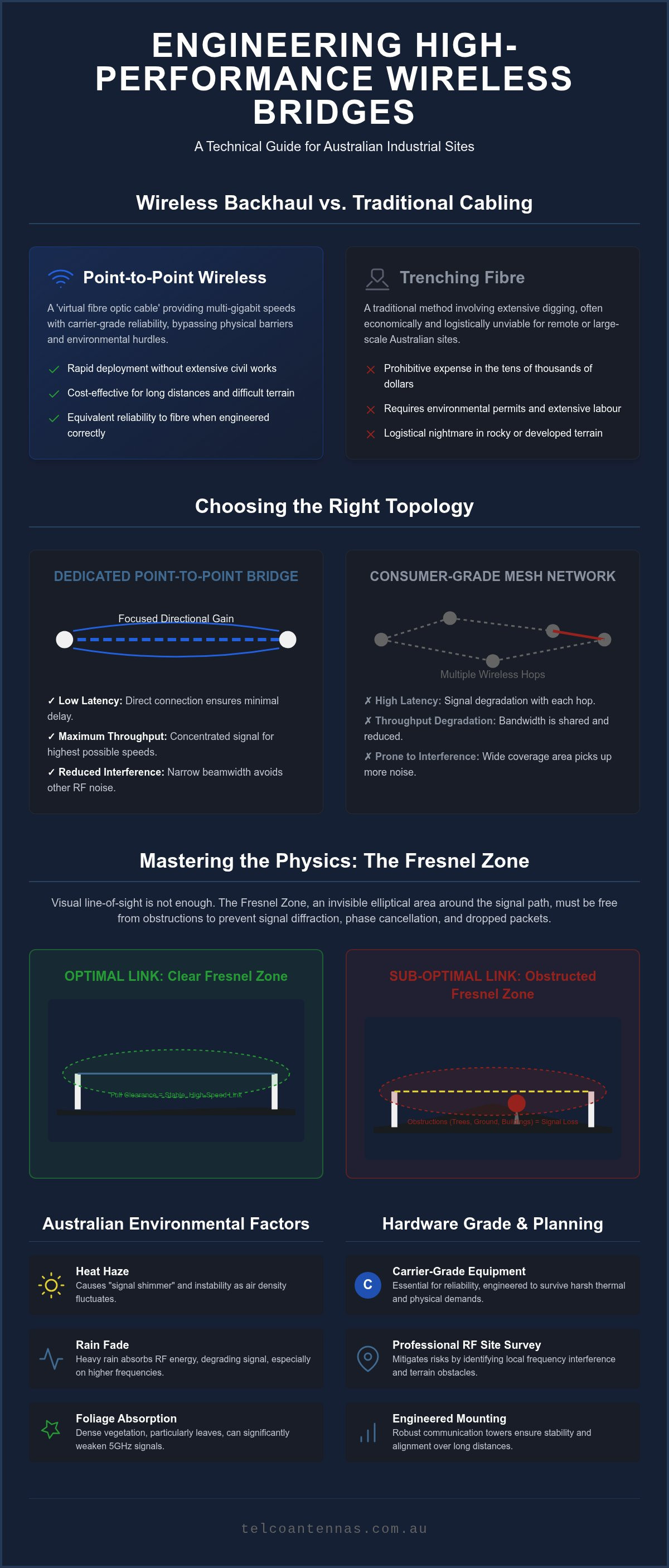
For managers of Australian mines, broadacre farms, and industrial complexes, wireless solutions are often the only viable choice. The economic argument is clear: traditional trenching requires extensive civil works, environmental permits, and expensive labour. By deploying point-to-point wireless bridges, organisations avoid the logistical nightmare of digging through rocky terrain or cutting through existing asphalt. These links are typically used to provide high-speed internet to remote machinery sheds, establish stable connections for site offices, or link perimeter security gates to a central monitoring hub.
The Core Components of a Wireless Link
A functional link relies on a specific hardware relationship between an Access Point (AP) and a Subscriber Module (SM). The AP initiates the broadcast, while the SM functions as the receiving client at the remote end. Depending on the link's distance and the local RF environment, hardware might feature an integrated antenna for a sleek, low-profile installation. Longer links, however, often require external high-gain antennas to maintain signal integrity over distance. Most industrial deployments utilise Power over Ethernet (PoE), which allows a single cable to provide both data connectivity and electrical power to the unit mounted on a mast or tower.
Wireless Bridging vs. Mesh Networking
It's vital to distinguish between dedicated bridges and mesh systems. While mesh networking is useful for general area coverage, it often introduces unacceptable latency and throughput degradation due to multiple wireless hops. Dedicated point-to-point wireless bridges use focused directional gain to concentrate the signal. This narrow beamwidth reduces interference from other nearby devices and ensures the maximum possible bandwidth reaches the destination. If a site requires connectivity across multiple buildings from a single source, a Point-to-MultiPoint (PtMP) configuration can be engineered to distribute the signal without the performance penalties associated with consumer-grade mesh hardware.
The Physics of Performance: Frequencies and Fresnel Zones
Achieving peak performance with point-to-point wireless bridges is an exercise in managing the physical environment. Visual Line of Sight (LoS) is merely the starting point. Many installations suffer from Near-Line of Sight (nLoS) issues where the path looks clear to the eye, but the radio waves are obstructed by invisible physical boundaries. Understanding these invisible barriers is the difference between a carrier-grade link and one that drops out whenever the weather shifts.
The Fresnel Zone is an elliptical volume of space around the direct line between two antennas. If obstacles like rooftops, trees, or the ground itself infringe upon this zone, the signal diffracts. This causes phase cancellation, which leads to dropped packets and reduced speeds. Clearing the ground is as vital as clearing the horizon; a link skimming a hot gravel road or a metal roof will likely fail due to thermal interference and signal reflection. To ensure your link avoids these physical pitfalls, consider professional RF site surveys to map your specific environment accurately.
Environmental variables in Australia significantly impact link stability. Heat haze can cause signal shimmer, while heavy rain leads to rain fade, especially on higher frequencies. Dense foliage also absorbs RF energy, particularly in the 5GHz band. These factors increase latency, which is the delay in data transmission. For real-time applications like VoIP or high-resolution CCTV, high latency causes jitter and broken audio, making the connection unreliable for critical operations.
Frequency Selection: 2.4GHz, 5GHz, and 60GHz
2.4GHz offers superior penetration through light obstacles but is often unusable in urban centres due to extreme spectrum congestion. 5GHz is the industry standard; it provides an ideal balance between long-range capability and high data throughput for most industrial sites. 60GHz (mmWave) supports multi-gigabit speeds for short-range links. Because it operates in a largely uncongested band, it avoids the noise of 5GHz environments, though it requires a perfect, unobstructed path.
Calculating Throughput and Capacity
Modulation and Coding Scheme (MCS) rates determine the efficiency of data transfer based on signal quality. A wider channel, such as 80MHz, allows for more bandwidth but is more susceptible to interference than a narrow 20MHz channel. Throughput is the actual volume of data successfully transferred across the link, distinct from the theoretical link speed reported by the hardware. Selecting the correct channel width is a balancing act between the required capacity and the stability of the point-to-point wireless bridges in a noisy RF environment.
Selecting Carrier-Grade Hardware for Industrial Reliability
Distinguishing between consumer-grade "range extenders" and industrial point-to-point wireless bridges is a critical first step in network design. While home-office equipment might suffice for basic indoor coverage, it lacks the internal architecture to manage the heavy packet loads found on commercial sites. Carrier-grade hardware utilises specialised processors designed to handle tens of thousands of packets per second. This high processing capacity is essential for maintaining low latency when multiple high-definition CCTV streams or autonomous machinery fleets operate across the link simultaneously. For manufacturing managers looking to integrate such automation, you can visit TME Systems Pty Ltd to learn more about their collaborative robot welding cells.
Ubiquiti's airMAX ecosystem, featuring the PowerBeam and LiteBeam series, offers a versatile platform for rural and industrial connectivity. These units are highly effective for establishing reliable links across several kilometres where cost-efficiency is a priority. For sites requiring extreme bandwidth, the 60GHz Wave hardware provides multi-gigabit backhaul capabilities. Every device in this range integrates with the UISP management platform. This allows technicians to monitor signal-to-noise ratios and link stability from a remote location, ensuring that any performance degradation is identified before it results in a total connection failure.
Cambium Networks: The Gold Standard for High-Interference
In environments where the RF spectrum is heavily congested, Cambium Networks provides a superior technical solution. Their hardware uses proprietary air interface protocols that are specifically engineered to outperform standard Wi-Fi in noisy environments. A standout feature is GPS Sync technology. This allows multiple point-to-point wireless bridges to be co-located on a single communication tower without causing self-interference. By synchronising the transmit and receive cycles of all radios on the mast, Cambium ensures that the ePMP and PTP series maintain stable throughput even when spectrum availability is limited. This level of engineering makes them a preferred choice for critical infrastructure and complex industrial hubs.
Planning and Commissioning a Robust Wireless Link
Successful deployment of point-to-point wireless bridges begins long before hardware is mounted. A desktop path profile is the essential first step; this involves using terrain data and RF simulation software to verify that the Fresnel zone remains clear of geographical obstructions. However, software models cannot account for real-world variables like local spectrum congestion or recent construction. This is why a physical RF site survey is mandatory for industrial projects. It allows technicians to identify existing interference from neighbouring networks that could degrade link performance.
Australian conditions introduce specific stressors such as intense heat-soak and fine dust. High ambient temperatures can cause thermal throttling in lower-quality equipment, while dust ingress can compromise connectors over time. When planning your installation, selecting the correct mounting hardware is vital. Telescopic masts are preferred for permanent, high-elevation links requiring maximum clearance, whereas heavy-duty aluminium tripods offer a stable, portable solution for temporary site offices or rapid deployments. Precise alignment is achieved through a combination of physical LED indicators on the chassis and fine-tuning via software alignment tools to peak the signal strength.
Ready to ensure your link is engineered for success? You can book your RF Site Surveys through our technical team to guarantee performance.
Mounting and Structural Requirements
Rigid mounting is paramount; even a few millimetres of antenna sway in high winds can cause significant packet loss on narrow-beam links. For setups utilising external antennas, industrial-grade LMR-400 coaxial cables are used to minimise signal loss between the radio and the antenna. Elevated installations also require robust grounding and lightning protection to safeguard the network against the electrical surges common during Australian summer storms; for sites requiring complex power connections or infrastructure upgrades, High Demand Electrical offers the Level 2 ASP expertise necessary to ensure total system compliance. Every component must be secured to withstand the physical vibration of heavy machinery or high wind loads typical of open rural sites.
Security must be integrated at the firmware level when commissioning point-to-point wireless bridges. Implementing WPA3 encryption and disabling SSID broadcast provides a foundational layer of protection for the link. We recommend using management VLANs to isolate the radio's control traffic from the actual data payload; this prevents unauthorised access to the hardware's configuration interface. Finally, setting up proactive monitoring alerts for signal-to-noise ratio (SNR) degradation allows for maintenance before a hardware failure occurs. This proactive approach ensures the system remains a reliable component of your site's infrastructure.
Engineered Connectivity: How Telco Antennas Solves Complex Link Challenges
Telco Antennas operates as a consultative partner, bridging the gap between hardware specifications and the environmental realities of the Australian landscape. While many providers focus on the retail sale of equipment, our engineering team prioritises the functional outcome of every installation. We provide specialised communication tower design for industrial complexes where standard mounting solutions lack the necessary height or structural rigidity required for high-performance point-to-point wireless bridges. This level of technical authority ensures that your infrastructure is built to survive, rather than just function in ideal conditions.
For temporary sites such as exploration camps or short-term civil works, we provide rapid deployment solutions using telescopic mast trailers and skids. These mobile systems allow for the immediate establishment of a high-capacity link without the delays associated with permanent construction. This pragmatic approach ensures that remote operations remain connected from day one, supported by Australian-based technical expertise and a deep understanding of local RF variables.
From Site Survey to Commissioning
Our engineering process ensures that your link meets specific throughput Service Level Agreements (SLAs). We've successfully established connectivity in notorious Australian "black spots" where traditional terrestrial options are unavailable. A common modern application involves integrating Starlink after-market power conversion with wireless bridges to distribute high-speed data across an entire property from a single satellite terminal. This creates a robust, property-wide network that leverages the strengths of both satellite backhaul and local wireless distribution without the need for multiple expensive subscriptions.
Complete Infrastructure Kits
Reliability depends on the quality of every component in the signal path. We standardise our infrastructure kits on high-quality RF components, including LMR-400 coaxial cables and UV-rated aluminium tri-pods, to prevent signal degradation over time. If your site presents unique mounting challenges, our custom fabrication services can produce bespoke hardware to ensure a secure, rigid installation. Contact our RF engineers to organise an RF site survey and ensure your network is engineered for peak performance in any environment.
Securing Your Industrial Connectivity Future
Deploying high-performance point-to-point wireless bridges is an engineering commitment that requires more than just high-quality hardware. It demands a thorough understanding of the RF environment, from clearing the Fresnel zone to selecting UV-stabilised components that withstand the Australian sun. We've explored how carrier-grade equipment and precise alignment are the foundations of a link that functions as a virtual fibre optic cable. By prioritising a consultative approach, you can avoid the common pitfalls of signal dropout and latency that plague standard consumer installations.
With over 15 years of RF engineering experience, Telco Antennas remains a trusted supplier of critical infrastructure to Australian industry. Our specialised Starlink and 5G integration expertise ensures that even the most remote properties achieve stable, multi-gigabit throughput. Enquire about our professional RF Site Surveys and Tower Design services today to build a network that grows with your operations. Your remote site's reliability is within reach when backed by seasoned technical knowledge.
Frequently Asked Questions
What is the maximum range of a point-to-point wireless bridge?
The maximum range of a point-to-point wireless bridge varies significantly based on the frequency band and the gain of the antennas used. While short-range 60GHz links are typically limited to under 2 kilometres, high-gain 5GHz carrier-grade hardware can establish stable connections exceeding 20 kilometres. Achieving these distances requires precise alignment and a clear Fresnel zone. Environmental variables and local interference will ultimately dictate the functional range for any specific site installation.
Do I need a clear line of sight for a wireless bridge to work?
A clear visual line of sight is essential for optimal performance, particularly when using higher frequencies like 5GHz or 60GHz. While 2.4GHz equipment can sometimes penetrate light foliage, this often results in significant packet loss and reduced throughput. For industrial applications, we recommend a clear path that also accounts for the Fresnel zone. Obstructions within this elliptical area will diffract the signal, leading to inconsistent speeds and potential link failure during adverse weather.
How does heavy rain or dust affect my wireless bridge performance?
Heavy rain and airborne dust cause signal attenuation, a phenomenon where RF energy is absorbed or scattered by physical particles. Rain fade is most prevalent in 60GHz links, where moisture can significantly reduce the effective range. In arid Australian environments, fine dust ingress can settle on connectors or antenna radomes, potentially degrading the signal-to-noise ratio over time. Using IP-rated enclosures and high-quality LMR-400 cabling helps mitigate these environmental impacts on the hardware's internal circuitry.
Can I share my internet connection with a shed 2km away?
You can easily share an internet connection with a remote shed or site office 2km away using point-to-point wireless bridges. This setup functions as a virtual Ethernet cable, allowing you to extend your local area network without the cost of trenching. Provided you have a clear line of sight between the two locations, a 5GHz bridge will provide enough bandwidth for high-definition CCTV, VoIP calls, and general data access with very low latency.
Is a wireless bridge as secure as a wired Ethernet connection?
Modern wireless bridges are highly secure when configured with industry-standard protocols such as WPA3 encryption. While a physical cable is inherently more difficult to intercept, a properly engineered wireless link uses narrow beamwidths and directional antennas that make signal interception extremely challenging for external parties. Implementing management VLANs and disabling SSID broadcasts further strengthens the security posture, ensuring that your data payload remains isolated from the hardware's management interface and external interference.
Do I need a licence to operate a wireless bridge in Australia?
Most point-to-point wireless bridges in Australia operate under the Radiocommunications (Low Interference Potential Devices) Class Licence 2025. This allows for the operation of equipment in standard bands like 2.4GHz, 5GHz, and 60GHz without an individual apparatus licence, provided the hardware complies with specific power limits and technical standards. It's the operator's responsibility to ensure their equipment carries the Regulatory Compliance Mark (RCM) and adheres to the EIRP limits defined by the ACMA to avoid interference.
Can I use a wireless bridge to connect multiple buildings (PtMP)?
You can connect multiple buildings from a single central point using a Point-to-MultiPoint (PtMP) configuration. In this scenario, a base station equipped with a sector antenna communicates with multiple subscriber modules located at different buildings. While this is more efficient for complex site layouts, the total bandwidth of the base station is shared among all connected sites. For critical backhaul requirements between two specific points, a dedicated point-to-point link remains the superior choice for throughput.
How much speed (throughput) can I expect from a 5GHz link?
Real-world throughput on a 5GHz link typically ranges from 100Mbps to over 500Mbps, depending on the channel width and local interference levels. Using a wider 80MHz channel increases the potential bandwidth but also raises the noise floor, which can impact stability. It's important to distinguish between the theoretical link speed shown in software and the actual data transferred. Factors such as distance, alignment precision, and the hardware's processing power will determine the final throughput.


