

Investing in high-gain antennas before conducting professional rf site surveys is often just an expensive way to discover exactly where your signal fails. In the demanding environments of the Australian outback, relying on theoretical coverage maps usually leads to costly trial-and-error with signal boosters that never quite deliver the required throughput. You've likely experienced the frustration of hardware that looks perfect on paper but struggles to maintain a stable connection once it's deployed in a remote black spot.
It's understandable to want a quick fix for connectivity gaps, but a "plug and play" approach rarely accounts for the complex variables of Australian topography or the strict requirements of the Radiocommunications Class Licence 2025. This guide demonstrates how professional surveys provide a data-backed blueprint for your communications infrastructure, ensuring reliable cellular and radio coverage across your entire industrial footprint. We'll explore how technical modelling identifies the exact hardware required for zero dead zones, while ensuring your system remains fully compliant with ACMA and ARPANSA standards.
Key Takeaways
- Understand why guessing antenna placement leads to packet loss and how a technical assessment prevents expensive hardware failure in remote environments.
- Compare the benefits of LiDAR-based desktop modelling against physical on-site spectrum analysis for identifying local noise floors and physical obstructions.
- Learn how professional rf site surveys utilise propagation modelling to simulate how 4G/5G signals interact with complex Australian topography and dense vegetation.
- Ensure your high-gain communication systems remain fully compliant with the latest ACMA regulations while eliminating indoor black spots.
- Discover how to translate technical survey data into a high-performance design featuring carrier-approved Cel-Fi GO boosters and MIMO antennas.
What is an RF Site Survey and Why Does Australian Industry Need One?
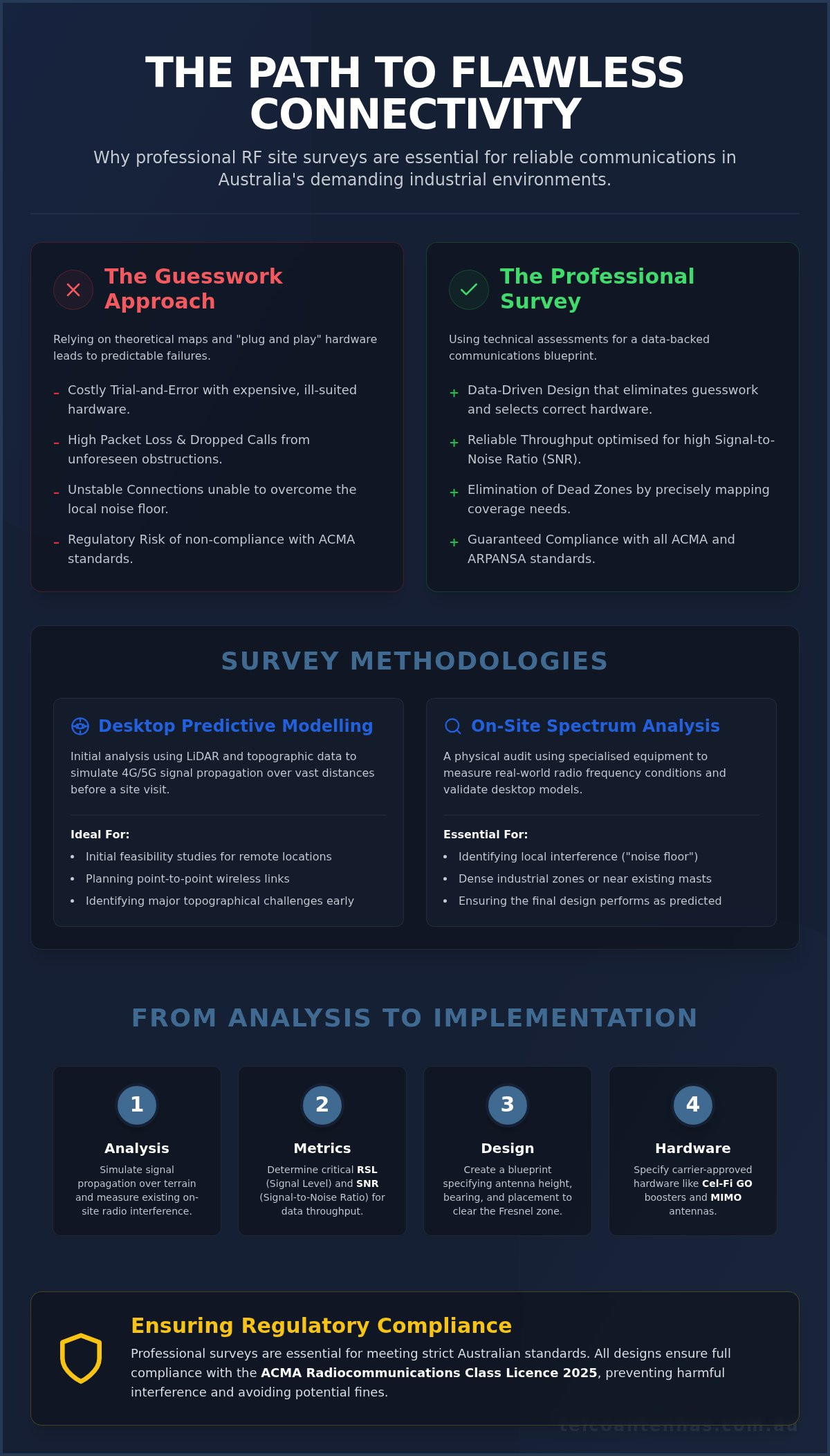
A professional RF site survey is a technical assessment of radio frequency propagation, interference, and signal strength within a specific geographic area. If you've ever wondered what is a wireless site survey in a practical sense, it's the methodical process of mapping how radio waves behave in your specific environment. For Australian industrial operations, this isn't a luxury. It's a fundamental requirement. Guessing where to bolt an antenna often results in high packet loss and dropped calls because the hardware cannot overcome local physical obstructions or high noise floors without precise positioning.
The financial argument for these surveys is straightforward. Investing in professional rf site surveys might require an upfront cost, but it prevents significantly larger losses in redundant or incompatible hardware. Without empirical data, you're likely to purchase the wrong high-gain system or place it in a location that fails to clear the Fresnel zone. Beyond the hardware, there's the matter of regulatory necessity. The Australian Communications and Media Authority (ACMA) maintains strict standards for high-gain signal boosters. Under the Radiocommunications Class Licence 2025, incorrect installations can cause harmful interference to carrier networks. This can lead to regulatory scrutiny and potential fines, making compliance a key outcome of the survey process.
The Core Objectives of Professional RF Modelling
The primary goal is to identify the Receive Signal Level (RSL) and the Signal-to-Noise Ratio (SNR). These metrics determine your actual data throughput. If the SNR is too low, even a strong signal will be unusable for critical data tasks. Modelling also determines the precise height and bearing for communication tower design, ensuring the antenna has a clear line of sight to the nearest base station. By mapping interference from existing infrastructure and natural terrain features, engineers can ensure the final design is robust and reliable.
Predictive vs. Physical Surveys: An Overview
Desktop modelling is the essential first step for remote Australian projects. Using LiDAR and high-accuracy topographic data, engineers can predict signal propagation over vast distances before anyone steps onto the site. This identifies potential issues with ridges or dense vegetation early in the planning phase. However, a physical site visit is often required to validate these findings with real-world spectrum analysis. This on-site phase identifies local interference sources that satellite data might miss, ensuring the hardware performs exactly as predicted once installed.
Desktop vs. On-Site RF Surveys: Comparing Methodologies
Choosing between a desktop study and a physical visit depends on your project's scale and environmental complexity. For many remote Australian operations, the cost of mobilising a technician is a significant budget consideration. We use a tiered approach to ensure engineering accuracy without unnecessary expenditure. While both methods fall under the umbrella of rf site surveys, they serve different roles in the design lifecycle. It's about balancing theoretical prediction with real-world validation.
Desktop surveys rely on high-resolution LiDAR and topographic datasets to simulate signal propagation. These are highly effective for predicting how 4G or 5G signals traverse hundreds of kilometres of undulating terrain. However, they can't always account for every local variable. On-site surveys involve physical spectrum analysis to identify the "noise floor," which is the background radio interference that can drown out your data. Even though we adhere to local ACMA guidelines, global radio frequency safety standards inform the general principles of how we manage signal density and power levels to ensure a reliable link.
When a Desktop Survey is Sufficient
A desktop model is usually the best starting point for initial feasibility studies, especially for point-to-point wireless bridges. If your site has a clear line-of-sight and minimal existing RF congestion, software modelling can accurately predict the necessary communication tower design and height requirements. It's a cost-effective way to rule out unsuitable locations before any hardware is purchased or shipped to a remote area.
The Critical Need for On-Site Spectrum Analysis
Physical audits become essential when you're dealing with "hidden" interference in dense industrial zones or near existing telecommunications masts. You can't accurately predict signal penetration inside heavy metal structures or underground facilities without being there. An on-site technician can test the real-world performance of Cel-Fi GO boosters in marginal signal areas, ensuring the hardware actually performs as intended. This step removes the guesswork from complex deployments where a theoretical model might miss a localised obstruction.
The most reliable Australian telco projects typically utilise a hybrid approach. We start with a desktop model to identify the strongest signal candidates, then confirm those findings with a physical audit of the proposed tower site. If you're currently planning a network upgrade, our team can provide a professional RF engineering assessment to ensure your hardware investment is backed by precise data.
The Technical Process: From Spectrum Analysis to Design
The technical execution of rf site surveys follows a methodical sequence designed to translate raw environmental data into a functional engineering plan. This process begins with data acquisition, where we gather existing carrier data from major Australian mobile network operators alongside precise site coordinates. By identifying the location and frequency bands of the nearest base stations, we establish a baseline for what the local spectrum can realistically support. This phase ensures that the subsequent design is built on a foundation of verified network infrastructure rather than theoretical assumptions.
Once we've gathered the initial data, we move into propagation modelling. This is where specialised software simulates how 4G, 5G, and LMR signals interact with the specific topography of your site. In the Australian context, this must account for significant variables like iron-rich soil, undulating hills, and dense vegetation, all of which attenuate signal differently. We then map these results to specific hardware requirements. If the survey indicates a high path loss, we'll specify high-gain antennas and low-loss LMR-400 coaxial cables to preserve signal integrity between the receiver and the booster. The final output is a comprehensive report featuring a signal heatmap and a detailed link-budget analysis. To effectively integrate these high-performance links into your wider corporate network, you can discover Voice Cloud Digital and their range of managed IT and business telecommunications services.
A successful design relies on evaluating the Reference Signal Received Quality (RSRQ) to ensure stable LTE and 5G connections. While signal strength is important, RSRQ provides a better indication of how much interference is present on the line. We also calculate path loss over distance to determine if high-gain MIMO antennas are necessary to maintain required data speeds. A link budget is the accounting of all gains and losses from the transmitter to the receiver.
Solving Environmental Signal Obstructions
Addressing the Fresnel Zone is critical in point-to-point wireless bridge design; if this elliptical area between antennas isn't clear of obstructions, the link'll suffer from phase cancellation. We also design systems to mitigate signal attenuation caused by heavy foliage or extreme Australian weather conditions, which can fluctuate significantly between seasons. In high-density industrial environments, we account for multipath interference, where signals bounce off metal structures and arrive at the receiver at slightly different times, potentially causing data corruption if not managed through correct antenna spacing.
Case Study: Eliminating Black Spots at a Remote Australian Industrial Site
Professional rf site surveys transform theoretical possibilities into operational reality. At one remote Australian industrial facility, the operational reality was grim: zero indoor cellular coverage and data links that failed whenever weather conditions shifted. Before engaging technical experts, the on-site team attempted a "best guess" installation. They purchased several high-gain omni-antennas, assuming that a broader reach would solve the issue. However, these antennas only amplified the existing noise floor without improving the signal-to-noise ratio, leading to continued packet loss and dropped calls.
Our combined desktop and physical audit identified a usable donor signal located 4km away. While the signal was non-existent at ground level, the survey data confirmed that a stable connection was achievable at a specific elevation. By integrating this survey data with a custom communication tower design and a Cel-Fi GO professional deployment, we eliminated the connectivity guesswork. The results were immediate. The facility achieved 100% site-wide coverage and a 400% increase in data throughput, providing the reliable backbone needed for their digital operations.
Initial Site Audit and Findings
The initial audit revealed that the facility sat in a deep signal "shadow" created by a prominent ridgeline located between the site and the nearest carrier base station. Staff had previously tried to solve this by mounting antennas on existing structures, but these locations lacked the necessary height to clear the ridge's diffraction zone. Our rf site surveys identified the optimal donor tower bearing for a high-gain directional array. This data-led approach proved that the previous omni-antennas were fundamentally unsuitable for the terrain, as they were receiving interference from multiple distant towers rather than a clean signal from the closest one.
Implementing the Engineered Solution
We specified industrial-grade LMR-400 coaxial cables to minimise signal loss between the donor tower and the internal booster system. Every decibel of gain captured by the antenna is precious in marginal areas, and using inferior cabling would have negated the tower's height advantage. To facilitate a rapid deployment, we utilised a telescopic mast trailer, which allowed for the temporary radio tower to be positioned and tested before a permanent concrete foundation was poured. Final validation testing confirmed that the Receive Signal Level (RSL) met the project requirements, ensuring long-term stability even during extreme weather events. If your remote operations are hampered by unreliable connectivity, you can request a professional site survey to identify a permanent, data-backed solution.
Implementing Your RF Design with Telco Antennas Hardware
The transition from data acquisition to mechanical implementation is where the value of professional rf site surveys becomes tangible. Hardware selection shouldn't be based on theoretical maximums; it must be a direct response to the Receive Signal Level (RSL) and interference profiles identified during the modelling phase. By matching survey-validated requirements with industrial-grade equipment, we ensure that the final installation performs reliably under real-world Australian conditions. This methodical approach prevents the signal degradation that often occurs when generic hardware is forced into complex RF environments.
The Cel-Fi GO Professional serves as the central component for most carrier-approved signal boosting projects in Australia. Unlike consumer-grade repeaters that can oscillate and interfere with carrier networks, the Cel-Fi GO is designed to work within strict ACMA parameters while providing significant gain. To maximise data speeds, we pair these boosters with high-performance MIMO antennas. These utilise spatial multiplexing, allowing multiple data streams to be transmitted simultaneously over the same frequency, which is essential for maintaining high throughput in remote industrial zones. Maintaining this signal integrity requires LMR-400 coaxial cables. These low-loss cables are non-negotiable for preserving the signal captured at the donor antenna, especially when long cable runs are required between the tower and the site office.
For temporary sites or mobile offices, telescopic mast trailers provide the necessary elevation to clear local obstructions identified in the survey. These trailers allow for rapid deployment of a complete communications hub without the need for permanent foundations, making them ideal for mining exploration or short-term construction projects. The height provided by these masts is often the difference between a failing link and a stable 5G connection.
Selecting the Right Antenna for Your Survey Results
If your survey identifies a distant donor tower with a weak but clean signal, we specify high-gain Yagi antennas. These directional arrays focus energy in a narrow beam to bridge long distances. Conversely, local site distribution often requires omnidirectional antennas to provide 360-degree coverage for workers moving around the footprint. It's also critical to ensure correct polarisation, matching the antenna's orientation to the carrier's tower specifications to prevent a cross-polarisation loss that can strip up to 20dB from your signal strength.
Custom Infrastructure for Remote Deployment
Modern industrial sites often require redundant backhaul, which is why we integrate Starlink aftermarket power conversion kits into our designs. This allows for a seamless transition between cellular and satellite links in off-grid locations. For lighter applications where a trailer isn't required, aluminium tri-pods offer a lightweight, rapid-response mounting solution that can be stabilised on uneven ground. Beyond remote connectivity, for those managing commercial facilities, you can discover Peninsula Smart Care and their solutions for integrated security and communication systems. If you're ready to eliminate the guesswork from your communications infrastructure, enquire about a professional RF site survey for your project to ensure your hardware investment is backed by engineering precision.
Establishing reliable communications in the Australian outback requires moving beyond theoretical coverage maps and adopting a data-driven engineering approach. By utilising rf site surveys, you replace the uncertainty of trial and error with a precise technical blueprint that accounts for terrain, vegetation, and local interference. This process ensures that every piece of hardware, from high-gain MIMO antennas to low-loss cabling, is specified to meet the exact requirements of your site's unique topography. It's the difference between a system that merely exists and one that performs under pressure.
Since 2008, our team has provided specialised Australian engineering expertise, focusing on custom communication tower and mast designs tailored for harsh environments. We ensure that every deployment features ACMA-compliant booster solutions that guarantee performance while maintaining strict regulatory alignment. Whether you require a permanent mast installation or a rapid-deployment telescopic trailer, the long-term success of your network depends on the accuracy of your initial technical assessment.
Contact our engineering team to organise your RF site survey and secure a communications network built on empirical data rather than guesswork. With a professionally engineered foundation, your remote operations can achieve the stable, high-speed connectivity required for modern industrial success.
Frequently Asked Questions
How much does a professional RF site survey cost in Australia?
The total investment for a survey depends on the geographic remoteness of the site and the depth of the required propagation modelling. A desktop study is typically more affordable than a physical audit because it eliminates mobilisation expenses for technical staff. The cost reflects the engineering time needed to analyse topographic data and produce an ACMA-compliant design. Professional rf site surveys prevent the much higher expenses associated with purchasing incorrect hardware or experiencing operational downtime.
Can I perform my own RF site survey using a smartphone app?
Smartphone apps are inadequate for industrial applications because consumer hardware cannot accurately measure the noise floor or signal-to-noise ratio (SNR). While these apps provide a basic indication of signal strength, they lack the calibrated antennas and spectrum analysis capabilities required for precise engineering. Professional surveys use specialised equipment to identify interference and multipath issues that a standard mobile device simply cannot detect, ensuring your hardware investment is backed by reliable data.
What is the difference between a passive and an active wireless survey?
A passive survey involves a technician measuring all radio frequencies in the environment without connecting to a specific network, which is vital for identifying noise floors. An active survey requires associating with a network to measure real-world data throughput and latency. Combining these methods during rf site surveys ensures that the final hardware design accounts for both the physical environment and the actual data requirements of your site equipment.
How long does it take to complete a desktop RF modelling report?
A standard desktop RF report is typically delivered within three to five business days. This process begins once we have gathered the site coordinates and existing infrastructure data from major Australian network operators. Our engineers use this time to process high-resolution LiDAR data and run propagation simulations. This ensures that the recommended tower height and antenna bearings are mathematically verified before any hardware is dispatched to the field.
Do I need a site survey for a Starlink installation?
A survey is essential for Starlink to identify soft obstructions like distant ridgelines or foliage that cause intermittent micro-outages. While the standard app is a good starting point, professional modelling ensures the dish is positioned for maximum celestial visibility. This is particularly important when integrating Starlink with aftermarket power conversion kits or cellular backhaul, where 100% uptime is required for critical industrial monitoring and remote site safety.
Will an RF survey help me comply with ACMA signal booster regulations?
Yes, a professional survey provides the technical documentation needed to prove your system adheres to the Radiocommunications (Low Interference Potential Devices) Class Licence 2025. The ACMA requires that high-gain boosters don't cause harmful interference to the wider network. By conducting a survey, we ensure the Cel-Fi GO is configured correctly and that the donor antenna's gain and bearing are within legal limits, protecting your business from potential regulatory fines or equipment shutdowns.
What equipment do engineers use during a physical RF site audit?
Engineers utilise a suite of specialised hardware, including handheld spectrum analysers, software-defined radios (SDRs), and calibrated directional antennas. They also employ high-accuracy GPS loggers to correlate signal quality with specific site coordinates. This equipment allows for the measurement of RSRQ and RSRP levels that standard mobile devices can't detect, providing the raw data necessary for a robust link-budget analysis and a reliable communication tower design.
How often should an industrial site re-evaluate its RF environment?
We recommend re-evaluating your RF environment every 12 to 24 months. Industrial sites are dynamic; new structures, changing vegetation, or the deployment of new carrier towers in the region can significantly alter your signal profile. Regular audits ensure your MIMO antennas and boosters are still tuned to the current environment. This proactive approach prevents the gradual degradation of data speeds and ensures your communications infrastructure remains a dependable asset.


