

Over 60% of shoppers have been in a store where their smartphones had poor mobile network coverage. Retailers can improve in-store reception with mobile signal boosters or distributed antenna systems, then support coverage by regularly checking signal strength and maintaining antennas and cable connections. The financial impact of poor mobile signal on retail can include lost purchases when customers can’t access apps, compare prices or complete mobile wallet payments.
It’s a practical concern: when a customer’s phone can’t connect at a key moment, the result may be more than a brief inconvenience. A failed payment or an inaccessible loyalty app can interrupt a purchase and affect how shoppers remember the store.
This article explains how weak reception can affect sales, checkout operations and reputation, and how retailers can assess coverage based on their building and connectivity needs. It also covers how signal-boosting equipment and RF site surveys can help identify a suitable approach to in-store coverage.
Key Takeaways
- Map reception across sales floors, checkout areas and back-of-house spaces to pinpoint where connectivity breaks down.
- Consider how weak coverage affects shoppers comparing prices or reviews, and staff checking stock across locations.
- Review mobile payment fallback processes carefully, as relying on Wi-Fi for card payments can raise PCI DSS compliance issues.
- Where in-store reception needs improvement, Cel-Fi GO Mobile Signal Boosters and suitable antenna and cable components can support a coverage solution.
How do retail stores make sure there is good signal coverage for customers ?
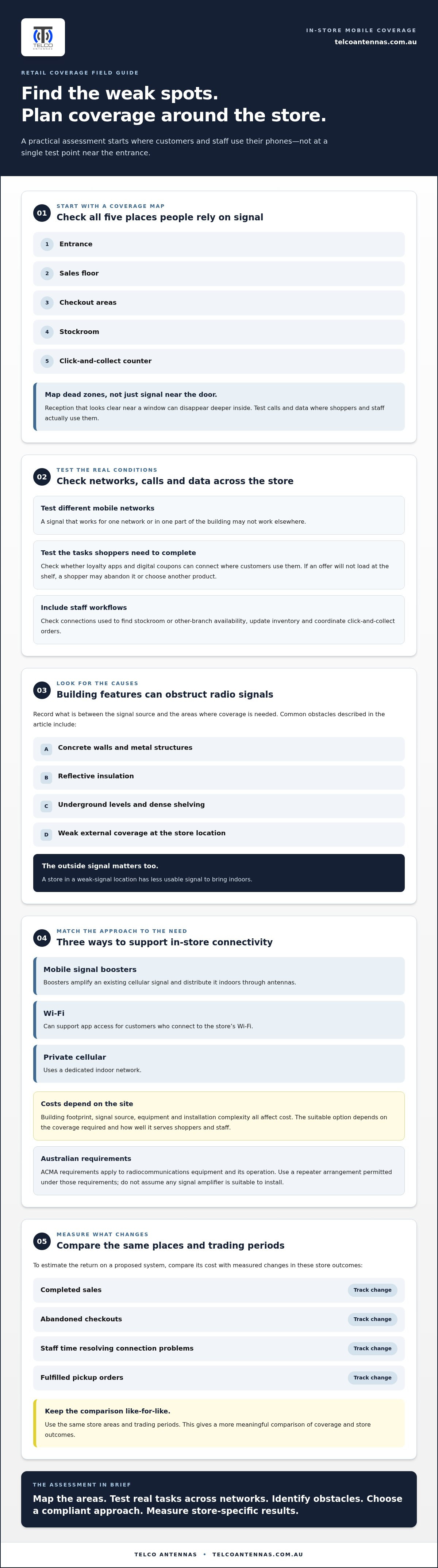
Start by mapping reception in customer and staff areas, including the entrance, sales floor, checkout, stockroom and click-and-collect counter. Test across different mobile networks: a clear signal near a window may disappear deeper inside. Loyalty apps and digital coupons also need a working connection. If shoppers can’t load an offer at the shelf, they may abandon it or choose another product.
Building materials and layout can weaken reception. Concrete walls, metal structures, reflective insulation, underground levels and dense shelving can obstruct radio signals. External coverage matters too: a store in a weak-signal location has less usable signal to bring indoors. Test calls and data where customers actually use them, and map dead zones rather than relying on a single test near the entrance.
Boosters amplify an existing cellular signal and distribute it indoors through antennas. Wi-Fi can support app access for customers who connect to it, while private cellular uses a dedicated indoor network. Costs depend on the building footprint, signal source, equipment and installation complexity. The value of each option depends on the coverage required and how well it serves shoppers and staff.
In Australia, ACMA requirements apply to radiocommunications equipment and its operation. Retailers should use a repeater arrangement permitted under those requirements, rather than assuming any signal amplifier is suitable for installation.
Coverage affects store operations as well as customers. A weak connection can prevent staff from checking stockroom or other-branch availability, updating inventory or coordinating click-and-collect orders. To estimate the return, compare the proposed system’s cost with measured changes in completed sales, abandoned checkouts, time spent resolving connection problems and fulfilled pickup orders. Use the same store areas and trading periods for a meaningful comparison.
Lost sales and damage to store reputation
The financial impact of poor mobile signal on retail can include missed purchases and reduced customer confidence. The effects may be felt during a visit and reflected in what shoppers share afterwards.
Checkout abandonment and lost sales
Checkout abandonment occurs when a shopper leaves before completing a purchase. If a payment interruption isn’t resolved, the retailer may lose the transaction. Track incomplete sales by checkout location and time to identify patterns. Repeated abandonment at one terminal, for example, differs from isolated customer decisions and may indicate a local connection issue affecting purchases.
Sales and customer conversion effects
Conversion means turning a store visit into a purchase. A shopper who can’t load a product review or compare an online price may leave without buying. Staff may also lose a sale if handheld tills or mobile point-of-sale devices can’t connect. These disruptions can affect customer decisions and limit the number of transactions staff can process during busy trading periods.
Financial costs of connectivity outages
There’s no single average outage cost for Australian retailers. The financial impact of poor mobile signal on retail depends on which checkout areas are affected, how long the interruption lasts and whether shoppers complete purchases another way. Compare transactions during the disruption with normal trading periods, and record staff time spent resolving issues. This gives retailers a store-specific view without treating every failed connection as a lost sale.
Reputation damage and retail case studies
Reputation damage occurs when a poor store experience influences customer feedback or future visits. Shoppers unable to get a signal or pay by phone may post negative online reviews. An Australian national retailer reported 95% mobile reception coverage in public and back-of-house areas after installing an in-building coverage solution. That figure describes coverage, not recovered sales, so assess revenue and reputation separately.
Failed mobile wallet payments and abandoned purchases
A mobile wallet tap and payment authorisation are separate parts of a checkout. The phone communicates with the terminal using contactless technology, while the terminal’s connection carries the transaction for processing. Losing mobile reception on a customer’s phone doesn’t automatically prevent a tap. However, a connection failure affecting the payment terminal or its processing route can stop the sale.
That distinction matters at the counter. A shopper may tap successfully, for example, but then face a declined or incomplete transaction while the terminal waits for a response. If the customer can’t pay another way, they may leave without the items. A queue can add pressure: shoppers waiting behind them may also abandon their purchases if the delay continues.
Staff need a clear way to identify where a failure occurs. Note whether the phone fails to present the wallet, the terminal doesn’t register the tap, or processing stalls. Compare reports across terminals and times of day. If only one terminal is affected, its connection or equipment may be the issue; failures across several terminals may indicate a wider connectivity disruption.
Wi-Fi may be used as a fallback for card-payment connectivity, but it can raise PCI DSS compliance issues. Retailers should assess the payment system’s approved network arrangements rather than switching terminals to an informal connection during an outage. A mobile signal problem and a payment-processing fault can look similar at checkout, so recording the exact error helps staff respond consistently.
To measure the sales effect, compare failed transactions with completed sales during the same trading periods. Record whether customers retry, use another payment method or leave, and note the affected checkout. This distinguishes recoverable delays from abandoned purchases. A successful cash payment after a failed wallet tap, for instance, is a delay; a customer leaving without buying represents a lost sale.
How does poor mobile signal affect retail sales and customer conversion rates?
Over 60% of shoppers have been in a store where their smartphones had poor mobile network coverage. That matters because customers use phones to compare prices, read product reviews and check availability before deciding to buy. If a page won’t load beside a product, a shopper may postpone the decision, choose another item or leave without purchasing.
Conversion also depends on what staff can do during a visit. If an employee can’t check stockroom inventory or another branch’s availability, they may be unable to offer an alternative size or colour. A shopper looking for a particular model, for example, may leave if staff can’t confirm its availability elsewhere. A missed sale can result from a service limitation, not just a checkout fault.
Measure these effects with store-level indicators rather than anecdotes alone. Compare purchase rates and completed transactions in areas with strong and weak reception. Record customer questions staff couldn’t resolve because stock information wouldn’t load, as well as instances where shoppers left to check information on their own phones. These observations help show where connectivity affects conversion.
Staff connectivity matters during busy periods, too. If a handheld till or mobile point-of-sale device loses connection, employees may need to redirect customers or use another checkout. That can slow service and reduce how many shoppers complete a purchase during peak trading. Compare checkout interruptions with queues and abandoned transactions to understand the operational effect.
Separate signal problems from other causes, such as unavailable stock or a payment-system fault. Note the affected store area, customer task and device, then compare those records with sales outcomes. To assess coverage challenges in your retail environment, map where shoppers and staff lose mobile reception and identify the points affecting service and sales.
Telco Antennas: Cel-Fi GO Mobile Signal Boosters
Telco Antennas supplies Cel-Fi GO Mobile Signal Boosters for retail premises where weak reception disrupts customer or staff connectivity. A booster amplifies an existing cellular signal and distributes coverage indoors, making it relevant when outdoor reception is available but fades across areas such as the sales floor or checkout.
Coverage needs depend on the building layout and where the signal drops out. A store with isolated dead zones may need a different setup from a large premises with weak reception throughout. Mapping affected areas helps determine whether a mobile signal booster suits the problem. Point-to-Point Wireless Bridges serve a different purpose: connecting separate locations rather than improving cellular coverage for shoppers’ phones.
If poor in-store reception is affecting your retail operations, contact Telco Antennas to discuss the relevant equipment.
Make your next coverage decision measurable
Use the financial impact of poor mobile signal on retail as a reason to replace assumptions with a store-specific coverage plan. Identify the locations and tasks where connectivity affects service, then weigh those findings against equipment suited to the premises. The right setup depends on the signal available outside, building materials and the indoor areas that need reception.
Telco Antennas offers Cel-Fi GO Mobile Signal Boosters, MIMO Antennas and LMR-400 Coaxial Cables for mobile signal infrastructure. These components can form part of a solution designed around the store’s coverage requirements. A clear assessment of the problem helps keep the next decision practical, whether you’re investigating a checkout dead zone or wider reception across the premises.
To discuss your retail coverage needs and potential equipment options, contact Telco Antennas about coverage. A measured approach can help you plan the next step with confidence.
Frequently Asked Questions
Why can’t your consumer get networks signal in store?
A customer may lose mobile network signal because the store’s structure blocks or weakens radio waves. Reinforced concrete, metal cladding and underground floors can reduce the signal reaching a phone. Reception also varies between mobile networks, so one shopper may have coverage while another has none. If signal is weak outside the premises, little usable reception may be available indoors.
Why is my phone signal poor inside retail stores?
Your phone may receive a stronger signal near an entrance or window than in the centre of a store. Walls, shelving and building materials can weaken reception further indoors. Your phone’s network provider and hardware also affect the connection. Compare reception in different parts of the premises, then see whether another device on a different network behaves differently.
How does poor mobile signal affect EFTPOS and mobile payment transactions in Australian stores?
A phone’s mobile signal and an EFTPOS terminal’s payment connection are separate links. A customer may tap a mobile wallet successfully while the terminal struggles to reach its payment processor over its own network connection. This can delay or interrupt authorisation. Staff should note whether the error occurs at the phone, terminal or processing stage, as each points to a different fault.
What revenue do retailers lose when customers cannot use mobile apps, loyalty programs, or digital coupons in-store?
There’s no single revenue figure that applies across Australian retailers. The effect depends on how many shoppers rely on an app or offer, and whether they still complete a purchase without it. Compare app or coupon access failures with redemption records and sales for the affected promotion. This helps distinguish a missed discount from a lost transaction and shows which offers are most affected.


