

Hospital basements, lifts and stairwells can lose mobile coverage because concrete, steel and the building’s position obstruct radio signals. Reliable mobile signal for staff in hospital basements depends on an outdoor signal reaching the site: a booster can amplify and redistribute that signal indoors, but it can’t create one. In Australia, mobile signal boosting equipment must meet ACMA requirements, and installations must comply with carrier rules.
It’s a practical concern: poor reception can affect staff communications and access to Triple Zero (000) calls in areas where coverage drops away. This guide explains why dead spots form in underground and enclosed hospital spaces, and what influences system costs, including the building layout, signal conditions and the type of system needed. Understanding these factors helps clarify what mobile signal for staff in hospital basements requires at a specific facility.
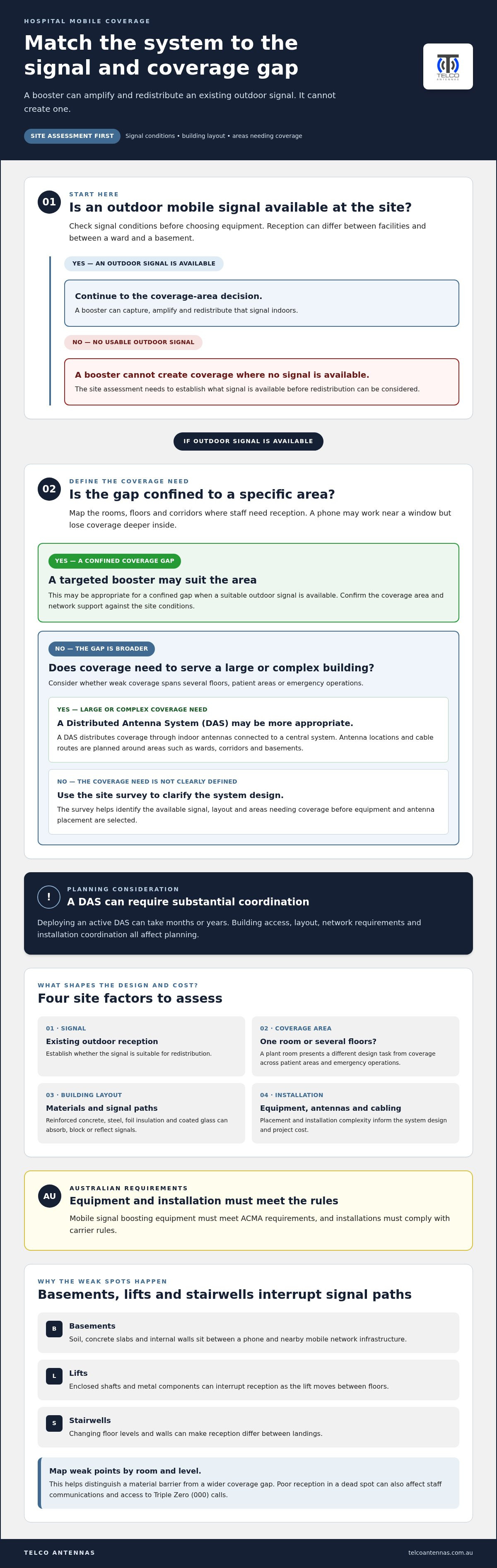
A site assessment helps establish whether a targeted booster or a broader in-building system is more appropriate. For mobile signal for staff in hospital basements, start by matching the solution to the signal available and the areas that need coverage.
Key Takeaways
- Identify how reinforced concrete, steel and below-ground locations can create mobile dead spots in hospital spaces.
- Understand why a booster needs an existing outdoor signal and how Australian ACMA requirements apply to boosting equipment and installations.
- Compare when a targeted booster may suit a confined coverage gap and when a DAS may better serve a large or complex building.
- Use the building layout, signal conditions and coverage area to understand the main factors that shape system design and cost.
The causes: what causes poor mobile coverage in Australian hospitals?
In Australian hospitals, reliable indoor mobile coverage supports staff, patients and visitors in areas where outdoor reception may not reach. A nurse in a basement treatment area may need to contact colleagues, while a visitor may need to call from a lift lobby. Poor mobile coverage can also leave people unable to make Triple Zero (000) calls from a dead spot.
For staff, cellular service can support calls and mobile workflows between nurse stations, patient rooms and emergency departments. A dropped call during a handover can interrupt the exchange of patient-care information, while unreliable reception can make mobile tasks harder. Signal strength can vary between rooms, floors and corridors, so a phone that works beside a window may lose coverage deeper inside the building.
Which mobile carriers have the best coverage inside Australian hospitals? There’s no single carrier that performs best in every hospital. Indoor reception depends on the carrier’s outdoor network at the site and how the building affects the signal. Coverage can vary between facilities, and even between a ward and a basement.
Can hospital Wi-Fi calling or apps replace cellular coverage underground? No. Wi-Fi calling and apps can support communication where the hospital’s Wi-Fi works, but Wi-Fi does not replace strong, legal, multi-carrier mobile coverage for safety and public communications. A phone also needs a suitable connection and service for the function being used.
A signal booster captures an existing outdoor signal, amplifies it and redistributes it indoors. It can’t create a signal where none is available. For a large or complex hospital, an active Distributed Antenna System (DAS) distributes coverage through indoor antennas connected to a central system. Deploying an active DAS can take months or years, so building access, layout, network requirements and installation coordination all affect planning.
In Australia, mobile signal boosting equipment must meet ACMA requirements, and installations must comply with carrier rules, according to the Australian Communications and Media Authority. When assessing a system for nurse stations, patient rooms or an emergency department, match the coverage area and network support to the site.
Why hospital building materials and locations weaken cellular reception
Hospital walls and below-ground layouts can weaken an outdoor mobile signal before it reaches staff areas. The same phone may stay connected near an outside entrance, then lose coverage in a concrete corridor.
How walls and concrete weaken signals
Thick walls and concrete weaken radio signals passing through a building. Each intervening wall, floor or enclosed corridor further reduces the signal reaching a phone, especially when reception is already weak. A basement treatment room separated from the outside by several concrete levels may therefore have much poorer reception than a nearby ground-floor space. This matters when staff need a connection in rooms without windows.
Materials that block or reflect signals
Some construction materials absorb, block or reflect radio signals, changing indoor reception. Reinforced concrete, steel, foil insulation and coated glass can all obstruct mobile signals in health and aged-care buildings. Steel around a lift core, for example, can create a different reception pattern from an open corridor, while coated glass can weaken signals near a window. The effect depends on where materials are placed and the signal path from outside.
Do Australian mobile signal boosters require ACMA approval or carrier consent? Mobile signal boosting equipment must meet ACMA requirements, and installations must comply with carrier rules, according to the Australian Communications and Media Authority. These requirements apply to Australian installations, including systems intended to improve reception through hospital walls.
Location compounds the effect of building materials. A basement sits below ground, with soil, concrete slabs and internal walls between the phone and nearby mobile network infrastructure. In lifts, the enclosed shaft and metal components can interrupt the signal as the lift moves between floors. Stairwells also have changing floor levels and walls, so reception can differ between landings. Mapping weak points by room and level helps distinguish a material barrier from a wider coverage gap.
For a hospital with variable indoor reception, in-building signal planning can account for wall materials, lift cores and the signal available outside.
How much do hospital signal booster systems cost?
Hospital system costs depend on the coverage area, building layout, existing signal and equipment required. A confined basement with an outdoor signal presents a different design task from a multi-level facility with gaps across patient areas and emergency operations.
A Distributed Antenna System (DAS) carries mobile coverage through indoor antennas connected to a central system. In a hospital, antenna locations and cable routes are planned around areas such as wards, corridors and basements, with the design matched to the required network coverage.
A site survey helps establish the available signal, building materials and layout before system design. It can identify whether coverage is needed in one plant room or across several floors, and whether the outdoor signal is suitable for redistribution. These findings inform equipment selection, antenna placement, cabling and installation complexity, all of which affect project cost.
For larger sites or complex layouts, a DAS can distribute coverage across multiple indoor zones. A targeted booster may suit a smaller underground area when a usable signal is available outside. Repeaters, DAS and small-cell systems use different architectures, so compare them against the site’s signal conditions, coverage objectives and network requirements, not on equipment alone.
What is a DAS and how does it provide mobile coverage in buildings? A DAS distributes mobile coverage through indoor antennas connected to a central system. Its antennas can serve separate zones across a hospital, including areas where external signals are obstructed.
What are the risks of installing mobile repeaters in hospitals? Poorly designed or non-compliant repeaters can interfere with mobile networks and fail to provide the intended coverage. In Australia, boosting equipment must meet ACMA requirements, and installations must comply with carrier rules, according to the Australian Communications and Media Authority.
Hospital operations also influence design: equipment access, cable routes, antenna positions and future maintenance all matter. A system covering patient rooms and emergency areas requires planned coverage zones and monitoring suited to the facility’s layout. Those project details, rather than a single standard price, determine the system scope and cost.
Mobile dead spots in hospital basements, lifts and stairwells
Basements, lift cars and stairwells can each have different reception conditions, even within the same hospital. There is no single typical basement coverage level across Australian hospitals: it varies with the carrier’s signal outside and the building’s structure.
Coverage in hospital basements
Basement coverage describes how reliably phones receive a carrier’s mobile signal below ground, where concrete, surrounding soil and floor slabs obstruct reception. The practical impact depends on the location: a staff room near an external wall may receive a signal while an inner store room has none. Before one hospital signal installation, more than 85% of the building had no mobile signal.
That figure comes from one hospital, not a national average. To understand a specific facility, compare signal strength across basement rooms, corridors and entrances, and record which carrier and phone were tested. Coverage at the basement ramp doesn’t establish reception deeper inside. Marking precise dead zones helps distinguish a local gap from a wider basement problem.
Dead spots in lifts and stairwells
Lift cars and stairwells are enclosed routes where reception can change over short distances. Metal lift structures and concrete walls may interrupt the carrier signal, while movement between floors changes the phone’s position relative to available coverage. A call that works in the lift lobby may drop after the doors close or the car moves.
Test lift cars at different stops and stairwell landings, rather than relying on readings from the adjacent corridor. Note whether the phone can maintain a call, send a message or reconnect after moving between floors. These observations help define where an installation needs to provide coverage, rather than treating the building as one uniform zone.
For a useful assessment, map each dead spot by floor, room and carrier, then use those results to define coverage priorities. Plan hospital mobile coverage around the basement, lift and stairwell locations where staff need connectivity.
Telco Antennas: Cel-Fi GO Mobile Signal Boosters
Telco Antennas supplies Cel-Fi GO Mobile Signal Boosters for sites where an existing outdoor mobile signal needs to reach indoor areas. A booster captures and amplifies available signal, then redistributes it through the building. It doesn’t create coverage where no usable signal reaches the site.
For a hospital basement or other defined dead zone, system design needs to account for the carrier signal outside, the building layout and the required coverage area. MIMO antennas and LMR-400 coaxial cables can form part of the signal infrastructure, depending on the design. In Australia, boosting equipment must meet ACMA requirements, and installations must comply with carrier rules.
For a discussion about mobile coverage in your facility, contact Telco Antennas.
Plan the next step for hospital coverage
Turn the coverage problem into a clear design brief: identify the rooms and routes where staff need a mobile connection, the carriers in use, and the signal available outside. This gives system design a practical target, rather than treating the entire hospital as one uniform space. For mobile signal for staff in hospital basements, the priority may be a defined basement zone, lift route or stairwell, each with different installation requirements.
Telco Antennas offers Cel-Fi GO Mobile Signal Boosters, MIMO Antennas and LMR-400 Coaxial Cables for mobile signal systems. The right combination depends on the site and its coverage requirements, not simply the equipment category. A discussion focused on your facility can help clarify the next technical considerations.
Contact Telco Antennas for advice about mobile coverage at your hospital. A well-defined brief is a practical starting point for improving connectivity in the areas that matter.
Frequently Asked Questions
How do I know which solution is right for my building's basement?
Match the system to the size and shape of the coverage gap. A single basement room with usable reception just outside may suit a targeted approach, while coverage across multiple levels or separate zones may call for a distributed design. Compare the carriers staff use, the locations that need service and signal readings from those areas to set a practical coverage brief.
Need A Solution?
Start by documenting where calls or mobile tasks fail, which carriers are affected, and whether reception changes by room or time. Telco Antennas offers RF Site Surveys to assess the site’s radio-frequency conditions and inform system planning. Mark problem areas on a floor plan to give the discussion a useful starting point. Contact Telco Antennas to discuss the coverage challenge at your facility.
What’s the best solution for cellular dead zones in healthcare facilities?
The best fit depends on the coverage objective and the usable signal reaching the building. A booster may suit a defined dead zone, while a Distributed Antenna System can distribute mobile coverage through indoor antennas connected to a central system across a larger or more complex facility. The design should account for the carriers required and the locations where staff need service.
Why is there no cell signal in my basement?
Below-ground rooms have physical barriers between phones and the carrier network, including surrounding soil, floor slabs and internal walls. Signal can also differ between rooms depending on their position in the building. For example, a phone may connect near a basement ramp but lose service in an interior office. Compare readings at the entrance, corridor and affected room to locate the change.
How can hospitals improve mobile signal in basements?
Hospitals can improve coverage by mapping affected spaces first and identifying which carrier connections matter for staff workflows. A system can then be designed around those zones, with indoor antennas positioned to serve the areas that need reception. Australian installations must use boosting equipment that meets ACMA requirements and comply with carrier rules, according to the Australian Communications and Media Authority.
How much does a hospital mobile signal booster or DAS cost in Australia?
Project cost depends on the area requiring coverage, building layout, existing signal conditions and system architecture. A confined zone has different equipment and cabling needs from a multi-level facility requiring distributed antennas. Antenna locations, cable routes, carrier requirements and installation complexity also shape the scope. Establishing these design factors provides a more meaningful basis for budgeting than comparing equipment alone.


