

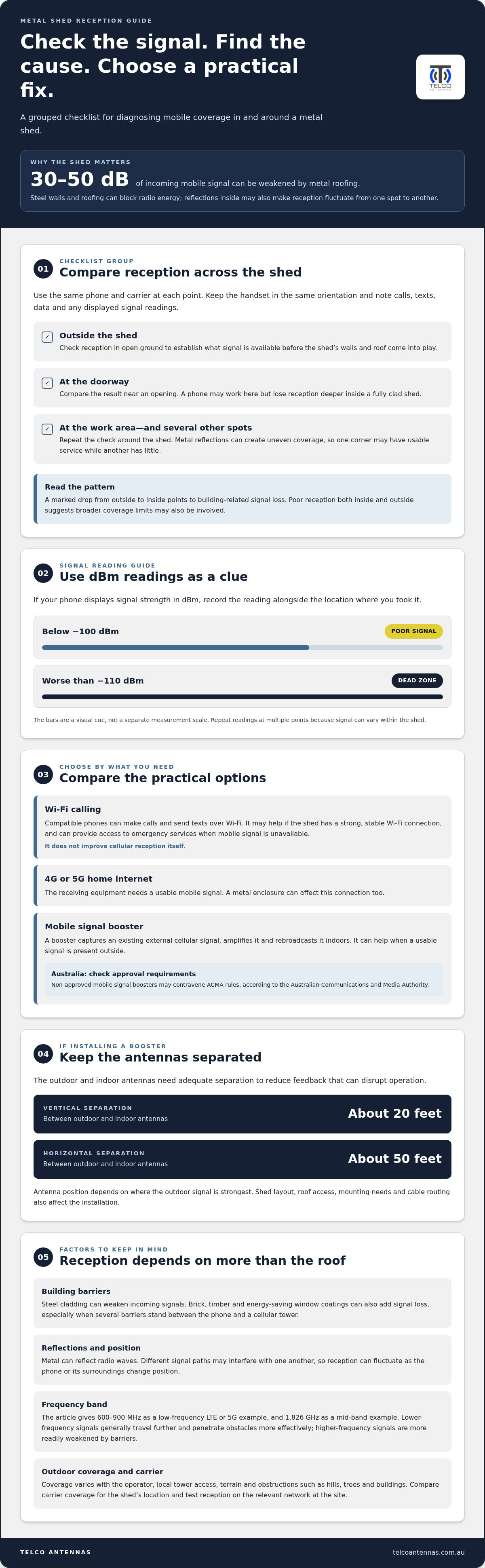
A metal shed can reduce incoming mobile signal by 30-50 dB, so a phone that works outside may struggle inside. To understand how to solve mobile reception issues in a metal shed, start with the building itself: steel roofing and walls can weaken radio signals, while their reflective surfaces can also make reception fluctuate.
If calls drop or data slows as soon as you step inside, that change is a useful clue. The shed may be blocking an otherwise usable outdoor signal, while weak reception outside can point to a wider coverage issue.
This guide explains how metal roofing affects mobile signals, how to compare reception inside and outside, and which practical options may help. It also explains why a booster’s external and indoor antennas need adequate separation to prevent feedback that can disrupt operation.
Key Takeaways
- Compare reception inside the shed with reception outside to help distinguish building-related signal loss from weak local coverage.
- Steel cladding can weaken incoming signals, while reflections from metal surfaces may contribute to fluctuating reception.
- When installing a booster, keep its outdoor and indoor antennas about 20 feet apart vertically or 50 feet apart horizontally to reduce feedback.
- Signal readings can help identify a dead zone: levels worse than -110 dBm indicate very poor coverage.
- In Australia, non-approved mobile signal boosters may contravene ACMA rules, according to the Australian Communications and Media Authority.
Do Metal Roofs Really Block Cell Signals?
Yes. Steel cladding can weaken mobile and Wi-Fi signals, so reception may change sharply between the shed and the yard. Metal roofing can attenuate incoming cellular signal by 30-50 dB, while other building materials and obstructions can add to the loss.
Comparing reception helps show whether the shed is the main barrier or local coverage is also weak. The construction, layout and outdoor signal all affect the result.
How building materials block mobile signals
Steel cladding blocks some radio energy travelling through a shed’s roof and walls. Brick, timber and energy-saving window coatings can also weaken incoming signals, especially when several barriers separate a phone from a cellular tower.
For example, a phone may work near an open doorway but lose reception deeper inside a fully clad shed. If reception is poor both indoors and outdoors, distance from a tower or obstructions such as hills and buildings may matter more than the cladding.
Metal roofing and signal reflection
Metal can both weaken and reflect cellular radio waves. Some energy is blocked, while reflected signals may take different paths before reaching a phone.
Those paths can interfere with one another, making reception fluctuate as the phone or its surroundings change position. A corrugated roof and metal walls can therefore create uneven coverage: one corner may receive a usable signal while another has little service. The roof is a barrier, but reflections also shape where signal remains available inside.
Testing signal strength inside and outside
Compare the same phone and carrier outside the shed, at its doorway and at a work area inside. Keep the phone in the same orientation, and note how calls, texts and data behave at each point.
If your phone displays signal readings in dBm, record them alongside the location. Signal levels below -100 dBm are poor, and levels worse than -110 dBm are described as a dead zone. A marked difference between outside and inside points to building-related loss; weak readings in both places suggest broader coverage limitations. Repeat the comparison at several spots, because metal surfaces can produce local variations.
Alternative connectivity and signal boosters
Wi-Fi calling lets compatible phones make calls and send texts over Wi-Fi. It can also provide access to emergency services when mobile signal is unavailable. It may help in a shed with a strong, stable Wi-Fi connection, but it does not improve cellular reception itself.
A 4G or 5G home internet service relies on a usable mobile signal at its receiving equipment, so a metal enclosure can affect its connection too. A mobile signal booster captures an existing external cellular signal, amplifies it and rebroadcasts it indoors. It can help when a usable signal is present outside. In Australia, non-approved mobile signal boosters may contravene ACMA rules, according to the Australian Communications and Media Authority.
No single carrier covers every shed location. Coverage varies with the operator, local tower access, terrain and obstructions. Compare carrier coverage for the shed’s location, then test reception on the relevant network at the site.
Does Metal Roofing Interfere with Cellular Reception?
Yes. A metal roof can weaken cellular reception, but the result also depends on the signal reaching the shed and the frequency band in use.
Location, nearby obstructions and antenna placement all affect the outcome. These factors matter when working out how to solve mobile reception issues in a metal shed, because the roof may not be the only cause.
Metal roofing and mobile reception
Metal roofing weakens and reflects radio waves before they reach a phone. The signal inside depends both on the incoming signal and on the shed’s construction.
A fully clad shed presents a larger barrier than one with an open doorway or non-metallic panel. Reflections from the roof and walls can make coverage uneven, so reception may differ between a workbench and the doorway. Trees, buildings and hills can weaken the signal before it reaches the shed.
Weather, location and mobile provider can also affect reception. If nearby users on the same network have poor outdoor coverage, the roof alone does not explain the problem. Compare reception in open ground with reception at the shed to distinguish outdoor coverage conditions from building-related signal loss.
Frequency bands and indoor reception
Frequency affects how radio waves travel through obstacles and into buildings. A phone can receive different bands with different strengths at the same site.
For example, 600-900 MHz is a low-frequency LTE or 5G band, while 1.826 GHz is a mid-band frequency example. Lower-frequency signals generally travel further and penetrate obstacles more effectively, while higher-frequency signals are more readily weakened by barriers. The metal roof still affects incoming signals, but the size of the effect depends partly on which band the phone uses.
Band availability also varies by carrier and local network. A phone may have a usable connection outside, then switch bands or lose service after entering the shed. When deciding how to solve mobile reception issues in a metal shed, compare reception using the same handset and carrier. A band change can affect the result.
Installation requirements also affect project cost and duration. Antenna position depends on where the outdoor signal is strongest; cable routing depends on the shed layout, entry points and equipment placement. Roof access, mounting requirements and separation between outdoor and indoor antennas are also practical considerations. A clear route and suitable mounting location simplify the work, while complex access or a long cable path adds installation tasks.
For a site-specific view, mapping signal conditions across the property can help distinguish building interference from weak regional coverage before selecting an approach.
Separating booster antennas to prevent oscillation
A practical approach is to capture an available outdoor signal with an external antenna, then distribute the boosted connection inside. If the booster’s antennas are too close, feedback can disrupt operation, so adequate separation matters.
Place the outdoor antenna where it receives the strongest usable signal, then route its cable through a suitable wall entry point. Position the indoor antenna to serve the work area, keeping it about 20 feet from the outdoor antenna vertically or 50 feet horizontally. That separation reduces feedback between the antennas.
Feedback, also called oscillation, occurs when the indoor antenna’s transmitted signal reaches the external antenna and re-enters the booster. The amplifier then receives its own output rather than only the mobile network signal. This can disrupt booster operation. Correct antenna separation is the practical control; feedback alone does not establish an effect on neighbours or emergency calls.
External antenna placement is central to the installation. A smartphone may be less effective at capturing cellular signals than an external antenna connected to a booster. Mounting the antenna outside the metal cladding gives it a clearer path to the network. Route the cable through a sealed wall entry, avoiding unnecessary bends and obstacles.
Inside, antenna placement determines where the improved connection is available. A single indoor antenna may suit a compact shed, while a larger or divided building may need coverage distributed across separate areas. A distributed antenna system uses connected antennas to extend coverage beyond one room or work zone. Plan around metal partitions, equipment and the areas where people need calls or data.
Before installation, compare reception at possible outdoor antenna positions and identify where the indoor connection is needed. If the shed has a weak external signal, moving an antenna to a better position may help capture it; a booster cannot create a network signal where none is available. For a site layout that needs a tailored antenna arrangement, planning booster antenna separation is a useful next step.
Identifying indoor mobile coverage problems
Compare reception at several points to find where coverage drops and whether the shed is the main barrier. Use the same phone, carrier and network setting for each test, because changing devices or networks can alter the result.
Start outside in an open area, then test at the shed entrance, beside a window and at the workbench. Note call quality, data access and any signal reading shown by the phone. Differences between these locations can reveal whether the roof, walls or a particular part of the shed affects reception.
Signal readings are commonly shown in dBm, where a more negative value means a weaker signal. Levels below -100 dBm are poor, while readings worse than -110 dBm are described as a dead zone. Use those figures as practical markers, not as a substitute for checking whether calls and data work where you need them.
Repeat the comparison in different parts of the shed. Metal walls can create local variations, so reception near a doorway may differ from coverage behind shelving or equipment. If readings are weak both inside and out, the issue may relate to the nearest cellular tower, terrain, trees, buildings or the provider’s coverage. Stronger outdoor reception suggests the shed structure is contributing to the loss.
- Outside: Test in open ground, away from the metal shed and nearby vehicles.
- At the boundary: Compare the doorway and any window or non-metallic panel.
- Inside: Check the regular work area and another room or corner.
Reception sometimes improves near glass, but glass types behave differently. Energy-saving window coatings can weaken incoming signals, so a window is not automatically a clear signal path. In a fully sealed shed, a corrugated polycarbonate panel can provide a permanent entry point for an external signal without removing the roof or wall cladding.
Keep test conditions consistent: use the same handset, network and location sequence, then compare results. If you can access another carrier’s service, repeat the checks on that network. Coverage varies by provider and site, and this comparison can show whether one network performs better at the shed. Strong outdoor reception paired with a sharp indoor drop points to a building-related problem; weak readings throughout suggest limited local coverage rather than an indoor-only dead spot.
How cellular radio waves interact with metal roofing
Cellular radio waves are electromagnetic energy travelling between a mobile tower and your phone. A metal roof changes that path: some energy reflects from its conductive surface, some is absorbed, and less may pass through the roofing into the shed. The result depends on the signal reaching the structure and the surrounding materials.
Reflection helps explain why reception can vary within one building. A wave may bounce off corrugated roofing, a wall or stored metal equipment before reaching a phone. Reflected paths can combine with the direct signal, strengthening it in one spot and weakening it in another. Moving a phone between a doorway and a workbench can therefore change its connection.
Radio waves interact differently with different building materials. Steel cladding is a substantial barrier, while openings and non-metallic sections can provide paths for signals to enter. Brick, coated glazing and other materials can also reduce the energy reaching a phone. In a fully enclosed shed, the roof and walls act together, so reception depends on the structure as a whole, not just one panel.
Frequency also shapes how radio waves interact with a building. Cellular networks use different bands, and a phone can switch between them as conditions change. Lower-frequency signals generally travel further and penetrate obstacles more effectively than higher-frequency signals. Metal roofing can still reflect or weaken either type, but the band in use affects how much signal reaches the interior.
MIMO antenna systems add another factor. Smartphone and tower MIMO antennas send and receive multiple signals at once, using reflections to improve signal strength and quality. A reflected path is not automatically harmful: it can help when the receiver combines useful signals, but poorly timed paths may contribute to uneven reception. That is why one reading from one spot may not represent coverage across the shed.
Wi-Fi and cellular connections both use radio waves, but Wi-Fi depends on a local router while mobile service comes from a cellular network. A strong internet connection outside will not make cellular signal pass through metal roofing. Identify where the outdoor signal is strongest, then consider how the shed’s openings, layout and work areas affect the signal path indoors.
For a clearer view of signal paths across a site, discuss your shed’s wireless requirements.
Telco Antennas: Cel-Fi GO Mobile Signal Boosters
Telco Antennas supplies Cel-Fi GO Mobile Signal Boosters for sites where an outdoor mobile signal needs to be brought inside a metal shed. The system uses an external antenna to capture the signal, then amplifies and rebroadcasts it indoors. Antenna placement and separation matter, so plan the setup around the shed’s layout and the areas needing coverage.
MIMO antennas and LMR-400 coaxial cables can also form part of a suitable signal system, depending on the site requirements. If outdoor reception is absent or extremely weak, a booster may not solve the underlying coverage problem.
To discuss mobile signal options for your shed, contact Telco Antennas or visit telcoantennas.com.au.
Plan the next step for your shed
Turn your reception checks into a practical site plan. Note where the signal is strongest, which work areas need a connection, and how the shed’s layout affects antenna placement. This helps you decide how to solve mobile reception issues in a metal shed before choosing equipment.
Where an external mobile signal is available, Telco Antennas offers Cel-Fi GO Mobile Signal Boosters, MIMO Antennas and LMR-400 Coaxial Cables for signal system configurations. The right combination depends on the site conditions and the coverage required inside.
Contact Telco Antennas to discuss your shed’s mobile signal requirements. A clear plan is a solid starting point for improving connectivity at your site.
Frequently Asked Questions
Why Can't I Get a Signal Inside My Shed?
Your phone may be losing an already weak connection as the signal passes through the shed. Check whether the problem affects one handset or every phone, then compare calls and data on the same network outside. If only one device struggles, its settings, SIM or hardware may contribute. If several phones lose service indoors, the building or local network conditions are more likely factors.
Does the size of the building matter?
Yes. A larger shed may have more distance between the outdoor signal source and the areas where people need service. Internal metal partitions, machinery and stored equipment can also create uneven reception. For example, a phone might connect near the entrance but fail in a workshop at the far end. Consider coverage across the whole floor plan, not just whether one spot receives a signal.
Need help planning the right setup for your shed?
Telco Antennas offers RF Site Surveys, Cel-Fi GO Mobile Signal Boosters, MIMO Antennas and LMR-400 Coaxial Cables. These offerings may be relevant when you’re assessing outdoor signal, antenna positioning and the cable route into a shed. Note the areas that need coverage, the mobile network in use and any obstacles around the building. You can then discuss those site requirements with Telco Antennas.
What Causes a Poor Cellular Reception in Phones?
Poor reception can result from weak network coverage, obstructions or the phone’s position inside a building. Hills, trees and nearby structures may affect the path to a tower; the mobile provider and weather can also influence reception. A handset may behave differently in open ground and inside a metal workshop. Compare another phone on the same network to see whether the problem is specific to one device.
What If the Shed Has No Windows?
A sealed shed without windows can still have a planned signal entry point. A corrugated polycarbonate panel can let mobile signal in without using a glazed window. Alternatively, place an external antenna outside and route its cable through a suitable wall entry. If Wi-Fi is available inside, Wi-Fi calling may support calls and texts over that connection.
Why Is Mobile Reception Poor Inside Steel Buildings?
Steel roofing and walls can weaken the radio signal reaching a phone, while internal metal surfaces and equipment can make reception uneven. A steel workshop beside a hill or large building may face both structural and outdoor obstructions. Compare reception in different work areas with reception outside. This helps distinguish an indoor problem from limited coverage across the site.
Will a signal booster from a hardware store fix this?
Not automatically. A mobile booster needs an existing external cellular signal to capture and amplify, so it cannot create coverage where the network signal is absent. In Australia, non-approved mobile signal boosters may contravene ACMA rules, according to the Australian Communications and Media Authority. Before choosing equipment, establish which network has usable reception at the site and whether the booster is approved for use.
Why does a metal shed block mobile phone reception?
Metal cladding reflects and weakens radio waves, reducing the signal that passes into the shed. The roof and walls can act together, while stored steel shelving or machinery may further affect reception around a phone. The effect can vary between locations inside the same building. An open doorway or non-metallic section may provide a path for the signal, which is why reception can improve near an opening.


