
A mobile communications trailer for outdoor events is a towable platform carrying communications equipment that can be deployed where temporary connectivity is needed. Depending on the site and the job, a mobile unit can integrate satellite, 4G/5G, Wi-Fi, microwave links and radio communications. It can provide a temporary alternative to a permanent installation, or support coverage as site requirements change.
For event organisers and site managers, the challenge is not simply getting equipment on site. The setup needs to suit the terrain, available power and communications links. This guide explains what a mobile communications trailer for outdoor events does and how a trailer differs from a communications skid or mast setup.
You’ll also learn which factors shape a practical configuration for an outdoor event or remote worksite, how backhaul and power affect deployment, and what Australian support can involve. This context helps you identify the equipment your site needs before planning a temporary communications setup.
Key Takeaways
- Match the mobile setup to the event site’s terrain, power supply and required communications links before planning deployment.
- Consider how satellite, cellular, Wi-Fi, microwave and radio connections could work together to cover temporary or remote areas.
- Choose between a trailer, skid or mast arrangement based on how the equipment must be transported, positioned and supported on site.
- Plan booking around site access, equipment configuration, backhaul and power needs, as these factors shape the deployment process.
Australian availability and deployment support
Australian deployment depends on the event location, communications design, mast requirements and site access. Plan these together so the trailer can reach its position and become operational.
Deployment speed and operating runtime
Deployment time depends on transport access, mast operation, connectivity setup and whether power is ready. Some custom LTE trailers can be operational within hours, while site-specific configuration affects the schedule. Runtime depends on equipment load and available power. Solar panels, battery storage and generator technology can support power needs, but organisers should match capacity to the equipment and operating period.
Before deployment, establish the mast’s rated wind limits and operating procedure. Event teams should account for exposed ground, changing weather and safe stowage instructions. Protect equipment from unauthorised access, and plan for connectivity disruption by identifying backhaul options such as satellite or microwave links.
Mobility and deployment efficiency
A towable communications trailer can move between event locations as coverage needs change. Check the route, ground conditions, turning space and final parking position before delivery. Some platforms use articulated or pneumatic mast mechanisms to simplify deployment. Their operating instructions and wind limits still determine when the mast can be raised or must be lowered.
Mobility can reduce the need for permanent installation at a temporary venue. Compare the trailer’s transport and setup requirements with the work involved in installing fixed infrastructure. For example, a changing event footprint may favour a relocatable platform, while a stable, long-term site may need a different solution.
Booking lead time
Book once the event date, location and communications requirements are defined. No single lead time suits every deployment: configuration, transport distance, frequency planning and site access all affect preparation. Share the event schedule, coverage areas, expected users, required radio services and setup window in one brief.
What Australian licensing and frequency rules apply to event radio communications? Requirements depend on the radio service and frequencies used, so plan around channels authorised for that service. Include frequency coordination and equipment configuration in the event’s communications plan.
Site power, space and access
What power, space, access and setup requirements do mobile communications trailers need? Provide a level position with enough room for the trailer, towing vehicle and mast operation, as well as access for delivery and repositioning. Match power provision to the equipment load, using suitable site supply or a planned independent system.
Check access constraints, overhead obstructions, ground stability and security arrangements before arrival. A site plan showing the trailer position, mast clearance, power point and backhaul route gives the deployment team practical setup details.
Mobile communications for remote and temporary worksites
A mobile communications trailer can bring several connectivity systems to a temporary site without permanent installation. At an Australian festival, for example, the unit can combine 4G/5G, Wi-Fi, radio and satellite links where local coverage or infrastructure doesn’t meet operational needs. Mining deployments have a different task: custom LTE trailers can extend an existing mine-site LTE architecture.
For remote mining zones, trailers can support new or temporary pits, haulage corridors, contractors, outages and construction phases. They can also move as work areas change, including when vehicles need communications coverage along a shifting route. Backhaul may use microwave links, fibre where available or satellite in extremely remote regions. Power planning can include solar panels, battery storage and backup generators.
How do communications trailers compare with portable radios, satellite phones and temporary cell towers? Portable radios support radio communications, while satellite phones provide a satellite-based connection for individual users. A communications trailer can host several systems together. Unlike a fixed tower, it can be relocated as temporary coverage needs change.
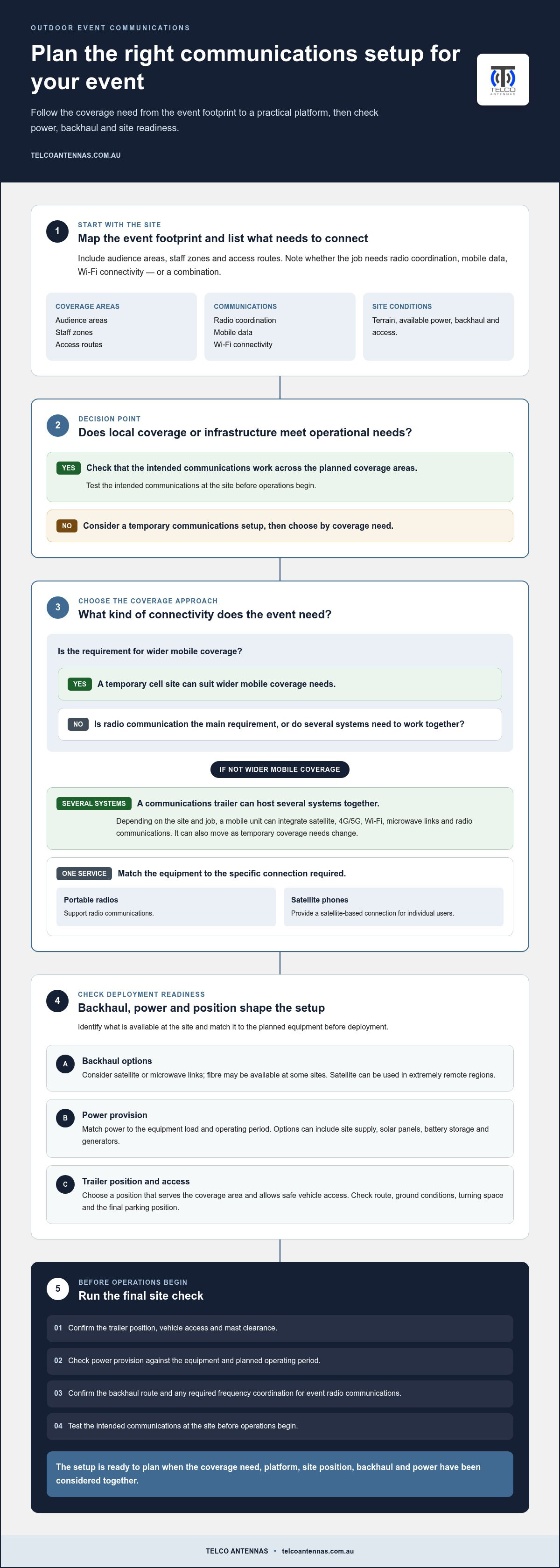
Organise event coverage as a sequence of practical decisions:
- Map the event footprint, including audience areas, staff zones and access routes.
- List communications needs, such as radio coordination, mobile data or Wi-Fi connectivity.
- Identify available backhaul and power options, then match them to the planned equipment.
- Choose a trailer position that serves the coverage area and allows safe vehicle access.
- Test the intended communications at the site before operations begin.
These steps reveal whether the requirement is local radio, broader data connectivity or both. A temporary cell site can suit wider mobile coverage needs, while a trailer can consolidate communications platforms and support changing locations. For a structured starting point, map the site’s communications requirements against its coverage zones, backhaul and operating needs.
Mobile communications trailers, skids and masts
Choose the platform according to how equipment must reach and operate at each location. A trailer suits sites where communications infrastructure needs to move between event areas or temporary work zones. It can be towed into position, then configured around the required connectivity. A skid is a transportable frame rather than a road trailer, while a mast provides a raised mounting point for communications equipment.
Trailer configuration depends on the mast and the systems it carries. Some communication trailers use articulated or pneumatic mechanisms to simplify mast deployment. Before selecting one, consider the ground, access route, position and required wireless links. Mobile units can combine satellite, 4G/5G, Wi-Fi, microwave and radio communications, so the platform should accommodate the equipment and connections needed at the site.
A skid can suit a location where forklift handling is available. Communication skid frames can accommodate additional solar panels and batteries, and forklift pockets support manoeuvrability. This arrangement can be useful when a unit needs to move around a work area without being towed between locations. Plan where the forklift can approach, place the skid and access its equipment without obstructing site operations.
A communications shelter is different: it is a permanent on-site structure that can house equipment and support extensive power requirements. For a temporary event, that fixed infrastructure may not suit a changing footprint. Compare the expected operating period, transport method, power arrangement and mast needs. If the site moves, a trailer or skid may fit better; if the equipment requires a fixed home, a shelter may be more appropriate. Match the platform to the deployment task, not simply the equipment list.
How far in advance should I book a communications trailer for an event?
There is no single booking lead time for every Australian event. The schedule depends on the communications design, trailer configuration, transport distance and site readiness. A straightforward setup with a prepared position differs from a remote event needing satellite backhaul, independent power or coverage across several areas.
Start planning once the event date and site layout are established. Share the coverage footprint, expected users, communications methods and operating hours. Include delivery access, the trailer’s final position, mast clearance and available power. These details help define the equipment configuration and identify site constraints before transport is organised.
Allow planning time for frequency coordination and system integration, particularly when radio communications must work alongside mobile data, Wi-Fi or satellite connectivity. Backhaul also affects preparation: a site with fibre access presents different requirements from one relying on microwave or satellite. Custom LTE trailers can be operational within hours, but that describes deployment after setup, not the time required to arrange an event configuration.
Use this sequence to organise the booking:
- Confirm the event date, venue access windows and coverage areas.
- List required services, such as staff radio, mobile connectivity and event Wi-Fi.
- Document site power, ground conditions, mast position and backhaul options.
- Set a delivery, deployment and testing window before event operations begin.
- Update the plan if the venue layout or communications requirements change.
For example, an event moving between separate paddocks needs a different coverage plan from one using a single central stage. Early site information gives the technical plan room to account for those differences. Plan your event connectivity requirements around the venue layout, backhaul and equipment needs.
Telco Antennas: Cel-Fi GO Mobile Signal Boosters
Telco Antennas supplies Cel-Fi GO Mobile Signal Boosters for projects where mobile signal coverage is part of the communications plan. If an event site has a usable mobile signal in some areas but needs a considered equipment setup, identify the coverage zones and signal requirements first. MIMO Antennas and LMR-400 Coaxial Cables can also form part of a suitable antenna system, while Point-to-Point Wireless Bridges address wireless links between locations.
These components serve different functions, so the right selection depends on the site layout and connectivity design. Share the event’s coverage needs and infrastructure plans to narrow down relevant equipment. Contact Telco Antennas to discuss the communications hardware for your project.
Turn your event requirements into a practical communications plan
Before arranging a mobile communications trailer for outdoor events, define the coverage areas, the systems people need to use and the site conditions that could affect connectivity. This gives you a clearer basis for deciding whether mobile signal equipment or a wider wireless link belongs in the plan.
Telco Antennas offers Cel-Fi GO Mobile Signal Boosters, MIMO Antennas and LMR-400 Coaxial Cables. These products address different parts of a communications setup, so the useful next step is to explain your site and intended use rather than start with a product name. That helps focus the discussion on relevant equipment for your requirements.
Contact Telco Antennas about your communications requirements and take the next planning step with a clearer view of the equipment involved.
Frequently Asked Questions
How Fast Can It Deploy and How Long Does It Run?
Some custom LTE trailers can be operational within hours, although travel and site preparation affect the overall schedule. Operating time depends on the equipment load and available power. Solar panels, battery storage and backup generators can support operation, with the configuration matched to the site’s communications equipment. For an event, plan the operating period alongside the power arrangement and the time needed to position and configure the trailer.
When Are They Used?
Communications trailers are used where fixed infrastructure is unavailable, unsuitable or temporarily out of service. An event might need coverage across a changing site, while a construction project may require connectivity before permanent infrastructure is ready. In mining, a trailer can support a temporary work zone or provide backup during a fixed-tower outage. The practical deciding factor is whether a relocatable platform suits the site’s changing communications needs.
What is a mobile communications trailer for outdoor events?
A mobile communications trailer for outdoor events is a transportable platform carrying communications equipment for temporary use at a venue. Its systems can support connectivity for event teams and operations, with a mast providing an elevated mounting point when the configuration requires one. It differs from portable radios, which are user-carried devices, and from a permanent communications shelter, which remains installed at a site.
What communications equipment and services can event trailers provide?
Depending on the system design, a trailer can bring together satellite, 4G/5G, Wi-Fi, microwave links and radio communications. These systems serve different purposes: backhaul connects the site to a wider network, while local Wi-Fi or radio supports on-site communications. For example, an event may need radio coordination for staff and a separate data connection for operational systems. The required mix depends on site coverage and equipment compatibility.
How much does it cost to hire a mobile communications trailer in Australia?
Hire cost depends on the trailer configuration, transport distance, deployment requirements and hire period. The communications system also affects the scope: a setup using satellite backhaul, additional power equipment or several coverage areas involves different requirements from a simpler installation. Provide the event location, operating schedule, site access details and required communications systems when seeking a hire price, so the proposed arrangement reflects the actual deployment.
Which Australian companies hire or supply event communications trailers?
Telco Antennas Pty Ltd supplies communications equipment and infrastructure, including mobile communication trailers, telescopic mast trailers and skids. Its range also includes Cel-Fi GO Mobile Signal Boosters, MIMO Antennas and LMR-400 Coaxial Cables. These supply options can help address different parts of a communications setup. For an event, distinguish equipment supply from trailer hire when defining what the project requires.


