
Yes, reliable mobile coverage for underground car parks can support voice calls and mobile data. A coverage system receives an existing mobile signal outside, amplifies it and distributes it indoors through antennas. It can help improve reception when an outside signal is available.
It’s frustrating when a call drops or an app stops loading as soon as you enter a basement. Concrete and steel can weaken radio signals, while internal walls, lift shafts and long corridors can create further dead zones. This can disrupt everyday communication, navigation and mobile services throughout the car park.
This article explains how underground coverage systems work, why voice and data rely on the same signal environment, and how distributed antennas can extend coverage through large or complex spaces. You’ll also learn which areas may need attention, from parking levels and travel routes to entry and exit points, so you can assess what a practical coverage solution needs to address.
Key Takeaways
- Concrete, steel and basement layouts can weaken reception, so identify where the signal drops before deciding how coverage should be distributed.
- Distributed antennas can extend voice and data coverage across larger or multi-level car parks by serving different areas from a connected system.
- Mobile reception supports more than calls: it can help with navigation, online activity and communication during emergencies.
- Plan coverage around practical use, including travel paths, lifts, stairwells and payment points, rather than focusing on a single location.
How To Get Mobile Signal In An Underground Car Park?
Mobile signal can weaken sharply below ground, even when reception is strong at street level. Building materials and the car park’s layout affect where a coverage system needs to distribute the signal.
Signal Loss From Concrete and Steel
Signal loss occurs when building materials absorb or obstruct radio-frequency energy travelling into a basement. Reinforced concrete combines dense material with steel bars, reducing the signal that reaches parking levels. Steel framing can add further obstruction, while foil insulation and energy-efficient glass can weaken signals around entrances. A phone may therefore lose reception in one section but connect elsewhere in the same car park.
How Boosters Distribute Mobile Signals
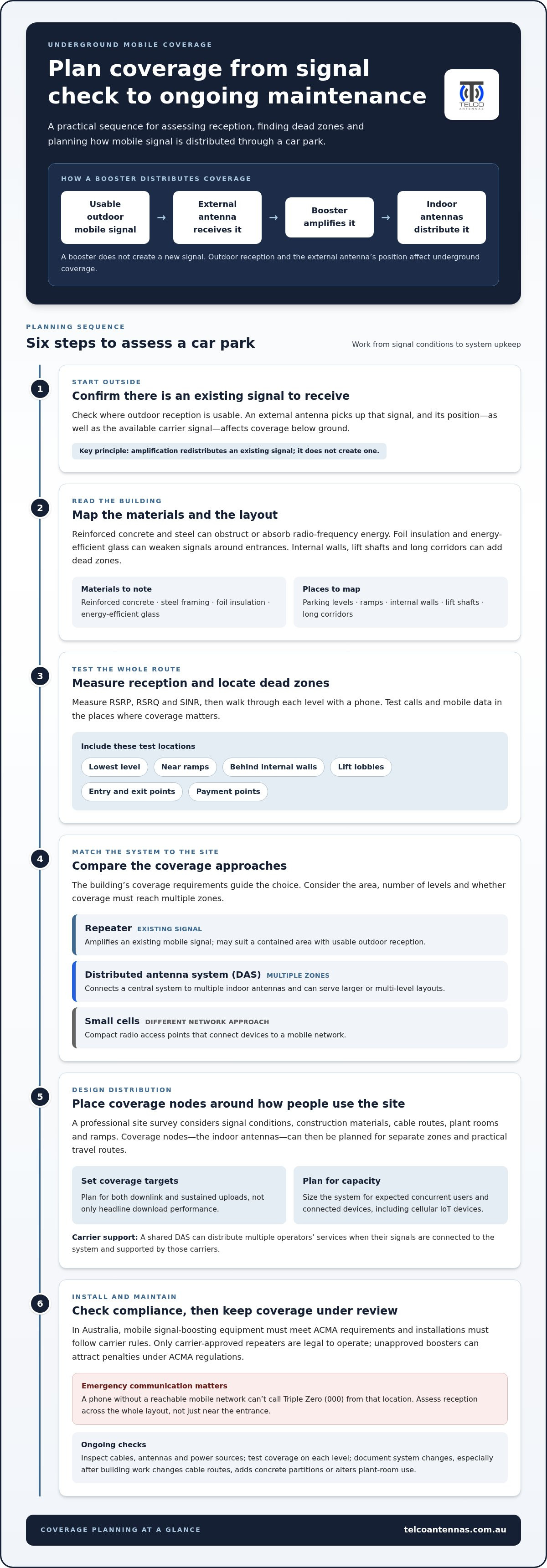
A mobile booster receives an existing network signal and rebroadcasts it inside the building. An external antenna picks up the signal where outdoor reception is usable, and the booster amplifies it. Internal antennas distribute the signal through the car park to support voice calls, SMS and mobile data. The system does not create a new signal, so the external antenna’s position and the available carrier signal affect coverage underground.
Comparing Repeaters, DAS and Small Cells
Repeaters amplify an existing mobile signal, while a distributed antenna system (DAS) carries coverage to multiple indoor antennas. Small cells are compact radio access points that connect devices to a mobile network. A repeater may suit a contained area with usable outdoor reception; a DAS can serve larger or multi-level layouts. Small cells use a different network approach, so the building’s coverage requirements guide the choice.
Checking Reception and Installation Legality
Measure RSRP, RSRQ and SINR, then walk through each level with a phone. Test calls and mobile data on the lowest level, near ramps and behind internal walls to locate dead zones. In Australia, mobile signal-boosting equipment must meet ACMA requirements, and installations must follow carrier rules. Only carrier-approved repeaters are legal to operate; unapproved boosters can attract penalties under ACMA regulations.
Distributed antenna systems for large underground areas
A distributed antenna system (DAS) connects indoor antennas to a central system, distributing mobile coverage across a wide area. It can suit multi-level car parks where a single targeted antenna would leave gaps.
Professional Design and Installation
Professional design maps the building’s signal environment, construction materials and layout before equipment is installed. A site survey helps identify how concrete, long cable routes, plant rooms and ramps affect coverage. Designers then plan antenna positions and system connections around the areas people use. This matters because a poorly placed antenna may serve one bay while leaving a lift lobby or lower level with weak reception.
Coverage Nodes, Targets and Costs
Coverage nodes are the indoor antennas that distribute the signal across separate zones. Position them according to the car park’s layout, including travel routes, levels and areas with heavier use. Set coverage targets for both downlink and sustained uploads, then size capacity for expected concurrent users and connected devices. Appropriate targets support calls and data without relying only on headline download performance.
System cost depends on the coverage area, number of levels, antenna locations, cable routes and carrier requirements. These factors determine equipment needs and installation complexity. A large basement with several plant rooms may need a different design from a compact, single-level site.
Carrier Support and Building Connectivity
Australian shared DAS coverage is organised around participating carriers. A shared system can distribute multiple operators’ services when their signals are connected to the system and supported by those carriers. One antenna network can then serve users on different mobile networks rather than limiting coverage to a single operator.
Mobile connectivity can also support building systems and IoT devices that rely on a cellular connection. For example, a connected device in a basement may need reception to send status information or communicate with a network service. Plan for these uses as well as visitor calls and data.
Ongoing Maintenance and Support
After installation, inspections can identify wear or damage affecting cables, antennas and power sources. Testing coverage on each level helps locate areas where performance has changed. Documenting system changes also makes future maintenance clearer, especially when building work alters cable routes, adds concrete partitions or changes how plant rooms are used.
Emergency calls, navigation and everyday communication
Mobile reception in an underground car park affects emergency communication as well as calls, navigation and online activity. A phone without a reachable mobile network can’t call Triple Zero (000) from that location.
In leased buildings, the party managing shared building infrastructure generally coordinates car park coverage; lease terms define responsibilities between owner and tenant. In strata properties, the owners corporation or body corporate manages common-property decisions, with responsibilities shaped by the strata arrangements. Clarifying who manages shared equipment helps avoid gaps between building operations and tenant needs.
For reliable mobile coverage for underground car parks, assess emergency access across the entire layout, not only near the entrance. Reception on one parking level does not establish coverage in a lower level, lift lobby or enclosed corner. Coverage in these areas can help visitors and staff make calls, contact family and continue online activities as they move through the building.
Emergency calling depends on a phone reaching a mobile network. In Australia, a mobile phone can use an available 4G or 5G network to make an emergency call, which can allow a single-operator coverage solution to support emergency calling. However, a dead zone with no reachable network prevents the call from connecting. Don’t treat ordinary phone bars at the entry as proof of coverage throughout the car park.
Use a structured coverage test to map weak areas: measure reception on the lowest parking level, then test travel routes, stairwells and lifts. Automated logging can record readings along those routes, helping operators compare zones and identify changes after building work. A coverage test assesses reception; it does not replace emergency procedures or prove that every call will connect.
A stable connection can help apps show directions to available parking spaces. If reception drops near a payment point or exit reader, mobile payments and access authentication may be disrupted. Mapping these practical locations alongside emergency routes gives building managers a clearer picture of where coverage matters day to day.
Coverage solutions for underground car parks and basements
In Australian underground car parks, available coverage depends on which mobile networks reach the site and how indoor systems distribute them. A designed system can extend supported carrier signals through basement areas, but its coverage needs to suit the building’s layout and service requirements.
Start with a coverage map of every level, not just the entrance. Internal walls, lift shafts, plant rooms and long corridors can create dead zones along everyday routes. Mark entry and exit readers, payment kiosks, stairwells and areas where attendants use mobile devices. This gives the design a practical footprint rather than a single antenna location.
For multi-operator service, plan coverage across the places people and devices move: parking aisles, ramps, lifts and payment points. Carrier participation and the signals connected to the system determine which networks it can distribute. A system serving one operator will not automatically provide service to customers using another network, so operator requirements shape the design.
Match the solution to the car park’s size and operating needs. A targeted booster may suit a defined weak area where a usable external signal exists. Larger or multi-level basements may need distributed antennas to reach separate zones. Plan for voice and data, with performance expectations based on actual use, such as calls between levels or data at an exit reader.
After installation, test coverage at each marked point and along travel routes. Record weak locations and retest them after building work or equipment changes. This helps managers determine whether a gap is localised or affects a wider section, and whether antenna placement or system configuration needs attention.
For a site-specific assessment of underground coverage needs, discuss your car park’s coverage requirements.
Telco Antennas: Cel-Fi GO Mobile Signal Boosters
Telco Antennas supplies Cel-Fi GO Mobile Signal Boosters for sites where improving an existing mobile signal is the practical next step. They may suit a defined coverage area with usable reception outside, while a large, multi-level car park may need a distributed antenna system instead.
Choosing equipment depends on the car park layout, signal conditions and areas requiring coverage. Telco Antennas also offers MIMO Antennas and LMR-400 Coaxial Cables, which form part of its available communications hardware. These offerings support planning around the site’s requirements without assuming that one booster will cover every basement level or carrier.
Contact Telco Antennas to discuss coverage requirements for your underground car park.
Plan the next coverage step
Planning reliable mobile coverage for underground car parks starts with a clear brief: which areas need service, which networks matter and how people use the space. Record priority locations such as payment points, access routes and staff work areas, and note planned building changes that could affect future coverage.
This gives the coverage discussion a practical starting point and helps distinguish a localised reception problem from a broader site requirement. Telco Antennas offers Cel-Fi GO Mobile Signal Boosters, MIMO Antennas and LMR-400 Coaxial Cables as communications hardware options. The right configuration depends on the car park’s signal conditions and coverage objectives.
Share your site’s requirements with Telco Antennas to discuss a suitable next step. A well-defined plan makes it easier to move towards coverage that fits the building and its everyday needs.
Frequently Asked Questions
Do coverage systems work for both voice and data?
Yes, a mobile coverage system can support voice calls and mobile data through the same network signal. For example, a visitor can make a call while another user loads a parking app, provided their carrier’s service is included. Data performance also depends on available capacity and demand, so planning should account for simultaneous users, not just whether a phone displays reception.
How do I know which solution is right for my building's basement?
Match the system to the site’s footprint, signal conditions and areas needing service. A booster can suit a defined zone with usable signal outside, while a multi-level basement with separated parking areas may need distributed antennas. A single weak corner is different from coverage gaps across several levels. Include carrier requirements and expected device use in the assessment.
Ready to turn the dead zone into an advantage?
Start by defining what the basement needs connectivity to support. List practical uses, such as staff coordination, mobile payments, visitor calls or connected building devices, then mark where each takes place. This turns a general reception complaint into a coverage brief. For example, if payment readers lose connection at the exit, prioritise that location alongside routes used by staff.
What can affect my mobile experience?
Your mobile experience can vary with building materials, distance from a cell tower, surrounding terrain, carrier coverage and the basement layout. A phone may work near a ramp but struggle behind a lift shaft or internal wall. Device capability and the number of people using the network at once can also affect data responsiveness, even when reception is present.
What solutions improve mobile coverage in underground car parks in Australia?
Options include a carrier-approved mobile signal booster for a defined area or a distributed antenna system for broader, multi-level coverage. The right design depends on outdoor signal, the operators to be served and where users need connectivity. In Australia, mobile signal-boosting equipment must meet ACMA requirements, and installations must comply with carrier rules. Unapproved repeaters are not legal to operate.
How much does it cost to install mobile coverage in an underground car park in Australia?
Installation cost depends on the car park’s size, number of levels, required coverage zones, antenna positions, cable routes and carrier arrangements. A contained area and a complex basement need different equipment and design work. Capacity requirements and access to installation locations also shape the project scope. Define coverage requirements first, then request a project-specific cost from Telco Antennas.


