

The business case for upgrading company vehicle antennas is strongest when the current setup limits fleet connectivity or contributes to interference between vehicle systems. A well-matched antenna system can support the connections vehicles need and help manage interaction between radio equipment.
A vehicle’s existing antenna may keep working as connectivity demands change, but added equipment and new uses can expose limits in the installation. The right upgrade depends on the vehicle, its radios and the signals the fleet needs to receive or transmit.
Antenna choice and installation can affect interference, while mobile data, Wi-Fi and positioning needs may warrant a review. To assess an upgrade, start with the actual connectivity problem and operational requirements, rather than changing hardware for its own sake.
Key Takeaways
- Match antenna capability to the fleet’s actual connectivity needs, from mobile data to positioning, rather than upgrading by default.
- Assess upgrade costs by considering the vehicle, antenna configuration and installation requirements; avoid judging the decision on hardware price alone.
- Compare an upgraded antenna with the OEM setup against the operating environment and required coverage, not just the equipment label.
- Link connectivity improvements to practical fleet outcomes, such as fewer interruptions and more reliable access to operational data.
2. Vehicle connectivity use cases
Fleet vehicles can carry several radio systems for different operational tasks. Wi-Fi 6 and Wi-Fi 7 antennas support in-vehicle hotspots and data offloading. A crew might use a hotspot for work devices while vehicle data transfers. Each connection has its own frequency and antenna requirements. Planning the layout helps limit unwanted interaction between systems.
For cloud connectivity, infotainment and vehicle teleoperation, automotive antennas support 5G NR and LTE. Software-defined vehicles may use 4×4 or 8×8 MIMO configurations to increase 5G throughput. MIMO uses multiple antenna paths to transmit and receive data. The vehicle’s equipment and intended use determine which configuration is relevant. This makes the required antenna arrangement a practical design consideration.
Vehicle-to-everything (V2X) communication is another use case. It supports safety-critical communication where extremely low latency matters. Precise GNSS positioning can support advanced driver-assistance and autonomous functions. These applications depend on receiving positioning signals effectively. Antenna placement and the surrounding vehicle structure can affect how signals reach the receiver.
Ultra-wideband (UWB) antennas can support secure digital keys and in-cabin localisation. A single vehicle may need antennas for sub-6 GHz, mmWave, UWB and satellite to operate simultaneously. Those systems occupy different frequency ranges and serve distinct tasks. A fleet specification should therefore start with the functions each vehicle actually needs, then account for how systems will fit together.
For a fleet manager, the useful step is to map each use case to its radio system. A vehicle carrying mobile data equipment may prioritise 5G NR, LTE and Wi-Fi. A vehicle using digital keys may also need UWB, while positioning-dependent functions may require GNSS. This inventory helps identify where an antenna upgrade could address a real connectivity need, rather than adding hardware without an operational purpose.
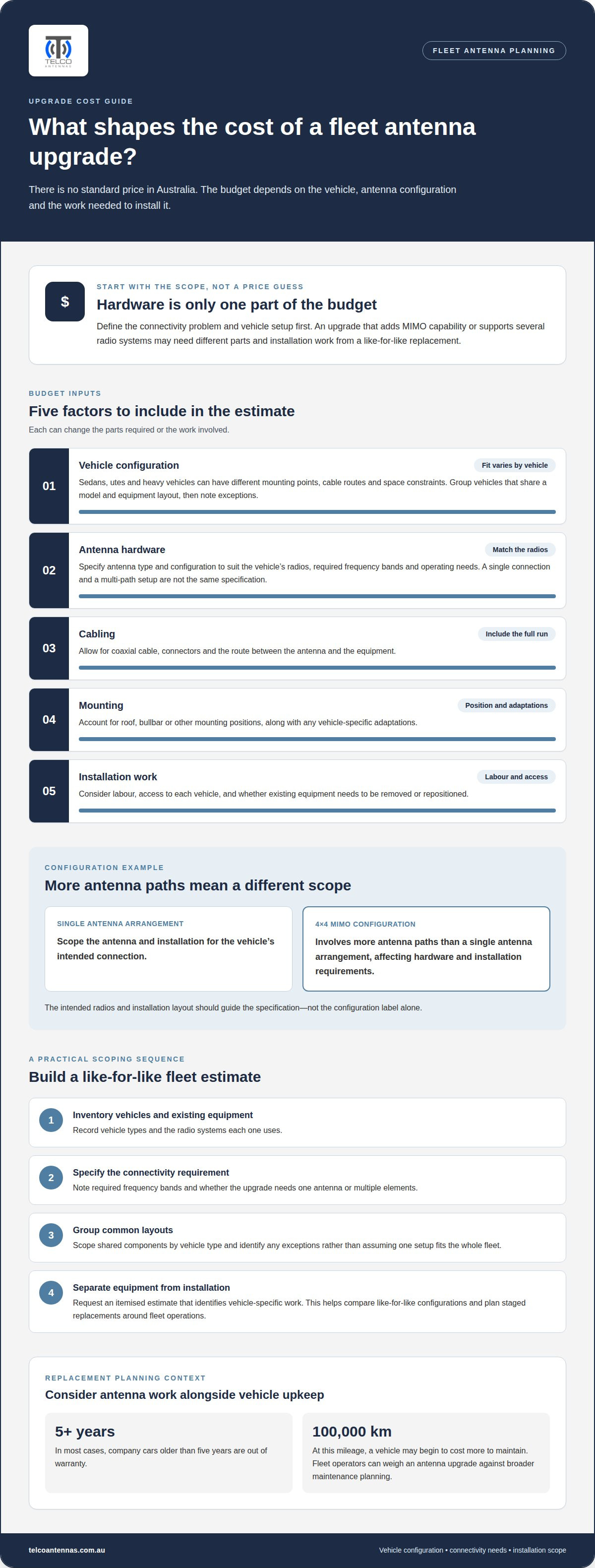
In most cases, company cars older than five years are out of warranty, making connectivity upgrades a consideration alongside vehicle age and operational needs.
3. How much does it cost to upgrade fleet vehicle antennas in Australia?
There is no standard cost for upgrading fleet vehicle antennas in Australia. The budget depends on antenna type, vehicle configuration, cabling, mounting requirements and installation work. A like-for-like replacement may require different parts from an upgrade that adds MIMO capability or supports several radio systems. Define the connectivity problem and vehicle setup first to scope the work.
Start with the fleet’s vehicle types and existing equipment. A sedan, ute and heavy vehicle can have different mounting points, cable routes and space constraints. Record the radios each vehicle uses, the required frequency bands and whether the upgrade needs one antenna or multiple elements. A 4×4 MIMO configuration, for example, involves more antenna paths than a single antenna arrangement, affecting hardware and installation requirements.
- Hardware: Match antenna type and configuration to the vehicle’s radios and operating needs.
- Cabling: Include coaxial cable, connectors and the cable route between antenna and equipment.
- Mounting: Account for roof, bullbar or other mounting positions and any vehicle-specific adaptations.
- Installation: Consider labour, access to the vehicle and whether existing equipment must be removed or repositioned.
For a multi-vehicle rollout, scope costs by vehicle type rather than assuming one setup fits the fleet. A vehicle with one mobile data connection may need a different configuration from one supporting several simultaneous services. Group vehicles that share a model and equipment layout to identify common components and exceptions.
Ask for an itemised estimate that distinguishes equipment from installation and identifies any vehicle-specific work. This makes it easier to compare like-for-like configurations and plan staged replacements around fleet operations. A MIMO antenna configuration may suit vehicles requiring multiple data paths, but the intended radios and installation layout should guide the specification.
For replacement planning, consider mileage alongside antenna requirements. At 100,000 kilometres, a vehicle may begin to cost more to maintain, so fleet operators can weigh antenna upgrades against broader maintenance planning and decide whether to coordinate the work with other vehicle upkeep.
3. How do upgraded vehicle antennas compare with standard OEM antennas for coverage and reliability?
A standard OEM antenna is selected for the vehicle’s original equipment and intended radio functions. An upgraded antenna can be specified for additional equipment or a different operating requirement. For example, a fleet vehicle using LTE for dispatch data may need a different configuration from one carrying several radio systems. The value lies in matching the antenna to those systems, not simply replacing the factory part.
Coverage depends on more than the antenna itself. Vehicle bodywork, mounting position, cable condition and the surrounding terrain all affect the signal path. A roof-mounted antenna may have a clearer path than one obstructed by equipment or metalwork. In regional Australia, hills, buildings and distance from network infrastructure can also affect mobile reception. An upgraded antenna cannot create network coverage where none exists.
Reliability depends on the complete installation. A suitable antenna connected to damaged coaxial cable or poor terminations may perform below its potential. Compare OEM and upgraded setups under the same operating conditions. Record signal levels, connection drops and data performance on routes where crews regularly work. Testing the same locations makes the comparison more useful than relying on a single reading.
- Check compatibility: Match the antenna’s supported frequencies to the vehicle’s LTE, 5G or other radio equipment.
- Review placement: Consider roof space, nearby antennas, vehicle height and physical obstructions.
- Inspect the signal path: Check coaxial cable routing, connectors and equipment connections.
- Compare in service: Assess connection stability on the fleet’s usual urban, regional and remote routes.
An upgraded antenna is most useful when testing identifies a specific limitation, such as poor reception with the existing setup or new radio requirements. If the OEM antenna supports the vehicle’s equipment and delivers the required connection, replacement may offer little operational benefit. Weigh actual fleet performance, installation condition and intended use before approving a change.
4. What productivity gains or cost savings can better vehicle antennas deliver for Australian fleets?
Better connectivity can reduce interruptions to work that depends on vehicle data. For example, a field technician may need to upload a completed job report before leaving a customer site. If the connection repeatedly drops, the upload may need to be retried or completed later. A well-matched antenna can support the connection, provided network coverage and the vehicle’s equipment also support the task.
For dispatch teams, stable data access can help crews receive job updates while travelling between sites. Vehicles sending location or diagnostic information can also keep operational records current. Practical benefits may include fewer connectivity-related delays, less manual re-entry and fewer follow-up calls to resolve missing information. These gains depend on the fleet’s workflow, not antenna hardware alone.
Build the business case on operating evidence, not assumed savings. Before an upgrade, record where connection problems occur and how they affect work. Track failed uploads, delayed job updates, repeat data entry and time spent troubleshooting. Compare the same measures after installation across similar vehicles and routes. This helps distinguish antenna-related changes from differences in workload or network conditions.
- Choose a baseline: Record recurring connectivity failures and the work they interrupt.
- Measure operational impact: Note delays, repeat tasks and staff time linked to each issue.
- Compare like with like: Use the same routes, vehicle types and work processes before and after.
- Review the result: Check whether fewer interruptions justify the upgrade and its ongoing requirements.
Cost savings can come from avoiding repeat work or reducing time spent resolving connection problems. They shouldn’t be assumed in advance. A vehicle operating outside reliable network coverage may still experience interruptions, whatever antenna it uses. The strongest case is where records show a recurring issue that a suitable antenna configuration can address. For fleets assessing data throughput, review MIMO antenna options against the vehicles’ equipment and work requirements.
Telco Antennas: Cel-Fi GO Mobile Signal Boosters
Telco Antennas supplies Cel-Fi GO Mobile Signal Boosters for fleets assessing mobile connectivity in vehicles. They may suit situations where crews encounter weak mobile signal during normal operations and need to review their vehicle equipment. The appropriate setup depends on the radios in use, antenna arrangement and operating environment.
For vehicles using multiple data paths, MIMO Antennas may be relevant to the system design. LMR-400 Coaxial Cables are also available for radio-frequency connections. Start by identifying where signal problems affect work, which vehicles experience them and what equipment each vehicle carries. That information helps frame the technical requirements for a suitable antenna or booster solution without assuming one configuration fits every vehicle.
To discuss vehicle connectivity equipment for your fleet, contact Telco Antennas.
Make the next fleet upgrade a considered one
A sound business case for upgrading company vehicle antennas starts with a clear fleet standard, not a blanket replacement decision. Document the antenna, cable routing and connected equipment for each vehicle configuration. This gives fleet managers a practical reference when vehicles change roles, radio equipment is added or connectivity issues recur.
Use the standard to guide future procurement and installation planning. If vehicle types have different equipment or mounting arrangements, document those differences instead of forcing one setup across both. This keeps the specification tied to operational needs and makes later reviews easier to manage.
Telco Antennas can help you consider equipment options for your fleet’s connectivity requirements. Discuss your vehicle antenna upgrade with Telco Antennas and take the next step with a clearer technical direction.
Frequently Asked Questions
What are the business benefits of upgrading antennas on company vehicles in Australia?
The business case for upgrading company vehicle antennas is strongest when a change supports a defined fleet requirement. Vehicles assigned to remote inspections, for example, may need connectivity equipment suited to their communications tasks and routes. A consistent specification for vehicles with similar roles can also simplify future procurement and asset records.
What are the risks of upgrading vehicle antennas, including compatibility, damage, and warranty issues?
Match the antenna’s supported frequencies to the vehicle’s radios and inspect cable routing, connectors and terminations; damaged coaxial cable or poor connections can reduce performance. The material gives no specific rule about whether an antenna upgrade affects a vehicle’s warranty.
What installation steps and downtime are involved in upgrading fleet vehicle antennas?
Installation may involve routing coaxial cable, fitting or adapting a mount, and removing or repositioning existing equipment. Allow for labour and vehicle access, and consider staged replacements around fleet operations; no downtime duration is provided.


