
Is the frustration of a dropped call in the middle of a critical work day really an unavoidable part of living in regional Australia? Many residents and remote workers have come to accept poor connectivity as a geographical reality, yet the technical gap between a dead zone and a high speed connection is often just a matter of the right hardware. Deploying a cel fi go system offers a professional solution to these mobile black spots, providing up to 100dB of signal gain when configured with precision. As the only consumer repeater category authorised by the ACMA, it remains the essential choice for those requiring a legal, carrier approved boost to their mobile reception without risking network interference.
You likely understand that a standard off the shelf approach rarely suffices when dealing with the vast distances and topographical challenges of the Australian landscape. This guide promises to help you master the technical requirements for a professional grade installation, ensuring you achieve crystal clear voice calls and stable 4G or 5G data throughput. We will step through the mechanical nuances of selecting high grade MIMO antennas and low loss LMR-400 cabling, providing a clear path to a compliant and high performing mobile environment that works when you need it most.
Key Takeaways
- Understand why the Cel-Fi GO is the only ACMA-exempt consumer repeater and how the IntelliBoost chipset ensures your installation remains network-safe.
- Discover the engineering principles behind achieving a 100dB signal gain, including the critical role of echo cancellation in preventing system oscillation.
- Determine the correct hardware for your specific use case by comparing the stationary G41 building unit with the ROAM R41 mobile solution for vehicles and marine vessels.
- Learn how to optimise your RF signal chain by selecting high-performance MIMO antennas and low-loss LMR-400 coaxial cabling to minimise signal attenuation.
- Explore the necessity of professional RF site surveys and communication tower design when deploying connectivity solutions in complex or highly remote topographical environments.
Understanding the Cel-Fi GO System for Australian Mobile Networks
The cel fi go is engineered as a carrier-class smart signal repeater, a designation that distinguishes it from the wide array of illegal wideband amplifiers found on the grey market. Unlike those devices, which blindly amplify all incoming frequencies and often cause destructive interference within a cellular network technology framework, the Cel-Fi system utilises a sophisticated IntelliBoost chipset. This processor continuously monitors the surrounding RF environment and adjusts its output in real-time to ensure it remains unconditionally network safe. In regional Australia, where distances to base stations are vast, this intelligent processing allows the unit to distinguish between usable signals and background noise, effectively processing 3G, 4G, and 5G bands to maintain a stable connection even in marginal conditions.
The Legal Landscape: ACMA Compliance and Carrier Approval
Using an unapproved mobile booster in Australia isn't just a technical risk; it's a legal one that can result in significant fines under the Radiocommunications Act. The Australian Communications and Media Authority (ACMA) strictly regulates repeaters because poorly designed hardware can "noise up" a local tower, effectively shutting down service for everyone in the vicinity. Cel-Fi remains the only consumer-installable repeater category exempt from these prohibitions because its firmware is locked to specific carriers like Telstra, Optus, or Vodafone. If you're deploying a system, it's vital to ensure you're using Australian-spec hardware configured for your specific provider, as this ensures the device communicates correctly with the local infrastructure and adheres to strict emission standards.
The 100dB Advantage: Why Gain Matters
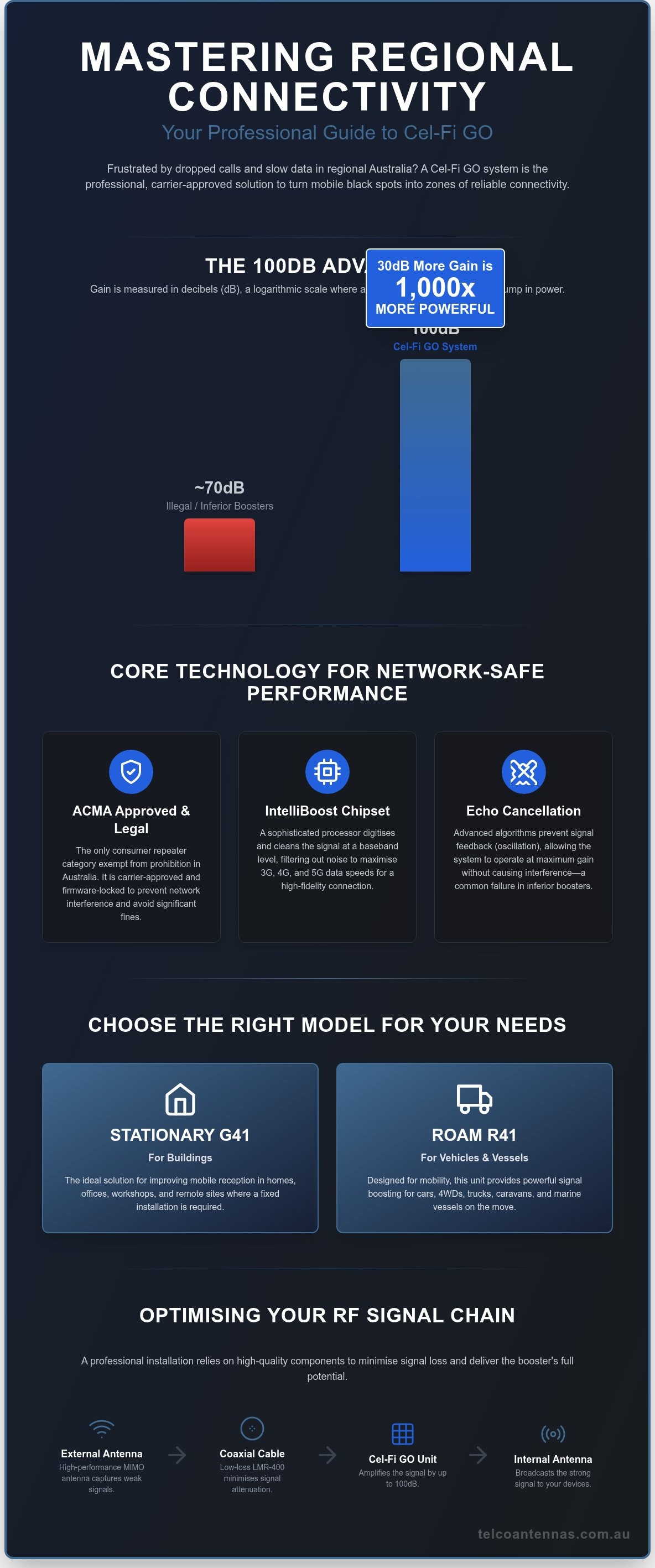
The primary performance metric for any repeater is its gain, measured in decibels (dB). While many inferior or illegal products offer a modest 60 to 70dB of gain, a cel fi go provides up to 100dB, which represents a monumental difference in real-world performance. Because the decibel scale is logarithmic, every 3dB increase represents a doubling of power; therefore, a 30dB advantage means the Cel-Fi system is effectively 1,000 times more powerful than a 70dB alternative. This massive overhead is what allows the system to capture a faint, distant signal and amplify it sufficiently to cover a large building or vehicle interior. Signal gain is the measure of a system's ability to increase the power of a received mobile signal to overcome the path loss caused by distance and physical obstructions in the Australian terrain.
The Engineering Behind 100dB Signal Gain and Echo Cancellation
Achieving a 100dB gain is a significant engineering feat because of the inherent risk of feedback. If a repeater amplifies a signal and then re-captures that same amplified signal via the donor antenna, it creates a loop known as oscillation. This is effectively the RF equivalent of holding a microphone too close to a speaker. To prevent this, the cel fi go employs advanced echo cancellation algorithms that subtract the system's own transmitted signal from the received input. This allows the device to operate at much higher gain levels than traditional wideband boosters, which are often limited by ACMA regulations on cellular repeaters to much lower power outputs to prevent network damage.
IntelliBoost Chipset: The Brain of the Booster
At the core of every cel fi go unit is the IntelliBoost chipset. This processor doesn't just amplify a signal; it digitises and cleans it at the baseband level. By filtering out out-of-band noise and focusing strictly on the designated carrier's frequencies, the chipset ensures the boosted signal is high-fidelity. This precision directly impacts data throughput and latency. If the signal-to-noise ratio (SNR) is poor, your 4G or 5G speeds will suffer regardless of the signal bars displayed. The IntelliBoost system effectively manages this balance, ensuring the amplified output is as clean as possible for the end user's device. This processing efficiency is what allows the hardware to maintain stable connections in areas where the raw outdoor signal is almost unusable.
Managing Signal Oscillation in Small Deployments
Oscillation remains the most common challenge in small-scale installations, such as 4WDs or small cabins, where physical separation between the internal and external antennas is limited. Isolation is the technical term for this separation. If the system detects that the antennas are too close, the Automatic Gain Control (AGC) will automatically reduce the gain to prevent a feedback loop. While this keeps the system running, it reduces the effective coverage area. The AGC doesn't just protect your local hardware; it's a vital safeguard for the macro network. By constantly adjusting the uplink power, the system ensures it only transmits the minimum signal required to reach the base station. This prevents the booster from "blasting" the tower with excessive noise, which is a common failure point in cheaper, non-intelligent amplifiers.
You can monitor these metrics in real-time using the Nextivity Wave App, which provides diagnostics on gain and isolation. If you see a "red light" error or low gain figures, it's usually a sign that you need to increase the physical distance or add RF shielding between your antennas. Achieving the perfect balance between high gain and system stability often requires specific hardware configurations. If you're struggling with isolation issues, consulting the technical specifications of high-performance antenna kits can provide the necessary physical separation for a stable 100dB deployment.
Choosing Between Stationary and Mobile Deployments
Selecting the appropriate cel fi go hardware depends entirely on your operational environment and available power infrastructure. For fixed structures such as regional homesteads, commercial offices, or metal-clad sheds, the Cel-Fi GO G41 serves as the primary engineering choice. In contrast, for assets in motion, the Cel-Fi ROAM R41 is designed to handle the unique stresses of the Australian outback. Both systems utilise the 100dB gain technology previously discussed, but their physical housings and power management systems are tailored to different mechanical demands. The G41 typically utilises 240V AC power for permanent sites, while the R41 is built for 12V DC vehicle integration, ensuring the unit remains functional during transit across remote regions.
G41 Stationary Kits for Homes and Offices
The G41 is a high-capacity solution designed for fixed-site deployments where multiple users require simultaneous 3G, 4G, or 5G connectivity. In many regional Australian buildings, metal roofing or foil-backed insulation creates a shielding effect that prevents external signals from penetrating the interior. By installing a donor antenna on the roof and the G41 unit inside, you can bypass this physical barrier. This model is particularly effective for large homesteads or multi-storey offices where signal distribution needs to be consistent across several rooms. If your property already features an ethernet backhaul or a Wi-Fi mesh system, the G41 can be integrated to ensure mobile reception is as reliable as your fixed internet connection.
ROAM R41 for the Australian 4WD and Caravan Market
The ROAM R41 addresses the specific challenges of the mobile market, including 4WDs, caravans, and marine vessels. This unit is ruggedised to withstand the constant vibrations and corrugations of unsealed roads, as well as the extreme ambient temperatures found in the Kimberley or the Red Centre. Unlike stationary units, the R41 must manage constant signal handover as the vehicle moves between different base stations. This requires a specific antenna strategy; while a fixed house might use a directional Yagi antenna, a vehicle requires a ruggedised omnidirectional bullbar mount or a low-profile radiator that can withstand foliage strikes. Using unapproved hardware in these sensitive remote environments is a serious risk, as the penalties for illegal boosters are substantial and enforced by the ACMA. The R41 provides a legal, carrier-approved way to maintain a safety link when you are far off the beaten track in national parks or remote stations.
Environmental protection is another critical variable. The R41 and G41 feature robust IP ratings to protect internal circuitry from dust ingress and moisture. When planning your installation, consider that the R41 is specifically tested for mechanical shock, making it the superior choice for any application involving movement. If you are unsure which unit suits your specific topography, a professional RF evaluation can determine the best hardware and antenna combination for your needs.
Optimising Your RF Chain: Antennas, Cabling, and Placement
The performance of a cel fi go system is fundamentally limited by the quality of the RF chain. While the booster unit provides the intelligence and gain, the external antenna and the cabling connecting it to the hardware are the primary variables that determine whether you achieve a usable connection or a failed deployment. A system engineering approach requires calculating the total system loss, which is the sum of signal attenuation through cables and connectors subtracted from the antenna's raw gain. If you use poor-quality components, you can easily lose 10dB or more of signal before it even reaches the booster, effectively reducing your coverage area by orders of magnitude.
Selecting High-Gain MIMO Antennas
Antenna selection must be matched to your specific location and the available cellular infrastructure. In fixed rural installations where the tower location is known, a directional Yagi or parabolic grid antenna is preferred because it focuses energy in a narrow beam, providing maximum gain. For mobile deployments on a 4WD or caravan, an omnidirectional whip antenna is necessary to maintain a connection as the vehicle's orientation changes relative to the tower. To achieve the highest possible data speeds on 4G and 5G networks, you should utilise MIMO (Multiple Input Multiple Output) antennas. These systems use multiple spatial streams to transmit more data simultaneously, which is essential for remote work or high-bandwidth applications. Elevating the donor antenna is critical for maintaining a clear Fresnel zone, particularly in flat Australian landscapes where ground-based reflections can otherwise degrade signal quality.
The Importance of LMR-400 Low-Loss Coaxial Cable
One of the most common mistakes in Australian signal booster installations is the use of standard RG-58 coaxial cable for long runs. RG-58 is acceptable for low-frequency CB radios, but at the high frequencies used by 4G and 5G networks (1800MHz to 3500MHz), it suffers from extreme signal attenuation. For any run exceeding five metres, LMR-400 low-loss coaxial cable is the industry standard. LMR-400 features superior shielding and a thicker core, which preserves the integrity of the faint signals captured by your antenna. For example, over a 10-metre run at 2100MHz, LMR-400 might lose only 2.2dB, whereas cheaper cables could lose over 6dB. This 4dB difference might seem small, but it represents a significant loss in the system's ability to reach the 100dB gain potential of the cel fi go.
Proper connector termination is equally vital to prevent moisture ingress, which is a major cause of system failure in humid or coastal Australian environments. Using N-type connectors with weatherproofing kits ensures that the connection remains electrically stable over years of exposure to UV and rain. You can find high-performance LMR-400 cable assemblies and MIMO antennas designed specifically to minimise attenuation and maximise the output of your Cel-Fi system.
Professional Deployment and RF Engineering for Remote Sites
Professional deployment of a cel fi go system in industrial or remote commercial environments requires a shift from simple installation to rigorous RF engineering. While a residential kit might solve a single-room issue, large-scale sites or remote camps face complex variables like multi-path interference and extreme path loss. Achieving reliable connectivity in these locations involves designing custom communication towers to secure a clear line-of-sight to the nearest base station. For temporary sites or rapid-response requirements, telescopic mast trailers and skids provide a mobile yet stable platform that can be deployed within hours to establish a network footprint where none previously existed.
RF Site Surveys: Measuring RSL and SINR
Relying on the signal "bars" displayed on a handset is an insufficient method for professional deployments. A thorough RF site survey measures precise metrics such as Received Signal Level (RSL) and Signal-to-Interference-plus-Noise Ratio (SINR). These values allow a technician to identify the optimal donor tower by analysing frequency and bearing data rather than simply aiming at the closest geographic station. By utilising RF modelling software, we can predict the coverage area across a site before any hardware is permanently fixed, ensuring that the gain potential of the cel fi go is distributed where it is most needed.
Custom Infrastructure: Masts, Skids, and Solar Power
Off-grid locations often lack the 240V AC power required for standard stationary units. In these scenarios, the system must be integrated with solar and battery kits to ensure 24/7 uptime. Lightweight mounting solutions, such as aluminium tri-pods or skids, allow for rapid deployment on varied terrain without the need for heavy concrete footings. If your project involves complex topography or requires a bespoke communication tower design, consulting with Telco Antennas provides access to specialised RF engineering solutions that are tailored to the Australian environment. As we move through 2026, future-proofing these installations for the ongoing 5G band rollouts is essential to ensure your infrastructure remains relevant as network operators transition away from legacy frequencies.
Securing Reliable Connectivity in Regional Australia
Transitioning from a state of constant connectivity loss to a stable, high-performance network requires more than just a booster; it demands a system-engineering approach. You've seen how the 100dB gain of the cel fi go provides the necessary power to overcome the vast distances of the Australian landscape, provided it's supported by a high-quality RF chain. Selecting the correct hardware, whether it's the stationary G41 or the mobile R41, ensures that your deployment is both ACMA-compliant and technically sound for your specific environment.
The difference between a failed installation and a successful one often comes down to the quality of the components and the precision of the initial site survey. By prioritising high-performance LMR-400 cabling and expert antenna placement, you can effectively eliminate mobile black spots and prepare your infrastructure for the ongoing transition to 5G. If you're ready to implement a robust solution for your homestead, vehicle, or remote industrial site, you can enquire about a professional Cel-Fi GO deployment with Telco Antennas. Our team provides specialist RF engineering support and maintains an extensive inventory of ACMA-compliant hardware and high-performance cabling to ensure your connection remains stable when it matters most. Reliable communication is achievable even in the most challenging terrains with the right technical partner.
Frequently Asked Questions
Is the Cel-Fi GO legal to use in Australia?
Yes, the cel fi go is legal to use in Australia and is currently the only consumer-installable mobile repeater category authorised by the ACMA. It is exempt from the general prohibition on repeaters under the Radiocommunications Equipment (General) Rules 2021. This exemption is granted because the device is engineered to be unconditionally network safe, ensuring it does not interfere with the mobile carrier's base station infrastructure.
Can I use a Cel-Fi GO for both Telstra and Optus at the same time?
No, a single unit can only amplify the signal of one carrier at a time. While the hardware is capable of supporting Telstra, Optus, or Vodafone, you must select the desired carrier via the Nextivity Wave App. If your site requires simultaneous coverage for multiple networks, you will need to deploy a separate booster for each specific carrier.
Do I need a professional to install my Cel-Fi GO?
While many users successfully perform a self-installation using pre-packaged kits, professional installation is recommended for complex residential or commercial sites. A specialist technician can conduct an RF site survey to identify the optimal donor tower and ensure sufficient antenna isolation. This professional approach prevents the system from automatically reducing its gain, which is essential for achieving the maximum 100dB signal boost.
What is the difference between the G41 and the R41 ROAM?
The difference is found in the mechanical design and power requirements of each unit. The G41 is a stationary system designed for fixed buildings, utilising 240V AC power and offering high-capacity throughput for multiple simultaneous users. The ROAM R41 is a ruggedised mobile unit designed specifically for 4WDs, caravans, and marine vessels, featuring a 12V DC power supply and internal components tested against extreme vibrations and heat.
How much cable can I run between the antenna and the booster?
The permissible cable length is determined by the signal frequency and the grade of the coaxial cable. Using high-performance LMR-400 low-loss cable allows for runs of 10 to 20 metres while maintaining signal integrity. If you utilise lower-grade cables like RG-58, the signal attenuation over long distances will likely negate the gain provided by the cel fi go, particularly on high-frequency 4G and 5G bands.
Will a Cel-Fi GO work if I have zero bars of signal outside?
No, the system requires a usable source signal to function. A signal booster acts as an amplifier rather than a signal generator; it cannot create a connection where no signal exists. If you have zero bars of reception on your roof or at the highest point of your property, the booster will have no input to process. In these scenarios, a taller communication tower or a higher-gain directional antenna may be required to reach a distant tower.
Does the Cel-Fi GO support 5G in regional Australia?
Yes, the latest G41 and ROAM R41 models are 5G compatible and support 5G NR (New Radio) bands. This ensures your installation is future-proofed as Australian carriers continue to migrate their networks. However, the ability to boost 5G depends on whether your specific carrier has deployed 5G infrastructure within range of your donor antenna.
Can I use my existing TV antenna with a Cel-Fi booster?
No, television antennas are incompatible with mobile signal boosters. TV antennas are designed for different frequency ranges and typically operate with a 75-ohm impedance. Mobile boosters require 50-ohm antennas specifically tuned to cellular frequencies between 700MHz and 3500MHz. Attempting to use a TV antenna will result in a severe impedance mismatch and could cause permanent damage to the booster's RF front-end.
More Articles

Cambium cnWave 60 GHz vs licensed microwave link: a 2026 cost comparison

GME Antenna Spring Base vs RFI Heavy Duty Spring Base: Which Is More Durable?
