
Operating an unapproved mobile signal booster in Australia can result in a fine of up to $728,000, even if you're simply trying to fix a dropped call in a regional shed or a metal-clad office. While the frustration of poor reception is a daily reality for many, the Australian Communications and Media Authority (ACMA) enforces strict regulations to prevent network interference. If you've struggled with slow data speeds or failed connections, you likely understand that a reliable link is no longer a luxury; it's a critical requirement for both safety and professional operations.
This guide provides a comprehensive framework to help you master the technical specifications and legal obligations involved in eliminating black spots across Australia. You'll learn how to identify carrier-approved hardware and understand the necessity of high-performance MIMO antennas and LMR-400 low-loss cabling. We'll examine the current 5G frequency landscape, the transition following the 3G shutdown, and the precise engineering steps required to achieve a legal, professional-grade deployment that delivers crystal clear voice and high-speed data.
Key Takeaways
- Understand the Australian legal landscape to ensure your installation complies with ACMA regulations and carrier-approval requirements, avoiding significant penalties.
- Identify the core components of a professional mobile signal booster system, including the donor antenna, the repeater unit, and high-performance LMR-400 coaxial cabling.
- Determine whether a stationary unit like the Cel-Fi GO G51 or a roaming solution like the ROAM R41 is the correct choice for your specific environmental and power requirements.
- Learn why professional RF site surveys are critical for measuring signal levels and interference to ensure your hardware performs optimally in complex reception zones.
- Discover how to integrate high-gain MIMO antennas to maximise data throughput and maintain reliable connectivity in remote regional areas or metal-clad structures.
Navigating Australia’s Mobile Black Spots and Legal Requirements
A mobile signal booster, technically classified as a cellular mobile repeater, is a sophisticated piece of hardware designed to resolve connectivity gaps in challenging environments. This cellular repeater technology functions by capturing a faint signal from a distant carrier base station via an external donor antenna, processing that signal through an intelligent amplifier, and then rebroadcasting it through internal server antennas. While the technical concept of a mobile signal booster seems straightforward, the execution within the Australian regulatory framework is complex and highly governed by federal law.
In regional areas or within modern steel-framed buildings, signal degradation is often caused by physical distance or material shielding. You can't simply install any device found online to rectify these issues. The Australian Communications and Media Authority (ACMA) manages the radiofrequency spectrum as a finite national resource. Unregulated devices can cause catastrophic interference, which is why the use of these units is governed by the Telecommunications (Prohibition of Mobile Phone Boosters) Declaration 2021 and the Radiocommunications Equipment (General) Rules 2021.
Why Most Boosters Are Illegal in Australia
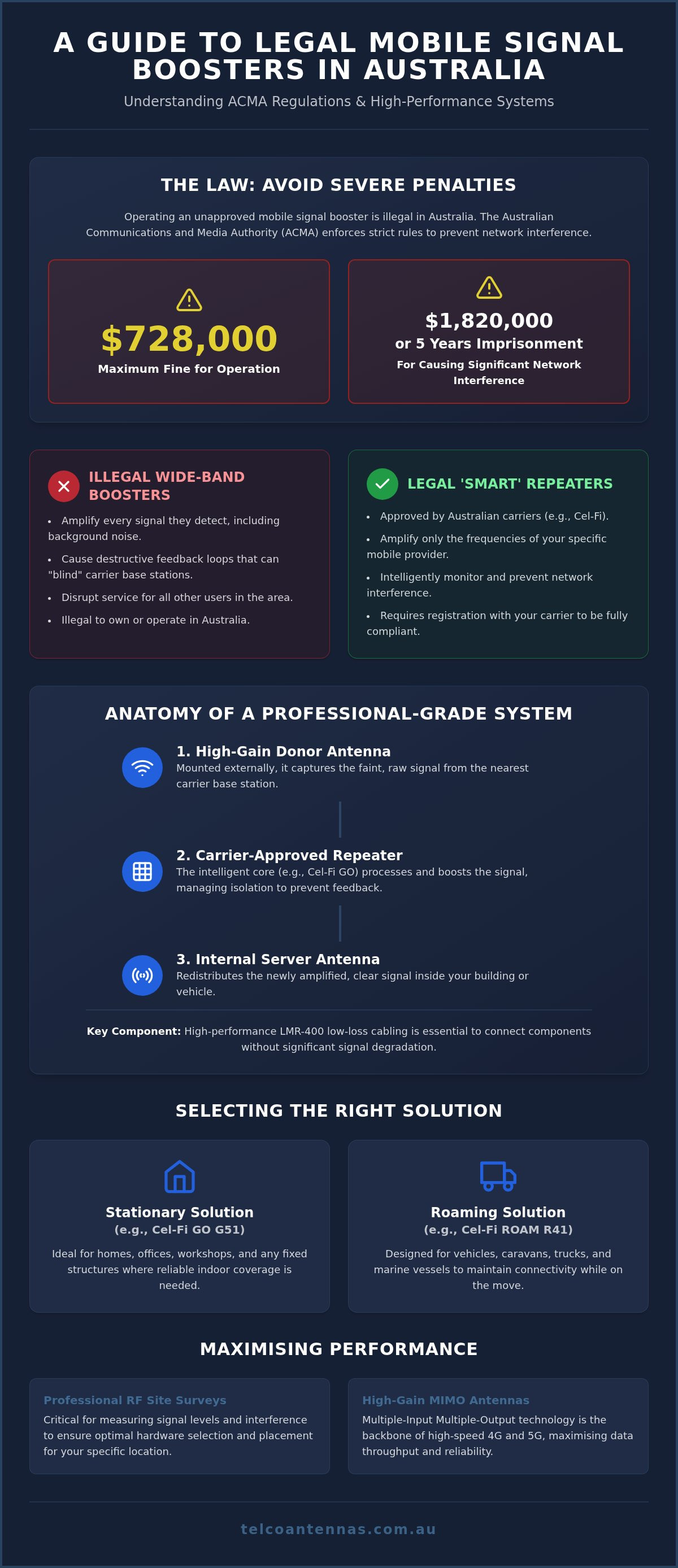
The majority of devices marketed globally as a mobile signal booster are wide-band analogue amplifiers. These units are problematic because they amplify every signal they detect, including electronic background noise. This creates a feedback loop that can effectively "blind" a carrier's base station, preventing all other users in the area from making calls or accessing data. Because these devices can't distinguish between legitimate signals and interference, they're illegal to own or operate in Australia. Operating an unauthorised device carries severe consequences. As of 2026, the ACMA can issue fines of up to $728,000 for the operation of unapproved devices. If your equipment causes significant interference to the mobile network, penalties can escalate to $1,820,000 or up to five years imprisonment.
The Carrier Approval Process
To operate a repeater legally, the device must be classified as an "exempt" or "smart" repeater. This means the hardware has undergone rigorous testing by major Australian carriers to ensure it interacts safely with their infrastructure. Cel-Fi hardware has become the industry standard because it's currently the only brand widely approved by all major Australian carriers. These units are carrier-specific; they only amplify the frequencies of your chosen provider, which prevents the network-wide noise issues associated with analogue boosters. Even when using approved equipment, you're required to register the device with your carrier. Telco Antennas provides professional-grade hardware and the technical guidance necessary to ensure your installation remains fully compliant with Australian law while delivering the performance you require.
The Anatomy of a High-Gain Signal Enhancement System
A professional mobile signal booster installation relies on three distinct functional blocks working in precise sequence. First, a high-gain donor antenna is mounted externally to capture the raw signal from the nearest base station. This signal travels via coaxial cable to the repeater unit, which acts as the intelligent processing core. Finally, a server antenna redistributes the amplified signal within the building or vehicle. For remote Australian properties, the "Signal In vs. Signal Out" principle is the baseline for success. If the donor antenna cannot capture a stable signal from the roof, the system has no foundation to build upon.
Modern systems like the Cel-Fi GO utilise an onboard CPU to monitor the environment in real-time. This is critical for managing isolation. If the donor and server antennas are positioned too close together, the system may experience oscillation, a feedback loop that causes the unit to shut down to protect the carrier network. To ensure compliance and performance, the ACMA mandates the use of carrier-authorised repeaters, which are engineered to detect and prevent these technical failures automatically without manual intervention.
MIMO Antennas: Maximising Data Throughput
Multiple-Input Multiple-Output (MIMO) technology is the backbone of high-speed 4G and 5G data. Unlike older systems that used a single stream, MIMO uses multiple antennas to transmit and receive data simultaneously. In rural contexts, antenna choice is pivotal. A directional Yagi antenna is ideal for point-to-point connections over long distances, whereas an omnidirectional antenna is better suited for moving vehicles. To achieve maximum stability, we often use cross-polarised antennas. By orienting antennas at opposing 45-degree angles, the hardware can better distinguish between signals, significantly reducing noise and increasing data speeds.
LMR-400 Coaxial Cable: The Silent Performance Killer
The cable connecting your antenna to your mobile signal booster is as important as the hardware itself. Many consumer kits use thin RG58 cable, which suffers from high attenuation, or signal loss. For professional deployments, we exclusively use LMR-400 coaxial cables. These are thicker, shielded cables designed to preserve signal integrity over longer distances. The 3dB rule is a critical metric for any installer to understand. Every 3dB of loss in your cabling effectively halves your signal power. If you use poor-quality components, you might lose the gain your antenna just provided before it even reaches the booster. For those looking to engineer a robust solution, reviewing the technical specifications of professional-grade RF components is the first step toward a reliable installation.
Selecting the Right Solution: Stationary vs. In-Vehicle Boosters
Choosing between a stationary and a mobile system requires an assessment of your primary usage case and power availability. For fixed locations like a homestead or a commercial office, the Cel-Fi GO G41 or G51 is the standard choice, typically operating on 240V AC power. Conversely, the ROAM R41 is engineered specifically for vehicles, utes, and caravans, drawing from 12V or 24V DC power sources. While both units are carrier-approved, they aren't interchangeable. A stationary unit is designed to provide a wide coverage footprint within a building, whereas a mobile unit prioritises the ability to maintain a connection while moving between different cell towers at high speeds.
Selecting a unit involves more than just picking a model. It requires understanding the physical environment. In large-scale industrial settings, such as a multi-storey warehouse or a mining camp, a single server antenna is rarely sufficient. These deployments require a distributed antenna system (DAS) where the signal from a mobile signal booster is split and sent to multiple internal dome or panel antennas. This ensures uniform coverage across thousands of square metres without signal drop-offs. It's also the point where many users inadvertently risk non-compliance by purchasing unapproved hardware online. To avoid legal complications, always refer to the ACMA illegal mobile booster regulations before finalising your hardware selection.
Boosting Signal in Vehicles and Caravans
Vehicle installations present unique mechanical challenges, particularly regarding antenna placement and vibration. When mounting a donor antenna on a bull bar, you must choose between a ground-plane and a non-ground-plane antenna to suit the mounting surface. For those traversing corrugated outback roads, ruggedised hardware is essential. The ROAM R41 is built to withstand these conditions, managing the complex "handover" process as your vehicle moves from the coverage area of one base station to the next. This prevents the call drop-outs that occur when standard handsets struggle to latch onto a new tower in low-signal environments.
Fixed Building Deployments for Homes and Sheds
Metal-clad sheds and modern homes with energy-efficient glass often act as Faraday cages, effectively blocking external cellular signals. A stationary deployment overcomes this by placing the donor antenna outside the shielded area. Inside the building, we typically use panel antennas for wall mounting or dome antennas for ceiling mounting to distribute the signal evenly. In remote areas where satellite internet is the primary data source, we often integrate these repeaters alongside Starlink systems. This hybrid approach provides high-speed data via satellite while ensuring the mobile signal booster maintains reliable voice and SMS services through the cellular network.
Maximising Performance: Site Surveys and RF Engineering
Many users assume that installing a mobile signal booster is a simple case of mounting an antenna and plugging in the power. However, in complex radio frequency (RF) environments, this "plug and play" approach often results in sub-optimal performance or complete system failure. Successful deployment requires a mechanical understanding of how signals propagate through terrain and building materials. Without professional engineering, you might find that while your phone shows full bars, your data speeds remain sluggish due to poor signal quality.
Professional RF engineering involves measuring specific metrics like Receive Signal Level (RSL) and Signal-to-Interference-plus-Noise Ratio (SINR). While RSL measures the raw power of the signal, it is the SINR that determines the actual quality and data throughput. A system with high signal strength but poor SINR will still experience dropped packets and slow speeds. For large properties or mine sites, we often extend connectivity using point-to-point wireless bridges, which allows a single high-performance cellular source to be shared across multiple remote locations without the need for extensive cabling between buildings.
The Importance of a Professional RF Site Survey
Our engineers use hand-held spectrum analysers to identify the most suitable donor tower, which isn't always the closest one geographically. Sometimes a tower further away provides a cleaner signal with less interference from competing cells. By mapping internal dead zones and measuring signal quality throughout a structure, we design a custom antenna layout that ensures consistent coverage. SINR is a critical metric that represents the ratio of the desired signal to the background noise and interference. This ratio is the primary driver of data speed; without a clean signal, even the best hardware will struggle to deliver 5G performance.
Telescopic Masts and Temporary Structures
For rapid deployment on remote sites or temporary projects, telescopic mast trailers and skids provide the height necessary to clear local obstructions like dense foliage or topographical rises. We also utilise aluminium tri-pods for lightweight, temporary antenna mounting in situations where a permanent tower isn't feasible. Every structure we design considers wind loading and structural integrity to ensure the equipment remains stable in harsh Australian weather. To move beyond guesswork and achieve a high-performance installation, you can request a professional RF site survey from our engineering team to ensure your infrastructure is built for long-term reliability.
Professional-Grade Connectivity with Telco Antennas
Since 2008, Telco Antennas has functioned as a technical bridge between complex RF engineering and practical connectivity requirements across Australia. We don't just supply hardware; we engineer systems that ensure your mobile signal booster deployment is both legally compliant and technically optimised for the specific topography of your site. By pairing Cel-Fi GO units with high-performance antennas, we address the mechanical causes of poor reception rather than just masking the symptoms. Our focus remains on technical integrity, ensuring that every component, from the mounting bracket to the internal repeater, meets the high standards required for reliable communication in regional environments.
We also recognise that many remote operations now rely on hybrid communication strategies to ensure redundancy. To support this, we provide specialised Starlink aftermarket power conversion and mounting kits. This allows for a streamlined integration where satellite data and cellular voice services coexist within the same infrastructure. Whether you're managing a remote mine site or a rural homestead, our hardware solutions are designed to withstand the physical demands of the Australian climate while maintaining carrier-approved status. This commitment to using only authorised equipment protects you from the regulatory risks associated with unapproved hardware.
Why Experience Matters in RF Hardware
Telco Antennas has been a fixture in the Australian communications market since 2008, providing us with a deep understanding of the unique challenges posed by the local landscape. Selecting the correct RF components involves more than comparing gain figures on a spec sheet. It requires an understanding of how different frequencies interact with environmental variables. We maintain an extensive inventory of specialised connectors and professional-grade LMR-400 cables to ensure that every link in your signal chain is as robust as the booster itself. Receiving expert technical advice before committing to a hardware purchase can prevent costly errors and ensure your system performs as intended from day one.
Next Steps for Your Connectivity Project
Every environment presents a unique set of variables that a standard kit may not fully address. If you're dealing with persistent black spots or require a large-scale industrial distribution system, reaching out for a custom recommendation is the most efficient path forward. Choosing an Australian-based specialist ensures you receive support that understands local carrier configurations and ACMA regulatory requirements. Our team is ready to assist you in designing a system that provides the reliability and performance your operations demand. To begin, you can Contact our engineering team for a professional RF solution tailored to your specific location.
Securing Your Connectivity for the 5G Era
Navigating the Australian cellular landscape in 2026 requires more than just high-gain hardware; it demands a commitment to regulatory compliance and technical precision. Successfully eliminating black spots depends on two primary factors: the use of carrier-approved electronics and the professional integration of low-loss infrastructure. As we've discussed, the distinction between a legal repeater and an unauthorised mobile signal booster is critical for avoiding significant penalties while ensuring your system doesn't interfere with the national network.
Telco Antennas has been Australian owned and operated since 2008, serving as an authorised Nextivity partner with a focus on specialist RF engineering services. Whether you're managing a remote industrial site or upgrading a regional vehicle, our expertise ensures your hardware is configured for optimal SINR and data stability. If you're ready to implement a reliable, high-performance solution, you can view our range of carrier-approved Cel-Fi GO boosters to find the correct system for your requirements. Achieving crystal clear voice and high-speed data is a straightforward process when you have the right technical partner at your side.
Frequently Asked Questions
Are mobile signal boosters legal in Australia in 2026?
Yes, provided the hardware is carrier-approved and meets ACMA standards. Most generic devices marketed globally as a mobile signal booster are illegal wide-band amplifiers that cause significant network interference. In contrast, smart repeaters like the Cel-Fi GO are permitted because they're authorised by Telstra, Optus, or Vodafone to operate safely on their specific spectrum. Operating unapproved hardware can lead to substantial federal fines.
What is the best mobile signal booster for a caravan?
The Cel-Fi ROAM R41 is the current industry standard for caravans and utes. It's specifically engineered to manage the rapid handover between cell towers while you're moving, which is a common point of failure for stationary units. The hardware is ruggedised to withstand the vibrations of corrugated Australian roads and operates on standard 12V or 24V DC power systems, ensuring reliable connectivity in remote regional areas.
Can a mobile signal booster improve my 5G data speeds?
Yes, current models like the Cel-Fi GO G51 are designed to support 5G frequencies. Improving your data speed isn't just about increasing signal bars; it's about improving the Signal-to-Interference-plus-Noise Ratio (SINR). By using a high-gain MIMO antenna configuration, the booster provides a cleaner signal path. This allows your device to sustain higher modulation schemes and faster throughput than a standard handset could achieve on its own.
Do I need an antenna for my Cel-Fi GO booster?
Yes, a repeater unit cannot function without an external donor antenna and at least one internal server antenna. The donor antenna captures the raw signal from the carrier's base station, while the server antenna redistributes the amplified signal within your building or vehicle. High-quality LMR-400 cabling is also required to connect these components without losing the signal gain provided by the donor antenna during transmission.
Will a booster work if I have no signal at all outside?
No, a repeater requires a usable baseline signal to function. If there's no detectable signal outside the building or vehicle, there's nothing for the donor antenna to capture and amplify. We recommend performing a basic test on your roof or bull bar; if your phone can't establish even a weak connection there, a mobile signal booster will not resolve the issue as it cannot create a signal where none exists.
What is the difference between a booster and a repeater?
The term "booster" is a colloquialism often associated with illegal, wide-band analogue amplifiers. A "repeater" or "smart repeater" is the technically correct term for legal, carrier-approved devices. Repeaters are intelligent units that filter and amplify only the specific frequencies of a chosen carrier. Illegal boosters amplify all background noise, which can cause interference that shuts down local mobile towers for all users in the vicinity.
How much does it cost to install a mobile signal booster professionally?
Professional installation costs are determined by the complexity of the RF environment and the physical requirements of the site. Factors such as the height of the antenna mount, the length of LMR-400 cabling runs, and the number of internal server antennas required all influence the final investment. A professional RF site survey is the best way to determine the exact infrastructure and engineering time needed for your specific location.
Can I use a signal booster with Telstra, Optus, and Vodafone simultaneously?
Standard consumer repeaters like the Cel-Fi GO are designed to amplify one carrier at a time. While you can switch between Telstra, Optus, and Vodafone using a mobile app, the hardware cannot process multiple carriers simultaneously. For environments requiring multi-carrier support, we engineer industrial-grade distributed antenna systems (DAS) that utilise separate repeater units or specialised broad-spectrum infrastructure to handle each carrier independently.


