
Buying the most expensive high-gain antenna on the market won't solve your rural connectivity issues if you're ignoring the underlying physics of your connection. Many regional Australians find themselves trapped in a cycle of purchasing hardware that promises "maximum bars" but delivers inconsistent results. Understanding your receive_signal_level is the critical first step in diagnosing why your connection fails, particularly as the 2026 expansion of 5G services in the 3.7 to 3.98 GHz bands introduces new complexities for signal interference. It's a frustrating experience when telco providers use confusing jargon that doesn't explain why your data speeds drop during specific environmental conditions.
Mastering these technical fundamentals is the only way to move beyond guesswork and achieve a professional-grade link. We'll show you how to interpret RSL metrics and calculate a link budget to eliminate black spots for good. This guide provides the technical clarity you need to choose the right Telco Antennas hardware, such as Cel-Fi GO boosters or LMR-400 cabling, ensuring your equipment is perfectly matched to the unique demands of your location. You'll gain the confidence to install a system that performs reliably, even as the Australian RF landscape becomes increasingly crowded and complex.
Key Takeaways
- Learn why the receive_signal_level is measured on a logarithmic dBm scale and how this raw data provides a more accurate picture of connectivity than standard signal bars.
- Identify the specific environmental factors, such as Free Space Path Loss and Australian terrain, that naturally degrade signal strength between your location and the nearest tower.
- Discover how to access hidden 'Field Test Mode' menus on your mobile device to perform a preliminary site survey and gather actionable signal data.
- Understand the mechanical role of high-gain directional antennas and active signal boosters, like the Cel-Fi GO, in stabilising weak incoming signals.
- Gain the technical knowledge required to calculate a basic link budget and select professional-grade components like LMR-400 low-loss coaxial cables for your installation.
What is Receive Signal Level (RSL) in Telecommunications?
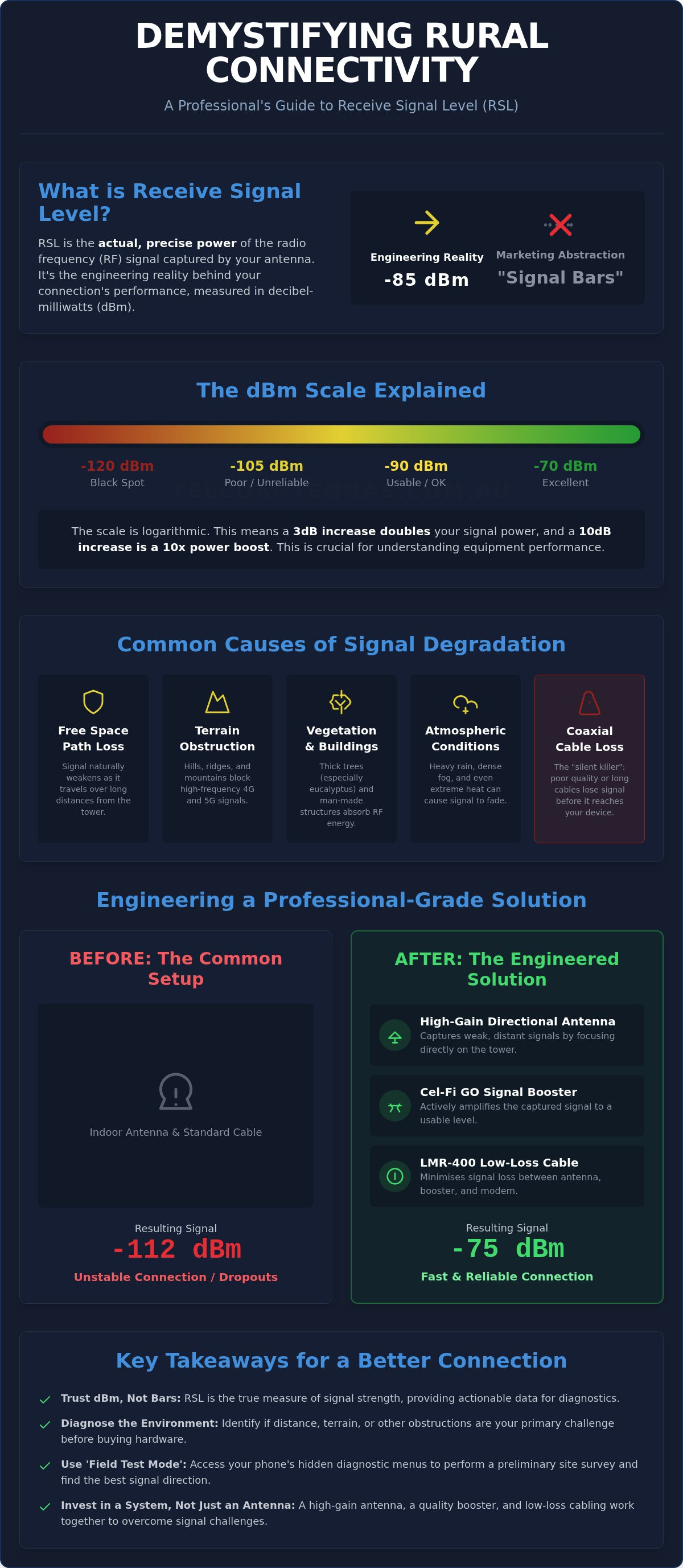
RSL represents the total power of the radio frequency (RF) signal captured by an antenna system at any given moment. While consumers often judge their connectivity by the number of bars on a smartphone screen, these graphical representations are merely marketing abstractions that vary between device manufacturers. In the engineering reality of Australian telecommunications, the receive_signal_level is the precise metric used to determine if a mobile link will actually sustain a high-speed data session or drop a call entirely. RSL is the absolute power level measured at the receiver input, typically ranging from -30 dBm to -120 dBm.
The measurement is expressed in decibel-milliwatts (dBm), which uses a logarithmic scale rather than a linear one. This is necessary because radio signals attenuate rapidly over distance. A linear scale would require unwieldy numbers to describe the massive range between a signal right next to a tower and one thirty kilometres away in the outback. On a logarithmic scale, every 3 dB increase represents a doubling of power, while a 10 dB increase represents a ten-fold increase. Understanding this relationship is vital for anyone attempting to optimise a remote communication system using professional hardware.
RSL vs RSSI: Clearing the Confusion
Many users confuse RSL with Received Signal Strength Indication (RSSI). While they are related, RSSI is often a relative index value determined by hardware vendors, which can vary significantly between an iPhone and a Samsung device even when standing in the same spot. Conversely, RSL is an absolute measurement of power, making it the more reliable metric for conducting a professional RF site survey. When you access diagnostic menus on modern Australian mobile networks, you may see RSRP (Reference Signal Received Power) for 4G and 5G connections. This serves as a highly specific form of RSL measurement for those digital standards, focusing on the power of the specific pilot signals rather than the entire frequency band.
Why dBm Values are Always Negative
In the world of RF engineering, 0 dBm is defined as exactly 1 milliwatt (mW) of power. Because mobile signals reaching your device are incredibly faint, they represent only tiny fractions of a single milliwatt. This necessitates the use of negative values. If your hardware reports a receive_signal_level of -70 dBm, you are enjoying an excellent, high-performance connection. However, once that value drifts toward -110 dBm or -120 dBm, you have reached the 'black spot' threshold. At these levels, the signal is too weak for the hardware to distinguish it from background electronic noise, leading to the dropped packets and failed connections common in regional Australia.
Factors That Degrade Your Receive Signal Level
Achieving a stable receive_signal_level in the Australian outback requires more than just a clear view of the horizon. Several physical and environmental variables act as resistors to your connection, thinning the signal before it ever reaches your hardware. Free Space Path Loss is the most fundamental factor, describing how radio waves naturally lose energy and "spread out" as they travel away from a Telstra or Optus base station. In regional areas where towers may be 50 kilometres away, this natural attenuation is the primary reason for weak reception.
Terrain obstruction provides the next significant challenge. Steep mountain ranges or even subtle ironstone ridges found in various parts of the country can completely block the high-frequency waves used for mobile data. Unlike lower frequency radio, 4G and 5G signals don't "bend" easily over hills. Vegetation also plays a role; thick eucalyptus scrub is particularly effective at absorbing RF energy due to the high moisture content in the leaves. Atmospheric conditions like extreme heat or heavy tropical rain can lead to signal fading. Research into Mobile Received Signal Strength highlights how these external variables contribute to RSRP fluctuations. If you're struggling to identify which factor is impacting your site, an RF site survey can provide the technical clarity needed to design a solution.
The Silent Killer: Coaxial Cable Loss
Signal degradation doesn't stop at the antenna. Attenuation occurs as the RF energy travels through the coaxial cable to your modem. While standard RG-58 cable is common in retail kits, it's often unsuitable for long runs in regional installations because it leaks too much energy. High-performance LMR-400 coaxial cables are engineered with lower loss characteristics to preserve as much of the receive_signal_level as possible. Every 3dB of cable loss effectively halves your received signal power. Using the wrong cable can essentially nullify the benefits of a high-gain antenna.
Multipath Interference in Built Environments
In industrial settings or farms with large metal sheds, signals often bounce off surfaces before reaching the receiver. This creates multipath interference, where the same signal arrives at slightly different times, causing RSL fluctuations and data errors. Modern MIMO (Multiple Input Multiple Output) antennas are designed to manage these reflected signals by using multiple spatial paths to rebuild the data stream. This is why achieving a stable link sometimes requires more than just a simple line-of-sight installation; it requires hardware capable of processing complex signal environments.
How to Measure RSL for a Professional Site Survey
Accurately measuring the receive_signal_level at a potential installation site is the only way to ensure your hardware investment delivers the expected performance. Relying on the signal bars on your handset is insufficient because these icons don't provide the granular data required for RF engineering. A professional site survey follows a methodical four-step process to quantify the raw power available from the local Telstra or Optus towers.
Step one involves accessing 'Field Test Mode' on your mobile device. iPhone users can enter this hidden menu by dialling *3001#12345#* into the keypad, while Android users can often find similar data under Settings > About Phone > Status, or by using dedicated network diagnostic applications. You are looking for RSRP (Reference Signal Received Power), which serves as your primary indicator of signal strength. Step two moves beyond the handset by using professional RF signal meters. These handheld spectrum analysers provide faster refresh rates and can detect signals from multiple towers simultaneously, which a standard phone often filters out.
Step three requires recording measurements at various elevations. Because signal strength can change dramatically with just a few metres of height, using a telescopic mast or a portable aluminium tri-pod is essential to find the "sweet spot" above local vegetation or structures. Finally, step four is the calculation of your link budget. This involves taking your measured RSL and adding the gain of your chosen antenna while subtracting the loss from your coaxial cable runs. This calculation tells you exactly how much power will reach your modem or booster.
Using the Cel-Fi WAVE App for RSL Diagnostics
If you are using a Cel-Fi GO system, the WAVE app is a critical diagnostic tool. It provides a real-time view of the 'Donor RSSI', which is the raw receive_signal_level coming from the network tower before any amplification occurs. By monitoring this value while adjusting your external antenna, you can identify the precise orientation that captures the strongest signal. The app also displays the 'Boosted RSL', showing you the final output level being distributed within your building or vehicle. If the gap between these two numbers is too small, it indicates that your external signal is too weak or your isolation is insufficient.
Interpreting the Numbers: What is a 'Good' Level?
Understanding the dBm scale is vital for a successful installation. A reading between -50 dBm and -70 dBm is considered excellent, providing maximum data throughput and voice clarity. If your measurements fall between -80 dBm and -90 dBm, the signal is fair but may benefit from a high-gain antenna to ensure stability during peak network load or poor weather. Once the receive_signal_level drops below -100 dBm, you are in a poor coverage zone where connections become unreliable. However, RSL is only half the story. You must also monitor the Signal-to-Noise Ratio (SNR). A strong signal is useless if it's "noisy" due to interference, as your data speeds will remain throttled regardless of the raw power level.
Improving RSL: Antennas, Boosters, and Engineering
Once you have quantified your receive_signal_level, the next phase is selecting hardware that can effectively bridge the gap between a weak tower signal and a high-performance connection. Improving your RSL is a mechanical process of increasing gain at the antenna and minimising loss throughout the rest of the signal path. For regional Australians, this often requires moving beyond standard omnidirectional antennas and adopting more focused hardware solutions that can isolate a specific carrier tower.
Active signal boosters, specifically Cel-Fi GO units, are the industry standard for Australian networks. These devices take a weak incoming receive_signal_level and re-broadcast it at a usable level within a vehicle or building. However, a booster is only as effective as the donor signal it receives. If the external RSL is too low, the booster will have nothing to work with. This is why mast height optimisation is critical. By elevating the donor antenna, you often clear the 'Fresnel Zone', which is an elliptical area around the line of sight that must remain clear of obstructions to prevent signal phase shifts and attenuation.
Cable management is the final, often overlooked, step in preserving RSL. Every decibel of gain you achieve with a high-quality antenna can be quickly lost through poor cabling. Using LMR-400 low-loss coaxial cable is essential for any run exceeding a few metres, as it provides the shielding and conductor quality required to deliver the signal to your device without significant degradation. You can shop our range of professional RF hardware to begin your installation with the correct components.
The Power of High-Gain MIMO Antennas
High-gain directional antennas, such as a 14dBi Yagi or a parabolic grid, act like a megaphone in reverse. By narrowing the 'ear' of your system, you can pull in a stable signal from towers located 50 kilometres away or more. For 4G and 5G connections, polarisation matching is vital; your antenna orientation must match the tower's transmission, which is often a 45-degree slant or a vertical/horizontal configuration. While 'more gain' sounds ideal, be aware that in high-interference areas, a very high-gain antenna can sometimes amplify noise alongside the signal, making proper alignment even more critical.
When to Engage Professional RF Engineering
DIY installations have their limits, particularly in industrial settings or complex topographies. When a standard mast isn't enough, professional RF engineering services are required for communication tower design or site surveys. For instance, if your homestead is in a valley but a nearby hill has a strong receive_signal_level, we can use point-to-point wireless bridges to 'beam' that connectivity down to your location. These custom solutions are essential for underground mines or remote transport hubs where reliability is non-negotiable and the environment is technically challenging.
Maximising Your Link Budget with Telco Antennas
A reliable receive_signal_level is the technical foundation of any successful remote communication strategy. If you don't have sufficient raw power at the receiver, even the most expensive modem or router will struggle to maintain a stable connection or sustain high data throughput. Telco Antennas operates as a specialised partner, providing the professional-grade hardware and engineering expertise required to turn marginal reception into a high-performance link. For those managing temporary worksites, emergency response zones, or seasonal agricultural operations, our telescopic mast trailers and skids offer a rapid, mobile solution to elevate your gear. This elevation helps clear local obstructions and significantly improves the link budget before permanent infrastructure is even considered.
It is a common mistake to guess signal strength based on the bars displayed on a mobile handset. These icons are often misleading and don't account for the noise floor or the nuances of specific frequency bands. You must measure the signal accurately to build a system that lasts. This pragmatic approach prevents the common pitfall of over-investing in high-gain antennas while neglecting the massive losses often incurred by poor cabling or insufficient mast height.
Professional Hardware for Remote Australia
Regional Australian conditions are notoriously harsh on sensitive RF equipment. Standard retail mounts often fail under high wind loads or the intense UV exposure common in the outback. We specialise in aluminium tri-pods and telescopic masts designed to withstand these environmental variables while maintaining the precise antenna alignment required for high-gain links. The integrity of your connection also relies on the physical connection between components. This is why we insist on using LMR-400 coaxial cables for every professional installation. The superior shielding and low-loss properties of LMR-400 are non-negotiable when trying to preserve every fraction of a decibel in the signal path. For a deeper look at system configuration and mounting options, consult our Cel-Fi GO Professional Deployment Guide.
Get a Custom RF Site Survey
While the fundamentals of receive_signal_level are universal, every location presents unique challenges that off-the-shelf solutions might not solve. Our engineering team uses collected RSL data and terrain modelling software to design custom communication towers and point-to-point wireless bridges. This consultative approach ensures that the equipment selected is perfectly matched to the specific frequency bands and path losses of your unique site. Whether you are managing a remote homestead, an underground mining operation, or a transport hub, we provide the technical expertise to ensure your communication strategy is based on physics rather than hope. Contact Telco Antennas for a Professional RF Site Survey to begin your network optimisation and secure a reliable link.
Engineering a Reliable Link for Regional Australia
Achieving a stable mobile connection in the Australian outback requires a transition from consumer guesswork to technical precision. We've established that your receive_signal_level is the fundamental metric that dictates performance; it's the raw data that allows you to bypass the ambiguity of signal bars and marketing jargon. By identifying environmental obstructions and selecting hardware that accounts for path loss, you can transform a marginal link into a robust communication system. It's about matching the right high-gain antenna with low-loss LMR-400 cabling to ensure your equipment operates at its peak theoretical capacity.
Telco Antennas brings over 15 years of Australian RF engineering experience to every project. As an authorised Cel-Fi GO distributor, we specialise in high-gain MIMO solutions designed specifically for the unique challenges of our local landscape. Don't settle for unreliable coverage when a professional-grade solution is within reach. Maximise your signal with Telco Antennas' professional hardware and gain the confidence that comes with a scientifically verified connection. Your path to better connectivity starts with the right data and the right equipment.
Frequently Asked Questions
What is a good Receive Signal Level (RSL) for 4G or 5G?
A high-performance receive_signal_level generally falls between -50 dBm and -70 dBm. While a reading of -80 dBm to -90 dBm is often sufficient for basic browsing, you'll likely experience reduced data throughput during peak periods. Once the level drops below -100 dBm, the link becomes unstable and prone to frequent dropouts, typically requiring high-gain hardware to maintain a functional connection.
Can I improve my RSL without buying an external antenna?
You can sometimes achieve marginal improvements by reducing the physical barriers between your device and the nearest tower. Placing your modem at a higher elevation or near a window that faces the transmitter reduces building penetration loss. However, these adjustments are usually insufficient in regional black spots where the physical distance from the tower is the primary cause of a poor receive_signal_level.
Why does my RSL change depending on the time of day?
Signal fluctuations often occur due to environmental variables such as atmospheric fading and temperature inversions. Extreme Australian heat can cause "heat haze" that refracts radio waves, while heavy rain or high humidity can absorb high-frequency energy. Additionally, network breathing during peak hours can cause the effective coverage area of a cell tower to shrink, resulting in a lower receive_signal_level at your location.
What is the difference between RSL and RSRP in mobile networks?
RSL is a broad measurement of total received power, whereas RSRP (Reference Signal Received Power) is a specific metric used in 4G and 5G networks. RSRP measures the power of the reference signals specifically, providing a more accurate representation of the usable signal for data sessions. While RSL tells you the total energy hitting the antenna, RSRP tells you the quality of the connection the network can actually use.
How much signal loss should I expect from a 10-metre coaxial cable?
The amount of attenuation depends entirely on the grade of the cable and the frequency being used. A 10-metre run of standard RG-58 cable can lose over 5 dB of signal at 1800 MHz, which is more than half your power. By contrast, a 10-metre run of professional LMR-400 cable typically loses less than 2 dB at the same frequency, preserving significantly more of your hard-earned gain.
Is a higher RSL always better for my internet speed?
A higher signal power doesn't guarantee faster speeds if the signal is "noisy" or the network is congested. If your RSL is high but your Signal-to-Noise Ratio (SNR) is low due to interference from other towers or local electronics, your data throughput will remain poor. Speed is the result of both raw signal power and the cleanliness of that signal relative to background noise.
Does a mobile signal booster actually increase the RSL at the antenna?
A booster like the Cel-Fi GO doesn't change the signal strength at the external donor antenna itself. Instead, it takes the existing signal captured by that antenna, amplifies it, and re-broadcasts it at a higher level inside your building or vehicle. The entire system relies on the donor antenna being placed in the best possible location to capture a clean initial signal from the carrier.
How do I find the RSL value on my iPhone or Android phone?
You can view raw signal data by accessing hidden diagnostic menus on your device. iPhone users can dial *3001#12345#* to enter Field Test Mode and look for the RSRP value under the serving cell measurements. Android users can typically find this information under Settings, About Phone, and then Status or Signal Strength, though some devices may require a dedicated network analyser app.


