

The antenna with the higher gain figure may still be the wrong choice for your vehicle. In a blackhawk collinear vs rfi collinear heavy duty vehicle antenna comparison, first check whether each model covers your radio’s operating frequencies and suits the vehicle and terrain. Gain matters, but it cannot predict performance on its own.
Specifications, mounting options and vehicle constraints all affect the decision. This comparison shows how to assess exact models on consistent terms, including frequency coverage, published gain, antenna height and removal options. It also covers practical installation factors such as mounting position, overhead clearance, cable routing and exposure to vibration or harsh conditions. Use these criteria to match an antenna to your radio system and plan an installation that fits the vehicle, rather than relying on brand reputation or a single headline specification.
Key Takeaways
- In the blackhawk collinear vs rfi collinear heavy duty vehicle antenna comparison, start with your radio’s operating bands and compare exact model numbers, not brand names alone.
- Read gain alongside frequency coverage and radiation pattern. A higher gain figure by itself doesn’t establish which antenna suits your operating conditions.
- Use manufacturer specifications to compare dimensions and other documented details side by side. Leave gaps rather than assuming the models are alike.
- Plan the installation around mounting position, vehicle height, overhead clearance, cable routing and exposure to vibration or harsh conditions.
- Consider the antenna as part of the wider RF system. Sound selection depends on the radio, vehicle and operating environment.
Blackhawk vs RFI collinear vehicle antennas: what are you comparing?
A collinear antenna is one part of a vehicle radio system, not the radio itself. The transceiver sends or receives radio-frequency (RF) signals. Connected through a feed line, the antenna converts transmitted electrical energy into radio waves and received signals back into electrical energy for the radio to process. A blackhawk collinear vs rfi collinear heavy duty vehicle antenna comparison is useful only when both models are assessed against the same radio requirements and intended use.
A collinear vehicle antenna uses radiating sections arranged along a common axis to shape how radio energy is transmitted and received. The precise construction varies by design. Collinear arrays use different arrangements and electrical methods, so the term alone doesn’t establish an antenna’s frequency coverage, gain or radiation pattern. The collinear antenna array reference explains the general principle; model-specific performance comes from manufacturer documentation.
What does collinear mean in a vehicle antenna?
In practical terms, the antenna is the radiating component mounted on the vehicle and linked to the radio by its feed line. Its design affects how RF energy is distributed, but it doesn’t replace the transceiver or compensate for a mismatch elsewhere in the system. General antenna principles apply across brands; check the specific model’s documented operating bands, construction and performance figures.
Why compare the exact Blackhawk and RFI model numbers?
Each brand’s range can include different frequency ranges and physical configurations. For example, RFI model codes such as CDR and CDQ identify different antenna models, while Blackhawk’s Trucker Edge range includes Compact and Omni variants. Those names don’t establish equivalent specifications. Record the complete model number, including any suffix, and use the current manufacturer datasheet for that exact version.
This avoids a common comparison error: treating two antennas as equivalent because they share a brand family, look similar or have the same broad product description. A model designed for one set of operating bands may not suit a radio using another. Similarly, a configuration that fits one mounting arrangement or vehicle profile may not work on another. Suitability depends on the radio’s requirements, the antenna’s documented specifications and the conditions in which the vehicle operates.
For a fair comparison, define the radio’s requirements first, then assess like-for-like models against current manufacturer information. Use documented details rather than transferring specifications from a related model or relying on brand reputation. The following sections apply that approach to frequency, gain, radiation pattern and physical fit, keeping the decision focused on system compatibility and installation needs.
How frequency, gain and radiation pattern affect collinear antenna performance
Before comparing gain figures, establish that each antenna is designed for the radio’s operating frequencies. An antenna outside the required band may be unsuitable, even if its other specifications look attractive. Check the exact model’s current documentation: frequency ranges can differ within the same brand family, and a model name alone doesn’t prove compatibility.
Check operating frequency and radio compatibility first
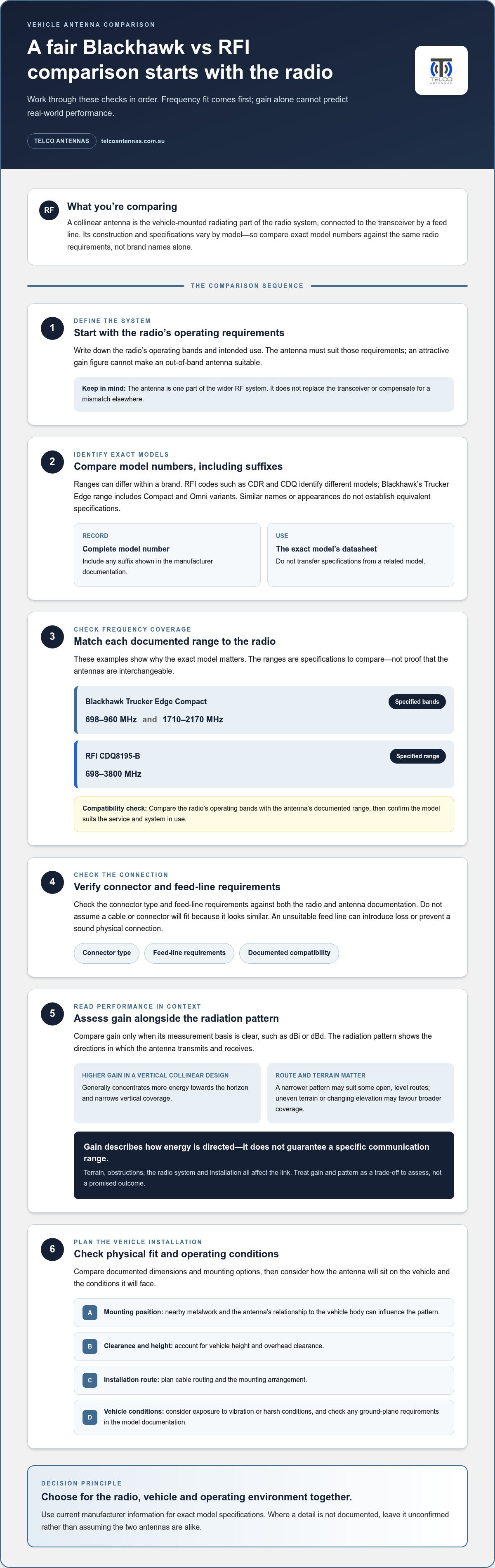
For example, the Blackhawk Trucker Edge Compact is specified for 698-960 MHz and 1710-2170 MHz. RFI’s CDQ8195-B is specified across 698-3800 MHz. These ranges show why checking each model matters, but they don’t make the antennas interchangeable. Compare the radio’s operating bands with the antenna’s documented range, and confirm that the specific model suits the service and system in use.
Frequency coverage is only one part of the connection. Check connector type and feed-line requirements against the radio and antenna documentation. Don’t assume a cable or connector will fit because it looks similar. An unsuitable feed line can introduce loss or prevent a sound physical connection, so don’t infer compatibility where the relevant specification isn’t stated.
Read gain and radiation pattern in context
Gain describes how an antenna directs energy relative to a reference, while the radiation pattern shows the directions in which it transmits and receives. Compare gain figures only when their measurement basis is clear, such as dBi or dBd, and consult the model’s datasheet for the stated value and pattern. A higher number isn’t automatically better for every route or vehicle.
In general, increasing gain in a vertical collinear design concentrates more energy towards the horizon and narrows its vertical coverage. That may suit some open, level routes, while uneven terrain or changing elevation may favour a broader pattern. Actual results depend on the antenna design and installation, so treat this as a trade-off to assess, not a promise of a particular outcome.
Antenna gain describes the way energy is directed; it doesn’t guarantee a specific real-world communication range. Terrain, obstructions, the radio system and installation all affect the link. On a vehicle, mounting position, nearby metalwork and the antenna’s relationship to the vehicle body can influence the pattern. Ground-plane requirements also vary by antenna design, so follow the model documentation rather than assuming every antenna mounts or performs the same way.
For the blackhawk collinear vs rfi collinear heavy duty vehicle antenna decision, assess frequency fit first, then read gain and pattern together and consider how the antenna will sit on the vehicle. Telco Antennas’ RF engineering expertise helps put antenna specifications in the context of a complete RF system.
Blackhawk vs RFI: compare heavy-duty vehicle antenna specifications side by side
A useful comparison starts with exact models, not broad labels. The table contrasts the Blackhawk Trucker Edge Compact and RFI CDQ8195-B using the specifications available for those models. Gain figures are shown as published, with frequency bands separated where the data provides them. Radiation pattern and some installation details aren’t stated in the specifications summarised here, so they’re left open rather than inferred.
| Specification | Blackhawk Trucker Edge Compact | RFI CDQ8195-B |
|---|---|---|
| Frequency range | 698-960 MHz; 1710-2170 MHz | 698-3800 MHz |
| Gain | 4 dBi (698-960 MHz); 6 dBi (1710-2170 MHz) | 6.5 dBi (698-960 MHz); 4.5 dBi (1710-2170 MHz); 5.5 dBi (2300-2700 MHz); 6.5 dBi (3400-3800 MHz) |
| Radiation pattern | Not stated in cited specifications | Not stated in cited specifications |
| Height | 680 mm | Not stated in cited specifications |
| Removable element | Not stated in cited specifications | Removable whip system |
| Connector, cable and mounting details | Not stated in cited specifications | Not stated in cited specifications |
Which specifications belong in a fair comparison table?
Compare values in matching units and keep the frequency band attached to each gain figure. The RFI figures are broken out across four bands, while the Blackhawk figures shown here cover two. Don’t combine them into a single number or treat the bands as identical. Before relying on the comparison, match each value to the current manufacturer documentation for the exact model and revision. If a datasheet doesn’t state a pattern, connector or mounting method, record that gap instead of filling it by assumption.
Dimensions and physical configuration help assess fit, but they answer a different question from electrical performance. The Blackhawk model’s listed height is 680 mm; the RFI specification describes a removable whip system, which may be relevant when planning for clearance. Neither detail establishes how the antenna will perform on a particular vehicle. Compare connector, cable and mounting compatibility only where the model documentation gives those details.
Does heavy-duty mean one antenna will perform better?
No. “Heavy-duty” describes a product category or intended construction, not a universal RF performance ranking. Durability claims and physical features may matter for a vehicle exposed to vibration or rough conditions, but they don’t replace frequency, gain or pattern data. Assess construction and electrical specifications separately, then consider how each model fits the radio and installation.
A vehicle antenna is only as suitable as the match between its documented specifications, the radio system and the way it’s mounted. For the blackhawk collinear vs rfi collinear heavy duty vehicle antenna decision, use the table as a starting point, then compare current datasheets and installation requirements. Broader listed frequency coverage may matter when those bands match the system; a shorter or removable configuration may suit a vehicle with height or access constraints. Neither feature alone determines the result.
Choose and install a collinear antenna for your vehicle and radio setup
Model selection is only half the job. The antenna must suit the radio, and the mount and feed line must work with the vehicle’s shape, height and operating conditions. Use this workflow before installation, especially if the vehicle regularly enters low-clearance areas or travels over rough surfaces.
Work through a practical vehicle antenna selection checklist
Start with the radio system, then work from electrical compatibility to physical fit. Keep the exact antenna model and current manufacturer documentation with your installation notes so each decision is tied to a stated requirement, not an assumption.
- Record the radio requirements. Note the service and operating frequencies the radio needs to use. Identify any system requirements that affect the antenna connection.
- Match the documented frequency range. Compare those operating frequencies with the selected antenna’s manufacturer-stated range. Don’t assume a similar model or brand-family name has the same coverage.
- Confirm the connection path. Check the specified antenna connector, mount and coaxial feed-line requirements against the radio. Consider the entire path, including any adaptors or joins, not just the antenna end.
- Assess mounting options and clearance. Choose a position that suits the vehicle, then account for the antenna’s full fitted height, including the mount. Consider garages, car parks, loading areas and equipment carried above the roofline.
- Match the installation to the work. Consider likely exposure to vibration, branches, weather and repeated vehicle use. A removable configuration may help where overhead clearance is a regular constraint, provided the model’s documented design suits the radio system.
Plan the installation around real vehicle conditions
Before fixing the mount, consider how the antenna will sit relative to the roof, bull bar or other nearby structures. Metalwork and obstructions can affect its operating environment, while a convenient position may leave it screened or vulnerable to impact. Follow the manufacturer’s mounting guidance for the specific model rather than assuming all collinear antennas need the same arrangement.
Next, trace the coaxial route from the antenna to the radio. Avoid unnecessary bends, pinch points and contact with sharp edges or moving components. Secure the cable so it won’t rub against the bodywork during normal vehicle movement, and keep the connector accessible for inspection. The feed line is part of the RF system, not an afterthought.
Allow for the vehicle’s actual working height, not just its parked height. A flexible or removable antenna may address a clearance issue, but only if its mounting and use suit the selected model. Recheck clearances after fitting and consider how loads, accessories or vehicle changes could affect the antenna’s exposure.
For a technically grounded approach, Telco Antennas’ telecommunications hardware and RF expertise puts antenna, feed-line and vehicle requirements in the context of a complete RF system.
Get from antenna comparison to a reliable RF solution with Telco Antennas
The comparison is most useful when it leads to a system-level decision, not a brand preference. Choose an antenna whose documented frequency range suits the radio, whose configuration fits the vehicle and whose installation matches how the vehicle is used. The blackhawk collinear vs rfi collinear heavy duty vehicle antenna choice depends on how these requirements fit together, not on a single gain figure or broad durability label.
What information helps turn a comparison into a sound decision?
Gather the details needed to assess antenna specifications against the actual setup:
- The radio model, service and operating frequencies it needs to support.
- The exact Blackhawk and RFI model numbers, including suffixes, and the current manufacturer datasheets for each.
- The vehicle type, available mounting positions and total height or clearance constraints.
- The intended operating environment, such as regular travel on rough roads, areas with overhead restrictions or routes with varied terrain.
- The planned mount, connector and coaxial feed-line path, including where the radio will sit in the vehicle.
This information helps separate essential compatibility requirements from preferences. If the vehicle must enter low-clearance areas, for example, antenna height or a documented removable configuration may carry more weight. If the radio must operate across specific bands, frequency fit comes first. Neither point establishes a coverage outcome by itself; terrain, obstructions and the complete installation still matter.
How Telco Antennas supports practical RF decisions
Reading a datasheet is one step. Applying its specifications to a radio, vehicle and operating environment takes a wider view of the RF system, including the antenna connection and feed line. Telco Antennas supplies telecommunications hardware and provides RF engineering services, including RF site surveys. This supports a considered assessment of how equipment requirements relate to the system, without treating one antenna brand as the default choice.
Telco Antennas is an Australian specialist serving customers nationally. Its telecommunications hardware and RF engineering experience provides context when documented specifications need to be considered alongside practical system requirements. The aim is an evidence-based selection, not a promise that any one antenna will perform the same way in every vehicle or location.
Explore Telco Antennas’ telecommunications hardware and RF engineering solutions as a practical next step once you’ve gathered the radio details, model numbers and vehicle constraints.
Make your antenna choice work in the vehicle
Turn the blackhawk collinear vs rfi collinear heavy duty vehicle antenna comparison into a practical installation brief. Record the radio requirements, the operating conditions the vehicle will encounter and any limits on mounting position or height. This gives the specification review a real-world reference point and keeps decisions aligned as the equipment and installation come together.
Consider the full RF system rather than treating the antenna as an isolated component. Telco Antennas supplies telecommunications hardware and provides RF engineering services, including RF site surveys. This system-level perspective helps put equipment specifications into context without relying on a headline gain figure or assuming a particular model suits every vehicle.
Explore Telco Antennas’ telecommunications hardware and RF engineering solutions to discuss your requirements and take the next step towards an informed choice for your radio setup.
Frequently Asked Questions
Is a Blackhawk collinear antenna better than an RFI collinear antenna?
Neither brand is automatically better. The right choice is the exact model that matches your radio system and vehicle. In the blackhawk collinear vs rfi collinear heavy duty vehicle antenna comparison, assess each model’s documented specifications against your operating requirements and installation limits. A broader frequency range or higher gain figure matters only if it suits the system and application. Consider the complete setup, not the brand name alone.
What specifications should I compare between Blackhawk and RFI vehicle antennas?
Compare the documented frequency range first, then review gain by band, radiation pattern and physical dimensions. Also look for model-specific information on mounting, connectors, feed-line requirements and environmental construction. Keep units and measurement references consistent: gain stated in dBi and dBd isn’t directly equivalent. If a manufacturer datasheet doesn’t provide a field, leave it blank rather than assuming a related antenna has the same specification.
Can I use a collinear vehicle antenna with any radio?
No. An antenna must suit the radio’s operating frequencies and the electrical requirements of the system. A cellular antenna, for example, isn’t automatically appropriate for a two-way radio just because both connect to radio equipment. Check the radio and antenna documentation for frequency coverage, connector type and any stated impedance or power-handling requirements. Also distinguish an antenna used with a signal booster from one connected directly to a transceiver.
How does antenna gain affect vehicle radio coverage?
Gain describes how an antenna directs energy compared with a reference, rather than guaranteeing a set communication distance. A higher-gain collinear may concentrate more energy towards the horizon, which can suit some routes but provide less vertical coverage. A vehicle moving through hilly terrain, for instance, may encounter changing elevation and obstructions that affect the link. Compare gain units and radiation-pattern information, and consider the other end of the radio link too.
Does heavy-duty mean a vehicle antenna has higher gain?
No. “Heavy-duty” is a broad description of a product category or construction intent, not a measurement of gain or a ranking of radio performance. An antenna’s mechanical features, such as its materials or spring arrangement, should be assessed separately from its electrical specifications. Look for documented information on both aspects, then decide which properties matter for the vehicle’s use. Don’t infer frequency coverage or gain from a ruggedness label alone.
What affects the performance of a collinear antenna on a vehicle?
Performance depends on more than the antenna model. The radio and antenna must operate on compatible frequencies, and the installed system can be affected by vehicle bodywork, nearby obstructions, the feed line and its connections. Terrain and the position of the communicating station also matter. If results differ from expectations, inspect the installed cable and connections as well as the antenna position, rather than assuming gain alone explains the difference.
How should I check whether a vehicle antenna will fit my radio setup?
Start with the radio’s model and required operating frequencies, then compare them with the exact antenna model’s current datasheet. Check the connector and any stated feed-line requirements, and account for the mount and total fitted height when assessing vehicle clearance. Include the cable route and intended operating conditions in your plan. A written compatibility checklist helps catch mismatches before installation, particularly when the vehicle uses a booster or more than one radio system.


