
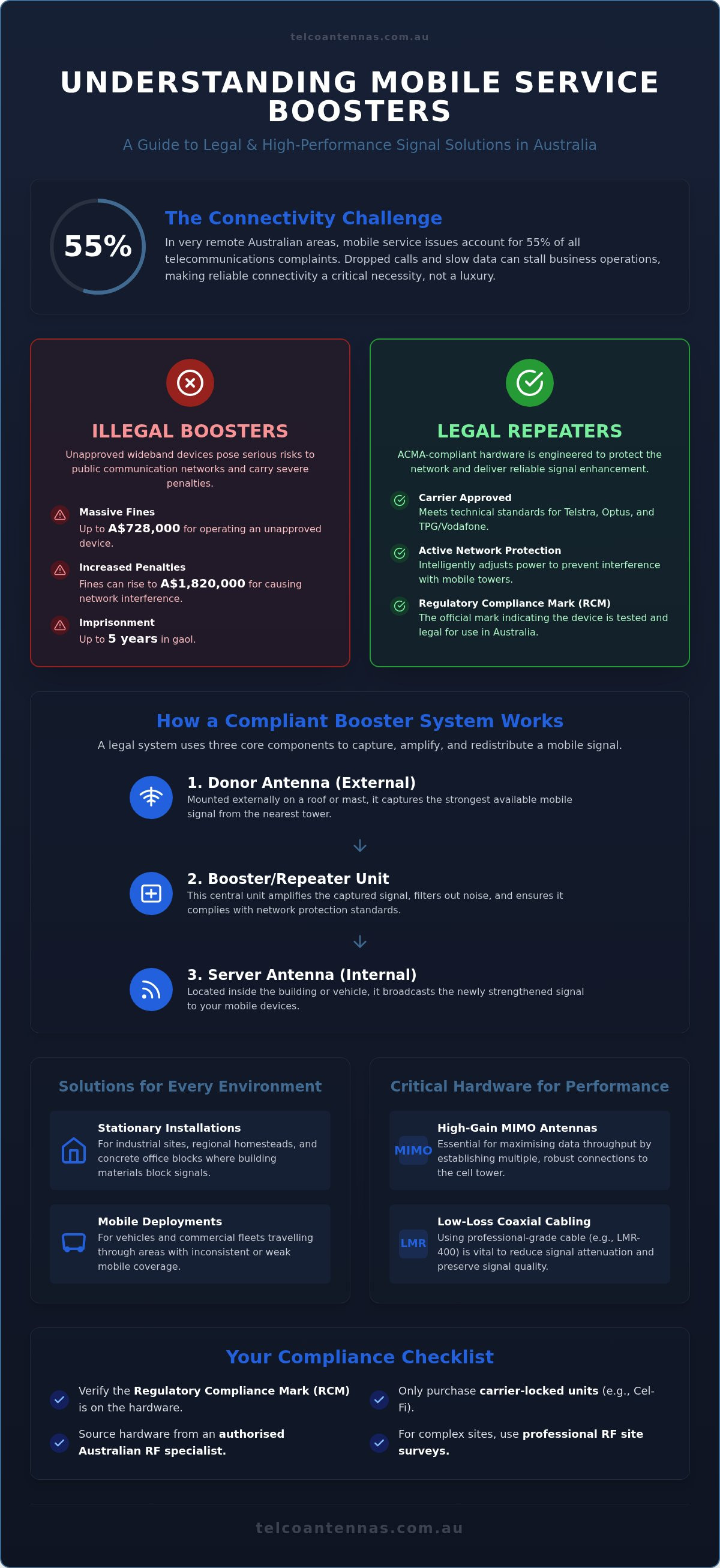
Did you know that operating an unapproved mobile service booster in Australia can result in a fine of up to A$728,000? For those managing remote sites or navigating regional black spots, where mobile issues account for 55% of all telecommunications complaints in very remote areas, the pressure to find a quick fix is immense. If you have experienced the frustration of dropped calls and data speeds that stall your business operations, you understand that reliable connectivity is a necessity rather than a luxury.
This guide clarifies the technical and legal distinctions between prohibited wideband boosters and carrier-approved signal repeaters, ensuring your mobile or fixed-site installation remains compliant with ACMA regulations. You will learn how to achieve a stable 4G or 5G signal by selecting professional-grade hardware that is engineered to perform in the demanding Australian climate. We will examine the essential components of a high-performance system, from MIMO antennas to low-loss coaxial cabling, providing a clear path to a legal and dependable communication solution.
Key Takeaways
- Distinguish between illegal wideband devices and carrier-approved hardware to avoid significant ACMA penalties while selecting an effective mobile service booster.
- Understand the mechanical role of the donor antenna, booster unit, and server antenna in creating a functional signal enhancement system.
- Recognise why high-gain MIMO antennas and low-loss LMR-400 cabling are critical for maintaining data throughput and reducing signal attenuation.
- Identify the specific hardware configurations required for stationary industrial sites versus mobile deployments in vehicles or commercial fleets.
- Learn when to utilise professional RF site surveys and engineering services to ensure optimal coverage in complex or high-interference environments.
What is a Mobile Service Booster and How Does it Work?
A cellular repeater, which is technically known as a mobile service booster, is a sophisticated radio frequency (RF) system engineered to solve coverage deficits. It's important to distinguish this hardware from a simple change in mobile plans. While a different carrier might offer better theoretical coverage, a booster is a physical solution that captures, amplifies, and redistributes electromagnetic waves to overcome environmental barriers. It acts as a dedicated bridge between a distant carrier tower and your specific location, ensuring the signal strength is sufficient for both clear voice calls and high-speed data throughput.
A functional system relies on three core components working in sequence:
- Donor Antenna: Mounted externally, usually on a roof or mast, to capture the strongest available signal from the nearest base station.
- Booster Unit: The central processing hub that filters and amplifies the incoming RF signal while preventing network interference.
- Server Antenna: Located inside the building or vehicle to redistribute the strengthened signal to your mobile devices.
The Mechanics of Signal Amplification
The donor antenna establishes a link with the base station, which may be located many kilometres away in regional Australia. Once the raw signal is captured, it travels via low-loss coaxial cable to the booster unit. This device doesn't just make the signal louder; it cleans up the noise and increases the RSL (Receive Signal Level) to a usable threshold. After processing, the server antenna redistributes this enhanced signal within the structure. This mechanical process effectively bypasses the interference caused by external terrain or heavy building materials that typically block cellular waves.
Active Repeaters vs. Passive Antennas
In many scenarios, a high-gain MIMO antenna connected directly to a modem is enough to improve data speeds. This is a passive solution that relies on the antenna's ability to "see" the tower more clearly than a small internal device can. However, passive antennas often fail when you need coverage across multiple devices or within large structures. If you're working inside a metal shed or a concrete office block, the signal attenuation is often too severe for a passive antenna to overcome. In these instances, an active mobile service booster is required to regenerate the signal internally. This ensures your devices don't drop back to 3G or lose connectivity entirely when you move away from a window or doorway.
Many operators of remote industrial sites or regional homesteads unknowingly risk severe legal consequences by purchasing unapproved signal enhancement equipment from international marketplaces. These devices, which are often marketed generically as a mobile service booster, are typically wideband amplifiers that lack the intelligence to protect the integrity of the cellular network. The Australian Communications and Media Authority (ACMA) strictly regulates the radio frequency spectrum to ensure that consumer hardware does not disrupt public communication infrastructure. Operating unapproved equipment is not a minor oversight; it is a serious breach of the Radiocommunications Act 1992. The ACMA regulations on cellular repeaters mandate that any device used to enhance signal must be carrier-approved and meet specific technical safety standards. As of August 2026, the ACMA continues to enforce strict penalties for those found using illegal boosters. The maximum penalty for possessing or operating an unapproved device is 2,000 penalty units, currently valued at A$728,000. If your hardware causes substantial interference to the broader network, these fines can increase to 5,000 penalty units or A$1,820,000, and may include up to five years of imprisonment.How to Identify a Legal Mobile Booster
A compliant device is easily identified by the presence of the Regulatory Compliance Mark (RCM) on its chassis. This mark indicates the hardware has passed rigorous testing for Australian conditions. Unlike illegal wideband boosters, legal repeaters such as the Cel-Fi GO series include active network protection. This technology monitors the environment in real-time and reduces its power output if it detects that it might interfere with a nearby base station. Cel-Fi remains the primary brand approved by Telstra, Optus, and TPG/Vodafone because it is designed to operate on a single carrier's frequency at any given time, which prevents the cross-network noise that leads to tower shutdowns.
Steps to Ensure Your Installation is Compliant
To maintain full compliance, you should only source hardware from an authorised Australian RF specialist who can provide carrier-locked units. Professional guidance is often necessary to ensure that your specific antenna configuration does not lead to signal oscillation. It is a mandatory legal requirement that every cellular repeater must be registered with the relevant mobile network carrier before the system is powered on. This registration process allows the carrier to document the device's location, which is vital for network management and troubleshooting in regional black spots.
Comparing Booster Solutions: Stationary vs. Mobile Applications
Distinguishing between stationary and mobile environments is the first step in selecting the correct hardware. While both systems aim to provide a stable 4G or 5G connection, their mechanical requirements and regulatory gain limits differ significantly. A mobile service booster for a vehicle is engineered for a dynamic environment where the distance between the donor and server antennas is minimal, whereas a stationary system is designed for fixed structures where high isolation is easier to achieve. Selecting the wrong category of hardware for your application won't just result in poor performance; it can lead to system shutdowns due to feedback loops.
The most critical technical difference lies in the system gain. Stationary units are typically permitted up to 100dB of gain, allowing them to cover large internal areas like warehouses or multi-storey homesteads. In contrast, mobile units are restricted to 70dB. This lower gain is a deliberate design choice to prevent signal oscillation, which occurs when the amplified signal from the server antenna is "seen" and re-amplified by the donor antenna. If hardware is not specifically tuned for these environments, it can create network-wide interference, which is why the ACMA continues to crack down on illegal mobile phone boosters that lack these intelligent gain controls.
Stationary Solutions for Buildings
Fixed installations are the primary method for overcoming "black spots" in rural homesteads and metal-clad industrial sheds. These structures often act as Faraday cages, blocking external cellular signals entirely. To resolve this, a donor antenna is mounted on a high-clearance mast or roof to capture the RSL from the carrier tower. Within larger warehouses, the system may utilise multiple server antennas connected via splitters to ensure uniform coverage. This integration with existing RF infrastructure requires precise cable runs, often utilising low-loss LMR-400 to minimise attenuation over longer distances. Whether you are installing a mobile service booster in a remote office or a farm shed, the hardware must be configured to handle the specific path loss of the building materials.
Mobile Solutions for Vehicles
For those traversing regional highways or off-road tracks, a mobile-optimised solution is essential. These systems must be ruggedised enough to withstand the constant vibrations and extreme temperatures of Australian corrugated roads. Hardware like the Cel-Fi GO Mobile is housed in a shock-resistant casing and paired with heavy-duty antennas designed for bullbar or roof mounting. Unlike stationary antennas that are often directional, mobile donor antennas are usually omni-directional to maintain a link as the vehicle changes orientation relative to the nearest tower. This ensures continuous voice and data connectivity for commercial fleets and caravans even in highly isolated areas where tower hand-offs are frequent.
Critical Hardware: Antennas and Coaxial Cables
The performance of a mobile service booster is fundamentally limited by the quality of the physical components connected to it. Even the most advanced carrier-approved amplifier cannot compensate for a poor-quality signal path. If the incoming signal is degraded by high-loss cabling or an incorrectly specified antenna, the system's ability to maintain high-speed data and clear voice calls is compromised. In modern 4G and 5G environments, the physical layer is the primary determinant of whether you achieve the theoretical maximum throughput of your hardware or merely a marginal improvement.
MIMO (Multiple-Input Multiple-Output) technology is now standard for Australian cellular networks. It relies on multiple antennas to send and receive data simultaneously over the same frequency. Without a high-quality MIMO antenna array, a mobile service booster cannot fully utilise the spatial multiplexing capabilities of the carrier's tower. This results in significantly lower data speeds, particularly in regional areas where signal quality is already borderline. To ensure your physical layer is up to standard, you can source professional-grade MIMO antennas and LMR-400 cabling from Telco Antennas designed for Australian conditions.
Selecting the Correct Antenna
For stationary installations with a clear line of sight to a specific tower, a directional Yagi antenna is the most effective choice. It provides high gain by focusing its reception in a narrow beam, which is ideal for remote homesteads. Conversely, mobile applications require omnidirectional antennas that can maintain a connection as the vehicle moves through changing terrain. Correct antenna polarisation, typically vertical or cross-polarised for MIMO, is essential in rural areas to ensure the incoming signal matches the orientation of the carrier's transmission, thereby maximising the Signal-to-Noise Ratio (SNR). For permanent sites, using heavy-duty aluminium tri-pods or telescopic masts ensures the donor antenna remains stable during high-wind events.
The Importance of LMR-400 Coaxial Cable
Signal attenuation is the loss of signal strength as it travels through a cable, and it is the most common cause of system failure. While standard RG-58 cable is common in consumer electronics, its high attenuation makes it unsuitable for cellular frequencies, especially the higher bands used for 5G. LMR-400 is the industry standard for low-loss cabling because it features superior shielding and a thicker conductor, which preserves the gain provided by your antennas. At 3.5GHz, the difference in loss over a ten-metre run between cheap cable and LMR-400 can be the difference between a stable 5G connection and no signal at all. Long-term reliability also depends on weather-proof connections, typically achieved by using self-amalgamating tape or IP-rated enclosures to prevent moisture ingress into the RF path.
Temporary sites, such as short-term construction projects or exploration camps, often require rapidly deployable infrastructure. In these cases, utilising telescopic mast trailers and skids allows for the elevation of donor antennas to clear local obstructions without the need for permanent civil works. These mobile platforms can be equipped with a mobile service booster and high-gain antennas to establish a reliable communication hub in a matter of hours.
Engineering for Industrial and Remote Sites
Large-scale mining or agricultural operations often require custom communication tower design to achieve the necessary height for line-of-sight connectivity. When coverage needs to extend across several kilometres, point-to-point wireless bridges can be integrated into the system to relay the signal from a primary hub to remote outbuildings. Managing multi-carrier requirements within a single professional deployment is another area where engineering expertise is vital. This involves configuring hardware to support Telstra, Optus, and Vodafone simultaneously without causing cross-network interference or desensitisation of the receivers.
Redundancy and Hybrid Solutions
For the ultimate off-grid redundancy, many professional installations now combine cellular enhancement with satellite backhaul. By integrating Starlink after market power conversion, operators can run their satellite systems on native 12V or 24V DC power, eliminating the inefficiencies of inverters. This hybrid approach ensures that if one network fails, the other remains active. If you are managing a mission-critical site where downtime is not an option, you should organise a professional RF site survey with our engineering team to design a resilient, high-availability communication architecture tailored to your specific environmental challenges.
Securing Your Connectivity with Compliant RF Solutions
Achieving reliable voice and data coverage in regional Australia requires a deliberate approach that balances technical performance with strict regulatory adherence. You now understand that a legal mobile service booster is not a standalone gadget; it's the core of an integrated system that relies on high-gain antennas and low-loss LMR-400 cabling to overcome environmental attenuation. By distinguishing between prohibited wideband devices and carrier-approved repeaters, you protect your operation from significant legal risks while ensuring your hardware remains functional as network standards evolve.
Whether you're outfitting a commercial fleet or an industrial warehouse, the success of your installation depends on selecting components engineered for the Australian climate. Since 2008, our team has provided specialist RF engineering expertise and fully compliant, ACMA-approved hardware backed by national support and shipping. You can browse our range of carrier-approved Cel-Fi GO boosters to find a solution that meets your specific site requirements. With the correct hardware and a focus on precision, you can eliminate regional black spots and maintain the connectivity your business demands. Additionally, for those requiring specialised digital communication tools like virtual numbers for SMS verification, you can check out Anosim.
Frequently Asked Questions
Is it legal to use a mobile service booster in Australia?
It is only legal to use a cellular mobile repeater that has been specifically approved by an Australian carrier. Most wideband devices sold as a mobile service booster on international marketplaces are illegal to possess or operate. These unapproved units lack the network protection features required by the ACMA. Using them can result in heavy fines, so you should only purchase hardware that carries the Regulatory Compliance Mark (RCM).
Will a mobile signal booster work if I have no signal at all outside?
No, a signal enhancement system cannot create a signal where none exists. The donor antenna must be able to capture at least a marginal Receive Signal Level (RSL) from a nearby carrier tower. If you are in a complete dead zone with no external signal, a booster will have no raw data to amplify. In these situations, alternative solutions like satellite backhaul may be necessary for connectivity.
What is the difference between a booster and a repeater?
Technically, a booster usually refers to an illegal wideband amplifier that boosts all frequencies indiscriminately, which causes network interference. A repeater, such as the Cel-Fi GO, is an intelligent device that selectively amplifies a specific carrier's signal. While the term mobile service booster is often used by consumers, the ACMA specifically authorises exempt repeaters that meet strict network protection standards to ensure they don't disrupt the broader cellular infrastructure.
Can I use one booster for both Telstra and Optus at the same time?
You cannot boost multiple carriers simultaneously with a single legal device. Australian regulations require repeaters to be locked to one specific network, such as Telstra, Optus, or TPG/Vodafone, to prevent interference. While some hardware allows you to switch between carriers via a mobile app, the system can only process one carrier's frequencies at any given time. Boosting multiple networks requires separate dedicated units and antennas.
Do I need a professional to install my Cel-Fi GO system?
While many mobile and residential kits are designed for DIY setup, complex industrial or large-scale building installations often require professional expertise. A technician can perform an RF site survey to identify the optimal tower and ensure sufficient antenna isolation. This prevents signal oscillation, which occurs when the internal and external antennas are too close, causing the system to reduce its power or shut down entirely to protect the network.
How much does a legal mobile service booster cost to install?
The total investment for a legal installation depends on the specific hardware model and the complexity of the site. Factors such as the choice of donor antenna, the length of low-loss LMR-400 cabling required, and the need for internal server antennas all influence the final cost. For industrial sites, additional expenses may include mounting masts or telescopic trailers to achieve the necessary line-of-sight to the nearest base station.
Will a booster improve my mobile internet speeds as well as voice calls?
Yes, a correctly configured system will significantly enhance both voice clarity and data throughput. By improving the Signal-to-Noise Ratio (SNR), the booster allows your mobile device to maintain a stable 4G or 5G connection. To achieve the best possible internet speeds, it's essential to use high-quality MIMO antennas that allow for multiple data streams, rather than relying on older, single-input antenna technology that limits bandwidth. Beyond signal strength, ensuring your smartphones and tablets are physically protected is key to long-term reliability; you can discover First Help Tech for expert tips on keeping your devices in top shape.
What happens if I use an unapproved booster and the ACMA finds out?
Operating an unapproved device is a serious breach of the Radiocommunications Act 1992. If the ACMA identifies your hardware as the source of network interference, you can face an immediate fine of up to A$728,000. For severe cases where significant disruption is caused to public infrastructure or emergency services, penalties can increase to over A$1.8 million or result in five years of imprisonment. The ACMA actively monitors the spectrum for such interference.


