
Why would you invest in a high-gain MIMO antenna and a legal Cel-Fi GO repeater only to let your signal bleed away before it even reaches your living room? It's a common frustration to see a strong signal on the roof but experience dropped calls inside, usually because the "artery" of the system is failing. Most users focus on the booster itself, yet the performance of your coaxial cable for mobile signal booster is what truly determines if that signal survives the journey into your home or office.
We understand that navigating technical specifications like impedance and attenuation can feel overwhelming. This guide provides the technical clarity you need to select the correct low-loss cabling to ensure your system performs at its peak in Australian conditions. We'll explain why 50 Ohm LMR-400 is the professional standard for minimising loss, how to identify the right SMA or N-Type connectors for your hardware, and how to ensure your installation remains durable against the intense UV and heat of the Australian climate.
Key Takeaways
- Understand why selecting the correct coaxial cable for mobile signal booster is essential to prevent signal loss between your external antenna and the repeater unit.
- Learn how attenuation works and why high-frequency signals like 5G require higher-grade, low-loss cabling to maintain performance over long distances.
- Compare common cable types such as RG58 and LMR-195 against professional-grade LMR-400 to find the right balance of flexibility and signal integrity for your specific setup.
- Discover the step-by-step process for calculating cable runs and selecting pre-terminated assemblies that minimise connection loss in harsh Australian environments.
What is Coaxial Cable for Mobile Signal Boosters?
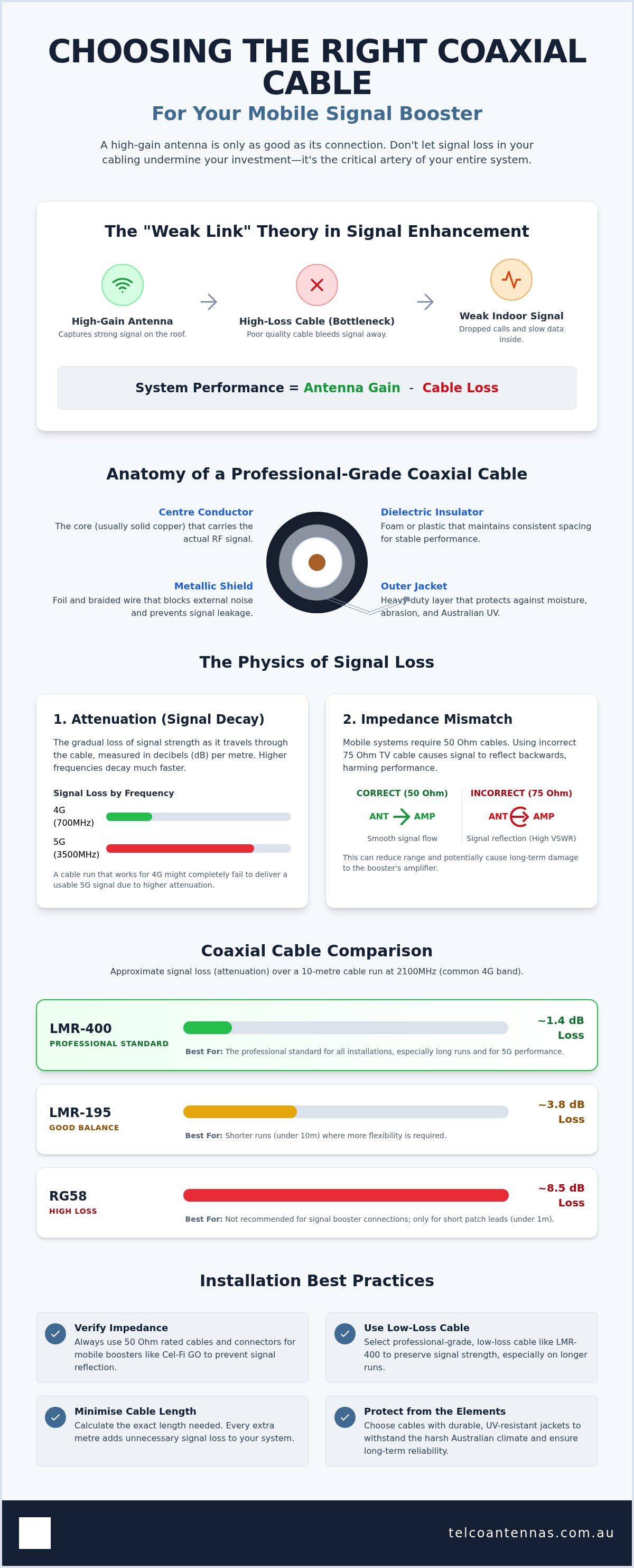
A Coaxial cable is a specialised transmission line engineered to carry high-frequency radio signals while protecting them from environmental interference. Within a signal enhancement system, the coaxial cable for mobile signal booster serves as the critical physical link between the external donor antenna and the internal repeater unit. While it may look like a standard electrical wire, its internal geometry is precisely managed to ensure that radio frequency (RF) energy travels with minimal resistance.
The construction of a professional-grade coax involves four distinct layers that must work in harmony:
- Centre Conductor: The core material, usually solid copper or copper-clad aluminium, that carries the actual RF signal.
- Dielectric Insulator: A layer of foam or plastic that maintains a consistent distance between the core and the shield to ensure stable electrical properties.
- Metallic Shield: A combination of foil and braided wire that prevents signal leakage and blocks external electromagnetic noise.
- Outer Jacket: A heavy-duty layer designed to protect the internal components from moisture, physical abrasion, and the intense Australian sun.
Standard cables used for television or CCTV are fundamentally unsuitable for this application. Those industries typically rely on 75 Ohm impedance, whereas mobile telecommunications hardware is built to a 50 Ohm standard. Mixing these two creates an impedance mismatch that reflects signal back toward the source, potentially causing hardware instability and significant power loss.
The "Weak Link" Theory in Signal Enhancement
Installing a high-performance antenna is only half the battle. If you connect that antenna using high-loss cabling, you risk negating the gain you've just achieved. This relationship is defined by System Gain; the total performance of your setup is the antenna gain minus the cable loss. If your cable choice is poor, you'll likely notice a high noise floor on your booster's diagnostic tools. This often manifests as fluctuating signal bars or calls that drop out despite the booster showing an active connection. Using the wrong grade of cable essentially turns your high-end antenna into a bottleneck.
Mobile Booster Compatibility Requirements
Australian carrier-approved devices, like the Cel-Fi GO, require 50 Ohm impedance to function correctly. Using the wrong cable type doesn't just reduce performance; it can lead to standing wave issues that stress the booster's internal amplifiers. Professional installations prioritise cables with dense shielding to isolate the mobile signal from electromagnetic interference generated by other electronics. This ensures the signal arriving at your booster is as clean and powerful as possible, allowing the hardware to operate at its maximum legal output without being drowned out by background noise.
The Physics of Signal Loss: Attenuation and Impedance
Understanding the technical constraints of your coaxial cable for mobile signal booster requires a look at how radio frequency energy behaves within a confined space. Attenuation is the primary challenge; it represents the gradual loss of signal intensity as it travels through the cable. This loss is measured in decibels (dB) per metre. Engineers often use precision equipment to measure cable loss across different frequencies, as the rate of decay isn't uniform. High-frequency signals, such as those used in 5G networks (3500MHz), experience significantly higher attenuation than lower-frequency 4G signals (700MHz). This means a cable run that works for 4G might completely fail to deliver a usable 5G signal.
Impedance is another non-negotiable factor. Mobile boosters are designed for 50 Ohm systems, which provide a balance between power handling and low loss. If you introduce a 75 Ohm cable, you create an impedance mismatch. This causes a portion of the signal to reflect back toward the booster rather than being transmitted through the antenna. This phenomenon is quantified as the Voltage Standing Wave Ratio (VSWR). A high VSWR doesn't just reduce the booster’s effective range; it can generate heat within the amplifier circuitry, potentially leading to long-term hardware damage.
Factors Influencing Attenuation Rates
Several physical attributes dictate how well a cable preserves signal. Solid copper conductors offer superior conductivity compared to copper-clad aluminium (CCA), which is often found in budget-grade alternatives. While CCA is lighter, its higher DC resistance increases attenuation. The dielectric, the insulating layer, also plays a role by determining the signal's velocity of propagation. High-quality foam dielectrics ensure the signal moves efficiently while maintaining the physical spacing required to keep impedance stable. Shielding effectiveness is equally vital, as it prevents signal "leakage" and keeps external noise from contaminating the stream.
Common Impedance Mistakes for DIY Installers
A common error among DIY installers is repurposing RG6 television cable. Because RG6 is a 75 Ohm standard, using it for a mobile booster leads to massive signal reflection and "ghosting" effects. This mismatch severely limits the system's ability to reach distant towers. You can usually identify the correct cable by checking the text printed on the outer jacket. If it doesn't explicitly state 50 Ohm or show a professional designation like LMR-400, it's likely the wrong tool for the job. For those unsure of their requirements, consulting a specialist for site-specific cabling advice can prevent costly installation errors.
Comparing Common Coax Types: RG58, LMR-195, and LMR-400
Selecting the correct grade of 50 Ohm cable requires a balance between physical flexibility and signal integrity. While various options exist, the three most common types used in the Australian market are RG58, LMR-195, and LMR-400. Each serves a specific purpose based on the environment and the length of the run. RG58 is a thin, 5mm diameter cable that's highly flexible, making it the standard choice for short vehicle installations where space is at a premium. However, it's generally unsuitable for building installs because its high loss rates can quickly consume the gain provided by your antenna.
LMR-195 acts as a middle-ground solution. It's similar in size to RG58 but features better shielding and a lower attenuation profile. This makes it ideal for medium-length runs in caravans or small sheds where you need a cable that's easier to route through tight cavities than industrial-grade options. For professional residential and commercial deployments, LMR-400 is the industry standard. It's a thicker, 10mm cable that provides the lowest loss possible for a flexible coax. The trade-off is a larger bend radius; LMR-400 is rigid and requires careful planning to avoid kinking the internal dielectric, which would permanently damage the signal path.
Performance Data: Signal Loss per 10 Metres
The clinical reality of Coaxial Cable Attenuation becomes clear when you compare different grades across the frequencies used by Australian carriers like Telstra and Optus. As frequency increases, the "skin effect" drives the signal to the outer edge of the conductor, increasing resistance and loss. The following table illustrates typical loss figures in decibels (dB) for a 10-metre cable run.
| Frequency | RG58 (dB Loss) | LMR-195 (dB Loss) | LMR-400 (dB Loss) |
|---|---|---|---|
| 700MHz (4G Low Band) | 4.5 dB | 2.5 dB | 1.1 dB |
| 1800MHz (4G/5G Mid Band) | 8.0 dB | 4.2 dB | 1.8 dB |
| 2600MHz (High Band) | 10.5 dB | 5.2 dB | 2.2 dB |
LMR-400 is the preferred cable for any run exceeding 10 metres.
Physical Durability and Australian Environmental Resistance
Cable performance isn't just about electrical specs; it's about how the hardware survives the Australian climate. Cables exposed on rooftops must be UV-stabilised to prevent the jacket from cracking and becoming brittle under intense sun exposure. Moisture ingress is a silent killer of RF systems. Budget "braid-only" cables often lack a solid foil layer, allowing humidity to penetrate the dielectric over time. This is particularly problematic in coastal or tropical regions where salt air can corrode the copper braid. For underground or high-exposure outdoor runs, we recommend cables with a Polyethylene (PE) jacket, which offers superior moisture resistance and physical durability compared to standard PVC.
Selecting and Installing Your Cable: Best Practices
A successful installation relies on methodical planning rather than trial and error. To ensure your coaxial cable for mobile signal booster delivers the expected performance, follow a structured deployment sequence. Start by calculating the exact distance between your donor antenna and the booster unit. Avoid the temptation to buy a longer cable "just in case" because every additional metre introduces measurable signal attenuation. Once you have the length, select the cable grade based on the frequency requirements established earlier; for most building installs, this means LMR-400.
Before beginning the physical run, identify your connector requirements. Most external antennas utilise N-Type connectors, while boosters like the Cel-Fi GO typically use SMA. Plan your route to avoid sharp corners. Forcing a thick cable like LMR-400 into a 90-degree bend can crush the internal dielectric, creating an impedance spike that ruins the signal path. Finally, apply self-amalgamating tape to every external join. Standard electrical tape will fail under the Australian sun, leading to moisture ingress and system failure.
Connector Guide: SMA vs N-Type vs FME
N-Type connectors are the large, rugged interfaces found on the back of donor antennas. They're designed for outdoor environments and high-power handling. Conversely, SMA connectors are small, threaded interfaces used for the booster side or internal antennas. While FME connectors are sometimes used for vehicle setups, they're less common in building installs. We strictly recommend crimped connectors over twist-on varieties. A crimped connection provides a gas-tight seal that ensures long-term signal integrity. Minimise the use of adapters; every transition adds roughly 0.5dB of insertion loss to your system.
Installation Tips for Australian Properties
Managing the physical environment is just as important as the electrical specs. Create a drip loop at the cable entry point to prevent rainwater from following the cable into your roof cavity during heavy storms. Interference is another risk; maintain a minimum separation of 300mm between your RF cabling and high-voltage 240V AC power lines to avoid noise contamination. On metal roofs, secure all cabling with UV-rated ties. Loose cables will chafe against corrugated iron in high winds, eventually wearing through the outer jacket and exposing the shield to the elements. For professional results, you can order custom pre-terminated cable assemblies built to your exact specifications.
Professional-Grade Cabling Solutions from Telco Antennas
Telco Antennas specialises in providing the industrial-grade hardware required to make mobile enhancement systems work in the most challenging Australian environments. Our LMR-400 range is considered the gold standard for any high-performance mobile repeater deployment. This specific coaxial cable for mobile signal booster is engineered to the same standards as the cabling found on professional communication towers; it's designed to deliver maximum signal integrity over long distances. By using a superior grade of coax, you ensure that the gain provided by your MIMO antennas isn't wasted before it reaches the booster. Selecting a high-quality coaxial cable for mobile signal booster is a technical necessity rather than an optional upgrade for those seeking reliable coverage.
We provide more than just off-the-shelf components. Our custom cable assembly services allow you to order the exact length needed for your specific site. This is a critical technical advantage; any excess cable coiled in a ceiling cavity acts as an unnecessary source of signal loss. Our pre-terminated cables are built in a controlled environment using factory-grade precision tools. This ensures that the N-Type or SMA connectors are perfectly seated, providing a gas-tight seal that field-crimping often fails to achieve. These assemblies are designed for seamless integration with Cel-Fi GO kits, ensuring your system remains stable and carrier-compliant.
Why Our LMR-400 Outperforms Generic Alternatives
Our LMR-400 features high-purity copper conductors and a superior gas-injected foam dielectric. These materials work together to provide a higher velocity of propagation and lower attenuation compared to budget alternatives found in generic retail stores. Because we prioritise RF engineering standards, our cables are fully compatible with the frequency bands used by all major Australian carriers, including Telstra, Optus, and Vodafone. You can view our full range of Telco Antennas LMR-400 Coaxial Cables to find the specific configuration your site requires.
Expert Support for Complex Deployments
For industrial sites or remote homesteads, cabling strategy becomes a component of a larger engineering challenge. We offer professional RF site surveys to identify the most efficient cable routes and antenna placements. This consultative approach allows us to help you calculate a precise link budget before you commit to hardware. We look at the intersection of hardware specifications and real-world environmental variables to ensure your system performs at its peak. If you require technical assistance with a complex installation, contact our engineering team for a professional signal solution.
Optimising Your Signal for the Long Term
Selecting the right coaxial cable for mobile signal booster is the final, critical step in ensuring your communication system operates reliably. The physical properties of your cabling, from the 50 Ohm impedance matching to the low-loss characteristics of LMR-400, directly dictate whether your booster can maintain a stable connection with distant towers. By prioritising high-quality materials and precise installation techniques, you protect your hardware from damage and ensure that your signal remains strong even during the intense heat and heavy storms typical of the Australian climate.
Telco Antennas has been Australian owned and operated since 2008, specialising in LMR-400 solutions for remote sites and professional Cel-Fi GO deployments. Our engineering-focused approach ensures that every component in your MIMO antenna system works in harmony to provide maximum coverage. If you're ready to eliminate signal bottlenecks, you can browse our range of high-performance Low-Loss Coaxial Cables to find the perfect match for your installation. Investing in professional-grade cabling today provides the peace of mind that your mobile connectivity will remain dependable for years to come.
Frequently Asked Questions
Can I use my existing TV coaxial cable for a mobile signal booster?
No, you cannot use TV cable for this application. Residential television systems operate on 75 Ohm impedance, while a coaxial cable for mobile signal booster must be 50 Ohm to match the cellular hardware. Using RG6 or similar TV leads causes a significant impedance mismatch. This reflects radio frequency energy back into your booster, which reduces the effective range and can potentially lead to internal amplifier damage over time.
How long can a coaxial cable be before I lose too much mobile signal?
The maximum length depends on your cable grade and the frequencies you need to boost. For low-loss LMR-400, we generally recommend keeping runs under 30 metres to maintain a healthy link budget. If you're using thinner RG58, anything beyond 5 metres will likely result in too much signal degradation. High-frequency 5G signals are particularly sensitive to length, so it's always best to keep the run as short as physically possible.
What is the difference between RG58 and LMR-400 cable?
The primary differences are physical diameter and attenuation performance. RG58 is a flexible 5mm cable suited for short vehicle runs, but it suffers from high signal loss. LMR-400 is a much thicker 10mm cable designed for permanent building installations. It offers significantly lower attenuation, which is essential for preserving the gain from your antenna over longer distances. Choosing LMR-400 ensures your system doesn't lose the very signal it's trying to enhance.
Do I need a special tool to install connectors on my coaxial cable?
Professional installations require specialised crimping tools to ensure a gas-tight seal between the cable and the connector. While twist-on connectors exist, they're prone to moisture ingress and signal leakage, especially in the harsh Australian climate. For DIY installers, we recommend ordering pre-terminated coaxial cable for mobile signal booster assemblies. These are factory-tested and ready to plug in, removing the need for expensive tools or the risk of a poor manual termination.
Why does my mobile signal booster have different connectors on each end?
This design choice balances durability with space constraints. Outdoor antennas typically use large N-Type connectors because they're rugged and offer superior weatherproofing against wind and rain. On the booster side, manufacturers like Cel-Fi use smaller SMA connectors to save space on the device's internal circuit board. This necessitates a patch lead or a cable assembly with different connectors on each end to bridge the two components of your system.
Is LMR-400 cable waterproof and suitable for outdoor use in Australia?
Standard LMR-400 with a Polyethylene (PE) jacket is highly waterproof and UV-stabilised, making it ideal for the Australian sun. However, the cable itself is only part of the equation. You must also protect the connection points at the antenna and booster. We always advise using self-amalgamating tape on all external joins. This creates a permanent, moisture-proof seal that standard electrical tape simply cannot provide in high-humidity or coastal environments.
Does the thickness of the coaxial cable affect the signal speed?
Yes, cable thickness directly impacts data throughput. While the cable doesn't limit speed like an internet plan, thicker low-loss cables preserve a higher Signal-to-Noise Ratio (SNR). When your booster receives a cleaner, stronger signal, it can utilise more advanced modulation schemes. This results in faster 4G and 5G download speeds. Using thin, high-loss cabling often forces the system to drop to lower, slower modulation levels just to maintain a stable connection.
Can I join two coaxial cables together if the lead is too short?
You can join cables using a barrel adapter, but it's a practice we generally discourage. Every connector or join in your line introduces approximately 0.5dB of insertion loss. In areas with already weak outdoor signal, this extra loss can be the difference between a working system and a failed one. It's always technically superior to use a single, continuous run of high-quality cable that's cut to the exact length your site requires.


