

Your 4WD's factory 12V socket is likely the weakest link in your remote communication setup. While the Starlink Mini is designed for portability, many travellers discover that standard vehicle power systems struggle to maintain the stable current required for high-speed satellite links. It's a common frustration to see your connection drop out exactly when you reach a remote black spot, often due to voltage sags or inefficient inverters that drain your house batteries faster than necessary.
We understand that reliable internet isn't a luxury when you're navigating the Outback; it's a critical safety and operational tool. This guide will help you master the technical requirements for selecting a starlink mini 12v adapter that ensures consistent performance across Australia's harshest tracks. You'll learn why a dedicated DC-to-DC step-up converter providing a stable 30V output is superior to basic plugs, especially when dealing with the peak power draws that can trip unprotected systems. We will also examine the essential hardware specifications, from IP67 weatherproofing to integrated fuses, that differentiate a professional-grade installation from a temporary fix.
Key Takeaways
- Learn why the Starlink Mini's wide input range still requires a voltage-stabilised source to prevent dropouts during high-throughput satellite handovers.
- Identify the essential features of a high-performance starlink mini 12v adapter, including the necessity of DC-to-DC step-up conversion for consistent 30V delivery.
- Understand how to calculate and mitigate voltage drop by selecting the correct cable gauge and using industry-standard Anderson plugs for secure off-road connections.
- Master the design of a dedicated electrical circuit that isolates your communication hardware from high-draw motors and ensures proper fuse protection.
- Discover how to ruggedise your setup for the Australian environment with UV-stabilised insulation and physical abrasion protection to ensure long-term reliability in the bush.
Understanding Starlink Mini Power Requirements: 12V vs 24V Systems
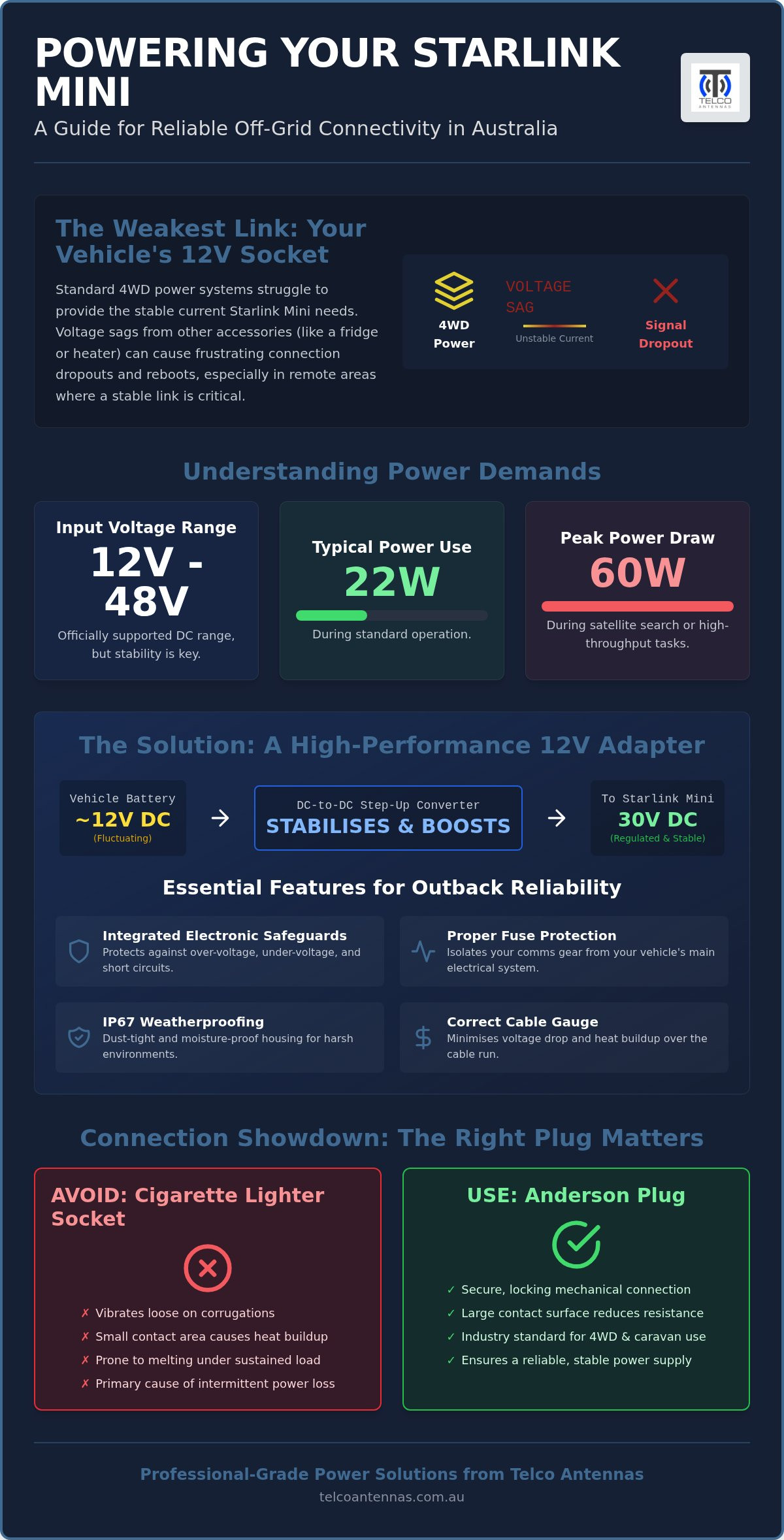
The Starlink Mini represents a significant shift in portable connectivity, offering an integrated router and a versatile DC input range that officially supports 12V to 48V. This broad compatibility is a major advantage for Australian off-grid travellers who want to avoid the energy waste associated with running a 240V inverter. However, providing a reliable connection to the Starlink satellite network requires more than just a physical plug match. While the unit typically consumes about 22W during standard operation, it can demand peak power spikes of up to 60W when searching for satellites or during intensive data uploads.
Relying on a basic, unregulated starlink mini 12v adapter often leads to performance issues. In a typical 4WD or caravan environment, battery voltage is rarely a static 12.6V. It fluctuates based on the state of charge, solar input, and the demands of other accessories. Without a regulated power source, these fluctuations can cause the Starlink hardware to behave unpredictably, leading to slow speeds or total connection loss at critical moments.
The Problem with Direct 12V Connections
Directly wiring your dish into a 12V circuit exposes the hardware to the "dirty" power environment of a working vehicle. Voltage sag is the temporary drop in electrical potential caused by high-load appliances. When a 12V fridge compressor kicks in or a diesel heater starts its glow plug cycle, the sudden surge in current can cause the system voltage to dip below the Starlink's operational threshold. These sags often result in frustrating reboot cycles where the dish loses its satellite lock and spends several minutes re-acquiring the signal, effectively rendering your remote office or emergency comms useless.
Benefits of 24V and 48V Step-Up Converters
The most reliable way to power the unit is through a high-quality starlink mini 12v adapter that incorporates a DC-to-DC step-up converter. By boosting the native 12V battery output to a regulated 24V, 30V, or 48V, you create a buffer against system fluctuations. This approach follows basic electrical principles; higher voltage allows for lower current (Amps) to deliver the same wattage. This reduction in current flow means less heat is generated in the cables and the hardware remains stable even during high-throughput tasks. These converters are perfectly suited for modern LiFePO4 battery systems, ensuring that your internet remains fast and stable regardless of other loads on your electrical grid.
Key Features of High-Performance Starlink Mini 12V Adapters
Selecting a starlink mini 12v adapter requires looking beyond basic voltage specifications to the physical build quality of the unit. In the Australian bush, your equipment must endure extreme heat, fine bulldust, and constant corrugations. A high-performance adapter acts as the critical interface between your sensitive satellite hardware and your vehicle's often harsh electrical environment. Beyond simple power conversion, the best units integrate electronic safeguards such as over-voltage, under-voltage, and short-circuit protection. These features prevent a faulty alternator or a wiring short from permanently damaging your dish.
Physical protection is equally vital. High-quality adapters often feature IP67-rated housings, ensuring the internal DC-to-DC circuitry remains dust-tight and protected against moisture. When you're parked up in a coastal camp or driving through a tropical downpour, these seals prevent corrosion from compromising your connection. For those building a permanent touring setup, choosing professional-grade power conversion hardware ensures your internet remains functional regardless of the external conditions.
Anderson Plugs vs. Cigarette Lighter Sockets
While many entry-level adapters use standard cigarette lighter plugs, these are often the primary cause of system failure on rough tracks. Cigarette sockets rely on a small spring-loaded tip and side tension, which can easily bounce loose on the Oodnadatta Track or any corrugated surface. This leads to intermittent power loss and hardware reboots. In contrast, Anderson plugs are the industry standard for 4WD and caravan use because they provide a secure, locking mechanical connection. They also offer a significantly larger contact surface area, which reduces electrical resistance and prevents the heat buildup that often melts plastic cigarette sockets under constant 60W loads.
Cable Length and Signal Integrity
The physical properties of your cabling directly impact the performance of your Starlink Mini. There is a constant trade-off between the convenience of a long cable and the reality of voltage drop. Using high-quality, heavy-gauge copper is essential to minimise resistance. In a vehicle-mounted setup, a 7-metre cable is often considered the "sweet spot." This length provides enough flexibility to position the dish away from the shade of your awning or roof rack while maintaining sufficient signal integrity. Cables used in these environments must also feature UV-stabilised insulation and abrasion-resistant outer jackets to survive long-term exposure to the Australian sun and the physical rubbing against roof racks or bull bars.
Overcoming Voltage Drop: Why Cable Gauge Matters
Voltage drop is the silent killer of remote internet performance. It is governed by Ohm’s Law, which states that voltage equals current multiplied by resistance (V=IR). In a DC system, every centimetre of cable adds resistance. If your cabling is too thin or too long, the resistance consumes a portion of the electrical potential before it reaches the hardware. For example, a healthy 12.6V battery output can easily drop to 11.5V at the end of a standard 18AWG cable during a 60W power spike. This reduction often pushes the hardware below its stable operating threshold, causing the intermittent dropouts many travellers blame on the satellite network itself.
A high-quality starlink mini 12v adapter that incorporates a step-up converter is the most effective defence against this loss. By boosting the internal voltage to 30V or 48V, the system requires significantly less current to deliver the same power. Since voltage drop is proportional to current, increasing the voltage reduces the "I" in the equation, making the entire setup more resilient to cable resistance. This allows for longer cable runs without the risk of signal degradation or hardware instability, which is vital when you need to park your vehicle in the shade while placing your dish in the sun.
Selecting the Correct Wire Gauge
While the standard 18AWG wire provided with many consumer-grade electronics might suffice for short indoor runs, it's inadequate for the high-demand environment of a 4WD. Upgrading to a heavy-duty 14AWG or 12AWG cable significantly reduces resistance and improves power delivery efficiency. It's also vital to source high-quality tinned copper wire for your installation. Tinned copper resists the corrosion common in coastal Australian environments, ensuring that your electrical connections remain low-resistance even after years of exposure to salt air and high humidity. Using thicker, better-quality wire ensures that the power your battery provides actually reaches the dish.
Thermal Management in High-Ambient Heat
Australian summer temperatures frequently exceed 40°C, which has a direct physical impact on your electrical system. As the temperature rises, the electrical resistance within the copper wiring also increases, further compounding the issue of voltage drop. A cheap starlink mini 12v adapter housed in thin plastic will often struggle to dissipate the heat generated by its internal components. This can lead to "thermal throttling," where the adapter reduces its power output to protect itself, resulting in sluggish internet speeds or sudden disconnections. Professional-grade units use aluminium heat sinking or ventilated housings to maintain stable performance even when the mercury climbs in the red centre.
Integrating Starlink Mini into Your 4WD or Caravan Electrical Setup
Designing a reliable electrical layout for your Starlink Mini requires more than just finding a spare 12V outlet. To ensure the hardware operates without interference, it should ideally be installed on a dedicated circuit. Sharing a power line with high-draw inductive loads, such as a 12V fridge or a water pump, introduces electrical noise and sudden voltage spikes that can disrupt the sensitive electronics within the dish. By isolating your communication gear, you ensure that the power delivery remains clean and consistent, regardless of what other accessories are cycling on or off in your canopy or caravan.
Physical installation also plays a major role in long-term reliability. The constant vibration and heavy jarring experienced on Australian tracks can quickly fatigue poorly secured wiring or loose components. When installing your starlink mini 12v adapter, ensure the converter is hard-mounted to a solid surface behind the dash or within an electrical cabinet using mechanical fasteners. Avoiding "floating" installations prevents the internal circuitry from suffering lead-stress or solder-joint failure over thousands of kilometres of corrugations. For a professional finish, you can source specialised Starlink power conversion kits that are engineered to withstand these specific environmental challenges.
Battery management is another critical consideration for off-grid users. While the Starlink Mini is efficient, its idle power draw of approximately 22W can still deplete a small house battery if left running overnight. Integrating a physical isolation switch or connecting the adapter to a managed output on your battery monitor allows you to track consumption accurately. This ensures you aren't met with a flat battery when trying to start your vehicle or run essential lighting in the morning.
Circuit Protection and Fusing
Every DC circuit must be protected by a fuse to prevent wiring fires in the event of a short circuit. For maximum safety, place the fuse as close to the power source as possible, typically within 30cm of the battery terminal or busbar. While resettable breakers offer convenience, high-quality blade fuses are often preferred for remote travel because they have no moving parts to fail under vibration. Ensure you use the correct amperage rating specified by the hardware manufacturer; over-fusing a circuit can lead to equipment damage before the fuse has a chance to blow.
Minimising Electromagnetic Interference (EMI)
Cheap DC-to-DC converters are notorious for generating electromagnetic interference that can bleed into other sensitive electronics. This often manifests as "white noise" on your UHF radio or a significant loss of signal quality on AM/FM bands. To avoid this, select an adapter with high-quality internal filtering and shielded cabling. It is a good practice to test your entire setup for radio noise before heading into the desert; simply power on the Starlink and cycle through your radio channels to listen for any new humming or static that could indicate a poorly shielded power supply.
Professional-Grade Power Solutions from Telco Antennas
Telco Antennas approaches satellite connectivity from a perspective of RF engineering rather than consumer retail. We select every component in our inventory based on its ability to perform in the specific environmental conditions found across remote Australia. A standard starlink mini 12v adapter might work in a suburban driveway, but our solutions are chosen for those who cannot afford downtime in the middle of the Simpson Desert. This commitment to reliability means we prioritise mechanical integrity and electrical efficiency in every kit we supply.
Our consultative approach often involves an ecosystem strategy. For many professional users, Starlink is just one part of a broader communication stack. We specialise in integrating satellite links with Cel-Fi GO signal boosters to provide a redundant data path. This ensures that even if satellite line-of-sight is blocked by heavy timber or terrain, you still have a viable mobile signal for voice and low-bandwidth data. This multi-layered redundancy is essential for mission-critical applications where staying in touch is a safety requirement.
Engineered for the Outback
The physical rigours of Australian touring demand hardware that exceeds standard consumer specifications. Our focus remains on vibration-resistant connectors and high-thermal-efficiency converters that maintain their rated output in 45-degree heat. These power solutions often work alongside our MIMO antenna solutions to maximise throughput in areas with marginal coverage. By treating the vehicle as a mobile communication hub, we ensure that your installation is robust enough to survive thousands of kilometres of corrugations without electrical failure. This Master Technician approach to your vehicle’s comms stack eliminates the weak links that often plague DIY setups.
Future-Proofing Your Mobile Office
Technology in the satellite space moves quickly. While the current Mini hardware is efficient, future firmware updates or the transition to Starlink Gen 3 systems may involve higher peak power requirements. Our high-capacity power kits are designed with this overhead in mind. We provide the necessary technical support from Australian RF experts who understand the nuances of remote connectivity. This ensures your starlink mini 12v adapter and wider electrical system won't become obsolete when the next generation of hardware arrives. We focus on providing the tools for long-term success rather than just a temporary connection.
Enquire about a custom Starlink power conversion kit for your vehicle today.
Securing Your Remote Connectivity for the Long Haul
Reliable off-grid internet depends on a power strategy that accounts for the physical and electrical realities of the Australian Outback. By moving beyond basic cigarette lighter plugs and implementing a regulated starlink mini 12v adapter, you eliminate the voltage sags and thermal issues that frequently cause connection dropouts. A successful installation prioritises heavy-gauge copper wiring and secure Anderson connections. This protects your hardware from the electrical noise of other vehicle accessories and ensures your link remains active during peak data loads.
Telco Antennas brings over 15 years of Australian RF engineering experience to every mobile communication challenge. Our ruggedised hardware is tested in genuine Outback conditions, ensuring your equipment survives the most corrugated tracks. If you're ready to upgrade your setup with components designed by specialised Starlink power conversion experts, view our range of Starlink aftermarket power conversion kits to find a solution tailored for your rig. With the right electrical foundation, you can travel with the confidence that your high-speed link will remain stable wherever the track leads.
Frequently Asked Questions
Can I run Starlink Mini directly from a 12V cigarette lighter socket?
While you can physically plug a starlink mini 12v adapter into a cigarette socket, these connectors often fail on corrugated tracks. The mechanical design of a cigarette lighter plug relies on a spring-loaded tip that can bounce loose, causing frustrating reboot cycles. Additionally, the small contact surface area can generate excessive heat under the constant 22W to 60W load required by the dish. For reliable remote travel, a locking Anderson plug is the professional standard.
Does the Starlink Mini require a specific voltage to operate reliably?
The hardware is rated for a wide input range between 12V and 48V DC. However, reliability depends on voltage stability rather than just the nominal rating. Vehicle batteries fluctuate significantly during charging cycles or when high-draw appliances activate. Using a regulated DC-to-DC converter ensures the unit receives a constant 30V or 48V, which prevents the hardware from tripping due to the momentary voltage sags common in standard 12V systems.
How much power does the Starlink Mini draw on a 12V DC system?
During standard operation, the unit typically draws approximately 22W. However, you must design your electrical system to handle peak power spikes of up to 60W. These spikes occur during initial satellite acquisition, heavy data uploads, or when the internal heating element activates to clear moisture. If your starlink mini 12v adapter or wiring isn't rated for this peak current, you will likely experience connection dropouts during high-throughput tasks.
What is the best way to prevent voltage drop over a long cable run?
The most effective method is to use a DC-to-DC step-up converter to increase the transmission voltage to 30V or 48V. Higher voltage reduces the current required to deliver the same power, which significantly lowers the impact of resistance. Complement this by using heavy-duty 14AWG or 12AWG tinned copper cabling. This combination ensures that the electrical potential remains stable even if you need to position your dish several metres away from your vehicle.
Is an Anderson plug necessary for my Starlink Mini power setup?
While not a factory requirement, an Anderson plug is considered essential for rugged Australian conditions. Unlike standard DC barrel jacks or cigarette plugs, Anderson connectors provide a secure, vibration-proof link that won't vibrate loose on unsealed roads. They also offer a much higher current rating and larger contact area, which reduces resistance and heat buildup. This makes them the ideal choice for integrating satellite hardware into a permanent canopy or caravan electrical system.
Can I use a portable power station (like a Jackery or EcoFlow) with a 12V adapter?
Most portable power stations are compatible as they provide a regulated 12V or 24V DC output. Using the DC output is significantly more efficient than plugging the Starlink's original AC brick into the station's inverter, as it avoids the energy loss associated with double power conversion. Ensure your power station's DC port can handle at least 5A to 10A to safely accommodate the peak power draws of the dish during satellite searches.
Will using an aftermarket 12V adapter void my Starlink warranty?
Using an aftermarket power solution does not automatically void your warranty, provided the adapter delivers power within the official 12V to 48V DC specification. However, damage caused by incorrect polarity, over-voltage, or poor-quality power supplies that lack integrated protection may not be covered. It's critical to use a high-quality converter that includes built-in safeguards against short circuits and voltage spikes to protect your investment while operating off-grid in remote environments.
How do I protect my Starlink Mini from power surges in my 4WD?
Protection starts with a high-quality DC-to-DC converter that acts as an electrical firewall between your vehicle's alternator and the dish. These units regulate the output voltage, filtering out the spikes and surges that occur when starting the engine or using high-load winches. Additionally, you should install a dedicated blade fuse as close to the battery as possible. This prevents wiring damage and protects the sensitive electronics from catastrophic electrical faults during your travels.


