

The antenna with the highest dBi rating may still deliver the less reliable connection. If you’re weighing gme cellular antenna vs dedicated high gain yagi for fringe reception, the better choice depends on more than headline gain: a vehicle moving between cell sites has different needs from a fixed property with a weak signal coming from one direction. Terrain, obstructions, antenna aim and cable losses all affect what reaches your device.
It’s easy to expect a higher-gain antenna to solve a fringe reception problem, but gain only describes how an antenna focuses radio energy. It doesn’t guarantee compatibility with your device or the mobile network bands available at your site. This guide explains the practical trade-offs between GME cellular antennas and dedicated Yagis, what to check before installation, and how to assess the complete RF path. Use your network, equipment and site conditions to guide the choice, rather than relying on a dBi figure alone.
Key Takeaways
- The gme cellular antenna vs dedicated high gain yagi for fringe reception decision depends on the exact antenna model, device, network bands and site conditions.
- Higher gain focuses reception rather than guaranteeing better signal quality; a directional antenna also needs accurate alignment.
- Before choosing, identify your device and supported bands, assess signal at the proposed mounting point, and note nearby terrain and obstacles.
- Compare each antenna’s documented frequency support, directionality and installation requirements instead of assuming all GME antennas share the same specifications.
- Choose for the complete RF link: antenna, cable and device all matter, while a signal booster is a separate system choice.
GME Cellular Antenna vs High-Gain Yagi: What Is the Actual Difference?
Fringe reception describes a location where the cellular signal available to the intended equipment is weak or inconsistent for usable service. The practical question in gme cellular antenna vs dedicated high gain yagi for fringe reception isn’t simply which antenna has the larger gain figure. It’s whether the antenna’s frequency coverage and reception pattern suit the device, network and signal at the installation site.
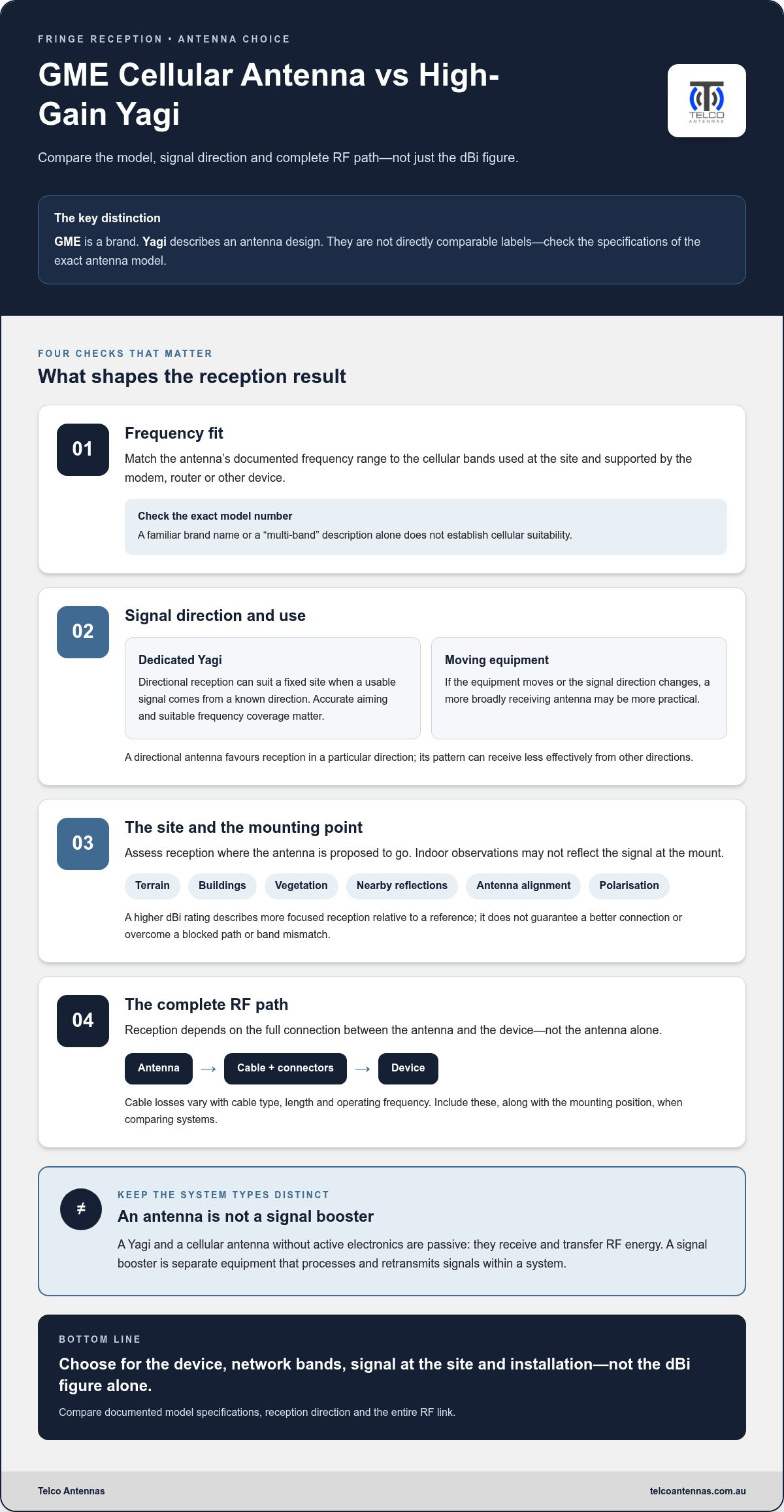
GME is a brand, while Yagi describes an antenna design. These aren’t directly comparable labels: a particular GME antenna may be intended for cellular use or another radio application, and a Yagi’s performance depends on its specifications and installation. Compare documented models, not broad categories or product names alone.
What does “GME cellular antenna” mean in this comparison?
Start with the exact model number and its stated application. Check that its documented frequency range covers the cellular bands your device needs, then review its connector, antenna configuration and intended mounting arrangement. GME also makes antennas for other radio uses, so a familiar brand name or a general description such as “multi-band” doesn’t by itself establish suitability for a cellular modem, router or booster.
How a dedicated high-gain Yagi receives a distant signal
A Yagi uses an arrangement of elements, typically including a driven element, reflector and directors, to favour reception in a particular direction. This Yagi-Uda antenna design can be useful when a fixed site has a usable signal arriving from a known direction. Its directional gain only helps if the wanted signal falls within the antenna’s receiving pattern. Accurate aiming, suitable frequency coverage and correct polarisation still matter.
Gain doesn’t create signal. Antenna gain describes how strongly an antenna concentrates or receives radio energy in a direction compared with a reference antenna. The unit dBi expresses gain relative to an ideal isotropic radiator, which radiates equally in every direction. A higher dBi figure can indicate a narrower, more focused pattern, but it doesn’t tell you on its own how much usable signal will reach your equipment at a particular site.
Both a Yagi and a cellular antenna without active electronics are passive: they receive and transfer RF energy, but don’t amplify it. A signal booster is separate equipment that processes and retransmits signals within a system; it isn’t another name for an antenna. This distinction matters because changing antennas and adding a booster address different parts of the reception problem.
For a stationary installation, a directional Yagi may suit a site with a clear direction to a usable signal and room to mount and aim the antenna. If the equipment moves or the signal direction changes, a more broadly receiving antenna may be more practical. In either case, the model’s specifications and the complete connection to the device determine whether the setup is compatible.
How Antenna Gain, Direction and Frequency Affect Fringe Reception
Gain is useful when comparing antennas, but it describes how an antenna concentrates reception relative to a reference, not the signal quality available at your site. A directional antenna may favour a weak signal arriving from one bearing while receiving less effectively from other directions. Its narrower beamwidth makes precise alignment more important, particularly if the usable signal comes through a gap between trees or buildings.
Antenna suitability depends on frequency compatibility and the propagation path between the serving cell and the antenna. That path can be affected by terrain, buildings and vegetation, as well as reflections from nearby surfaces. The signal reaching a proposed mount may differ from what you observe indoors, so assess reception at the intended antenna position rather than relying on a gain rating to predict the outcome.
Why dBi alone cannot predict the result
dBi describes an antenna’s directional performance relative to an ideal isotropic reference. It doesn’t state how strong the incoming signal is before installation or guarantee a particular data connection. A higher-gain antenna can’t compensate for a band mismatch or a blocked path. Nor does the antenna work in isolation: coaxial cable, connectors, mounting position and alignment all affect the RF path between antenna and equipment. Cable losses vary with cable type, length and operating frequency, so include them when assessing the system.
For the gme cellular antenna vs dedicated high gain yagi for fringe reception comparison, treat gain as one specification alongside signal conditions and installation details. The overview Understanding cellular antennas for 4G and 5G also discusses antenna patterns and frequency support, useful context when interpreting product specifications.
Band, polarisation and device compatibility
An antenna must support the network bands used by the connected modem, router or other cellular equipment. A broad product label doesn’t establish that match: compare the antenna’s documented operating frequencies with the bands supported by the device and used at the site. If they don’t overlap, the antenna can’t provide the intended reception on that band.
Polarisation describes the orientation of the radio wave’s electric field. For a practical installation, match the antenna orientation and mounting arrangement to its specifications and the equipment configuration. A mismatch can reduce how effectively the antenna and device couple to the signal. If the equipment has multiple antenna ports, check whether it’s designed for a MIMO arrangement before connecting a single antenna or changing the supplied configuration. A MIMO antenna technical guide can help explain how multiple antenna paths are used.
- Compare the antenna’s operating bands with the device’s supported bands.
- Check polarisation and mounting instructions before fixing the antenna in place.
- Account for cable and connector losses along the full route to the equipment.
- Observe signal conditions at the proposed mount, including changes caused by obstructions or direction.
If the serving signal or mounting constraints are unclear, an RF site survey can help assess the site before you settle on an antenna and installation approach.
GME Antenna vs Dedicated High-Gain Yagi: Compare the Trade-Offs
There’s no universal winner in the gme cellular antenna vs dedicated high gain yagi for fringe reception decision. A Yagi may suit a fixed site with a known signal direction, while an antenna with a broader pattern may be easier to use if the signal direction is uncertain or changes. GME is a brand, not a single antenna specification, so compare the exact model’s documented cellular application and technical details with those of the Yagi.
Comparison factor
- Intended application: A GME antenna’s suitability depends on the specific model’s stated use. A dedicated cellular Yagi is designed for directional reception on its documented operating bands.
- Frequency support: Check the exact GME model and Yagi frequency range against the bands used by the network and supported by the connected equipment.
- Directionality: A Yagi receives most effectively towards its intended direction. A GME model’s pattern varies, so consult its specifications rather than assuming it’s omnidirectional.
- Alignment: A directional Yagi needs careful aiming. The alignment requirements of a GME antenna depend on its documented radiation pattern.
- Installation constraints: Consider mounting space, a stable support, cable routing and access for alignment. A directional antenna also needs a suitable orientation and a clear enough path towards the signal.
When a directional Yagi may suit the site
Consider a Yagi if observations at the proposed mounting position indicate a usable signal arriving from a known, relatively stable direction. Check whether terrain, buildings or vegetation obstruct that path, and whether a practical mounting position can improve the line towards it. Then confirm that the Yagi covers the required cellular frequencies and suits the connected equipment. If the direction is uncertain or the antenna can’t be mounted and aimed securely, its directional design may be difficult to use effectively.
When a broader-pattern or model-specific antenna may fit better
A broader reception pattern may be more practical if the equipment moves, usable signals arrive from several directions, or the strongest direction varies with surroundings. Don’t assume a GME-branded antenna suits cellular service: identify the exact model and compare its documented frequency range, gain pattern and connection requirements with the device and network. The same model-level checks apply when considering a GME cellular antenna for a stationary fringe site.
Use the comparison to narrow the choice, then judge it against what the site can support. For example, a fixed installation with a stable signal direction and a suitable mounting point may favour a compatible Yagi. A site with changing signal directions may call for an antenna whose documented pattern better matches those conditions. Neither choice guarantees usable service if the relevant bands or signal path don’t match.
If the serving signal direction or mounting constraints remain unclear, an RF site survey can help inform antenna selection from observed site conditions. Base the decision on the site and equipment requirements, not the brand name or a gain figure alone.
How to Assess a Fringe Reception Site Before Choosing an Antenna
A reliable antenna choice starts with the equipment and the site, not the product label. Work through these checks in order and record what you find, so the final decision reflects conditions at the proposed mounting point.
- Identify the equipment. Note whether the system uses a modem, router or booster. Record its supported cellular bands, antenna ports, connector types and any stated antenna configuration, including whether it uses multiple antenna paths.
- Check network band information. Compare the device’s supported bands with current information for the intended Australian mobile network at the site. Coverage maps can help narrow the investigation, but don’t treat a map as a measurement of signal at a particular mounting position.
- Assess the available signal. Take readings at the existing equipment location and at candidate external mounting points. Where the device or a suitable measurement tool provides them, record indicators such as RSRP, RSRQ and SINR, along with the band and time. Compare results consistently; one reading may not represent changing conditions.
- Map obstacles and direction. Note terrain, buildings, tree cover and other obstructions between the antenna position and likely serving sites. Compare reception at different positions and orientations. Network information or measurement tools can help investigate likely signal direction, but confirm the useful direction through observations at the site.
- Select and aim the antenna. Use the collected evidence to compare compatible antenna patterns, then align a directional model towards the strongest usable signal. Recheck readings after aiming and record the final position and orientation.
Keep the observations from the proposed external mounting position. An indoor reading alone may not show whether lifting the antenna clear of a nearby roofline or foliage changes the usable signal. Testing before final selection can help prevent a mismatch between the antenna pattern and the site.
Check the complete antenna-to-device path
Before installation, match the antenna connector to the equipment port and follow the specifications for impedance and port configuration. Plan the coaxial route as well: longer cable runs and cable type affect attenuation, so include cable loss when judging the full RF path. Secure connections and use weather-resistant fittings and cable entry details suited to exposure at the mounting location.
For booster systems, the external antenna is one part of a configured system, not a substitute for the booster itself. The Cel-Fi GO professional deployment guide explains how antenna choice fits into a booster installation.
Plan for safe access, suitable mounting support and secure cable routing. Mains proximity, structural loading and working at height all need consideration; don’t improvise a mount or climb to a position you can’t reach safely. If signal direction, readings or installation constraints remain unclear, a professional RF site survey can help assess the site before you settle on the gme cellular antenna vs dedicated high gain yagi for fringe reception choice.
Choose a Fringe-Reception Antenna System That Fits the Whole RF Link
The practical decision rule is straightforward: select an antenna whose documented frequency bands, reception pattern and installation requirements fit the measured site and connected equipment. A dedicated Yagi may suit a fixed position with a usable signal from a known direction. A different antenna pattern may make more sense where reception arrives from several directions or the equipment moves. Neither category is automatically the better option.
Think beyond the antenna itself. The complete RF link runs from the external antenna through its connectors and coaxial cable to the modem, router or booster. Each component must be compatible with the network bands and equipment configuration. Cable type and route matter too, because losses along the feed can affect how much of the received signal reaches the device.
For equipment with MIMO capability, one Yagi isn’t automatically the right configuration. The device may use multiple antenna ports and require separate antenna elements arranged according to its specifications. Check the number of ports and the manufacturer’s recommended setup before deciding whether a single antenna or a MIMO arrangement is appropriate. A technically suitable antenna connected incorrectly can undermine the system design.
When to consider a booster or a broader system assessment
An external antenna receives or directs RF energy; a booster is a separate part of a cellular system. Consider a booster only if the system needs one, and assess its operation alongside the antenna arrangement, device and network requirements. The Cel-Fi GO signal booster guide explains how external antennas fit into a booster system without treating either component as a guaranteed fix for fringe reception.
How Telco Antennas supports technically demanding installations
Where signal direction, mounting constraints or the right system configuration are unclear, an RF site survey can help assess site conditions and inform system design. Telco Antennas supplies high-gain antennas, MIMO antennas and LMR-400 coaxial cable, alongside RF site surveys and engineering support. This helps you consider antenna choice as part of the complete link rather than as an isolated gain specification.
For a final sense-check, compare the antenna’s documented bands and pattern with your site observations, then account for the device ports, cable route and any booster requirement. This evidence-based process is more useful than choosing by brand or dBi rating alone. It also gives you a clearer basis for resolving the gme cellular antenna vs dedicated high gain yagi for fringe reception question at your site.
Explore Telco Antennas’ RF engineering and antenna solutions for technical support with a demanding cellular link.
Turn Your Site Findings into a Confident Antenna Choice
The next step is to turn your observations into an installation plan that suits the equipment and the site. Keep a record of the network bands, signal readings and mounting constraints, then use that evidence to resolve the gme cellular antenna vs dedicated high gain yagi for fringe reception decision. If the result is still uncertain, a professional RF assessment can help clarify the design before hardware is installed.
Telco Antennas is an Australian specialist supplier of high-performance antennas and RF hardware, with RF site surveys and engineering services for technically demanding installations. Its hardware and engineering services help connect measured site conditions with a practical system design, rather than relying on a headline gain figure alone.
Explore Telco Antennas’ RF solutions and take the next step towards a setup designed around your reception conditions. A considered plan gives you a clearer path forward.
Frequently Asked Questions
Is a high-gain Yagi always better for fringe mobile reception?
No. A high-gain Yagi can be less suitable if the wanted signal arrives from an unexpected direction, the device needs bands the antenna doesn’t cover, or the mount can’t be aligned securely. For the gme cellular antenna vs dedicated high gain yagi for fringe reception choice, compare readings from each candidate antenna at the same location and device settings. This helps distinguish antenna-pattern effects from changes in network conditions.
Can a cellular antenna improve reception if there is no usable signal at the site?
An antenna can’t create a cellular signal, but a suitable external antenna may receive a weak signal that an indoor device can’t detect reliably, especially if its position has a clearer path. If measurements find no usable signal on the required bands at any practical mounting point, a passive antenna alone won’t provide service. A booster also needs an adequate donor signal to work with.
How do I know whether a GME antenna supports my mobile network and device?
Find the exact model number, then compare its documented frequency range with the bands used by your network and supported by your modem, router or booster. Check that the antenna is specified for cellular use, rather than another radio application, and confirm the connector and antenna-port arrangement suit the equipment. A brand name or “multi-band” label alone doesn’t establish compatibility across every Australian network or device.
Does a high-gain Yagi need to be aimed at a mobile tower?
Yes, a directional Yagi needs to face the direction of the wanted signal, but you don’t necessarily need to see the tower. Network information can suggest a likely direction; then compare reception while making small adjustments to the antenna’s bearing. Allow the device time to update its readings after each change. If the strongest result comes from another direction, use the measured signal rather than visual assumptions.
Can I connect a Yagi antenna directly to a 4G or 5G modem?
Often, if the modem has external antenna ports and the Yagi’s supported bands, connector and electrical specifications are compatible. Check the modem manual for the correct port and whether it expects one antenna or a paired arrangement. Use an appropriate adaptor only where specified, since the wrong connection can prevent operation or damage hardware. A Yagi connected to a modem is still a passive antenna, not a booster.
Does a longer coaxial cable reduce cellular antenna performance?
It can. Coaxial cable attenuates RF energy, and the loss depends on cable type, length and operating frequency. A longer run can therefore reduce the signal reaching the modem, even if the antenna is well positioned. Plan the shortest practical route, choose cable with suitable RF characteristics, and include connectors and adaptors in the path. LMR-400 is one cable category used in RF system applications.
Can one Yagi antenna support a MIMO modem?
A single Yagi can connect to one compatible modem antenna port, but it doesn’t provide multiple independent antenna paths by itself. If your modem uses MIMO, follow its port and antenna configuration requirements; using one antenna may mean the additional MIMO path isn’t available. Check whether the equipment requires separate antenna elements and how they should be positioned. A MIMO antenna system is designed to provide multiple paths when correctly configured.


