

Reliable mobile signal can support workplace communication, but it can’t replace site controls or a clear emergency plan. Improving staff safety with better mobile signal starts with finding out where communication fails, whether staff work alone, in remote areas or inside buildings where reception drops out.
If mobile black spots interrupt check-ins or make it harder to raise a concern, better coverage may be worth assessing. The right response depends on the site, carrier, device and work requirements. Installing equipment before checking these factors may not solve the problem.
This guide explains how to identify where and when coverage gaps occur, compare communication options and plan a site-specific improvement. It also covers how an RF site survey can establish baseline conditions before equipment is selected, and why signal enhancement equipment should be checked against current Australian requirements and carrier conditions. Mobile coverage is one part of a broader safety system, not a guarantee of contact or assistance.
Key Takeaways
- Map communication needs by work area, task and time. Record the carrier and device in use when a coverage gap occurs.
- Compare network or device changes, Wi-Fi calling, compliant signal enhancement equipment and dedicated radio systems against site conditions and work risks.
- Improving staff safety with better mobile signal means treating coverage as part of a broader communications plan, not a guarantee of contact or assistance.
- Check current Australian requirements, carrier conditions, device compatibility and installation suitability before choosing signal enhancement equipment.
- An RF site survey can establish baseline conditions and identify site-specific constraints before equipment is selected.
How improving staff safety with better mobile signal can support workplace communication
Mobile coverage is a radio connection between a device and its mobile network. It enables functions such as calls, texts and data, but a signal icon on a screen doesn’t prove that a call will connect or a message will send from a particular spot.
A coverage gap is an area or situation where the connection is too weak or unreliable for the communication a worker needs. It may interrupt a check-in or delay an update to a supervisor. Improving staff safety with better mobile signal may reduce one communication barrier, but it doesn’t make a worksite safe by itself. It can’t replace hazard controls, agreed check-in procedures, an emergency response plan or other suitable ways to contact help.
Which workplace communication tasks may rely on mobile coverage?
Depending on the role and site, staff may use mobile phones to check in with a supervisor, coordinate between work areas or raise an incident. These are examples, not universal requirements. The appropriate system depends on the task, the consequences of lost contact and how quickly assistance may be needed.
Start by mapping who needs to contact whom, from which areas, and whether communication must work while staff are moving. Some operations may need dedicated radios or another system designed for their requirements, rather than relying on mobile phones alone.
Why does a mobile black spot matter differently at each site?
Usable signal can vary with distance from network infrastructure, terrain, obstructions and building materials. A metal-clad shed, reinforced structure or underground work area may have poor indoor reception even if outdoor service is usable. Remote outdoor work areas and vehicle-based roles may have different limitations.
Don’t assume one carrier, handset or test location represents everyone’s experience. A phone may connect outdoors but lose service inside a plant room, and another device or network may behave differently in the same spot. When recording a gap, note the carrier, device, work area and whether the test was indoors, outdoors or in a vehicle. Repeat tests in the places and conditions that matter to the work.
If an assessment points towards signal enhancement, a cellular repeater receives and retransmits cellular radio signals to improve service in a defined area. That describes the technology, not permission to use any equipment in Australia. Check current ACMA requirements and carrier conditions, and treat connectivity as one part of a site-specific communications approach.
How mobile signal reaches staff devices and where workplace coverage breaks down
A mobile device communicates by radio with a nearby serving cell site, which connects it to the wider network. The quality of that link can change across a worksite. Distance, terrain, obstructions, network conditions and the device all affect whether calls or data work reliably. A coverage map or signal reading is a useful starting point, not proof that every worker can connect from every task location.
For remote or isolated work, communication is also a risk-management consideration. Safe Work Australia's guidance on remote work identifies unreliable or limited communications as a potential hazard. Better signal may address one part of that problem, but it doesn’t replace suitable work procedures or other controls.
What affects mobile signal inside buildings and work vehicles?
Walls and roofs can weaken radio signals, particularly when construction includes metal cladding, reinforced concrete or other dense materials. Terrain, distance from a cell site and intervening obstructions can also reduce outdoor coverage. A vehicle’s body may affect reception, and conditions can change as it moves between work areas.
Carrier networks and handsets may perform differently at the same point. Assess representative locations, not just an office entrance or one worker’s phone. Include indoor rooms, outdoor zones and vehicle routes where communication is needed, and record the carrier, device, location and test conditions.
What can a signal booster improve, and what can’t it fix?
A properly designed repeater system uses an external antenna to receive an existing mobile signal and an internal antenna to retransmit it within a defined area. The external antenna needs a usable incoming, or donor, signal. A repeater can redistribute that signal, but it can’t create network service where no usable signal reaches the external antenna.
Results depend on the donor signal, system and device compatibility, antenna placement and site design. Poor placement or an unsuitable system may not address the actual dead zone. Signal enhancement also doesn’t guarantee emergency calls, uninterrupted service or coverage throughout a premises. Before selecting equipment, check current Australian requirements and carrier conditions, and confirm that it is technically suitable for the site.
For improving staff safety with better mobile signal, first establish where a usable donor signal exists and where coverage is needed. An RF site survey can document baseline conditions and inform equipment selection. If this is relevant to your site, review RF site survey options as part of the assessment.
Comparing workplace options for improving staff mobile coverage
The right option depends on the gap you need to address. Before choosing equipment, check carrier and device support, network conditions at the site and the communication tasks staff perform. To improve staff safety with better mobile signal, compare options against actual work areas and procedures rather than assuming one solution will suit every site.
| Option | May suit | Dependencies and limitations | What to assess |
|---|---|---|---|
| Network or device change | Sites where another carrier or compatible handset may provide usable service. | Coverage varies by network, device and location. A change won’t necessarily fix an indoor dead zone or a remote-area gap. | Compare carrier coverage information and test relevant devices in the work areas staff use. |
| Wi-Fi calling | Buildings with reliable Wi-Fi but limited mobile reception. | The carrier, service, handset and site configuration must support it. It relies on working Wi-Fi and may not suit every operational need. | Confirm support and test calls from the locations where staff need to communicate. |
| Cellular repeater | Areas with usable external mobile signal but weaker indoor reception. | It needs a suitable donor signal and compatible equipment. In Australia, check current ACMA requirements and carrier conditions; repeater use requires the relevant carrier’s written authorisation. | Assess incoming signal, carrier and device compatibility, installation design and intended coverage area. |
| Dedicated radio system | Operations needing defined group communication or procedures that don’t depend on mobile coverage. | Coverage, infrastructure, equipment and operating procedures must suit the site. It’s a separate communications system, not a mobile-phone fix. | Define who must communicate, across which areas, and what system performance the work requires. |
When might a mobile signal booster be worth assessing?
A repeater may be worth investigating if testing shows usable signal outside a building but poor reception where staff work. “Booster” is often used informally, but Australian rules distinguish between equipment types. Don’t assume a product marketed as a booster is lawful to use. Verify carrier authorisation, device compatibility and installation requirements before selecting equipment. Telco Antennas’ Cel-Fi GO Signal Boosters: A Professional Guide to Australian Mobile Connectivity is a relevant resource, but it doesn’t establish suitability for every site.
When could another communication option suit the work better?
Wi-Fi calling may suit a building where mobile reception is weak but supported Wi-Fi is dependable. Dedicated radios may be more appropriate when staff need group calls or established radio procedures. If testing finds no usable mobile signal at a remote site, assess other communications infrastructure rather than expecting a repeater to create a network connection. No option guarantees emergency calls or complete coverage.
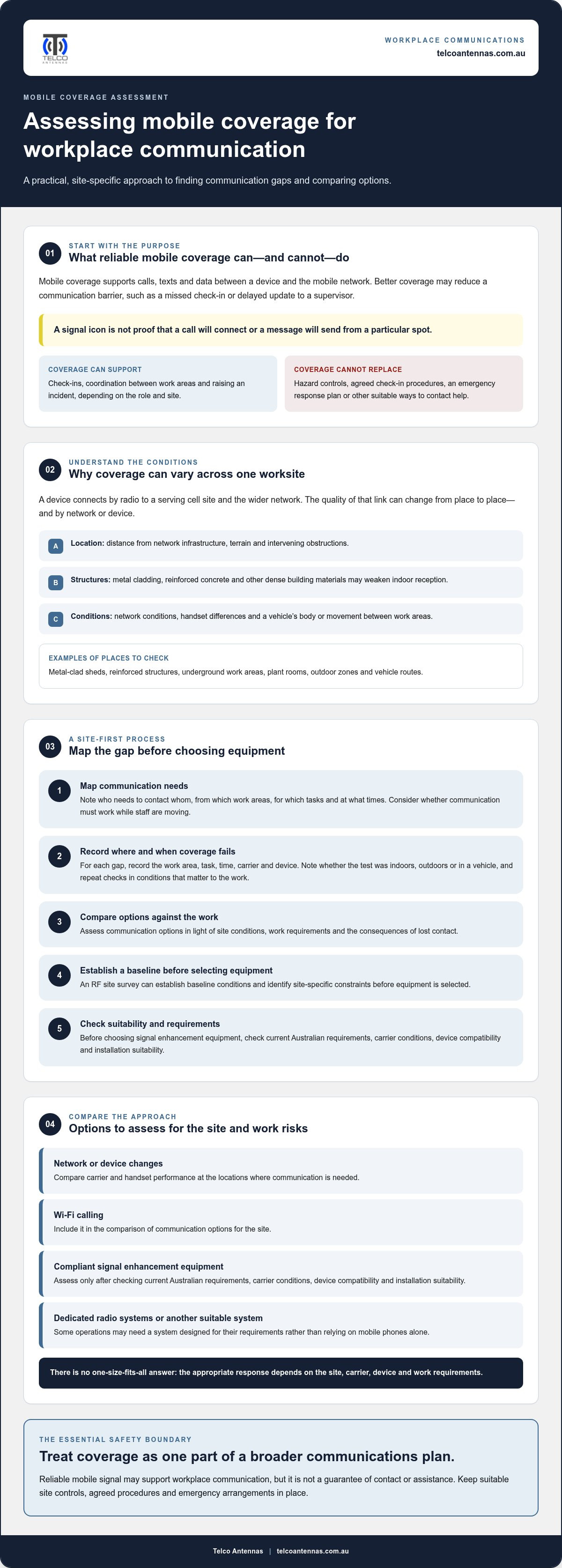
How to assess mobile coverage and choose a safer workplace communications approach
Start with work requirements, not equipment. Define which staff need to communicate, what they need to do and where a missed or delayed message could affect the work. Then test actual conditions and choose a response that fits the site. This makes improving staff safety with better mobile signal a practical, evidence-led process while keeping communication procedures and alternatives in view.
What should a workplace mobile coverage assessment record?
Map staff locations, tasks, communication routes and known dead zones. Include representative indoor, outdoor and vehicle-based work areas, and consider conditions that may change during a shift. For each test, record the carrier, device, location, time, whether it was indoors or outdoors, and what happened. Signal bars alone aren’t enough: note whether calls connect and remain usable, and whether required data functions work.
Be specific about the task. Some roles may need voice calls; others may depend on messaging or data access. Identify who needs to communicate with whom, and whether a mobile phone is the intended system or only one part of the plan.
How should employers test a proposed solution?
Use a repeatable process to move from communication needs to a reviewed system:
- Map the work. List roles, tasks, work areas, communication paths and situations where contact is required.
- Establish a baseline. Test representative devices and carriers in relevant locations. Record conditions, call or data performance and existing dead zones.
- Set acceptance criteria. Specify which areas, users and communication tasks need to work. Identify limitations that would require another control or communication method.
- Compare options. Consider network or device changes, supported Wi-Fi calling, authorised signal enhancement equipment, dedicated radios or other infrastructure. Check compatibility and current Australian requirements before selecting equipment.
- Test and review. After implementation, repeat tests with representative users and devices. Document results, known limitations, alternative communication procedures and any maintenance or review needs.
For complex sites, variable terrain or coverage needs across multiple work areas, an RF site survey can establish baseline conditions and inform the next step. Check current Safe Work Australia guidance and the WHS requirements applicable in your state or territory. A connectivity change isn’t a substitute for assessing work risks or maintaining suitable procedures.
To establish site conditions before selecting equipment, arrange an RF site survey with Telco Antennas.
How Telco Antennas can help assess mobile signal options for staff safety
Choosing signal equipment before understanding the site may leave the actual coverage gap unresolved. Telco Antennas supplies mobile signal equipment and RF infrastructure, and offers professional RF site surveys and engineering services. A survey can establish baseline conditions, identify constraints and help inform whether signal enhancement equipment is appropriate for the communication tasks staff need to perform.
Relevant equipment includes Cel-Fi GO mobile signal boosters and MIMO antennas. These may form part of a site-specific communications plan, but suitability depends on measured conditions, carrier and device compatibility, installation design and current Australian requirements. Improving staff safety with better mobile signal means treating coverage as one part of the plan, alongside safety procedures and alternative ways to communicate.
What information helps specialists assess your site?
Prepare information that connects the signal issue to the work. Useful details include:
- Site layout: Plans showing work areas, buildings, known dead zones and where communication is needed.
- Network and devices: Affected carriers, handset or device types, and whether staff need calls, data or both.
- Site conditions: Building materials, indoor and outdoor work areas, vehicle use, terrain and existing antennas or communications equipment.
- Observed failures: Examples of where calls fail, messages are delayed or data becomes unavailable, with the location and conditions recorded.
- Work requirements: Who needs to contact whom, for which tasks, and what communication procedures and alternatives are already in place.
This information helps distinguish an indoor reception problem from a wider network or remote-site limitation. It also gives an assessment a practical purpose: defining the communication task rather than aiming for an undefined improvement in signal.
What should a responsible signal improvement plan include?
A sound plan sets out the areas and tasks it is intended to support, checks equipment against the carrier, devices and site conditions, and considers installation constraints. It should include validation testing with representative users and devices, then record results and remaining coverage limitations. Keep suitable alternative communications and emergency procedures in place. Improved signal can’t guarantee contact or assistance.
For technical background, Telco Antennas’ article Understanding Receive Signal Level (RSL) for Better Gain discusses a relevant signal measurement concept. To discuss a site assessment, contact Telco Antennas with site information and examples of communication failures, and ask whether an RF site survey can help establish baseline conditions before equipment selection.
Turn coverage findings into a practical safety plan
Reliable mobile coverage can support staff check-ins and escalation, but it isn’t a complete safety system. Map where and when communication is needed, test representative devices and carriers, then compare options with the site conditions and work requirements. Keep alternative communication methods and emergency procedures in place, and document coverage limitations.
Improving staff safety with better mobile signal is a site-specific process, not a matter of installing equipment and assuming every work area is covered. A professional RF site survey can establish baseline conditions and help inform equipment selection before you commit to a solution.
Telco Antennas supplies mobile signal boosters and RF infrastructure, and offers professional RF site surveys and communication tower design. The business can help assess the technical factors relevant to your site. Discuss a site-specific mobile signal assessment with Telco Antennas.
Start with the communication tasks and where they happen. A measured, carefully planned approach helps you make clearer decisions and strengthen your workplace communications plan.
Frequently Asked Questions
Is better mobile signal enough to make a workplace safer?
No. Reliable coverage may support routine check-ins or escalation, but it can’t guarantee a safe outcome. Employers still need to manage work risks through appropriate controls, training and emergency procedures. First identify who needs to communicate, where and for what purpose. Then assess whether mobile service is suitable as one part of the broader workplace safety approach.
Can a mobile signal booster provide coverage throughout a workplace?
Not necessarily. Results depend on the incoming signal, equipment compatibility, antenna placement, building materials and the areas requiring coverage. A system that works in one room may not perform the same way elsewhere or for every carrier and device. Assess representative work areas and test the installed system against defined requirements. A signal reading at one point doesn’t prove the whole premises is covered.
What should I check before installing a mobile signal booster at work?
Check whether usable external signal is available, which carriers and devices staff use, and where coverage is required. In Australia, “booster” can refer to restricted equipment; cellular repeaters require written authorisation from the relevant mobile carrier. Confirm current ACMA requirements, carrier conditions and equipment compatibility before purchase or installation. For a complex site, an RF site survey can establish baseline conditions and inform equipment selection.
How do I find mobile black spots across a worksite?
Map where staff need to communicate, then test relevant devices and carriers in representative work areas and conditions. Record the location, time, whether testing was indoors, outdoors or in a vehicle, and whether calls or data failed. Signal bars alone don’t show whether a device can complete the task reliably. For a complex site, a documented RF assessment can clarify the coverage problem before equipment is selected.
Can Wi-Fi calling replace a mobile signal booster?
Sometimes, if the carrier service, device, Wi-Fi connection and site configuration support Wi-Fi calling. It may help with indoor calling where Wi-Fi is available, but it won’t suit every work area or task, and it depends on the Wi-Fi connection. Compare it with other options against actual site conditions and operational requirements. Keep suitable safety procedures and alternative communication methods in place rather than relying on one technology alone.
When should a business arrange an RF site survey?
Consider an RF site survey when coverage varies across a complex site, equipment selection is uncertain or antenna placement needs careful assessment. A survey can document radio conditions and inform a site-specific design, but it doesn’t guarantee a particular result. Before engaging a specialist, identify the areas, carriers, devices and communication tasks to assess. Telco Antennas offers professional RF site surveys for this purpose.
Does a mobile signal booster guarantee emergency calls will connect?
No. Signal enhancement equipment can’t guarantee emergency calls or uninterrupted service. Connectivity depends on network availability, equipment compatibility and site conditions, and the system may not cover every area. Don’t treat a repeater as an emergency response plan. Check current Australian requirements and carrier conditions, and maintain communication procedures and alternative arrangements suited to the work and site.


