

The cable labelled LMR-400 isn’t automatically the right choice for every RF installation. When comparing LMR-400 coaxial cable Australia listings, check the construction, connector fit and cable route as carefully as the product name.
Signal loss matters, particularly over a longer run, but a cable that doesn’t suit the installation can create practical problems too. Standard LMR-400 is stiffer than LMR-400-UF, and each connector must match the equipment at its end. Cable length, bends and exposure to the installation environment also affect what’s suitable.
This guide covers the specifications to compare, how to choose between cable constructions and how to identify the connector configuration your RF system needs. You’ll also find what to confirm before ordering cable by the metre, including the required length and termination details. Telco Antennas lists Times Microwave LMR400 cable per metre, so checking your requirements first can help you make a clear, informed enquiry.
Key Takeaways
- For LMR-400 coaxial cable Australia options, compare the specific cable construction and manufacturer data rather than relying on the label alone.
- Assess whether standard LMR-400 or the more flexible LMR-400-UF better suits your cable route and installation.
- Check impedance, frequency range, attenuation and environmental ratings against your RF equipment and site conditions.
- Identify the connector interfaces at both ends, then measure the complete route, including entry points and service loops, before ordering.
- Review Telco Antennas’ listed Times Microwave LMR400 product and confirm current specifications and termination requirements before making an enquiry.
What is LMR-400 coaxial cable and its use in Australia?
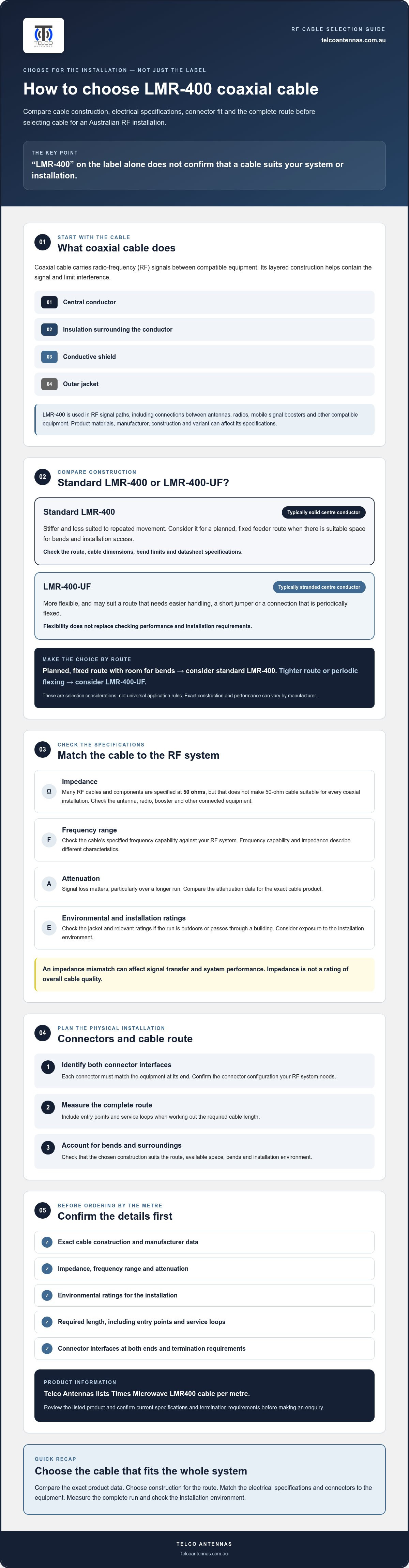
Coaxial cable carries radio-frequency (RF) signals between compatible equipment. It has a central conductor surrounded by insulation, a conductive shield and an outer jacket. This layered construction helps contain the signal and limit interference. The Coaxial cable overview explains the basic design and its uses.
LMR-400 is a cable category used in RF signal paths, including connections between antennas, radios, mobile signal boosters and other compatible equipment. The label doesn’t guarantee identical performance across every product. Manufacturer, materials, construction and variant can affect the specifications, so check the datasheet for the exact cable before selecting one for an Australian installation.
Two details are easy to confuse: impedance and frequency capability. Impedance describes an electrical matching characteristic, while frequency capability indicates the range over which a cable is specified to operate. Neither tells you the other. Check both against your equipment and system requirements.
What does 50-ohm impedance mean for an RF cable?
Impedance, measured in ohms, is part of how a cable and connected RF equipment are electrically matched. Many RF cables and system components are specified at 50 ohms, but that doesn’t make 50-ohm cable suitable for every coaxial installation. A mismatch can affect signal transfer and system performance. Check the impedance requirements of the antenna, radio, booster and any other connected equipment, then confirm the cable specification. Impedance is not a rating of overall cable quality.
Where might LMR-400 cable be used?
Where the system is compatible, LMR-400 may serve as an antenna feeder run or an RF connection between equipment. For example, a fixed route between an external antenna and indoor radio equipment may call for a different construction from a short lead that needs to bend around nearby components. These are selection considerations, not universal application rules.
Plan for the environment as well as the signal path. If a run is outdoors or passes through a building, check the cable jacket and relevant environmental or installation ratings. Don’t assume all LMR-400-labelled products are equivalent. For a short connection that will be moved or flexed, assess whether a more flexible variant is suitable. The next section compares standard LMR-400 with LMR-400-UF. In either case, use the product datasheet and installation conditions to guide your choice of LMR-400 coaxial cable for Australian projects.
LMR-400 versus LMR-400-UF: compare construction before choosing
The main distinction is flexibility. Standard LMR-400 is typically built with a solid centre conductor, while LMR-400-UF uses a stranded centre conductor to make the cable more flexible. Exact construction and performance can vary by manufacturer, so check the product datasheet rather than assuming every cable with a similar label is identical.
Similar cable labels don’t guarantee identical specifications. Verify the construction and performance data for the exact product you plan to use. The manufacturer’s LMR-400 technical specifications are a useful reference for its standard cable, but they aren’t specifications for every alternative or flexible variant.
| Selection factor | Standard LMR-400 | LMR-400-UF |
|---|---|---|
| Typical construction | Typically a solid centre conductor | Typically a stranded centre conductor |
| Flexibility | Stiffer; less suited to repeated movement | More flexible; may suit routes needing easier handling |
| Routing | Consider for a planned, fixed route with suitable space for bends | Consider where a route is tighter or the cable may be flexed periodically |
| Potential role | Fixed feeder runs, if system and route requirements suit | Short jumper runs or connections that need greater flexibility |
When is standard LMR-400 worth considering?
If the cable will stay in place along a clear feeder route, standard LMR-400 may be a suitable candidate. Its greater rigidity can make it harder to route through confined spaces or around tight corners, so check the planned path and installation access before choosing it. A fixed run has different handling demands from a jumper that may be moved or flexed. Confirm the cable’s dimensions, bend limits and electrical specifications in the manufacturer’s datasheet.
When could LMR-400-UF be a better fit?
For a short jumper or a connection that needs periodic flexing, the more flexible construction of LMR-400-UF may be worth considering. Flexibility doesn’t mean the cable can be bent without limit: follow the product’s bend guidance and avoid stressing the cable or its terminations. Check that its impedance, frequency performance and other specifications meet the system requirements before treating it as a substitute for standard LMR-400.
For LMR-400 coaxial cable Australia installations, choose between the variants based on the route and operating requirements, not convenience alone. Telco Antennas lists Times Microwave LMR400 cable. Review its LMR-400 cable information when confirming which product construction fits your planned installation.
Which LMR-400 specifications and connectors should you check?
Before choosing a cable, compare its documented electrical and physical specifications with your equipment and installation route. A familiar label alone won’t confirm that the cable suits your operating frequency, connectors or environment.
| Information | What’s confirmed or generally true | What to verify for your cable |
|---|---|---|
| Listed product | Telco Antennas lists Times Microwave LMR400 Low Loss Communications Cable per metre. | Check the current product details and manufacturer datasheet for the exact construction and specifications. |
| Impedance and frequency | These are product-specific electrical ratings, not guaranteed by the LMR-400 label alone. | Match impedance and operating-frequency range to the connected equipment. |
| Attenuation and power handling | Attenuation is signal loss along the cable; handling limits depend on cable specifications and operating conditions. | Compare the manufacturer’s attenuation data at relevant frequencies and confirm power handling for your system. |
| Physical and environmental fit | Outer diameter, bend limits, jacket and environmental ratings can vary by product. | Check these against the route, available space and exposure conditions. |
How do cable specifications affect an RF installation?
Attenuation is the reduction in signal level as it travels through a cable. It generally increases with cable length and varies with frequency, so compare the manufacturer’s figures at the frequencies your system uses. A figure for one frequency or cable variant doesn’t establish performance at another. Treat specifications as inputs to system selection, not a guarantee of the final result, which also depends on the equipment and installation.
For LMR-400 coaxial cable Australia applications, check power handling and impedance against your equipment documentation too. Confirm the outer diameter before planning penetrations or conduit, and use the stated bend radius to assess corners and entry points. If the cable will face outdoor exposure or other environmental conditions, verify that its jacket and ratings suit the route.
How do you match connectors to LMR-400 cable?
Identify the connector interface on both devices, then confirm the connector type, gender and termination method required at each end. Type-N is one example, but it’s suitable only where the cable product and connected equipment documentation confirm compatibility. A connector that appears to fit may still be wrong for the interface or operating requirements.
Termination matters too. Confirm that the connector suits the cable’s construction and diameter, and that it can be fitted correctly. The right cable with an unsuitable or poorly terminated connector can add avoidable loss or prevent a sound connection. Check the complete assembly requirements before ordering.
How to specify and order LMR-400 coaxial cable in Australia
A clear specification helps reduce the risk of ordering cable that won’t suit your equipment or installation route. Work through these checks before placing an order or making an enquiry:
- Identify the equipment. Record the antenna, radio, booster or other RF devices the cable will connect, along with their required impedance and operating frequency.
- Choose a cable variant. Decide whether standard LMR-400 or a more flexible variant may suit the route, then check the exact product datasheet.
- Measure the full route. Trace the intended path, including bends, entry points and practical service loops. Don’t use the straight-line distance between devices as your cable length.
- Confirm both connector ends. Note the interface and connector requirements at each device, including type, gender and any termination needs.
- Check the order details. Confirm current product specifications, availability, quantity format and any termination options with the supplier before proceeding.
How do you calculate the cable length you need?
Measure along the route the cable will actually follow, allowing for equipment position, bends and entry points. Include practical service loops where needed for installation or access, but don’t assume a fixed extra allowance will suit every layout. Telco Antennas lists its Times Microwave LMR400 cable per metre. Check the current listing to confirm how to specify the required quantity.
What information should you provide with an enquiry?
Share the connected equipment, operating frequency, impedance and installation environment, including whether the route is indoors or exposed to outdoor conditions. Add your selected cable variant, measured length and connector requirements if known. If you’re unsure about a specification or termination, say so and ask for it to be confirmed rather than guessing.
Before ordering LMR-400 coaxial cable for Australian installations, make sure the product and connectors match the equipment documentation and intended route. Stock, current cable specifications and available termination options can change, so confirm them directly rather than relying on an older listing or assumption.
Ready to check your cable requirements? Enquire about LMR-400 coaxial cable with your equipment, route length and connector details available.
Source LMR-400 coaxial cable from Telco Antennas
Choosing the cable is only one part of specifying an RF connection. Before ordering, confirm the equipment requirements, cable construction, route and connector interfaces as a complete system. This helps you check that the cable’s electrical characteristics suit the application and its physical construction suits the installation.
What is listed for Telco Antennas’ LMR-400 cable?
Telco Antennas lists Times Microwave LMR400 Low Loss Communications Cable, sold per metre. The product is described as non-halogen, low-smoke and fire-retardant for in-building use, with a stated exclusion. These descriptions relate to the listed product; don’t assume they apply to other LMR-400 variants or equivalent cables.
Before relying on these properties for a particular installation, check the current product listing, including its stated limitation, and consult the manufacturer documentation. Confirm the exact cable construction and electrical specifications for the product being considered. This is especially important if your project has specific in-building, environmental or RF performance requirements.
What should happen before you place an order?
Use the product listing and manufacturer documentation to check the cable against your system and route. Confirm:
- the operating frequency and impedance required by the connected equipment
- the cable’s attenuation and other relevant electrical specifications
- whether the construction, jacket and physical dimensions suit the route and environment
- the required length, measured along the route with bends, entry points and service loops considered
- the connector interfaces at both ends, plus any termination or assembly requirements
If a specification, connector configuration or product option remains unclear, ask for confirmation rather than inferring it from the LMR-400 label. Confirm stock, current specifications and available termination options before ordering, as these aren’t established by a general product description.
For LMR-400 coaxial cable Australia buyers, this process keeps the decision grounded in the actual equipment and installation, not assumptions about a cable category. Telco Antennas supplies LMR-400 cable and related RF equipment. Have your route measurements and equipment details ready when checking the listed product.
View LMR-400 coaxial cable from Telco Antennas
Make your next RF cable choice with confidence
Choosing LMR-400 coaxial cable for Australian systems starts with the installation, not just the cable label. Match impedance, frequency and attenuation requirements to your equipment, then select a construction that suits the route. Confirm connector interfaces at both ends and measure the full cable path before ordering.
Telco Antennas lists Times Microwave LMR400 Low Loss Communications Cable per metre. Check the current product details and manufacturer documentation to confirm the specifications, cable variant and any termination requirements relevant to your setup. Telco Antennas also supplies specialist RF hardware and offers RF engineering services.
With those details in hand, you can make a more informed selection and avoid guesswork around cable length or compatibility. View LMR-400 coaxial cable from Telco Antennas and review the listing as you prepare your requirements. A careful specification is a practical first step towards an RF system suited to its intended installation.
Frequently Asked Questions
What is LMR-400 coaxial cable used for?
LMR-400 is a coaxial cable category used to carry RF signals in compatible systems, including antenna feeder connections. Products in this category are commonly specified at 50 ohms, but suitability depends on the exact cable, operating frequency, route and connected equipment. Check the manufacturer’s datasheet for the product you’re considering, especially if the cable will be installed outdoors or along a fixed route.
Is LMR-400 suitable for outdoor use in Australia?
It may be suitable, but outdoor use depends on the exact cable jacket and documented environmental ratings. Some products are described as having UV-resistant jackets, while construction and intended use can differ between products. Check the datasheet for exposure, temperature and installation requirements, then assess conditions along the full route. Don’t assume every product labelled LMR-400 has the same outdoor ratings.
What is the difference between LMR-400 and LMR-400-UF?
LMR-400-UF is a more flexible variant that may suit routing where easier handling or periodic flexing is required. Its construction and specifications may differ from standard LMR-400, so don’t assume the two are interchangeable. Compare the datasheets for the exact products, including electrical performance and bend guidance, then choose based on the route, movement, connector requirements and the RF system’s documented needs.
How much signal loss does LMR-400 have?
Signal loss depends on cable length, operating frequency and the specific cable construction. To assess it, find the manufacturer’s attenuation figures at the frequencies your system uses and consider the planned cable length. Connectors and installation quality can also affect the connection. Avoid applying one attenuation figure to every LMR-400 product or frequency; use data for the exact cable and operating conditions.
Can I fit connectors to LMR-400 coaxial cable myself?
You can fit connectors yourself only if you have a connector suited to the cable and can follow the correct preparation and termination method. Check that its dimensions and design match the cable’s construction, then follow the connector manufacturer’s instructions and use suitable tools. If you’re uncertain about compatibility or termination, ask a qualified technician or supplier to confirm the parts and approach before installation.
How do I choose the right LMR-400 cable length?
Measure the route the cable will follow, rather than the straight-line distance between devices. Include bends, entry points, equipment positions and a practical service loop where the installation needs one. Then check the supplier’s current listing to see how cable quantity is specified, such as by the metre or another format. Confirm that the measured length and connector arrangement suit the equipment and route.
Does Telco Antennas sell LMR-400 cable by the metre?
The product listing describes Times Microwave LMR400 Low Loss Communications Cable as sold per metre. Before ordering, check Telco Antennas’ current listing for availability, specifications and ordering details. If your installation has particular connector, route or environmental requirements, include them in your enquiry. Confirm any unresolved details rather than assuming a connector configuration or termination option is available for the listed cable.


