
Why does a thousand-dollar smartphone often fail to maintain a basic voice call the moment you drive beyond the suburban fringe? The reality is that even the most advanced mobile devices are limited by their small internal hardware, which is rarely optimised for the significant path loss and interference found across regional Australia. You've likely experienced the frustration of a "one bar" signal that disappears during a critical business meeting or data speeds that fail to support basic video conferencing. It is a common challenge, but it's one that can be solved through a methodical approach to signal enhancement rather than relying on luck.
This guide provides the technical framework you need to select and install the right antenna technology for your specific location. We will demystify complex concepts like dBi gain, frequency bands, and MIMO polarisation, ensuring you have the confidence to choose hardware that is fit for the harsh Australian environment. By understanding the intersection of radio physics and local infrastructure, you can eliminate mobile black spots and achieve the stable, high-speed connectivity required for modern operations. We'll examine the essential components of a high-performance system, from carrier-approved boosters to low-loss cabling and the latest ACMA compliance standards.
Key Takeaways
- Understand how a high-quality antenna functions as the primary interface between your hardware and the carrier network, using passive gain to focus signals rather than generating power.
- Master the relationship between dBi gain and beamwidth to ensure your equipment is correctly matched to the distance and topography of your local terrain.
- Learn to differentiate between directional and omnidirectional configurations to select the most effective solution for fixed rural sites or mobile marine applications.
- Recognise why industrial-grade LMR-400 cabling is essential for minimising signal loss and maintaining the integrity of your telecommunications link.
- Identify the critical legal distinctions between unauthorised repeaters and ACMA-compliant, carrier-approved boosters like the Cel-Fi GO system.
What is a Telecommunications Antenna and How Does it Work?
At its most fundamental level, a telecommunications antenna acts as the critical bridge between your local equipment and the broader carrier network. It is a transducer, meaning its primary function is to convert electrical energy into radio waves for transmission and to capture radio waves from the air to convert them back into electrical signals. Without this interface, a mobile phone or 4G/5G modem is effectively isolated, relying solely on its internal, space-constrained components. In regional Australia, these internal components are often insufficient to overcome the vast distances and geographical obstacles between your location and the nearest base station.
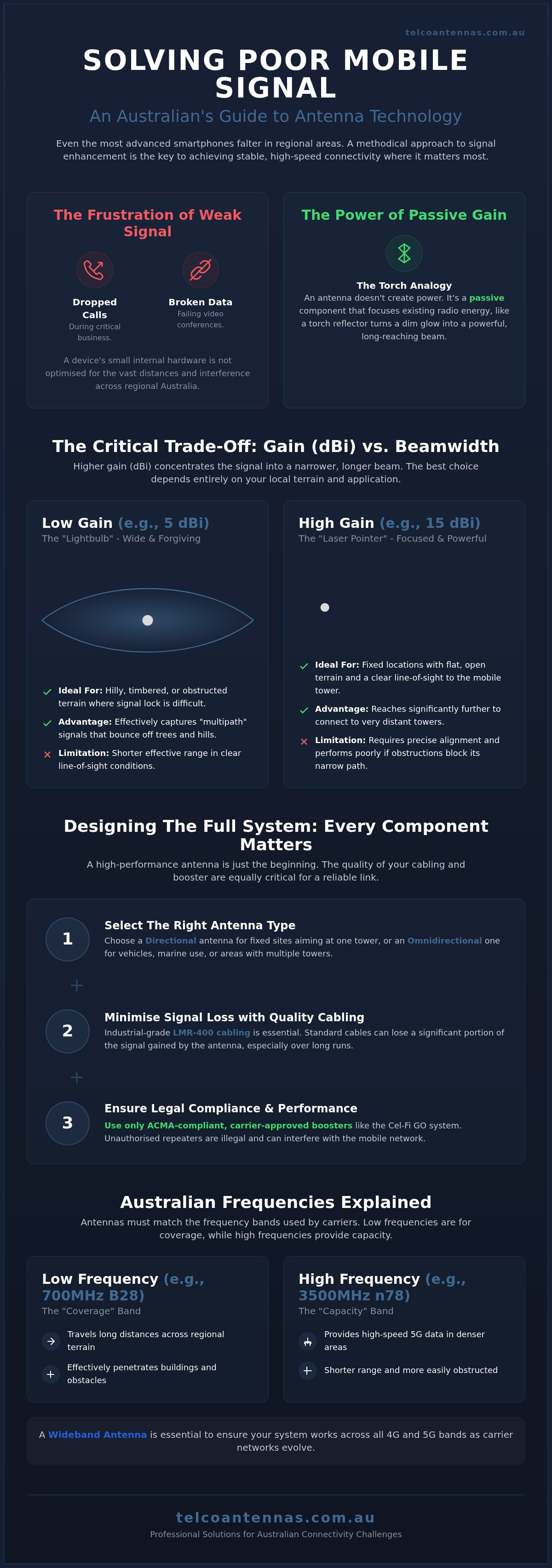
It's vital to understand that an antenna is a passive component. It does not generate power or amplify a signal in the way an electronic circuit does. Instead, it provides what we call "passive gain" by focusing radio energy in a specific direction or pattern. Think of it like the reflector in a torch; it doesn't make the bulb brighter, but it concentrates the light into a beam that reaches much further. In our local RF environment, where users are often many kilometres away from the nearest mobile network tower, this directional focus is the difference between a dropped call and a stable connection.
While the terminology is similar, these devices are distinct from traditional TV aerials. A TV aerial is designed to receive one-way broadcast signals across specific VHF and UHF bands. In contrast, telecommunications hardware must facilitate high-speed, two-way data transfers across a much broader and more complex set of frequencies. We specialise in cellular and data connectivity; we do not supply or install television equipment.
The Role of Frequency and Wavelength
The performance of your system is dictated by the frequency of the radio waves it handles. In Australia, mobile bands range from low-frequency 700MHz (Band 28), which travels long distances and penetrates buildings effectively, to high-frequency 3500MHz (n78) used for 5G capacity. Frequency refers to the number of times a radio wave oscillates per second, and it determines the physical size and design requirements of the hardware. Wideband antennas are increasingly essential because they are engineered to support this entire spectrum, ensuring your installation remains functional as carriers re-farm 4G bands for 5G services.
Receiving vs. Transmitting
Radio hardware operates on the principle of reciprocity, which states that the directional characteristics of an antenna are identical whether it is receiving or transmitting. This is particularly important for upload speeds. While your modem might "hear" a distant tower quite well, its small internal components often lack the focus to "talk back" effectively. A high-gain external system improves the link budget in both directions. This reduces the noise floor and improves the Signal-to-Interference-plus-Noise Ratio (SINR), which is often more critical for data stability than raw signal strength alone.
Understanding Key Specifications: Gain, dBi, and Polarization
Selecting the correct antenna requires more than looking for the highest number on a specification sheet. The most common metric you will encounter is dBi, which stands for decibels relative to isotropic. This is a measurement of how much more signal the hardware can capture or transmit compared to a theoretical isotropic radiator, which is a point source that sends energy equally in every direction like a perfect sphere. In practical terms, dBi tells you how much the signal has been compressed and focused into a specific shape.
Gain is always a trade-off. As you increase dBi, you narrow the beamwidth of the signal. A low-gain 5dBi model behaves like a standard lightbulb, casting signal in a broad, wide pattern. A high-gain 15dBi model acts more like a laser pointer. While the laser reaches much further, it requires precise alignment and a clear line of sight. If you are located in hilly or heavily timbered terrain, a laser-focused beam may actually perform worse. It cannot capture the "multipath" signals that bounce off trees or hillsides as effectively as a wider beam would. In the Australian bush, the "more is better" approach to gain often backfires because scattering makes a narrow beam difficult to lock onto a stable signal.
Deciphering dBi and Performance
When planning your installation, consider your specific environment. Mobile applications, such as on a vehicle or boat, typically require lower gain (3 to 6dBi) because the orientation to the tower is constantly changing. Fixed remote sites with a clear view of a distant tower benefit from 12 to 15dBi directional units. A 3dB increase represents a doubling of signal power. This means a move from 6dBi to 9dBi is not a marginal gain; it is a significant mechanical shift in how the system processes RF energy. For those in complex topographies, our team can provide technical guidance on antenna selection to ensure you don't over-spec the gain and lose signal stability.
The Importance of MIMO (Multiple Input, Multiple Output)
Modern 4G and 5G networks rely on MIMO technology to achieve high data throughput. This system uses multiple antennas to transmit and receive different data streams simultaneously on the same frequency. Most high-performance routers now feature at least two ports to facilitate this. To make MIMO effective, we utilise polarisation diversity. This involves orienting the signals so they are physically distinct from one another. We typically mount elements at 45-degree angles, known as cross-polarisation. This ensures the two signals don't interfere with each other, even when they occupy the same space. By using this method, the modem can distinguish between the two streams, effectively doubling the potential bandwidth of the connection.
Directional vs. Omnidirectional Antennas: Making the Choice
Choosing the correct antenna configuration depends entirely on your operational environment and whether your receiver is stationary or in motion. This decision dictates how the system interacts with the local carrier infrastructure. If you select a pattern that doesn't match your situational needs, even the highest quality hardware will fail to provide a stable link. We categorise these choices based on their radiation patterns: those that capture signal from every direction and those that focus energy toward a specific point.
In the Australian regional landscape, we often compare Log Periodic Dipole Array (LPDA) and Yagi designs. An LPDA is a wideband directional solution that supports a broad range of frequencies, typically from 700MHz to 3800MHz. This makes it a future-proof choice for sites where carriers might switch between different 4G and 5G bands. In contrast, a Yagi is traditionally tuned to a narrower frequency range. While a Yagi can be highly efficient, its lack of frequency flexibility often makes the LPDA the more pragmatic choice for modern multi-band networks. Both require a clear Line of Sight (LoS) to the base station to achieve their theoretical performance levels.
When to Choose an Omnidirectional Antenna
Omnidirectional models are engineered for 360-degree signal capture, making them the standard for mobile applications. If you are installing equipment on a ute, caravan, or marine vessel, you cannot rely on a directional beam because your orientation to the tower is constantly shifting. These are "set and forget" installations that perform reliably in urban areas where signals reflect off multiple surfaces. However, their broad capture area makes them more susceptible to interference and background noise, and they generally offer shorter range than directional alternatives. When deploying these systems on commercial fleets or work vehicles, custom branding and durable UV-resistant identification from irisdtf.com can help manage assets and maintain a professional appearance in the field.
When to Deploy a Directional Antenna
For fixed buildings or remote sites where the nearest tower is over 10 kilometres away, a directional system is necessary. By focusing all captured energy into a narrow beam, these units can establish a connection where a standard mobile device would show no service. Installation requires precision; you must aim the hardware toward the specific Telstra, Optus, or Vodafone tower serving your area. We recommend using a dedicated signal meter or a smartphone diagnostic app to find the peak signal strength during the mounting process. Because these high-gain units are sensitive to movement, they must be secured to stable structures like Aluminium Tri-pods or permanent roof mounts to prevent signal "flutter" during high winds.
Designing the Full System: Cables, Connectors, and Mounts
The antenna is only as effective as the transmission line connecting it to your receiver. Many users invest in a high-gain system only to see that performance vanished due to high signal attenuation in the cabling. This is particularly evident at higher frequencies, such as the 1800MHz or 3500MHz bands used for 4G and 5G. Every metre of cable and every connector interface introduces a measurable drop in the Receive Signal Level (RSL). If the cumulative loss exceeds the gain of the hardware, the entire system becomes counterproductive. To ensure your hardware performs to its mechanical specifications, you must view the cable, connectors, and mounting as a single integrated system.
LMR-400 vs. Standard Coaxial Cable
Standard coaxial cables like RG58 are often unsuitable for telecommunications runs exceeding three metres. At 2400MHz, RG58 can lose approximately 1dB of signal per metre; in contrast, LMR-400 loses only about 0.22dB per metre. Over a 10-metre installation, the difference is nearly 8dB. This is a massive discrepancy that can turn a high-speed connection into a series of dropped packets. To maintain system integrity, we recommend using custom LMR-400 coaxial cable assemblies that are terminated with precision. Using the correct connector type, such as N-Type for external units and SMA or TS9 for modems, is essential to minimise impedance mismatch. Every adapter used is a potential point of failure and signal leakage.
Mounting for Stability and Longevity
The physical placement of your hardware is the final piece of the engineering puzzle. While many assume the centre of a roof is the most logical point, local RF shadowing from chimneys or air conditioning units can create dead zones. For industrial sites or temporary deployments, we utilise telescopic mast trailers and skids to achieve the necessary height for a clear Line of Sight. Aluminium tri-pods provide a stable, lightweight base for directional gear that must remain perfectly aimed during high-wind events. In harsh Australian conditions, from the salt spray of the coast to the extreme heat of the outback, all connections must be weatherproofed with self-amalgamating tape or IP-rated enclosures. This prevents moisture ingress from corroding the copper core and increasing the noise floor over time. If you are planning a large-scale project, you can book a professional RF site survey to identify the optimal mounting locations for your specific topography.
Professional Solutions for Australian Connectivity Challenges
Achieving reliable coverage in regional Australia requires more than just high-performance hardware; it necessitates a system that is legally compliant and engineered for specific environmental variables. Many users are unaware that the Australian Communications and Media Authority (ACMA) strictly regulates the use of signal boosters. Operating an unapproved consumer repeater can lead to significant fines because these devices often create interference on the carrier network, impacting other users in the area. We focus exclusively on carrier-approved solutions that enhance connectivity without compromising the integrity of the national telecommunications infrastructure.
The Cel-Fi GO Advantage
The Cel-Fi GO system is the industry standard for legal mobile signal enhancement in Australia. Unlike generic repeaters, it is designed to amplify only one carrier at a time, which is why it is authorised for use by Telstra, Optus, and Vodafone. The system creates a powerful synergy when paired with a high-gain MIMO antenna. The external unit captures the best available donor signal, while the Cel-Fi unit processes and rebroadcasts that signal inside a building or vehicle. This setup effectively bypasses the path loss caused by modern building materials or remote terrain. For detailed technical requirements, you can refer to our Cel-Fi GO professional deployment guide to ensure your installation meets carrier standards.
Engineering for Remote and Industrial Sites
For large-scale operations in mining, agriculture, or emergency services, a standard kit is rarely sufficient. These environments demand a higher level of reliability and often require custom RF engineering to overcome topographical barriers. We provide comprehensive RF site surveys for complex national deployments, identifying the precise placement of towers and repeaters to ensure coverage across a site. This methodical approach eliminates the guesswork that leads to failed installations in the field, much like how Ideawake helps organisations manage the transition of complex concepts into measurable operational ROI.
We also specialise in integrating modern satellite technology with traditional RF infrastructure. Many off-grid sites now utilise Starlink for backhaul, but they still require a robust local network for mobile voice and data. We provide Starlink aftermarket power conversion and high-performance antenna arrays to create a unified communication hub. Whether you are managing a remote cattle station or a multi-site industrial project, our engineering team can design a solution that provides stable connectivity in the most challenging conditions. You can contact our engineering team to book a professional RF site survey and begin your deployment with confidence.
Optimising Your Regional Connectivity Strategy
Establishing a reliable telecommunications link in regional Australia requires a move away from generic hardware toward a system-wide engineering approach. You now understand that a high-performance antenna is only one part of the equation; the success of your installation depends on matching dBi gain to your specific topography and utilising industrial-grade LMR-400 cabling to preserve signal integrity. By choosing ACMA-compliant, carrier-approved boosters like the Cel-Fi GO, you ensure your connectivity is both stable and legal.
Since 2008, we have operated as an Australian owned and operated specialist, providing the technical expertise required for complex RF environments. Our team offers full RF engineering and site survey capabilities to ensure your hardware is perfectly suited to the local terrain. You don't have to settle for unreliable mobile coverage when the right technical framework is available. Browse our range of high-performance Australian antennas to secure your digital infrastructure. We are here to help you achieve the stable, high-speed connection your operations require.
Frequently Asked Questions
Do I need a different antenna for 5G than I used for 4G?
Yes, but it depends on the frequency bands used by your carrier. Many existing 4G units support the 700MHz to 2700MHz range, which is also used for 5G. However, newer 5G services in Australia often utilise the 3500MHz band for increased capacity. To ensure full compatibility, we recommend a wideband antenna that covers the 698MHz to 3800MHz spectrum, providing a future-proof solution for both 4G and 5G-Advanced network deployments.
What is the difference between a mobile phone booster and an antenna?
A passive component focuses radio waves, whereas a booster is an active electronic device that amplifies the signal. The passive unit captures the raw signal from the air and passes it through a cable. A booster takes that weak signal, increases its power, and rebroadcasts it inside your premises. Most effective systems use both components to overcome significant path loss and provide reliable indoor coverage in regional areas.
Can I install a high-gain antenna myself, or do I need a professional?
You can physically mount the hardware yourself, but all telecommunications cabling work that connects to a carrier network must be performed by an ACMA-registered cabler. This is a legal requirement under the Telecommunications Act 1997. Professionals have the signal meters required to align high-gain directional gear precisely. Incorrect installation can lead to signal "flutter" or interference, which often negates the benefits of investing in high-end equipment.
How do I know which direction to point my directional antenna?
You should point your directional unit toward the nearest base station belonging to your specific carrier. You can identify tower locations using the ACMA Radcom database or third-party smartphone apps that map local infrastructure. Once you have a general heading, use your modem's web interface to monitor the RSRP and SINR values. Small adjustments of only a few degrees can result in significant performance improvements for your data connection.
Is LMR-400 cable really necessary for a home installation?
LMR-400 is essential for any installation where the cable run exceeds five metres. High-frequency signals are prone to attenuation, where the energy is lost as it travels through the copper core. Standard cables like RG58 can lose over half your signal strength in a short distance, negating the gain of your antenna. Using LMR-400 ensures that the maximum signal reached by the hardware is delivered to your modem, maintaining stable data speeds and lower latency.
Will an antenna help if I have zero signal bars outside my house?
This system can only help if there is a usable signal present at the mounting height, even if your phone cannot detect it. If there is absolutely no signal at the roofline due to terrain masking, a standard external mount will not function. In these cases, you may require a high-gain directional configuration mounted on a mast or a Cel-Fi GO booster to "pull" a distant signal from over the horizon.
What is a MIMO antenna and why does my router have two ports?
MIMO stands for Multiple Input, Multiple Output, and it uses two or more paths to transmit data streams simultaneously. Your router has two ports because 4G and 5G networks send data over distinct spatial paths to increase throughput. By connecting a dual-polarised MIMO setup, you allow the modem to distinguish between these streams more effectively. This results in significantly higher download and upload speeds compared to a single-input configuration.
Are signal boosters legal to use in Australia?
Only carrier-approved signal boosters, such as the Cel-Fi GO, are legal for use in Australia. The ACMA prohibits the use of wideband consumer repeaters because they can cause severe interference on mobile networks. Cel-Fi units are legal because they are "smart" devices that only amplify a single carrier's frequency at a time. Using an unauthorised device can lead to heavy penalties and the immediate seizure of your telecommunications equipment.


