

A higher-gain Yagi can leave a Cel-Fi installation performing no better if the booster, frequency bands, antenna configuration and cable run aren’t suited to one another. That’s the key to a cel-fi stationary booster donor antenna upgrade to high gain yagi: treat the whole RF path as a system, not just an antenna swap. It’s understandable to expect more antenna gain to mean a stronger indoor signal, but direction, aiming and cable loss all affect what reaches the booster.
This guide explains how to check your exact Cel-Fi model’s supported bands and approved antenna configuration before choosing a Yagi, and how to weigh its focused reception against the flexibility of an omnidirectional antenna. You’ll also learn what to consider when selecting a tower direction, planning the mount and cable route, and checking the booster’s operating limits and current Australian requirements. We’ll work through the practical checks in order, so you can assess whether an upgrade suits your site and identify when an RF site assessment may help resolve uncertainty.
Key Takeaways
- Before buying an antenna, identify your exact Cel-Fi model and check its supported bands and approved donor antenna configuration in current manufacturer documentation.
- A Yagi may suit a stationary site with a usable signal from a known direction, while an omnidirectional antenna offers a broader reception pattern with less aiming.
- Plan the mount and cable route together: alignment, cable loss and the booster’s limits all affect whether a cel-fi stationary booster donor antenna upgrade to high gain yagi is suitable.
- Use a methodical installation process: check the documentation, secure the mount, aim towards the verified signal direction and assess the result before finalising the setup.
- If signal direction or site conditions are unclear, an RF site survey can help assess the upgrade before you commit to components.
When is a high-gain Yagi donor antenna upgrade worthwhile for a Cel-Fi stationary booster?
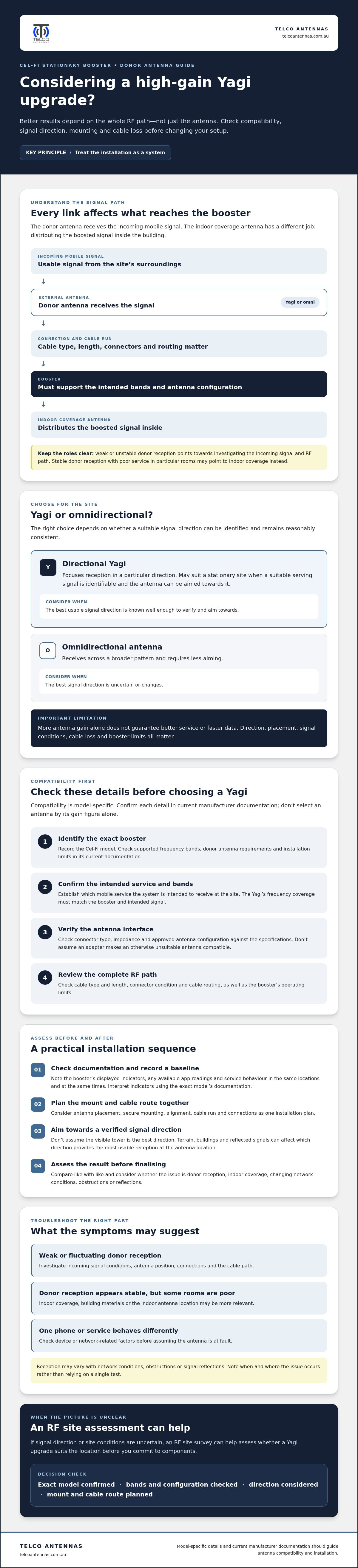
A donor antenna is the external antenna that receives an incoming mobile signal and feeds it to the booster. It serves a different role from the indoor coverage antenna, which distributes the boosted signal inside the building. If the donor antenna receives a weak or unstable signal, the booster has less useful signal to work with; if reception at the donor antenna is adequate but coverage is poor in one room, the problem may be inside the building instead.
A Yagi-Uda antenna is directional, so it may help at a stationary site where a suitable serving signal can be identified from a particular direction. But a cel-fi stationary booster donor antenna upgrade to high gain yagi isn’t automatically the right fix. Antenna gain alone can’t guarantee better service or faster data: the booster, signal conditions, antenna placement and the rest of the RF path all matter.
What symptoms suggest the donor antenna may be the limitation?
Look for evidence that distinguishes incoming reception from indoor distribution. Before changing hardware, record the booster’s displayed indicators, any available app readings, and how service behaves at the same locations and times. The exact indicators depend on the Cel-Fi model, so check its documentation when interpreting them.
- If the booster indicates weak or fluctuating donor reception, investigate the incoming signal, antenna position, connections and cable path.
- If donor reception appears stable but service is poor only in certain rooms, indoor coverage, building materials or the location of the indoor antenna may be more relevant.
- If one phone or one service behaves differently from others, check for device or network-related factors before assuming the antenna is at fault.
Intermittent reception can also reflect changing network conditions, obstructions or signal reflections. A higher-gain antenna won’t necessarily resolve these causes, so note when and where the issue occurs rather than judging the system from a single test.
When might a directional Yagi be preferable?
A Yagi focuses reception in a particular direction. That can be useful if a suitable serving signal is identifiable and remains reasonably consistent, allowing the antenna to be aimed towards it. An omnidirectional antenna receives across a broader pattern, which may be more practical where the best signal direction is uncertain or changes.
Don’t assume that a clear view of a tower guarantees the best reception. Terrain, buildings and reflected signals can affect which direction provides the most usable signal at the antenna’s location. Confirm the Cel-Fi model and intended service before settling on an antenna configuration. For more context on booster operation, see this guide to Cel-Fi GO signal boosters.
Check Cel-Fi model, frequency bands and donor antenna compatibility before upgrading
Compatibility is model-specific, so don’t choose a Yagi based on its gain figure alone. The antenna must suit the booster’s supported frequencies and approved configuration, and the complete path from antenna to booster must meet the manufacturer’s requirements. Use this sequence before purchasing components; confirm each detail against current documentation rather than assuming all stationary Cel-Fi units use the same arrangement.
- Identify the booster. Record the exact Cel-Fi model and check its current manufacturer documentation for supported frequency bands, donor antenna requirements and any installation limits.
- Confirm the service and bands. Establish which mobile service the system is intended to receive at the site, then verify the relevant frequencies. A Yagi’s coverage must match both the booster and the intended signal.
- Check the antenna interface. Verify connector type, impedance and approved antenna configuration from the specifications. Don’t rely on appearance or assume an adapter makes an otherwise unsuitable antenna compatible.
- Review the complete RF path. Check cable type, length, connector condition and routing. Coaxial cable and connectors introduce loss, reducing the signal that reaches the booster; compare the expected antenna gain with those losses using verified component specifications.
- Confirm applicable requirements. Check current Australian manufacturer and regulatory requirements for the specific booster and antenna arrangement before installation.
Which booster and network details should you confirm?
Write down the model number, the mobile service you need and the bands relevant at the site. Then compare them with the antenna’s documented frequency coverage and the booster’s stated requirements. This check is central to a cel-fi stationary booster donor antenna upgrade to high gain yagi, because a model-dependent mismatch can undermine the upgrade even if the antenna is directional and advertised as high gain.
How do cable and connectors affect a Yagi upgrade?
Longer cable runs and unsuitable or damaged connectors can add loss, so a higher-gain antenna doesn’t tell you the net result by itself. Inspect the full route and confirm cable and connector specifications before installation. Also distinguish the donor antenna input from other antenna arrangements: systems using MIMO have distinct configuration considerations, outlined in this MIMO antenna technical guide.
The FCC’s FCC regulations for cell phone boosters explain US requirements, but they aren’t a substitute for checking current Australian requirements. If any specification is unclear, confirm the booster and antenna combination before committing to parts. Telco Antennas supplies Cel-Fi GO boosters and RF components, and its RF site survey information may help if the system or site conditions need assessment.
High-gain Yagi versus omnidirectional donor antenna: weigh the practical trade-offs
A Yagi and an omnidirectional antenna collect signals differently, so the better choice depends on what reaches the site and how reliably you can position the antenna. A Yagi concentrates reception in a particular direction; an omnidirectional antenna receives across a broader pattern. Neither is automatically the better Cel-Fi donor antenna.
| Factor | Directional Yagi | Omnidirectional antenna |
|---|---|---|
| Reception pattern | Focused towards a chosen direction | Broader reception around the antenna |
| Orientation | Needs careful aiming and secure mounting | Generally less sensitive to horizontal aiming |
| May suit | A site with a suitable serving signal identifiable from one direction | A site where useful signals come from multiple directions or the best direction is uncertain |
| Practical consideration | Direction, obstructions and reflections can affect the result | A broad pattern may be useful, but doesn’t guarantee a suitable signal at the site |
What does high gain change in a real installation?
Antenna gain describes how an antenna’s pattern concentrates reception; it doesn’t create a signal. With a Yagi, the potential benefit depends on aiming its focused pattern towards a usable signal. A small change in orientation can matter, particularly if the intended direction is uncertain or the mount shifts.
Real sites aren’t always straightforward. Terrain and buildings may obstruct a direct path, while reflections can mean the most useful signal arrives from a direction other than the apparent tower direction. Compatible frequency coverage also matters. And even a well-aimed antenna must be considered with cable and connector losses, which reduce the signal reaching the booster. That’s why a cel-fi stationary booster donor antenna upgrade to high gain yagi should be assessed as a complete setup, not by comparing antenna gain labels alone.
When is an omnidirectional antenna the more practical option?
If useful signals may arrive from more than one direction, or you can’t confidently identify the best direction, an omnidirectional antenna may avoid the need to aim at one source. Its broader pattern can make initial positioning simpler, although the site still needs to provide a suitable incoming signal.
A Yagi may be worth considering where a suitable signal direction is known and the antenna can be aligned and mounted securely. An omnidirectional option may be more practical where direction is unclear or variable. Compare the site conditions, compatible bands and cable path before choosing; neither antenna pattern guarantees better service on its own.
How to install and aim a Cel-Fi donor Yagi, then check the result
Treat installation as a controlled test, not just a mounting job. Before starting, check the current Cel-Fi and antenna instructions for the approved configuration, placement requirements and any specified wait time before readings settle. Plan a secure mount and cable route first. If the work involves working at height, electrical hazards or RF configuration beyond your experience, use a suitably qualified professional.
- Record a baseline. Note the booster indicators and test mobile service in the areas where coverage matters. Keep the measurement method consistent so you can compare results later.
- Plan the mount and cable path. Choose a stable mounting point that allows the Yagi to be oriented as required. Check that the proposed route avoids sharp bends, damage risks and unnecessary cable length, while meeting the manufacturer’s instructions.
- Make a temporary setup where practical. Before fixing the antenna permanently, position it securely for testing. Keep donor and indoor antenna placement within the booster’s documented requirements.
- Connect and protect the system. Check connectors are correctly fitted and in good condition. Apply weatherproofing and cable strain relief as specified by the product instructions, then confirm the mount remains stable.
- Aim and compare. Point the Yagi towards the verified serving-signal direction, then assess the indicators and service before making further adjustments.
What is a sensible Yagi alignment process?
Use verified signal information and observations at the site to choose a starting direction. Adjust the antenna in small, controlled increments, changing one variable at a time. After each adjustment, allow the booster to respond for the period stated in its documentation, then record the same indicators. This method helps distinguish a genuine improvement from a change caused by moving several components at once.
How can you tell whether the upgrade helped?
Compare the before-and-after booster readings using the same measurement method, then test calls or data service in the same locations where coverage is needed. Keep the phone, carrier, test position and other conditions as consistent as practical. A better indicator alone doesn’t confirm that everyday service has improved.
If results are worse or inconsistent, check Yagi orientation, cable routing, connectors and the approved configuration before concluding that the booster is at fault. A cel-fi stationary booster donor antenna upgrade to high gain yagi depends on the complete installation working together. If signal direction or site conditions remain uncertain, consider an RF site survey. Explore RF site survey options before committing to a permanent setup.
When to get RF advice for a Cel-Fi Yagi upgrade
A Yagi upgrade is worth considering only after you’ve confirmed the exact booster model, supported frequency bands, approved antenna configuration and relevant site conditions. If any of these remain uncertain, getting RF advice before choosing hardware can help avoid solving the wrong problem. The aim is to assess the complete setup, not to assume that a different antenna will produce a particular service outcome.
When is a site assessment worth considering?
An RF site survey may be useful if booster readings vary, the likely serving-signal direction is unclear, or terrain and nearby structures obstruct reception. Reflections can also make the most useful signal direction difficult to judge from a map or line of sight alone. An assessment can help inform antenna positioning and system design based on the conditions observed, but the result depends on the site and equipment being assessed.
If you’ve already made changes and the results are inconsistent, a survey may help separate donor-side reception issues from cable, configuration or indoor coverage factors. Telco Antennas offers RF site surveys and engineering services for assessing RF requirements. This doesn’t mean a specific Yagi configuration will suit every Cel-Fi system, or that a performance improvement can be guaranteed.
What information should you have ready before seeking advice?
Useful details help make a compatibility discussion more precise. Gather the following before you enquire:
- Booster: exact Cel-Fi model and its current manufacturer documentation, including supported bands and antenna requirements.
- Existing antenna: type, configuration and any available specifications.
- Cable path: cable type and approximate length, connector details and the proposed route.
- Site setup: potential mounting position, nearby obstructions and any known information about the serving-signal direction.
- Observed behaviour: booster indicators and where, when and how service is unreliable or inconsistent.
These details help frame a cel-fi stationary booster donor antenna upgrade to high gain yagi around documented compatibility and actual site conditions, rather than antenna gain alone. If you don’t have every specification, start with the booster model and the information available; confirm the rest before selecting components.
For a compatibility discussion or to explore whether an RF assessment is appropriate, discuss your Cel-Fi antenna requirements with Telco Antennas.
Plan your Cel-Fi upgrade with confidence
A Yagi upgrade is most worthwhile when your Cel-Fi model, supported bands and approved antenna configuration match the proposed hardware, and site checks point to the donor antenna as a limitation. A directional antenna can suit a known signal direction, while an omnidirectional option may be more practical when reception comes from several directions or the best direction is uncertain.
The cel-fi stationary booster donor antenna upgrade to high gain yagi should be assessed as a complete RF path. Cable and connector losses, mounting, alignment and real-world service checks all matter; antenna gain alone can’t promise faster data or better coverage. Make changes methodically and compare results under consistent conditions.
Telco Antennas supplies Cel-Fi GO mobile signal boosters and RF components, including coaxial cables, and offers RF site surveys and engineering services. If you’d like to confirm compatibility or discuss whether your site may benefit from an assessment, discuss your Cel-Fi antenna requirements with Telco Antennas.
With the right checks before choosing components, you can make a considered upgrade and move ahead with greater confidence.
Frequently Asked Questions
Can I use a high-gain Yagi antenna with a Cel-Fi stationary booster?
Yes, if the exact Cel-Fi model supports the antenna configuration and the Yagi’s frequency coverage, connector and impedance meet its documented requirements. Check current manufacturer information before buying, as compatibility can vary between models. Also account for cable and connector losses: the signal reaching the booster depends on the complete donor path, not just the antenna’s stated gain.
Will a high-gain Yagi improve my Cel-Fi signal?
It may improve the incoming signal if a suitable serving signal is available in the direction the Yagi is aimed. Gain doesn’t create a signal, and the result depends on frequency compatibility, antenna orientation, obstructions and cable losses. A stronger donor signal also doesn’t guarantee faster data or better indoor service, so compare booster indicators and real service performance before and after the change.
How do I aim a Yagi donor antenna for a Cel-Fi booster?
Start with the verified direction of the suitable serving signal and the antenna manufacturer’s orientation instructions. Securely position the Yagi, then make small, controlled adjustments, changing one variable at a time. Allow the booster to respond as its documentation specifies, and record the same indicators after each adjustment. Terrain, buildings and reflections can affect the best direction, so don’t rely on tower visibility alone.
Can a long coaxial cable reduce the benefit of a high-gain antenna?
Yes. Coaxial cable and connectors introduce signal loss, and a longer run can reduce the signal delivered to the booster. The amount depends on the cable and system specifications, so check the documented loss for the cable type and frequency rather than assuming the antenna’s stated gain is the net result. Inspect connector condition and routing, and keep the run as short as practical while meeting installation requirements.
Is a Yagi better than an omnidirectional antenna for a Cel-Fi booster?
Neither type is universally better. A Yagi focuses reception in a chosen direction and may suit a site with a suitable, identifiable serving signal. An omnidirectional antenna receives across a broader pattern, which may be more practical if useful signals arrive from different directions or the best direction is uncertain. Choose based on site conditions, compatible frequency coverage and the booster’s approved antenna configuration.
What should I check before replacing a Cel-Fi donor antenna?
Before a cel-fi stationary booster donor antenna upgrade to high gain yagi, record the exact booster model and confirm its supported bands and approved antenna configuration in current manufacturer documentation. Check the replacement antenna’s frequency coverage, connector and impedance, then review cable type, length, condition and routing. Consider the mounting position and signal direction, and verify current Australian requirements for the specific equipment before installing it.


