

The best farm wireless network infrastructure isn’t necessarily the option with the highest headline speed. It’s the one that reliably connects the places and systems your operation depends on. A connection that works at the homestead may not reach machinery sheds, yards or paddocks, where terrain, distance and obstacles can affect coverage.
That gap can make it harder to use connected equipment consistently or decide whether an upgrade will deliver enough value to justify its cost. The answer isn’t always more hardware or a faster internet plan. It’s a network designed around your site, operational priorities and the connection available at each location.
This article compares cellular, satellite, Wi-Fi and point-to-point wireless links, and explains where each may fit. You’ll also learn how to connect network investment to practical outcomes, such as improving access to farm systems or supporting sensors and equipment, and what information to gather before committing. Assessing terrain, coverage, line of sight and intended uses can help turn an uncertain purchase into a considered business case.
Key Takeaways
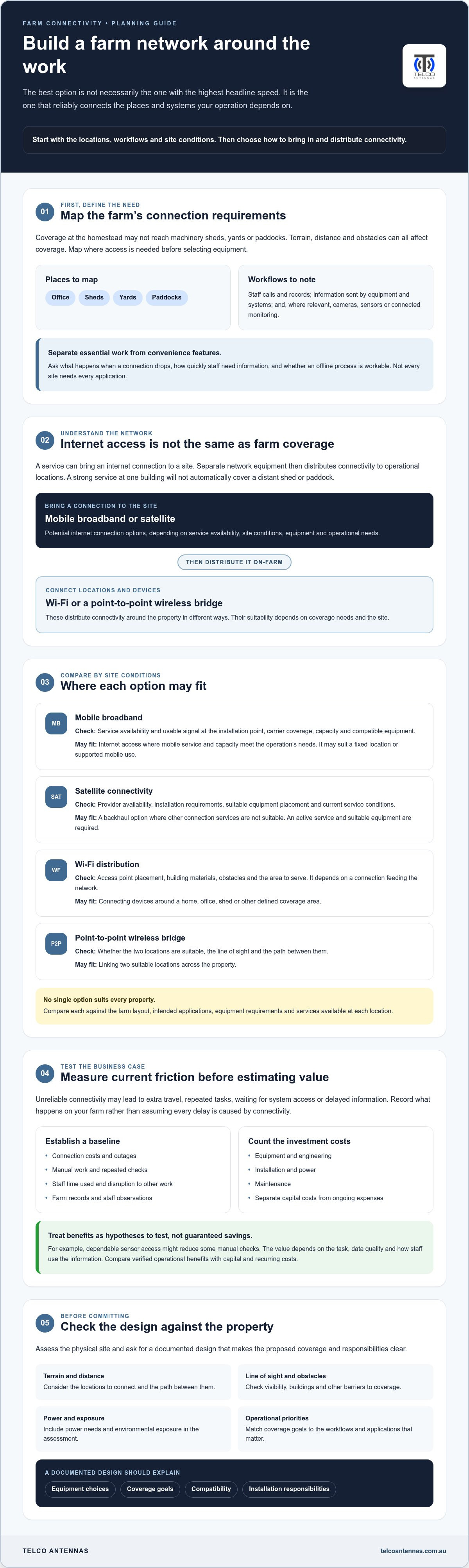
- Map where coverage is needed and which farm workflows rely on connectivity before selecting equipment.
- Assess farm wireless network infrastructure against terrain, distance, line of sight, power and environmental exposure, not headline speeds alone.
- Separate the internet connection from the on-farm network that distributes it, then compare options against site conditions and intended uses.
- Use farm records to establish a baseline for connection costs, outages, manual work and disruption. Distinguish capital costs from ongoing expenses.
- Before committing, request a documented design that explains equipment choices, coverage goals, compatibility and installation responsibilities.
Why farm wireless network infrastructure can become a business case
Patchy coverage between the office, sheds, yards and paddocks can leave staff without reliable access to communications or operational data. Connected assets may drop offline, monitoring information may arrive late, and workers may need to repeat checks in person. Depending on the workflow, these issues can cause delays, extra travel or gaps in the information used to make decisions.
Farm wireless network infrastructure includes the connected links, network equipment and coverage that serve operational sites across a property. Plan it around what the farm needs to connect and where, rather than starting with a preferred technology or supplier. For context on the broader challenges and methods involved, see this overview of rural internet access.
Which farm operations depend on reliable connectivity?
Map communications needs across the office, sheds, yards and paddock operations. Note where staff need to make calls or access records, and where equipment or systems send information. Depending on the operation, this could include cameras, sensors or connected monitoring. Not every site needs every application.
Separate essential workflows from convenience features. Ask what happens if a connection drops during a routine task, how quickly staff need information, and whether an offline process is workable. This helps establish a realistic service requirement and prevents the design being driven by features that don’t address the main operational problem.
What makes rural connectivity an investment decision?
Unreliable connectivity can contribute to costs that are easy to overlook. A worker might travel to check a site because remote monitoring isn’t available, repeat a task because information didn’t sync, or wait to access a system. Record how often these events occur, how much staff time they use and whether they disrupt other work. Farm records and staff observations can help establish a baseline without assuming every delay is caused by connectivity.
Treat possible benefits as hypotheses to test, not guaranteed savings. For example, more dependable access to a sensor might reduce some manual checks, but the value depends on the task, the quality of the data and how staff use it. Compare verified operational benefits with capital and recurring costs, including equipment, engineering, installation, power and maintenance.
A farm connectivity business case compares verified costs with operational benefits. Grounding that comparison in farm requirements gives you a practical basis for assessing options without assuming one network technology will suit every property.
Compare farm wireless network infrastructure options by site conditions
Start with the locations to be connected and the services available there. Mobile broadband or satellite can provide an internet connection, while Wi-Fi and point-to-point wireless bridges distribute connectivity around the property. These options solve different problems: a strong internet service at one building won’t automatically provide coverage in a distant shed or paddock.
Assess each option against the farm’s layout, intended applications and equipment requirements. The key distinction is between bringing an internet connection to a site and distributing it across operational locations.
| Option | Coverage and line of sight | Mobility and dependencies | Potential fit |
|---|---|---|---|
| Mobile broadband | Depends on service availability and usable signal at the installation point. | May suit a fixed location or supported mobile use; depends on carrier coverage and compatible equipment. | Internet access where mobile service and capacity meet the operation’s needs. |
| Satellite connectivity | Availability and installation requirements depend on the provider and equipment. | Requires suitable equipment placement and an active service; verify current service conditions. | A backhaul option where other connection services aren’t suitable. |
| Wi-Fi distribution | Coverage depends on access point placement, building materials, obstacles and the area to serve. | Typically serves local devices within a designed coverage area; depends on a connection feeding the network. | Connecting devices around a home, office, shed or other defined area. |
| Point-to-point wireless bridge | Links two suitable locations; assess line of sight and the path between them. | A fixed link, dependent on compatible equipment and a suitable installation at both ends. | Extending a network from a connected building to another site. |
When do mobile, satellite or fixed wireless links fit?
Before selecting mobile broadband or fixed wireless, check available services, signal conditions and required capacity at the intended connection point. Satellite may be worth assessing where other services aren’t suitable. Confirm provider availability, equipment requirements and service terms for the specific site. For more on planning a bridge link, see this professional guide to long-range wireless bridges.
How do antennas and bridges extend coverage around a farm?
MIMO antennas use multiple signal paths and may improve data throughput when the radio equipment and conditions support it. Results depend on compatibility, signal conditions and installation. A point-to-point bridge can connect buildings or other sites when a suitable line-of-sight path is available. Review this technical guide to MIMO antennas for more detail. For a site-specific assessment, explore RF site surveys and wireless bridge hardware.
Build a farm internet business case with measurable costs and benefits
A defensible business case compares a proposed network with the current situation and realistic alternatives. Use farm records to establish what connectivity problems actually cost your operation, rather than relying on general claims about rural broadband. The value of improved connectivity depends on the workflows it supports, conditions across your property and how consistently the network performs. Your case needs site-specific evidence.
A connectivity investment case is only as reliable as its site-specific inputs. Record the assumptions behind each estimate, identify which figures are measured and which are uncertain, and test how the result changes if expected benefits are lower than anticipated.
Which costs belong in the comparison?
Separate upfront capital costs from ongoing expenses to make the full commitment visible. Depending on the design, include:
- Initial costs: network equipment, antennas, cabling, mounts, power requirements, engineering and any required installation work.
- Recurring costs: internet or other service charges, maintenance, equipment replacement and staff time spent administering the network.
Use supplier or service-provider quotes for the proposed design, and check that they cover the same locations and requirements. Compare the proposal with credible alternatives, such as improving only the most critical link, rolling out the network in stages, or making no change. A staged approach may help test whether the expected operational benefit occurs before extending coverage across more of the property.
How can a farm measure operational value?
Choose indicators that match the workflows the network is intended to support. These might include staff time spent on manual checks, travel required to reach equipment, the frequency and duration of connectivity-related downtime, or delays accessing operational records. Set a pre-installation baseline using logs, work records or a simple staff tally. Decide who will collect the same information after deployment and over what review period.
For a transparent estimate, show the calculation inputs. For example: estimated time recovered = checks avoided × average time per check. If you value that time financially, document the rate used and whether the time is genuinely redeployed to other work. Mark uncertain inputs clearly, and don’t treat all saved time as cash savings.
Compare measures before and after deployment, while noting other changes that could affect the result, such as altered work practices or seasonal conditions. Don’t attribute a wider productivity change to connectivity without evidence and a reasonable comparison. This makes the business case for farm wireless network infrastructure more useful when deciding whether to proceed, adjust the design or gather more information.
Plan farm wireless infrastructure around coverage, resilience and scale
A reliable design starts with the work the network must support and the physical route between connection points. A shed behind a rise, a tree line between buildings or limited power at a remote site can affect which links are practical. Plan in sequence, then validate the design against conditions on the property:
- Map workflows and coverage goals. Mark essential connection points across offices, sheds, yards and paddocks, and note what each location needs to access.
- Record site conditions. Document terrain, structures, vegetation, distances, line of sight, available power and exposure to the elements.
- Survey and design. Verify RF conditions and likely link paths before specifying antenna positions, bridge equipment or mounting arrangements.
- Validate and document. Check the installed network at the required locations, record dependencies and confirm that it supports the intended workflows.
This sequence helps ensure farm wireless network infrastructure is designed for actual coverage needs, not just straight-line distances on a map.
What should a farm RF site survey establish?
A survey should map required coverage points, existing infrastructure, likely obstructions and proposed network paths. It should also measure or verify RF conditions and line of sight before equipment is specified. An apparently clear path may still be affected by terrain or structures. An RF site survey and wireless bridge engineering guide explains this assessment context. If an elevated mounting position may be needed, review this communication tower design reference.
How can the network grow without redesigning everything?
Note planned buildings, new equipment and changing operational requirements during the initial design. This doesn’t mean installing for every possible future use. It means documenting how the proposed layout could accommodate likely changes, subject to a fresh site assessment and verified equipment compatibility.
Resilience also needs deliberate planning. Identify which workflows would be affected if a link, power source or internet connection became unavailable, and consider suitable backup arrangements for those dependencies. Keep a record of equipment locations, cabling routes, power requirements, mounting details and network connections so maintenance or changes don’t rely on guesswork. Select equipment with specifications that suit the environment and can be checked against future requirements.
Where terrain, distance or mounting height makes the design uncertain, consider a site-specific RF site survey and communication tower design before settling on hardware and link locations.
Choose a farm wireless network partner and take the next step
A suitable partner should explain how the proposed design addresses the farm’s actual coverage requirements, not simply provide a hardware list. Before approving a solution, ask for a documented design that connects each equipment choice to a location, operational need and agreed business case. This gives you a clear basis for comparing proposals and checking whether the finished network meets its intended purpose.
What should you ask before approving a farm network design?
Use these questions to check whether a proposal is specific enough to support a sound decision:
- Coverage: Which buildings, yards or other locations are included, and what assumptions have been made about signal conditions and line of sight?
- Constraints: What obstructions, terrain, power limits or other dependencies could affect the design? What still needs to be verified?
- Compatibility: Are the antennas, bridges, cabling and other components compatible with the existing connection and equipment? Ask for relevant specifications to be confirmed.
- Responsibilities: Which hardware and engineering tasks are included, and who is responsible for installation, internet service arrangements, ongoing maintenance and support?
- Validation: How will coverage and operation be checked after deployment against the requirements you agreed on?
Clear answers help identify gaps before work proceeds. If a proposal depends on an unverified link or assumes coverage without explaining how it will be achieved, ask for the uncertainty to be recorded and resolved before committing.
When can specialist RF engineering help?
Consider an RF site survey if terrain, coverage, signal conditions or the path between buildings is uncertain. A survey can inform where links may work and which constraints the design needs to account for. Antennas, point-to-point wireless bridges, cabling and communication tower design should be selected against assessed conditions, with specifications and compatibility checked for the intended use.
Telco Antennas supplies specialist telecommunications hardware and RF engineering services, including RF site surveys and communication tower design. It isn’t an internet service provider and doesn’t supply consumer internet plans, so confirm separately how your farm will obtain its internet connection and what service arrangements apply.
Before making an enquiry, gather a site map, mark the locations that need coverage, note existing equipment and connections, and list the workflows the network must support. Then discuss your farm wireless infrastructure requirements with Telco Antennas to explore relevant hardware and RF engineering options for the site.
Turn your connectivity requirements into a practical plan
A sound farm wireless network infrastructure decision starts with the work your farm needs to support, then matches connectivity options to actual coverage, terrain and line-of-sight conditions. Separate the internet service from the network that distributes it across your property, and compare the full costs with operational benefits measured using your own records.
Before committing, request a documented design that explains coverage assumptions, equipment compatibility, dependencies and how performance will be checked. A site survey can clarify uncertain RF conditions and link paths, so hardware choices are based on the property rather than guesswork.
Telco Antennas supplies MIMO antennas, point-to-point wireless bridges and specialist RF cabling. Its engineering services include RF site surveys and communication tower design. Telco Antennas supplies hardware and RF engineering services, not consumer internet plans.
Prepare a site map and note the locations, workflows and connectivity issues you need to address. Then discuss your farm wireless infrastructure requirements with Telco Antennas to explore relevant options for your site.
Frequently Asked Questions
What is farm wireless network infrastructure?
Farm wireless network infrastructure is the equipment and links that distribute connectivity across operational locations on a property. It can include an internet connection, routers, Wi-Fi access points, mobile or satellite links, antennas and point-to-point wireless bridges. The right arrangement depends on where coverage is needed, which applications use it, and site factors such as distance, obstructions, power and line of sight. A connection at one building won’t automatically cover the whole farm.
Is rural internet connectivity worth the investment for a farm?
It can be worthwhile if reliable connectivity addresses a defined operational problem and measurable benefits justify the full costs. Start by recording current service expenses, outages, delays and time spent on manual tasks. Then compare those records with proposed equipment, engineering, installation and recurring costs. The result will vary by farm, so treat expected benefits as estimates to test, not guaranteed savings or productivity gains.
What internet connection is best for a farm?
There isn’t one best internet connection for every farm. Compare available mobile broadband, satellite and fixed wireless services against coverage, capacity, site layout, service dependencies and operational needs. The connection brings internet service to a site; antennas, Wi-Fi or wireless bridges can then distribute connectivity to other locations. Check current service availability and verify technical performance for your property before choosing a provider or specifying equipment.
How can wireless internet reach sheds and other buildings on a farm?
First identify the buildings that need connectivity and assess what separates them from the existing connection, including distance, terrain and obstructions. Wi-Fi may suit areas near an access point, while a point-to-point wireless bridge can link separate locations when the path is suitable. Antennas and mounting structures may also form part of the design. Confirm line of sight, power availability and equipment compatibility before selecting the link.
Can Starlink be used as part of a farm wireless network?
Satellite internet such as Starlink may provide the internet connection for a farm network, subject to current service availability, equipment requirements and site conditions. It won’t automatically provide suitable coverage to every shed, yard or paddock. The local network still needs to distribute connectivity using appropriate cabling, Wi-Fi or wireless links. Check current service terms and hardware compatibility before including satellite equipment in a network design.
How do you calculate the business case for rural internet connectivity?
Record current service costs and connectivity-related impacts, such as outages, downtime or time spent on manual checks. Then list proposed capital and recurring costs, and estimate benefits using measurable, farm-specific indicators. Show your assumptions, compare realistic options and choose a period for reviewing results after deployment. Treat uncertain benefits as estimates rather than guaranteed savings, and update the calculation with actual figures as they become available.
Do farms need an RF site survey before installing wireless infrastructure?
An RF site survey can help when coverage, terrain, line of sight, obstructions or link placement are uncertain. It may identify suitable network paths and inform equipment selection before installation. The need and scope depend on the property and proposed system. Ask which locations and conditions the survey will assess, what it will measure, and how the findings will inform antenna positions, bridge links and the overall design.


