

The antenna with the greatest reach isn’t always the one that keeps you connected at sea. If your vessel is moving, the Poynting OMNI-493’s all-direction coverage may be more practical than a high-gain directional antenna. At a fixed mooring in a fringe coverage area, aiming towards a known tower may deliver a stronger signal. That’s the key distinction in the poynting omni-493 vs high gain directional antenna for marine vessel decision.
Signal dropouts as your boat rolls or pitches can disrupt weather updates and communications, while distance from coastal towers can limit data speeds. Your antenna, mount and cabling also need to suit saltwater exposure, not just offer an impressive gain figure.
This comparison looks at how vessel movement, tower location and installation affect performance, and when each option is likely to suit your setup. The complete signal path matters: the antenna, MIMO configuration, coaxial cable and any booster all influence the connection your equipment can use. The OMNI-493 offers peak gain of up to 9 dBi, but the right choice depends on where and how you use your vessel, not gain alone.
Key Takeaways
- Compare 360-degree coverage with a focused beam to see which antenna pattern suits your vessel’s usual operating conditions.
- Use the poynting omni-493 vs high gain directional antenna for marine vessel comparison to assess mobility, tower direction and installation requirements before choosing.
- Consider a directional antenna when your vessel stays in one location and you can reliably aim it towards a suitable tower.
- Check marine protection and mounting requirements when choosing hardware for prolonged saltwater and weather exposure.
- Assess the full RF signal path, including antenna configuration and coaxial cable, rather than choosing on antenna gain alone.
Understanding Marine Antenna Physics: Omni vs Directional
Choosing between an omnidirectional and directional antenna comes down to how each distributes signal and how your vessel moves relative to a cellular tower. An omni antenna receives and transmits across a 360-degree horizontal pattern, so it can work with towers in different directions without being manually aimed. A directional antenna concentrates its energy into a narrower beam. This can improve reception from a particular direction when the vessel is stationary and a suitable tower is known. The basic distinction is explained in Directional Antennas.
Radiation Patterns and Vessel Stability
Picture an omni antenna’s pattern as a doughnut around the antenna: coverage extends outwards in every horizontal direction, with less coverage directly above and below. A directional pattern is more like a torch beam, concentrating reception towards one area rather than covering all bearings. That focus can be useful at a fixed mooring, but on choppy water, rolling and pitching can shift the beam away from the tower. Higher gain alone won’t prevent dropouts if the antenna’s direction changes with the boat.
The Marine Environment and Antenna Gain
Mounting height matters because cellular signals generally benefit from a clearer path to a tower. Higher placement can reduce obstruction from parts of the vessel or nearby structures, but it can’t remove the effects of distance, terrain or buildings along the route. Salt spray is a separate concern: it can corrode exposed hardware and connections, so marine suitability and a properly protected installation matter over time.
Gain, measured in dBi, describes how an antenna directs or receives energy compared with a reference antenna. It isn’t a direct measure of guaranteed range or data speed. A high-gain directional antenna may provide useful focus when aligned, while an omni’s broader coverage can be more practical on a moving vessel. The best choice depends on movement, tower position, obstructions and the rest of the signal path, including coaxial cable.
The Role of 4G and 5G Frequencies at Sea
Lower cellular frequencies, such as around 700 MHz, can generally travel farther and cope better with obstacles than higher frequencies. Higher bands can offer greater capacity where coverage and conditions support them. Actual performance depends on the available network band, signal conditions and compatible equipment, so check an antenna’s frequency specifications against the carrier and service you intend to use.
Wideband means an antenna is designed to operate across a broad range of frequencies. This can help marine hardware accommodate multiple compatible cellular bands and remain useful as network requirements change.
The Poynting OMNI-493: An Option for Marine Mobility
The Poynting OMNI-493 is an omnidirectional antenna designed for marine and coastal use. Its stated operating range of 617 to 3800 MHz covers a broad span of 4G/LTE and 5G frequencies, while its IP68 rating and saltwater protection address the exposure a vessel’s external hardware faces. These specifications make it a candidate for mobile installations, but overall performance still depends on the modem, antenna placement and cabling.
Its all-direction pattern avoids the need to aim the antenna at a particular tower. That can make installation simpler than with a directional array, especially on a vessel that changes heading or moves between coverage areas. “Set and forget” doesn’t mean “fit anywhere”, though. Mounting position, nearby obstructions, secure connections and coaxial cable losses all affect the signal delivered to your equipment.
Optimising Throughput with MIMO Antennas
MIMO, or Multiple-Input Multiple-Output, uses multiple antenna paths to send and receive data, allowing compatible network equipment to improve throughput and connection performance. A MIMO setup may use two antennas, but the right arrangement depends on the modem’s supported configuration and the antenna system. Positioning and separation matter: antennas mounted too close together or obstructed by vessel structures may not provide the intended spatial diversity. For a deeper explanation, see this MIMO antenna technical guide.
Cabling is part of the system, not an afterthought. Long or lossy coaxial runs can reduce the signal reaching the modem, so choose suitable low-loss cable and keep the route practical. Telco Antennas supplies MIMO antennas and LMR-400 coaxial cables for installations where the complete RF path needs consideration.
Mechanical Protection and Installation Checks
Marine hardware needs to withstand more than occasional rain. Salt spray, sun exposure and ongoing vibration can challenge the antenna, mount, connectors and cable entry points. The OMNI-493’s IP68 rating and stated saltwater protection are relevant, but IP68 alone shouldn’t be treated as proof of UV resistance or suitability for every mounting arrangement. Check the manufacturer’s installation guidance, including mounting compatibility and any environmental limits.
On engine-heavy vessels, secure mounting and strain relief help prevent vibration from working connections loose over time. Before fitting, confirm that the mount suits the vessel’s existing infrastructure and that the antenna has suitable clearance. If your vessel also carries marine radio equipment, the FCC’s Maritime Mobile Service page describes that distinct radio service. Cellular broadband equipment serves a different purpose.
In the poynting omni-493 vs high gain directional antenna for marine vessel comparison, the OMNI-493’s practical advantage is coverage without manual aiming. Its value depends on a correctly configured MIMO system and a well-built signal path, not the antenna alone.
High-Gain Directional Antennas: When Reach is the Priority
A directional antenna is worth considering when your vessel spends most of its time in one place, such as a fixed mooring or marina, and you know the direction of a usable cellular tower. By concentrating reception into a narrower beam, it can favour a distant tower over signals arriving from other bearings. This may help in a remote coastal coverage area, but no antenna can guarantee reception at a set distance. Terrain, obstructions, tower height, network conditions and installation all influence the result.
That focus comes with a trade-off: the antenna must be aimed accurately, and the vessel needs to remain oriented so the beam stays on target. A directional setup might suit a live-aboard boat at a stable berth, but it can lose signal as the vessel swings at anchor or changes heading. In a busy harbour, a narrow beam may also reduce reception from unwanted directions, though it can’t remove interference or overcome a weak network signal by itself.
Choosing a Directional Antenna for the Vessel
Two common forms are log-periodic dipole array (LPDA) and panel antennas. An LPDA uses visible elements arranged along a boom, while a panel antenna places its elements within a flatter enclosure. Suitability depends on the supported frequency bands, mounting options, beamwidth and installation environment. Check these details against your modem and intended use rather than choosing on appearance or gain alone.
Protect the Signal Path, Not Just the Antenna
High antenna gain can be undermined by signal loss in the coaxial cable, particularly on a long run between an elevated antenna and equipment below deck. Cable attenuation reduces the signal travelling in either direction, so the cable type, run length, connectors and installation all matter. Telco Antennas supplies LMR-400 coaxial cables, a low-loss option to consider when designing the complete RF path.
Marine installation adds another failure point: water entering a connector or cable termination can damage the connection and degrade performance. Use terminations suited to the equipment and marine exposure, follow the manufacturer’s sealing instructions, and inspect cable entry points as part of routine maintenance. A carefully aimed antenna won’t compensate for a compromised coaxial connection.
In the poynting omni-493 vs high gain directional antenna for marine vessel decision, directional gain makes most sense when the vessel is stationary, the target tower is identifiable and the antenna can remain aligned. If you regularly move or change heading, that alignment requirement may outweigh the benefit of a focused beam.
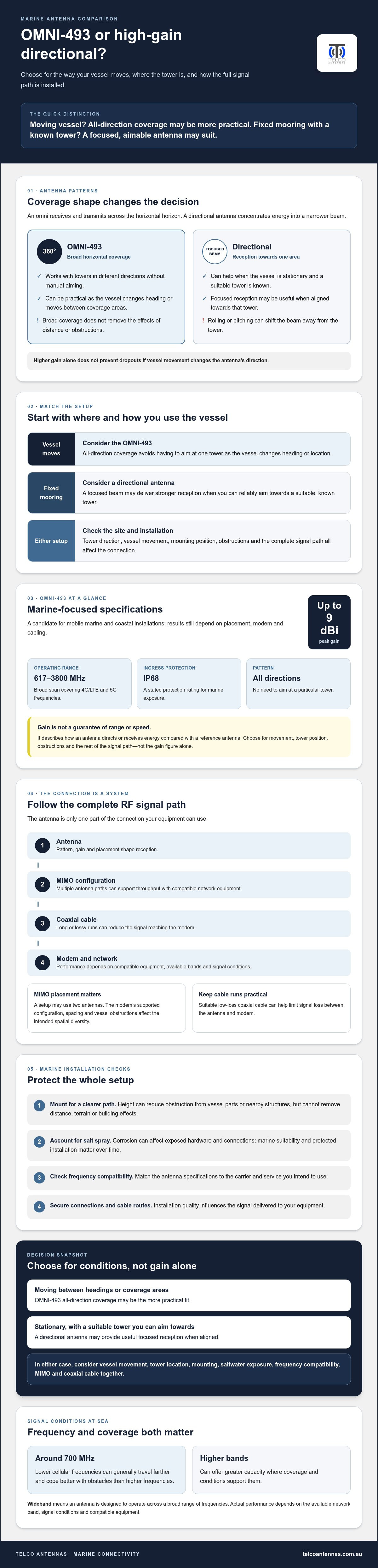
Head-to-Head: OMNI-493 vs High Gain Directional
The practical difference is not simply peak gain. A directional antenna concentrates reception into a narrower part of the sky, which can favour a distant tower when the antenna is aligned and the vessel is steady. The OMNI-493’s omnidirectional pattern accepts signals from different horizontal directions, making it less dependent on heading as the vessel moves. In marine use, the more useful antenna is the one that maintains a workable signal through the conditions you actually encounter.
Stability, Beamwidth and Vessel Movement
Horizontal beamwidth describes the antenna’s coverage around the horizon; vertical beamwidth describes its coverage above and below that plane. A directional antenna’s narrower pattern can improve focus, but it also makes accurate alignment more important. Pitch changes the antenna’s elevation relative to a tower, while roll can shift its bearing. The effect depends on the antenna’s beamwidth, the tower’s position and the vessel’s motion.
A 10-degree roll does not produce a predictable 50 per cent signal drop across directional antennas. Signal loss depends on the installation and link geometry, so that figure shouldn’t be treated as a general rule. An omni can be more forgiving as a boat changes heading because it doesn’t need to point at one tower, although movement, obstructions and changing signal conditions can still affect reception.
Installation demands differ, too. An omni is mounted for suitable clearance and coverage without manual tower aiming. A directional array needs to be aimed and secured, and may require realignment if the vessel’s position or target tower changes. On a high mast, consider wind loading and mounting strength alongside signal performance. Antenna size, shape and exposure affect the mechanical demands on the support.
Data Performance in Marinas and Coastal Areas
In a suburban coastal area or urban marina, available 4G or 5G bands, network congestion, obstructions and signal-to-noise ratio all influence data speed. A directional antenna may improve reception from a preferred tower if it reduces competing signals, but it won’t guarantee higher throughput. An omnidirectional MIMO setup may be more practical where several towers are available or the vessel moves between locations. In either case, compatible modem and antenna configurations, sound placement and low-loss cabling matter.
Farther from shore, a directional antenna may help where a usable tower is distant and the vessel can remain aligned. It cannot create coverage where no cellular signal is available. For a recreational cruiser travelling between coastal locations, the OMNI-493 prioritises connection across changing headings, while a directional antenna prioritises reach from a stable position.
To compare a setup against your vessel’s movement, mounting and cabling requirements, discuss marine antenna options with Telco Antennas.
Poynting OMNI-493 vs High Gain Directional Antenna for Marine Vessel: The Verdict
The right choice depends on whether your priority is connection flexibility or focused reception from a known tower. For the poynting omni-493 vs high gain directional antenna for marine vessel decision, match the antenna to the vessel’s movement, typical mooring and available signal rather than choosing on gain alone.
- Coastal cruiser: The OMNI-493’s all-direction coverage suits a boat that changes heading or moves between coastal locations, without needing manual realignment at each stop.
- Remote live-aboard: A directional antenna may suit a vessel that stays in one place and has a known, usable tower to target. Its advantage depends on alignment and a stable mounting position.
- Commercial trawler: Separate omni and directional antenna systems may serve different operating situations, but they need compatible equipment and a considered installation. Don’t combine antenna outputs unless the modem or RF system is designed for that configuration.
A compatible Cel-Fi GO signal booster may form part of a mobile coverage setup for voice and data. Confirm compatibility with the network, antenna arrangement and intended installation. A booster can’t create a signal where none is available.
Placement and Cable Checks
On a yacht, a mast may provide a high mounting point, but sails, rigging and other equipment can obstruct parts of the signal path. On a powerboat, consider the hardtop, radar equipment and other antennas. For either vessel, aim to reduce shadowing while keeping suitable clearance and a secure mount. More height can improve line of sight, but longer coaxial runs can increase signal loss. Balance placement with cable length and select suitable low-loss coax.
Before purchase, check the modem or router’s external antenna connector, such as SMA or TS9, and confirm that it matches the antenna system or required leads. Measure the cable route, including the path into the cabin, then check the cable type and connector compatibility. Treat waterproof cable entries and terminations as part of the installation, not an afterthought.
If you need help assessing the operating environment and signal path, enquire about an RF site survey to inform your antenna selection and installation planning.
Choose a Marine Antenna Setup That Fits Your Route
The key decision in the poynting omni-493 vs high gain directional antenna for marine vessel comparison is whether your vessel needs coverage as it moves or focused reception from a known tower while stationary. The OMNI-493’s all-direction pattern suits changing headings and coastal cruising; a directional antenna may be a better fit for a stable mooring where alignment can be maintained.
Whichever approach you choose, performance depends on the whole signal path. Check antenna and modem compatibility, mounting position and cable length, and use suitable low-loss coax to limit avoidable signal loss. For data-focused setups, make sure the MIMO configuration matches the equipment and installation.
Telco Antennas supplies connectivity hardware and offers RF engineering services, including RF site surveys. Explore compatible MIMO antennas, LMR-400 coaxial cables and Cel-Fi GO mobile signal boosters, then enquire about marine connectivity options for your vessel. Contact Telco Antennas to discuss the equipment and RF engineering support that may suit your installation.
Frequently Asked Questions
Can I use a directional antenna on a moving boat?
Yes, but movement can make it harder to maintain a strong connection. A directional antenna focuses reception towards a narrower area, so pitching, rolling or changing heading may shift its beam away from the target tower. It’s most practical when the vessel stays in a stable position and the antenna can be aimed accurately. For a boat regularly under way, an omnidirectional antenna avoids manual realignment as the vessel changes direction.
Is the Poynting OMNI-493 compatible with 5G networks in Australia?
The OMNI-493’s stated frequency range of 617 to 3800 MHz covers a broad span of 4G/LTE and 5G frequencies. Compatibility still depends on whether the antenna supports the bands used by your network and whether your modem or router supports those same bands. Check the equipment specifications against your carrier’s current network bands before installation. An antenna alone doesn’t provide 5G service or guarantee coverage in a particular location.
Do I need a dual-antenna setup for MIMO data speeds?
Not in every setup. MIMO uses multiple antenna paths to improve data performance when the modem, network and antenna configuration support it. Some equipment may use two antennas, but the required arrangement depends on the modem’s specifications and the antenna system. Check how many external antenna connections your device has and what configuration it supports. Correct placement and separation can also matter, so avoid mounting antennas close together without checking installation guidance.
How does salt water affect my antenna’s performance over time?
Salt deposits and moisture can corrode exposed metal parts and connectors, while water entering a cable termination may degrade the connection. Choose hardware specified for marine conditions, protect cable entries as directed by the manufacturer, and inspect the antenna, mount and connections periodically. The OMNI-493 is described as IP68-rated with saltwater protection, but that doesn’t remove the need to install it correctly or check the complete signal path for wear.
What is the maximum range I can expect from a high-gain marine antenna?
There isn’t a reliable maximum range that applies to every installation. Reception depends on tower location, terrain, obstructions, antenna height and alignment, network conditions, and losses in the coaxial cable. A directional antenna may help connect to a distant usable tower when aimed accurately, but it can’t create coverage where no signal is available. In the poynting omni-493 vs high gain directional antenna for marine vessel comparison, consider your operating location and movement rather than relying on a promised distance.
Should I mount my antenna as high as possible on the mast?
Mount it where it has a clear signal path and a secure, suitable installation, but not automatically at the highest possible point. Greater height can reduce nearby obstructions, while a longer cable run can add signal loss between the antenna and modem. Consider mast movement, nearby equipment and the cable route together. Keep the coaxial run practical, use suitable low-loss cable, and follow the antenna manufacturer’s mounting and clearance instructions.
Can I paint my antenna to match the colour of my boat?
Don’t paint the antenna unless its manufacturer confirms that painting is suitable. Paint can affect the radome material, weather protection or radio-frequency performance, and some coatings may not adhere or withstand marine exposure. Check the product instructions before applying any coating, including to mounting parts or connectors. If appearance is the concern, consider positioning the antenna discreetly while preserving the required clearance and following the manufacturer’s installation guidance.
What is the best coaxial cable for a marine antenna installation?
The right cable depends on the antenna, modem, connector type and length of the run. Choose compatible, low-loss coaxial cable and keep the route as short and direct as practical to limit attenuation. LMR-400 is an ultra-low-loss coaxial cable option supplied by Telco Antennas. Confirm connector compatibility, protect terminations from water ingress and follow the equipment manufacturer’s guidance, as a poor cable or exposed connection can undermine the antenna’s performance.


