

What if your investment in signal reliability didn't just become obsolete, but actually served as the foundation for a vastly superior 5G connection? Transitioning through the Telstra 3G closure with a mobile booster upgrade to 4G and 5G represents more than a simple hardware swap; it's a technical recalibration of your entire RF environment. If you're currently operating a legacy Cel-Fi unit in a remote area, you've likely noticed your voice calls dropping or data speeds stalling as the 3G spectrum is decommissioned across the country. It's a frustrating situation that turns specialised hardware into a paperweight overnight.
We understand that maintaining a link in the Australian bush isn't just about convenience, it's a critical safety requirement. This professional engineering guide from Telco Antennas details how to transition your signal enhancement hardware for the post-3G landscape. We'll examine the specific physics of higher frequency 4G and 5G signals, explain why your existing LMR-400 cabling might still be your greatest asset, and identify which MIMO antenna configurations are necessary to restore reliable throughput. You'll learn how to audit your current system and select future-proof components that ensure your connectivity remains stable long after the final 3G tower goes dark.
Key Takeaways
- Understand the technical shift of spectrum refarming and how the transition of the 850MHz band impacts long-range signal propagation in regional areas.
- Learn how to use the Cel-Fi WAVE App to audit your current hardware and determine if your existing unit supports the necessary frequency bands.
- Identify the specific hardware requirements for a telstra 3g closure mobile booster upgrade to 4g and 5g, focusing on the role of MIMO antenna arrays.
- Discover why low-loss LMR-400 coaxial cabling is a critical component for maintaining signal integrity when transitioning to higher frequency 4G and 5G services.
- Determine when a professional RF site survey or custom communication tower design is required to solve complex connectivity challenges in remote locations.
The Reality of the Telstra 3G Closure in Regional Australia
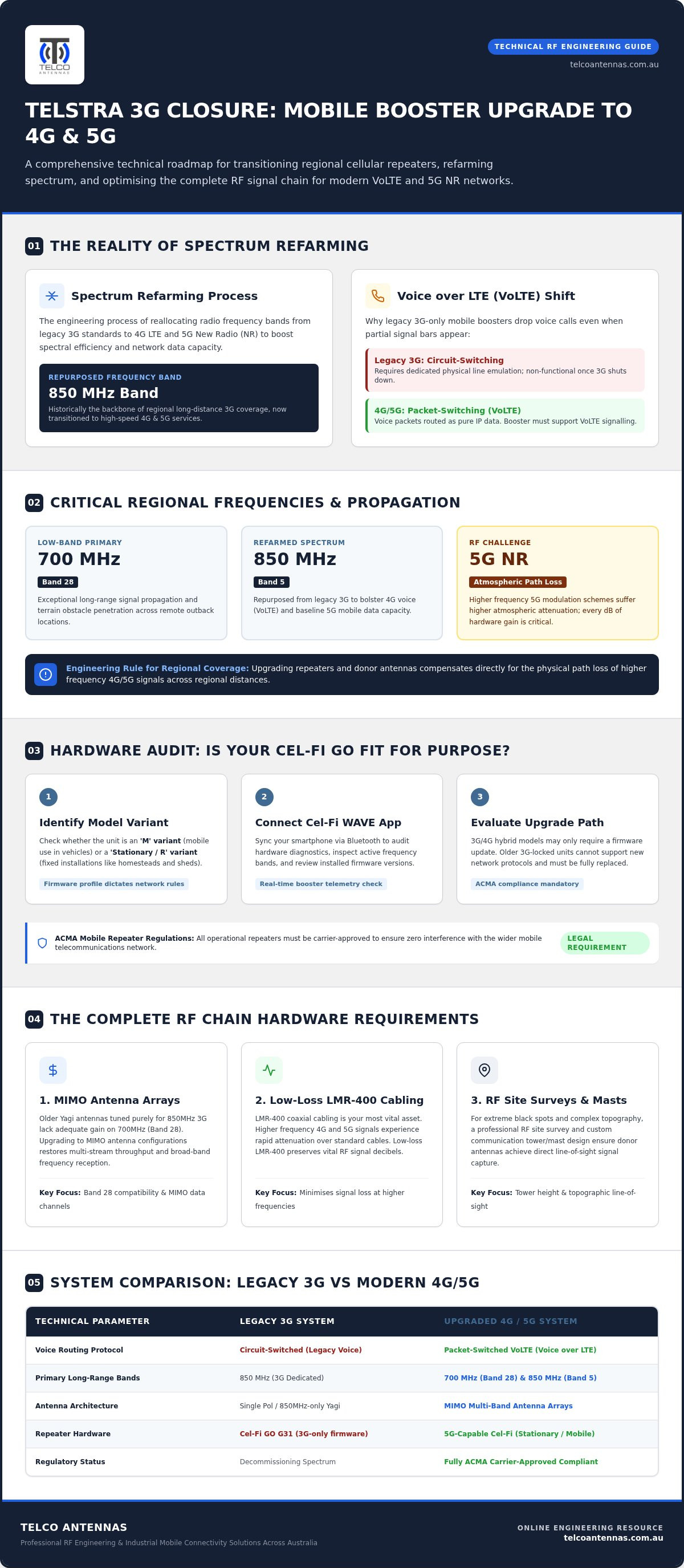
The Telstra 3G closure isn't just a simple switch-off; it's a fundamental restructuring of the Australian mobile landscape. At the centre of this change is spectrum refarming. Spectrum refarming is the engineering process of reallocating radio frequency bands from legacy network technologies, such as 3G, to modern standards like 4G and 5G to improve spectral efficiency and data capacity. For regional users, this means the 850MHz band, previously the backbone of long-distance 3G coverage, is being repurposed. While this improves data speeds, it creates a significant hurdle for those using older cellular signal repeater systems.
These legacy units were designed to fall back to 3G for voice services. Once the 3G signal is gone, these boosters often lose the ability to facilitate calls entirely, even if a marginal 4G signal is present. This makes a telstra 3g closure mobile booster upgrade to 4g and 5g essential for maintaining safety and connectivity in remote black spots. Many users who relied on network certification for handheld performance in the bush will find that their coverage footprint changes as the network shifts its reliance to different protocols.
Why Voice over LTE (VoLTE) Changes Everything
Historically, 3G handled voice through circuit-switching, a dedicated connection method. 4G and 5G use packet-switching, where voice is treated as data, known as Voice over LTE (VoLTE). If your current signal booster isn't specifically engineered to handle VoLTE signalling, you'll experience silent calls or immediate drops. It's a common symptom for users with 3G-only hardware; the device might show bars of signal, but the underlying protocol can't route the voice packets. Modern boosters from Telco Antennas must be fully compatible with these packet-switched standards to ensure voice calls remain reliable.
Frequency Shifts and RF Propagation
The transition relies heavily on the 700MHz (Band 28) and 850MHz (Band 5) frequencies. These lower bands are prized for their ability to travel long distances and penetrate obstacles, which is why they were the foundation of regional coverage. However, 5G New Radio (NR) introduces different modulation schemes that can interact differently with the environment. Higher frequency bands suffer from greater atmospheric attenuation, meaning the signal weakens faster over distance. In the outback, every decibel of gain matters. Upgrading your hardware ensures your system is tuned to these specific 4G and 5G bands, compensating for the physical challenges of signal path loss over vast distances.
Auditing Your Existing Signal Booster Hardware
Before committing to a telstra 3g closure mobile booster upgrade to 4g and 5g, you must determine exactly what hardware you're currently running. You can't engineer a solution without a clear diagnostic of the existing system. Most regional Australians rely on the Cel-Fi GO series, but there's a significant technical divide between the original GO G31 units and the newer 5G-capable models. The first step is identifying your unit's variant. The 'M' variant is designed for mobile use in vehicles, while the 'Stationary' or 'R' variant is tuned for fixed installations like homesteads or sheds. Each has specific firmware profiles that dictate how they interact with the network.
Is Your Cel-Fi GO Still Fit for Purpose?
Open the Cel-Fi WAVE app on your smartphone and connect to your device via Bluetooth. This tool provides a window into the unit's health, showing you the current firmware version and the active frequency bands it's boosting. If your unit is an older 3G-only model, it's effectively a legacy device that cannot be updated to support the new 4G/5G network architecture. However, if you have a 3G/4G capable unit, a simple firmware update might be all that's required to restore service. All operations must comply with ACMA mobile repeater regulations, which mandate that repeaters are carrier-approved and don't cause interference to the wider network. If the WAVE app shows your hardware is locked to 3G bands that no longer exist, a hardware replacement is your only viable path forward.
The Antenna Audit: Beyond the Booster
The booster is only one link in your RF chain. Your donor antenna must be compatible with the frequencies Telstra is now prioritising for 4G and 5G. Many older Yagi antennas were tuned specifically for the 850MHz 3G band and have very poor gain on the 700MHz (Band 28) frequency. A "narrow-band" antenna will choke your signal, leading to high packet loss and poor data speeds even if you've replaced the booster box itself.
Check the physical condition of your cabling as well. Look for signs of UV degradation, such as cracking in the outer jacket, or water ingress at the connectors. If you find damage, it's the perfect time to audit your RF components to ensure your system can handle the increased bandwidth requirements. Standard RG-58 cable is often insufficient for modern high-frequency signals. We recommend inspecting every connector for impedance mismatches or physical wear to ensure your new 4G or 5G signal isn't lost before it even reaches the booster.
The Upgrade Path: 4G and 5G Hardware Requirements
Selecting the right hardware for a telstra 3g closure mobile booster upgrade to 4g and 5g requires a technical shift in how we view signal path efficiency. The Cel-Fi GO G51 represents the current benchmark for 5G-capable consumer repeaters, offering support for the n78 (3.5GHz) band alongside legacy 4G frequencies. However, the booster is only as effective as the antenna array feeding it. While 3G systems often operated on a narrow frequency window around 850MHz, modern 4G and 5G networks utilise a much broader spectrum. You must select antennas with a wide frequency response, typically ranging from 698MHz to 3800MHz, to ensure compatibility with all current and future Telstra bands. This alignment is consistent with the AMTA 3G network closure guidance, which emphasises the need for hardware that supports repurposed spectrum.
MIMO Antennas vs. Single Input Systems
One of the most significant changes in the post-3G era is the reliance on MIMO (Multiple Input, Multiple Output) technology. Unlike 3G, which used a single spatial path, 4G and 5G use multiple antennas at both the tower and your site to send and receive data simultaneously. This spatial multiplexing significantly increases throughput and link stability. For a successful upgrade, you'll need a MIMO antenna array, often consisting of two antennas mounted with opposing polarisations, typically at 45-degree angles. For a deeper dive into these configurations, see our guide on MIMO Antennas: A Technical Guide to Enhancing Data Throughput. Without a proper MIMO setup, your data speeds will be physically capped, regardless of the booster's theoretical potential.
Cabling Infrastructure: LMR-400 is the Standard
As frequencies increase, signal attenuation becomes a critical factor. A signal at 3.5GHz loses strength much faster than a 850MHz signal when travelling through coaxial cable. Legacy RG58 cable, common in older installations, is entirely unsuitable for 5G because its high loss profile will effectively swallow the signal before it reaches your equipment. LMR-400 coaxial cable is the industry standard for these installations. It features a larger centre conductor and superior shielding, providing significantly lower decibel loss per metre. Professional connector termination and weatherproofing with self-amalgamating tape are also mandatory. Even a small amount of moisture in a connector can cause impedance mismatches that destroy 5G performance. It's a simple mechanical failure that can render the most expensive booster useless.
Step-by-Step Installation and Optimisation
Once you've procured the correct hardware for your telstra 3g closure mobile booster upgrade to 4g and 5g, the focus shifts to physical installation and RF optimisation. A successful deployment begins with a preliminary signal survey. Using the Cel-Fi WAVE tool's "Antenna Position Test," you can measure the Receive Signal Level (RSL) and Signal-to-Noise Ratio (SINR) at various points on your structure. Don't assume your old antenna location is still the best. The shift to 4G and 5G bands means the strongest signal might now originate from a different sector or a newer tower altogether. Finding the "sweet spot" before permanent mounting is essential for long-term stability.
Antenna Alignment for Higher Frequencies
5G signals require significantly higher precision during alignment than legacy 3G systems. While 3G was relatively forgiving, 4G and 5G utilise higher frequencies that are more sensitive to slight misalignments. We recommend Locating Your Nearest Telstra Tower for Maximum Signal using topographical maps to ensure a clear line-of-sight. Even a few degrees of error in your Yagi's orientation can lead to a drastic drop in data throughput. In regional environments, where signals travel over vast distances, this precision can be the difference between a stable VoLTE link and a failed connection.
Managing antenna isolation is the next critical technical hurdle. If the internal server antenna is too close to the external donor antenna, the system will experience feedback. This causes the booster to automatically reduce its gain to protect the network, resulting in a much smaller indoor coverage footprint. To prevent this, ensure maximum physical separation between the two antennas. Ideally, use the building's roof structure or foil-backed insulation as an RF shield to block the internal signal from "leaking" back to the donor antenna.
Configuring the Booster for Your Network
After mounting, use the WAVE app to verify the booster is set to the correct operator. For Telstra customers, this ensures the device is scanning the specific Band 28 or Band 5 frequencies required for VoLTE. Monitor the app for any "Network Interference" notifications. If the booster detects it's causing issues for the local tower, it will shut down to comply with carrier requirements. This is often solved by improving isolation or slightly adjusting the donor antenna's aim to reduce unwanted noise.
Final verification must go beyond just looking at the signal bars on your phone. Conduct several test calls to verify VoLTE quality and run multiple speed tests to check data ping rates. High latency or "jitter" often indicates poor SINR, suggesting the antenna needs further fine-tuning. If you encounter persistent RSL issues during your install, you can contact our technical team for hardware support to ensure your system performs at its peak engineering capacity.
Future-Proofing with Professional RF Engineering
Transitioning from a single-point solution to a property-wide network requires more than just a telstra 3g closure mobile booster upgrade to 4g and 5g. It requires a systematic engineering approach. While a standard Cel-Fi GO works for many fixed installations, complex regional topographies and industrial layouts often create persistent RF shadows that hardware alone cannot solve. Professional RF engineering ensures that your investment provides comprehensive coverage across the entire site, rather than just a single room or vehicle. We focus on the intersection of hardware specifications and the physical reality of your specific environment.
The Value of an RF Site Survey
An onsite engineering audit removes the guesswork from signal enhancement. Our team uses specialised spectrum analysers to map signal black spots across large properties or industrial centres. This process identifies exactly where the signal is failing and why, whether it's due to terrain shielding or structural interference. By conducting RF Site Surveys for Remote Connectivity, we provide a guaranteed coverage map before any hardware is purchased. This data-driven approach prevents the common mistake of over-specifying hardware for areas that don't need it or under-powering critical zones where connectivity is vital for safety.
Commercial and Industrial Scaling
For commercial operations, the telstra 3g closure mobile booster upgrade to 4g and 5g often involves scaling from a single vehicle unit to a sophisticated multi-building solution. This might involve custom communication tower design to achieve the necessary height for a stable line-of-sight to the nearest 4G or 5G tower. In temporary or rapidly shifting environments, such as mining exploration or disaster recovery, we deploy telescopic mast trailers and aluminium tri-pods to establish immediate connectivity. These mobile platforms allow for rapid height adjustment, which is critical for clearing local vegetation or terrain that might otherwise block high-frequency 5G signals. Consulting with our engineering team for bespoke designs ensures that your infrastructure is built to survive the harsh Australian climate while maintaining peak performance.
Reliability in the post-3G era also means building redundancy into your communications stack. We frequently integrate mobile signal boosters with other technologies, such as Starlink, using after-market power conversions to create a robust communications hub. This hybrid approach ensures that if one network technology fails, the other remains active. Telco Antennas supports national infrastructure upgrades by providing these technical frameworks, ensuring that regional Australian businesses aren't just catching up to the network shift, but are positioned ahead of it for the next decade of connectivity.
Securing Your Connectivity for the Next Decade
The transition away from 3G is a necessary evolution for Australia's mobile networks, providing the bandwidth required for a 5G future. Successfully managing a telstra 3g closure mobile booster upgrade to 4g and 5g depends on more than just swapping a box; it requires a holistic audit of your RF chain. By prioritising high-gain MIMO antennas and low-loss LMR-400 cabling, you ensure that your system remains resilient against the physical challenges of higher frequency signals. Whether you're managing a single vehicle or a complex industrial site, the focus should always be on technical precision and verified performance metrics.
As an Authorised Cel-Fi Specialist with an in-house Australian RF Engineering Team, we provide the hardware and National Technical Support necessary to bridge the gap between complex spectrum changes and practical field applications. Don't leave your regional connectivity to chance. Upgrade your mobile signal with Telco Antennas’ professional booster kits to restore reliable voice and data links. With the right hardware and engineering oversight, you can transform a network shutdown into a significant infrastructure advantage.
Frequently Asked Questions
Will my 3G mobile booster work at all after the Telstra closure?
Your 3G-only mobile booster will effectively cease to function for voice calls and data once the shutdown is complete. These legacy units rely on the 850MHz 3G spectrum, which Telstra has refarmed for 4G and 5G services. While the hardware may still power on, it cannot process the modern packet-switched signals. A telstra 3g closure mobile booster upgrade to 4g and 5g is required to restore connectivity in areas without native coverage.
Do I need to replace my outdoor antenna when upgrading to a 5G booster?
You should audit your donor antenna's frequency range before assuming it's compatible. Many older antennas were tuned specifically for the 850MHz band and exhibit poor performance on the 700MHz (Band 28) or 3500MHz (n78) frequencies used for 5G. For optimal results, we recommend wide-band MIMO antennas that support the full spectrum from 698MHz to 3800MHz. This ensures your new booster receives a clean, high-bandwidth signal from the tower.
What is the difference between a 4G booster and a 5G booster?
The primary difference lies in frequency support and signal processing capabilities. A 4G booster focuses on LTE bands and VoLTE for voice calls. A 5G booster, like the Cel-Fi GO G51, adds support for New Radio (NR) bands, specifically the n78 3.5GHz spectrum. This allows for significantly higher data throughput and lower latency. 5G units are also engineered to handle complex beamforming signals that legacy 4G-only hardware cannot process.
Can I still make emergency 000 calls if my booster is 3G-only?
If you are in a signal black spot and rely entirely on a 3G booster for connectivity, you won't be able to make 000 calls once the network is deactivated. Emergency calls on the 4G network require VoLTE compatibility, which 3G hardware lacks. It's a critical safety risk for regional residents. Upgrading to a 4G or 5G capable system ensures your device can route emergency traffic over the active digital network.
Why is LMR-400 cable recommended for 4G and 5G upgrades?
LMR-400 is the industry standard because of its low-loss characteristics at higher frequencies. As you move from 3G to 5G, the signal frequencies increase, leading to higher attenuation over standard cables like RG58. Using LMR-400 coaxial cables preserves the signal integrity from the donor antenna to the booster. This is especially vital for 5G n78 signals, which can be entirely lost over long runs of inferior, high-loss cabling.
How do I know if my area has Telstra 5G coverage yet?
You can verify local coverage by checking the official Telstra coverage map or using the Cel-Fi WAVE app to scan for available bands. If the app identifies Band 28 or n78 signals, your site is a candidate for a high-speed upgrade. Even if 5G isn't yet active, installing hardware for a telstra 3g closure mobile booster upgrade to 4g and 5g ensures your system is future-proofed for when the local tower is eventually updated.
Can I install a Cel-Fi GO upgrade myself or do I need a pro?
While many users successfully install Cel-Fi GO boosters themselves, professional installation is recommended for complex sites. A technician uses specialised tools to ensure precise antenna alignment and optimal isolation between internal and external components. If your installation involves high-gain MIMO antennas or long cable runs, a professional RF site survey can identify potential interference issues that are difficult to diagnose without advanced spectrum analysis equipment.
What happens if my booster shows an "E1" or "E8" error code after the shutdown?
An E1 error typically indicates a hardware failure or a system-level fault within the unit. An E8 error often points to "Network Interference," where the booster detects a signal it cannot process or is causing feedback to the tower. After the 3G shutdown, these codes frequently appear on legacy hardware trying to lock onto decommissioned frequencies. In most cases, these errors on older units signal that the hardware is no longer compatible.


