

Operating an unapproved mobile signal booster in Australia is no longer just a technical risk; it's a significant legal liability that can attract fines of up to $728,000 in 2026. While the desire to resolve dropped calls in remote areas is understandable, the distinction between a prohibited booster and a carrier-approved cellular repeater is critical for both compliance and performance. You likely recognise the frustration of a dead zone halting your business productivity, and you're seeking a solution that provides high-speed 4G or 5G data without interfering with the wider network.
We understand that navigating RF engineering and ACMA regulations feels complex, but securing a reliable signal is a matter of choosing the right hardware and following a methodical installation process. This guide provides the technical clarity you need to eliminate black spots and achieve professional-grade connectivity across your site or vehicle. We'll outline the specific requirements for legal operation, compare the latest 5G-ready Cel-Fi GO models, and explain how high-gain MIMO antennas and low-loss LMR-400 cabling work together to deliver consistent throughput in the most challenging Australian environments.
Key Takeaways
- Learn the critical legal distinction between prohibited devices and carrier-approved mobile signal booster systems to avoid severe ACMA penalties.
- Compare the technical specifications of the latest Cel-Fi GO G41 and G51 models to select the most effective hardware for your 4G and 5G requirements.
- Understand how professional RF site surveys and link budget calculations are used to overcome signal attenuation in complex industrial environments.
- Discover rapid deployment strategies for remote sites using telescopic mast trailers and high-gain MIMO antennas to ensure reliable data speeds.
Understanding Mobile Signal Boosters in the Australian Context
In the Australian telecommunications landscape, the term mobile signal booster is often used colloquially to describe what is technically classified as a cellular repeater. To understand the technology, one must distinguish between passive components and active electronic devices. A passive antenna simply provides a better physical interface to capture waves, whereas an active repeater uses an external power source to electronically increase the signal strength. Because these active devices transmit on frequencies licensed exclusively to carriers like Telstra, Optus, and Vodafone, their use is governed by strict federal legislation.
The Australian Communications and Media Authority (ACMA) regulates these devices to prevent network-wide interference. If a device is poorly designed or incorrectly installed, it can create "noise" that shuts down a local base station, affecting thousands of other users. For this reason, operating an unapproved device is a serious offence. Compliance isn't a mere suggestion; it's a fundamental requirement for maintaining the stability of the national mobile infrastructure.
How Signal Enhancement Technology Operates
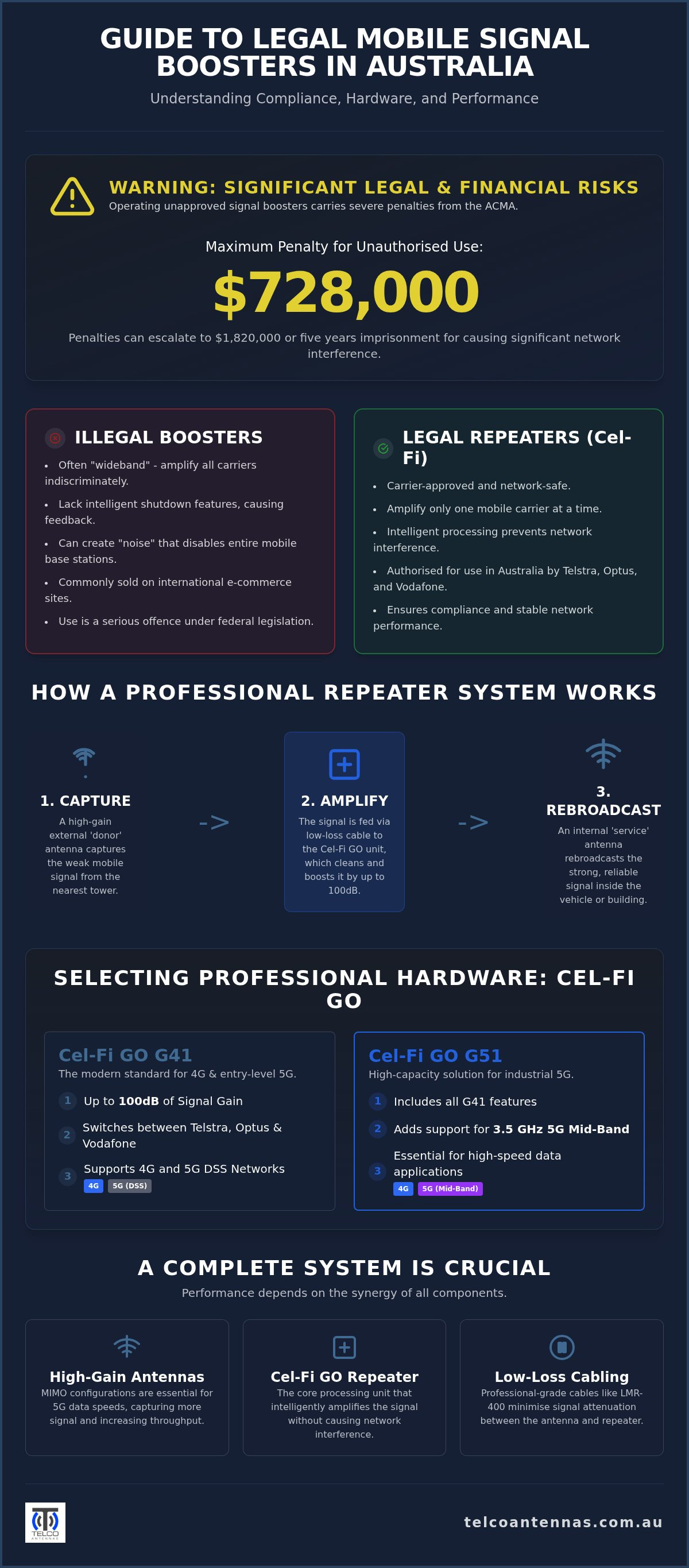
The system functions through a three-stage process. First, a high-gain donor antenna, usually mounted on a roof or a telescopic mast, captures the existing signal from the nearest carrier base station. This raw signal is then fed into the repeater unit via low-loss coaxial cable. Inside the unit, the hardware increases the Receive Signal Level (RSL) through sophisticated signal processing. Understanding the mechanics of cellular repeater technology is vital for identifying why professional-grade hardware outperforms cheap, unverified alternatives. Once the signal is cleaned and amplified, an internal service antenna re-broadcasts the enhanced coverage within a specific area, such as a site office, vehicle, or residential building.
Legal vs. Illegal Boosters: The 2026 Regulatory Landscape
As of September 2026, the legal risks associated with unapproved hardware are higher than ever. Many "wideband" boosters sold on international websites are illegal to use in Australia because they amplify all carrier frequencies indiscriminately. These units lack the intelligence to shut down if they cause feedback, leading to severe network degradation. The ACMA has set the maximum penalty for operating such a device at 2,000 penalty units, which equates to a $728,000 fine. If the interference is deemed significant, penalties can escalate to $1,820,000 or five years in prison.
To remain compliant, you must use hardware that is "network-safe" and carrier-approved. The Cel-Fi GO range remains the industry standard in 2026 because it is designed to amplify only one carrier at a time. This provider-specific approach ensures the device doesn't interfere with neighbouring networks, making it the only consumer-class mobile signal booster widely authorised for use by Australian carriers.
Selecting Professional Hardware: Cel-Fi GO and High-Gain Antennas
Choosing a professional mobile signal booster requires a technical understanding of how hardware specifications translate into real-world performance. The Cel-Fi GO ecosystem is the primary solution for Australian users due to its strict adherence to ACMA regulations on boosters. In 2026, the hardware selection has evolved to support the transition from 4G to 5G. While the G31 and G32 models served as reliable entry points for 4G connectivity, the current G41 and G51 units provide the processing power required for modern high-speed data. The G41 offers up to 100dB of signal gain and the ability to switch between Telstra, Optus, and Vodafone via the WAVE app, while the G51 introduces support for the 3.5 GHz 5G mid-band, which is essential for high-capacity industrial applications.
Performance is not determined by the mobile signal booster alone. The synergy between the repeater and the antenna system is paramount. Antenna gain, measured in dBi, dictates how effectively the system can communicate with a distant tower. For sites with weak donor signals, high-gain MIMO (Multiple Input Multiple Output) antennas are necessary. By using two or more data streams simultaneously, MIMO configurations significantly increase throughput, making them indispensable for 5G environments where data speed is a priority. Selecting the correct combination of hardware is a precise task; reviewing professional equipment specifications ensures your system meets the specific demands of your site.
Stationary vs. Mobile Signal Solutions
The application environment dictates the hardware configuration. Stationary systems for buildings utilise high-gain directional antennas fixed toward a specific tower to provide consistent coverage for residential or commercial premises. Conversely, mobile systems for vehicles or marine craft require ruggedised, omnidirectional antennas that maintain connection while moving through varying terrain. Users can switch between these modes using the Cel-Fi WAVE application to organise their device settings for optimal performance based on their current location and carrier requirements.
Antenna Selection for Remote Black Spots
In remote areas where the nearest base station is dozens of kilometres away, a directional Yagi antenna is the standard choice. These antennas focus their energy in a narrow beam to bridge the distance. In contrast, omnidirectional antennas are preferred for logistics and transport where the signal source is constantly changing. Understanding polarisation, whether vertical, horizontal, or cross-polarised, is also critical for ensuring signal stability and reducing interference in high-density areas. This technical precision ensures that the link between the tower and the repeater remains robust regardless of external environmental factors.
The Role of RF Engineering: Site Surveys and Signal Attenuation
A successful installation of a mobile signal booster depends on precise RF engineering rather than simple hardware assembly. For complex industrial environments, a professional site survey is essential to map the existing signal landscape and identify potential interference sources. Without this data, calculating a link budget, which balances the gain provided by the amplifier against the inevitable signal loss from cables and splitters, is impossible. Building materials play a significant role in this calculation. Reinforced concrete, metal cladding, and modern Low-E glass can attenuate signals by as much as 30dB or more. Understanding these variables allows engineers to select authorised cellular mobile repeaters that are specifically configured to overcome these physical barriers.
Organising cable runs is another critical factor in system efficiency. High-frequency cellular signals are prone to attenuation over distance. Using the correct coaxial cable is the only way to ensure the gain achieved at the antenna isn't lost before it reaches the repeater. Meticulous planning of these runs ensures that the Receive Signal Level remains high enough to provide stable data throughput across the entire facility.
LMR-400 Coaxial Cable: The Professional Standard
In professional installations, LMR-400 is the benchmark for high-performance cabling. Unlike standard RG-58 or RG-6 cables, which are often bundled with consumer-grade kits, LMR-400 features a much thicker core and superior shielding. This design reduces signal loss to approximately 0.22 dB per metre at 2.5 GHz, whereas cheaper alternatives can lose double that amount. High-quality connectors and meticulous weatherproofing are also vital. Even a small amount of moisture ingress at a join can cause impedance mismatches that degrade performance over time. Choosing the right cable is just as important as the repeater itself if you want to maintain signal integrity.
Optimising Receive Signal Level (RSL)
Finding the optimal donor antenna position is a methodical process. Technicians use signal meters to identify the strongest and cleanest signal from the carrier tower. A high RSL is the foundation of a stable system, but it must be balanced against internal feedback, also known as oscillation. If the internal and external antennas are too close, the system will automatically reduce gain to protect the network. You can find more detail on Understanding Receive Signal Level (RSL) for Better Gain to see how these metrics influence your final coverage area. Achieving sufficient antenna separation is often the most challenging part of a mobile signal booster deployment, requiring careful placement to ensure the system operates at its maximum rated capacity.
Deployment Strategies for Remote and Industrial Sites
Remote industrial operations, such as mining camps, construction projects, and emergency response centres, require connectivity solutions that are both robust and rapidly deployable. In these environments, the primary challenge is often the physical distance from a carrier base station combined with topographical obstructions. A professional mobile signal booster installation in these contexts often involves temporary infrastructure designed to be moved as the project progresses. Utilising telescopic mast trailers and skids allows technicians to elevate donor antennas well above local terrain or machinery, ensuring a clear line of sight to the nearest tower. This elevation is critical for maintaining a stable Receive Signal Level (RSL) in areas where ground-level signal is non-existent.
Reliability in the Australian outback also depends on power efficiency. Most remote sites operate on off-grid solar arrays or battery banks, making 12V or 24V DC power conversion a technical necessity. By running hardware directly on DC power, you eliminate the 15 to 20 percent efficiency loss typically associated with AC inverters. This methodical approach to power management ensures the communication system remains operational even during periods of low solar gain, providing a dependable link for critical site safety and logistics.
Temporary RF Structures and Portable Towers
For lightweight or short-term deployments, aluminium tri-pods provide a stable platform for mounting MIMO antennas without the need for permanent footings. When larger coverage areas are required, portable communication towers or mast trailers become the preferred choice. These structures can support multiple antenna arrays and the associated cabling required for a high-capacity mobile signal booster system. If you are planning a temporary site setup, reading this Telescopic Mast Trailers: A Professional Guide to Rapid RF Deployment will help you understand the engineering requirements for various mast heights and wind loadings.
Starlink and Mobile Booster Synergy
In 2026, many industrial sites utilise Starlink for high-speed data backhaul while relying on Cel-Fi hardware to provide a local cellular "bubble" for voice and SMS services. This hybrid approach ensures that staff can use their standard mobile handsets for communication without needing specialised satellite phones. Integrating these technologies requires specific hardware, including aftermarket power conversion kits that allow Starlink to operate efficiently in remote Australian settings. For a detailed breakdown of the components required for this integration, refer to the Best Starlink Accessories Australia: Professional Solutions for Remote Connectivity in 2026. To ensure your site has the necessary infrastructure for these advanced deployments, you can browse our range of rapid deployment hardware and mast trailers.
Professional Installation and Compliance: Avoiding the $360k Fine
Operating an active repeater requires more than just a hardware purchase; it involves a formalised legal process. In Australia, you must have written permission from the mobile carrier whose frequencies you intend to amplify. Professional installers facilitate this by using carrier-approved equipment that automatically registers with the network or by managing manual approval requests for larger commercial deployments. This ensures that your mobile signal booster installation is recognised as a legitimate part of the network infrastructure rather than a source of interference. It's a pragmatic step that protects your business from legal exposure while ensuring the hardware functions as intended.
Testing and commissioning represent the final technical phase. A technician verifies that the system provides the required coverage without leaking signal back into the macro network, a phenomenon known as oscillation. By monitoring performance metrics through the Cel-Fi WAVE portal, we can confirm that the hardware is operating within carrier-mandated parameters. Regular maintenance includes firmware updates managed via this portal, which ensures the device remains compatible with ongoing network upgrades and security protocols. This methodical oversight is what separates a professional installation from a temporary fix.
The Consequences of Non-Compliance
The ACMA holds significant enforcement powers to protect the integrity of the national spectrum. While the headline figure of $360,000 is often cited in industry discussions, current 2026 regulations allow for fines of up to $728,000 for the unauthorised use of a mobile signal booster. These penalties exist because unapproved boosters often generate excessive "noise" that can effectively shut down local towers, preventing others from making even emergency calls. Smart signal boosters, such as the Cel-Fi GO, mitigate this risk through sophisticated echo cancellation and automatic gain control. This technology allows the device to adjust its output in real-time or shut down instantly if it detects a potential network conflict.
Final Checklist for a Successful Deployment
Before finalising any installation, a systematic review of the system's physical and technical properties is required. This ensures long-term reliability and compliance with Australian standards. You should follow a logical sequence to verify the installation's integrity.
- Verify donor signal quality, specifically RSRQ and SINR, at the precise antenna mounting point.
- Ensure adequate physical or electronic isolation between internal and external antennas to prevent automatic gain reduction.
- Confirm all connectors are torqued correctly and weatherproofed with self-amalgamating tape to prevent moisture ingress.
- Register the device through the carrier's authorised portal to secure its legal status.
If you require a system that meets these rigorous technical and legal standards, consult with our RF Engineering team for a compliant signal solution.
Securing Reliable Connectivity for the Future
Achieving professional-grade signal enhancement requires a methodical approach that balances high-performance hardware with strict regulatory compliance. Selecting a carrier-approved mobile signal booster like the Cel-Fi GO is the only way to ensure your site remains operational without risking severe ACMA penalties. Success in remote environments depends on the precise integration of high-gain MIMO antennas, low-loss LMR-400 cabling, and strategic RF engineering. Since 2008, Telco Antennas has served as an Australian owned and operated specialist in remote and industrial connectivity. Our team provides professional RF site surveys to eliminate guesswork and ensure your installation is both effective and legally compliant.
Explore our range of ACMA-approved Cel-Fi GO Boosters to secure your communication infrastructure. With the right hardware and engineering oversight, you can transform unreliable black spots into high-speed data hubs that support your business objectives across the most challenging Australian environments.
Frequently Asked Questions
Are mobile signal boosters legal in Australia in 2026?
Yes, provided they are carrier-approved cellular repeaters like the Cel-Fi GO and you have obtained written permission from the mobile carrier. Unapproved wideband boosters remain illegal to own or operate. In 2026, the ACMA enforces strict penalties for non-compliance, including fines up to $728,000. Using a legal mobile signal booster ensures you aren't interfering with the national network while effectively resolving coverage gaps in remote or shielded locations.
Can a mobile signal booster work with no signal at all outside?
No, a repeater cannot create a signal where none exists; it requires a donor signal to amplify. If there is absolutely no signal outside the building or vehicle, the hardware has nothing to process. However, a high-gain antenna mounted on a telescopic mast can often capture a usable signal from a distant tower that a handheld phone cannot detect. We recommend a professional RF site survey to determine if a donor signal is available.
What is the difference between a mobile signal booster and a MIMO antenna?
An active repeater, often called a mobile signal booster, uses an external power source to electronically amplify signal strength. In contrast, a MIMO antenna is a passive component that uses Multiple Input Multiple Output technology to improve data throughput by sending and receiving multiple data streams simultaneously. While an antenna captures the raw signal, the booster increases its power. Combining both is essential for achieving high-speed 4G and 5G data in remote areas.
Do I need a separate booster for Telstra, Optus, and Vodafone?
You don't need separate hardware units, but you must configure the device for one carrier at a time. The Cel-Fi GO G41 and G51 models allow you to switch between Telstra, Optus, and Vodafone using the WAVE app. This carrier-specific approach is a legal requirement in Australia to prevent network interference. If you change service providers, you simply update the settings in the application rather than replacing your entire hardware setup.
Will a mobile signal booster improve my NBN or Starlink internet?
A cellular repeater is designed specifically for mobile network frequencies and won't directly improve NBN or Starlink satellite connections. However, these technologies are often used together in a hybrid setup. You might use Starlink for primary data backhaul and a Cel-Fi system to provide local voice and SMS coverage. We supply Starlink aftermarket power conversion kits to help integrate these systems for comprehensive connectivity in remote Australian industrial sites.
Can I install a Cel-Fi GO booster myself in my car or caravan?
Yes, mobile kits for vehicles and caravans are designed for straightforward installation. These systems usually include a 12V power plug and an omnidirectional antenna, making them suitable for DIY setup. However, stationary installations in buildings or large industrial sites often require precise antenna separation and cabling to avoid feedback loops. For complex environments, we recommend engaging our specialist RF engineering team to ensure the system is commissioned correctly and meets all carrier requirements.
What happens if I use an illegal mobile signal booster from eBay?
Using an unapproved wideband booster can lead to severe consequences. These devices often create significant noise that can shut down local carrier base stations, affecting emergency services and thousands of other users. The ACMA uses sophisticated tracking equipment to locate interference sources. If caught, individuals face fines of up to $728,000, while significant interference can result in penalties exceeding $1.8 million or five years in prison. It isn't worth the legal risk.
How much does a professional mobile signal booster installation cost?
Costs vary significantly based on the complexity of the site and the hardware required. A basic vehicle setup is less intensive than a multi-storey industrial facility requiring extensive LMR-400 cabling and multiple internal service antennas. Factors such as the need for telescopic mast trailers, RF site surveys, and specific 5G-ready hardware like the Cel-Fi GO G51 will influence the final investment. We provide tailored quotes based on the specific engineering requirements of your project.


