

A standard Starlink kit is engineered for a manicured suburban lawn, not the relentless vibration of a corrugated track or the strict power constraints of a remote 12V canopy. While the latest Standard 4 hardware provides impressive speeds, the factory-supplied plastic mounts and AC-only power supply are often the weakest links when you're operating hundreds of kilometres from the nearest service centre. Relying on basic hardware in these environments often leads to avoidable equipment failure or critical power depletion at the worst possible moments.
You've likely discovered that using a 240V inverter to run your dish quickly depletes your battery bank, or that standard mounting brackets simply don't hold up against the structural stress of off-road travel. This article details the essential starlink accessories australia demands for professional-grade reliability in 2026. We'll show you how to transition to a stable 12V DC power solution, implement engineered mounting systems that survive the outback, and use low-loss cabling to ensure your signal remains consistent despite terrain obstructions. By the end of this guide, you'll have a blueprint for a high-performance, off-grid communication system that works as hard as you do.
Key Takeaways
- Transitioning to 12V or 24V DC power conversion kits can improve battery runtime by up to 30% by eliminating the energy loss associated with standard 240V inverters.
- Standard plastic mounts often fail in harsh environments, making engineered starlink accessories australia like aluminium tri-pods essential for structural integrity on corrugated roads.
- High-performance LMR-400 coaxial cabling and MIMO antennas allow for extended cable runs and hybrid connectivity without compromising data throughput or signal stability.
- Professional site surveys and the use of telescopic mast trailers are critical for identifying the optimal positioning required to bypass terrain and timber obstructions.
- Learn how to transform a single satellite connection into a regional communication hub using point-to-point wireless bridges for reliable data distribution across remote sites.
The Australian Starlink Landscape: Why Standard Kits Aren’t Enough
While the Starlink satellite constellation has revolutionised global connectivity, the standard hardware provided in the box is primarily engineered for the relatively benign conditions of a suburban backyard. In the Australian outback, equipment faces a different set of mechanical and thermal stresses. High ambient temperatures often trigger thermal throttling in standard routers, while fine silica dust can penetrate unsealed connections. For those relying on a connection for emergency comms or critical business operations, a basic "plug and play" setup lacks the necessary resilience. This is where specialised starlink accessories australia become a functional requirement rather than an optional upgrade.
Gen 3 vs. Starlink Mini: Choosing Your Base
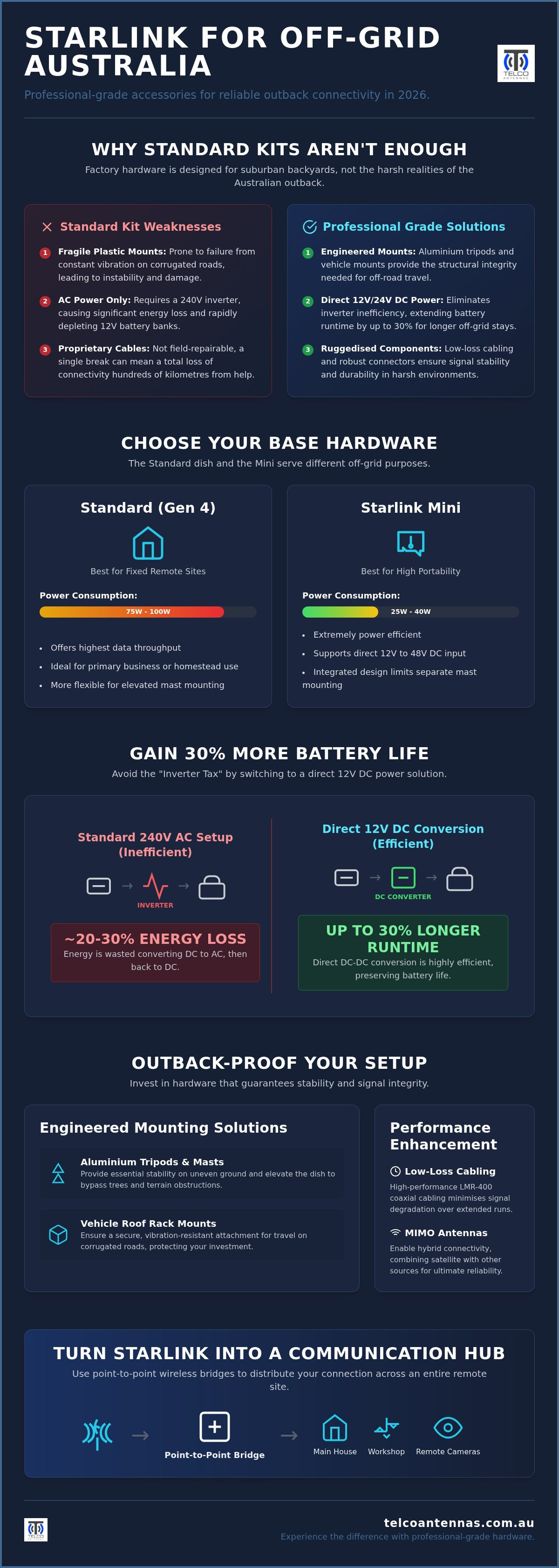
As of August 2026, the Standard 4 hardware and the Starlink Mini represent the two primary paths for Australian users. The Standard 4 kit, which now ships with a compact Mini Router, offers high throughput but demands a significant power footprint, typically drawing between 75W and 100W. This model is often the preferred choice for fixed remote site deployment where maximum data speeds are the priority. Conversely, the Starlink Mini is designed for high portability. It features a lower average power draw of 25W to 40W and supports a direct 12V to 48V DC input. While the Mini is excellent for light 4WD use, its integrated antenna design means it's less flexible for situations requiring elevated mounting to bypass heavy timber or terrain obstructions.
The Hidden Costs of Standard Hardware
The standard proprietary cables provided by Starlink are a frequent failure point when subjected to the constant vibration of corrugated roads. These cables use a specific connector that isn't easily repaired in the field, meaning a single break can result in a total loss of connectivity. Beyond physical fragility, standard kits assume access to a 240V AC power source. Running a dish through a standard inverter introduces a significant "inverter tax," where roughly 20% of your battery capacity is lost during the DC-to-AC conversion process. This inefficiency is unsustainable for extended off-grid stays. High-quality starlink accessories australia address these mechanical and electrical gaps by providing ruggedised cabling and direct DC power conversion. Investing in these components ensures that your hardware complies with Australian safety standards while maintaining the structural integrity required for long-distance travel.
Power Conversion and Off-Grid Efficiency: 12V and 24V DC Solutions
Operating a satellite system in the outback requires a ruthless focus on power efficiency. Standard Starlink kits are designed to plug into a 240V wall socket, but for the off-grid traveller, this setup is inherently wasteful. Using a 240V inverter to power your dish introduces what technicians call the "Inverter Tax." This process converts your battery's DC power to AC, only for the Starlink power supply to convert it back to DC again. This double conversion typically results in a 20% to 30% loss of energy. By utilising direct DC-to-DC Starlink after market power conversion hardware, you can significantly extend your battery runtime.
The Australian Starlink landscape for remote users is often defined by limited solar capacity and finite battery banks. For the Standard 4 (Gen 3) dish, managing power is particularly critical because it can draw between 75W and 100W during peak operation. Without a stabilised power source, voltage sag can lead to frequent hardware reboots or even permanent damage to the sensitive internal electronics. Choosing the right starlink accessories australia ensures your system remains operational when you're far from help.
Converting Starlink Gen 3 to 12V DC
A professional 12V conversion for the Gen 3 requires two primary components: a high-output DC-DC step-up converter and a specialised PoE (Power over Ethernet) injector. The converter is responsible for taking your 12V or 24V house battery voltage and stepping it up to a consistent 48V or 56V required by the dish. It's vital to select a converter capable of handling the 100W peak draw. We recommend using heavy-duty wiring and keeping the run between the battery and the converter as short as possible. This setup avoids voltage drop, which is a common cause of signal dropouts during high-bandwidth usage.
Starlink Mini 12V Adapters: Portability vs. Reliability
The Starlink Mini simplifies things with native DC support, drawing a modest 25W to 40W. However, the choice of physical connector remains a primary concern for reliability. While cigarette lighter adapters are convenient for temporary use, they frequently vibrate loose on corrugated tracks. For a robust installation, we suggest using Anderson plugs. These provide a secure, locking connection that can handle the harsh vibration of Australian tracks. If you're installing the power components inside a vehicle canopy or an enclosed battery box, ensure there's adequate airflow. Even efficient DC-DC adapters generate heat that must be managed to prevent thermal throttling.
Reliable power is the foundation upon which the rest of your remote communication hub is built. Investing in high-quality starlink accessories australia for power management prevents hardware failure and ensures your connectivity doesn't come at the cost of a flat battery.
Mounting Solutions for the Outback: Masts, Tri-pods, and Roof Racks
The standard Starlink mounting hardware is typically designed for static, residential environments. In the Australian outback, these polymer components often succumb to extreme UV exposure and high wind loads. When you're operating in open plains or coastal regions, a standard plastic mount can become brittle and fail under the structural stress of a sudden squall. Professional starlink accessories australia prioritise structural integrity through the use of marine-grade aluminium and stainless steel components that can withstand the rigours of the trail.
Mobile Mounting for 4WDs and Caravans
For mobile users, the primary challenge is managing mechanical vibration. Continuous exposure to corrugated tracks can damage the internal motors and sensitive phased-array electronics of earlier actuated models. While magnetic mounts offer convenience for short stops, permanent bolt-on solutions for roof racks provide far greater security. Many 4WD enthusiasts adopt a "Stow and Go" workflow, where the dish is securely stored in a padded case during transit and deployed on a pole-mount once at camp. This protects the hardware from low-hanging branches and reduces the risk of mechanical fatigue caused by vehicle movement.
Fixed Infrastructure for Remote Stations
Fixed installations on cattle stations or mine sites require a different approach. Elevating the dish is often necessary to clear local scrub, heavy timber, or terrain obstructions that cause signal dropouts. Our Australian-made Aluminium Tri-pods are engineered for these specific scenarios, providing a stable platform that can be weighted or pegged down in high-wind areas. For larger operations or temporary work camps, telescopic mast trailers offer an industrial-grade solution for site surveys or establishing emergency comms hubs in areas with significant topographical challenges.
When planning these installations, it's vital to consider ACMA's regulatory oversight of Starlink. Ensuring your mounting infrastructure meets Australian standards isn't just about performance; it's about maintaining compliance and equipment longevity in a harsh environment. Using heavy-duty masts allows for better antenna positioning, which directly translates to faster speeds and fewer dropouts. By moving beyond basic retail mounts, you ensure your connectivity infrastructure is as rugged as the vehicle carrying it.
Performance Enhancement: MIMO Antennas and Low-Loss Cabling
Standard Starlink setups often encounter performance bottlenecks when cable runs exceed factory lengths or when environmental interference is high. For industrial sites or complex vehicle builds, the standard proprietary cable isn't always sufficient for the required application. To unlock professional networking capabilities, the Starlink ethernet adapter is a mandatory piece of hardware. It acts as the primary gateway for integrating high-performance MIMO antennas and external routing hardware, which are essential starlink accessories australia for those requiring maximum data throughput and network control.
The Role of Low-Loss Coaxial Cables
Standard Ethernet cabling is susceptible to electrical interference and physical degradation in high-vibration or electrically noisy environments. When extending runs from a mast-mounted dish to a central communication hub, professional installers utilise LMR-400 coaxial cables to maintain signal integrity over long distances. LMR-400 provides superior shielding and lower resistance compared to standard CAT6. Weatherproofing these connections is equally vital, particularly in coastal areas where salt spray can corrode unsealed ports or in the dusty interior where fine particulates can bridge electrical contacts. Signal attenuation in the context of Starlink refers to the progressive reduction in electrical power and data integrity as the signal travels through the length of the transmission cable. By selecting low-loss specialised cabling, you ensure that the high-speed data captured by the dish actually reaches your end-user devices without significant packet loss.
Hybrid Systems: Combining Starlink and Cellular
Relying on a single point of failure is a significant risk for remote businesses or emergency services. The most resilient communication strategies involve using a Cel-Fi GO signal booster alongside your Starlink system. This hybrid approach provides voice and data redundancy; if the satellite link is obscured by heavy storm clouds or local terrain, the cellular booster maintains a critical connection for mobile phones and essential telemetry. Managing the RF environment is essential to prevent cross-device interference, especially when multiple antennas are mounted on a single roof rack or communication tower. Properly spaced MIMO antennas ensure that both the satellite and cellular systems operate at peak efficiency without desensitising each other's receivers. This configuration ensures that your remote site remains connected regardless of atmospheric conditions or satellite visibility.
For those designing a mission-critical remote office, explore our range of LMR-400 coaxial cables and professional antennas to complete your high-performance connectivity setup.
Professional Site Integration: Turning Starlink into a Communication Hub
A single Starlink dish is often just the ingestion point for a much broader network. For agricultural stations or industrial work sites, the challenge shifts from simply receiving data to distributing it across a vast physical area. This is where professional site integration and specialised starlink accessories australia transform a standard kit into a resilient communication hub. Before pouring concrete or erecting permanent masts, conducting rf site surveys is a critical first step. These surveys identify potential Fresnel zone obstructions and signal interference that the standard Starlink app might overlook, ensuring your primary link remains stable despite local terrain.
Wireless Bridging for Large Properties
Distributing high-speed internet from a main residence to a workshop, cottage, or remote pump station requires more than a simple Wi-Fi extender. Professional point-to-point wireless bridges are the industry standard for kilometre-scale data distribution. These systems require precise antenna alignment and a clear line of sight to maintain maximum throughput. By using a bridge, you avoid the prohibitive cost of trenching fibre-optic or ethernet cables across rural acreage. Once the signal reaches the secondary location, a local Wi-Fi mesh can be established to provide seamless coverage across the entire work site.
The Telco Antennas Engineering Approach
We provide customised kits designed specifically for the unique demands of mining and agricultural clients. This often involves accessing professional communication tower design to ensure that fixed Starlink mounts are structurally sound and positioned for optimal satellite visibility. Future-proofing is a core component of our strategy; with the smaller "V5" dish anticipated for Australian release in early 2027, we design our infrastructure to be modular. This allows for hardware swaps without needing to replace the entire mounting system. A professional-grade deployment should follow this final checklist:
- Verified 12V/24V power stability with adequate battery backup.
- Structural mounting that exceeds local wind load requirements.
- Low-loss LMR-400 cabling with industrial-grade weatherproofing.
- Managed wireless distribution for property-wide connectivity.
By treating Starlink as one component of a larger connectivity ecosystem, you ensure your remote operation remains productive and safe, regardless of the distance from the nearest town. Precise planning today prevents connectivity failures tomorrow.
Securing Your Remote Connectivity for the Long Haul
Hardening a satellite setup for the Australian environment is a methodical process of systematic technical upgrades. By replacing standard plastic components with engineered aluminium tri-pods and implementing direct 12V DC power conversion, you solve the dual challenges of physical durability and electrical efficiency. These specialised starlink accessories australia ensure that your hardware doesn't just function, but excels under the intense heat and constant vibration of remote travel. Moving beyond the basic retail kit allows you to maintain a stable link for critical business or emergency comms when you're hundreds of kilometres from the nearest service centre.
Telco Antennas has been Australian-owned and operated since 2008, providing expert RF engineering support and heavy-duty hardware designed specifically for the outback. We focus on delivering the structural and electrical reliability required for mission-critical connectivity in areas where standard gear frequently fails. View our range of professional Starlink power and mounting accessories to find the right solution for your specific deployment. With an engineered approach, your remote connection will remain stable no matter how far off the grid you venture.
Frequently Asked Questions
What are the best Starlink accessories for 4WD travel in Australia?
The most effective accessories for 4WD travel include direct DC-to-DC power conversion kits and Australian-made aluminium tri-pods for stable deployment. For off-road use, you should also consider ruggedised connectors like Anderson plugs to replace standard cigarette lighter inputs. These starlink accessories australia ensure your hardware survives the extreme vibration of corrugated tracks. A padded transit case is also essential to protect the phased-array electronics from mechanical stress during transit through rough terrain.
Can I run my Starlink Gen 3 dish directly from a 12V battery?
Yes, you can run a Gen 3 dish from a 12V battery, but it requires a DC-DC step-up converter to provide the necessary 56V output. Because the Gen 3 can draw up to 100W during peak operation, you must use a PoE injector rated for this specific load. Direct DC power is significantly more efficient than using an inverter, provided you use heavy-gauge wiring to prevent voltage sag across the circuit.
Do I need a special roof mount for the Starlink Mini in Australia?
While the Starlink Mini includes a built-in kickstand for ground use, a specialised roof mount is highly recommended for permanent vehicle installations. A secure bolt-on bracket or a heavy-duty magnetic mount allows the dish to remain stable at higher elevations, which helps in bypassing local obstructions. Ensure any mount you select uses stainless steel or aluminium components to resist the high UV levels and salt air common in Australian coastal environments.
How do I extend the Starlink cable without losing signal speed?
To extend your connection without losing speed, you should use the official Starlink ethernet adapter paired with high-quality LMR-400 coaxial cabling. Standard ethernet cables often suffer from signal attenuation over long distances, whereas LMR-400 is specifically designed for low-loss transmission in RF environments. This setup allows you to position your dish on a mast or tri-pod up to 50 metres away from your vehicle or hub without impacting data throughput.
Is an aftermarket 12V power conversion kit better than a 240V inverter?
An aftermarket 12V conversion kit is technically superior because it eliminates the energy loss associated with converting DC to AC and back to DC again. This "inverter tax" typically wastes 20% to 30% of your total battery capacity. By using a direct DC solution, you extend your off-grid runtime and reduce the heat generated within your vehicle's electrical cabinet, which is a significant advantage during the Australian summer.
Can I use Starlink and a Cel-Fi GO mobile booster at the same time?
You can certainly use Starlink and a Cel-Fi GO booster simultaneously to create a redundant communication hub. This hybrid configuration ensures you have a backup link if the satellite signal is blocked by heavy timber or intense storm activity. To prevent cross-device interference, you must maintain adequate physical separation between the Starlink dish and the cellular antennas. This provides a reliable failover system for remote work sites or emergency services.
What is the best way to mount Starlink on a caravan roof?
The most reliable way to mount a dish on a caravan is using a permanent pole-mount attached to the rear ladder or a dedicated roof rack bracket. This allows for rapid deployment while ensuring the hardware is securely fastened against high wind loads. Some travellers prefer a "stow and go" approach with a quick-release mechanism, which protects the sensitive internal motors from the constant vibration experienced while towing on unsealed roads.
Are third-party Starlink cables as good as the original SpaceX cables?
High-quality third-party cables are often superior to the original SpaceX cables for professional Australian installations. While the standard cables are functional, they aren't always ruggedised for the extreme dust and vibration of the outback. Specialised starlink accessories australia like LMR-400 cables offer better shielding and physical durability. They use industrial-grade weatherproofing that prevents moisture ingress in coastal areas, ensuring your connection remains stable over many years of heavy use.


