
What if the heaviest mounting gear in your inventory is actually the primary cause of your deployment delays and signal instability? While the instinct in telecommunications is often to equate mass with durability, the reality of Australian field work demands a more sophisticated balance of physics and metallurgy. Professional-grade aluminium tri-pods have emerged as the critical tool for RF engineers who need to deploy high-gain MIMO antennas or Starlink terminals without the logistical burden of heavy-duty masts. You've likely experienced the frustration of signal jitter caused by mount vibration or the slow degradation of gear exposed to salty coastal air or harsh inland humidity.
We understand that your priority is a stable, portable platform that can be deployed by a single technician in minutes. This guide explores why high-tensile aluminium is the preferred material for temporary RF mounting, offering an exceptional weight-to-strength ratio that doesn't compromise on rigidity. We'll examine the mechanical advantages of these mounts for site surveys and temporary black spot solutions, ensuring your hardware remains secure in the most demanding environments. You'll gain a technical understanding of how to select the right mounting gear to eliminate corrosion risks and improve your rapid deployment workflows across the country.
Key Takeaways
- Identify why specific aluminium alloys provide the essential corrosion resistance required for the salt-spray and high-humidity conditions found across the Australian coastline.
- Optimise your field logistics by understanding the weight-to-strength ratio that makes aluminium tri-pods the preferred choice for rapid, single-person deployment.
- Calculate the necessary load capacity for your gear by accounting for both the physical weight of MIMO antennas and the lateral force of wind surface area.
- Learn the technical requirements for stabilising temporary mounts in high-wind environments using three-point guy wire systems to prevent signal oscillation.
- Discover how to effectively integrate portable mounting solutions into professional RF site surveys and Starlink aftermarket power conversions.
What are Aluminium Tri-pods in Telecommunications?
An aluminium tri-pod is a three-legged portable mounting structure engineered to support telecommunications hardware during field operations. It's not a standard camera stand. In the context of RF engineering, these units serve as temporary vertical supports for high-gain antennas, sensors, and wireless hardware. Most professional aluminium tri-pods are manufactured from 6061-T6 or 7075-T6 aluminium alloys. These specific grades are chosen because they offer a high strength-to-weight ratio and excellent resistance to atmospheric corrosion, which is vital for the Australian outback and coastal regions. While permanent Radio masts and towers rely on heavy foundations and steel lattices, the tri-pod provides a rapid deployment alternative that balances structural integrity with mobility.
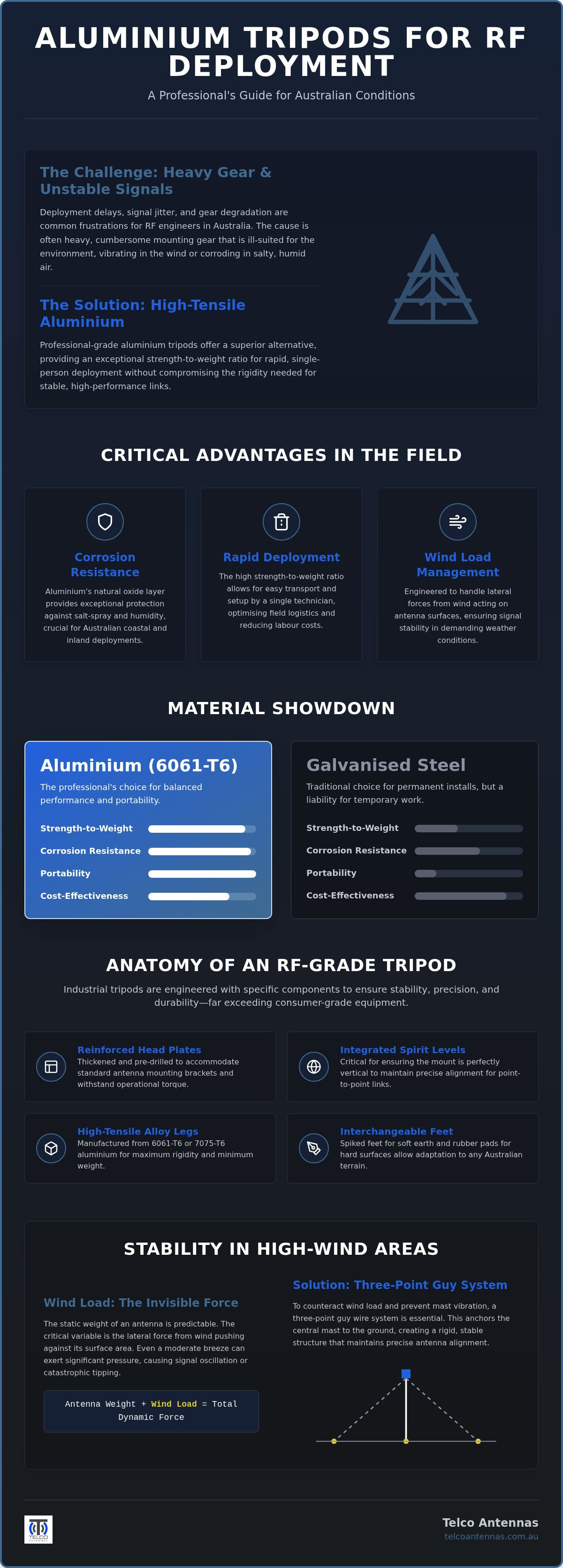
Portability is the primary reason technicians choose aluminium over steel or timber. Steel mounts provide mass, but they're difficult for a single person to transport to remote black spots and are prone to rust if the galvanised coating is scratched. Aluminium's natural ability to form a protective oxide layer ensures the gear remains functional in salt-spray zones or humid inland environments. It's a practical choice for remote work. An industrial RF tri-pod is built to withstand the torque and lateral forces generated by wind acting on a mounted antenna, a requirement that consumer-grade tripods simply cannot meet without failing or tipping.
The Anatomy of an RF-Grade Tri-pod
An industrial RF tri-pod differs significantly from consumer gear in its structural reinforcement. The head plates are often thickened and pre-drilled to accommodate standard antenna mounting brackets. You'll also find integrated spirit levels, which are critical because even a slight tilt can impact the alignment of a point-to-point wireless bridge or a MIMO antenna. For the varied Australian terrain, these units feature interchangeable feet. Spiked feet are used to bite into soft earth or gravel during a rural RF site survey, while rubber pads provide grip on finished concrete or rooftops where surface penetration isn't allowed.
Weight vs. Stability: The Professional Trade-off
Achieving rigidity is a primary challenge when using lightweight materials for microwave links. If the structure flexes, the narrow beamwidth of the signal can oscillate, leading to packet loss. Professionals must calculate the "tip-over" point by considering the height of the mast and the surface area of the mounted gear. Maintaining a low centre of gravity is essential for temporary setups. If you're mounting a heavy antenna, the weight should be concentrated as low as possible on the central mast to ensure the base remains planted during sudden gusts. This mechanical stability is what allows aluminium to function as a reliable substitute for heavier permanent mounts in short-term applications.
Technical Specifications for Australian RF Deployments
Deploying hardware in Australia requires a rigorous assessment of physical load. While the static weight of a MIMO antenna might be manageable, the critical metric is the wind surface area. A moderate breeze of 40km/h against a flat panel antenna creates significant lateral force. Professional aluminium tri-pods must be rated for these dynamic loads to prevent structural failure or signal misalignment. This stability is particularly important when adhering to Australian planning regulations for antennas, which often dictate specific mounting heights and safety standards for temporary structures.
The natural oxide layer of aluminium provides a significant advantage in coastal salt-spray zones. Unlike steel, which requires heavy galvanisation that can chip and lead to structural rot, aluminium creates its own protective barrier. This makes it ideal for long-term site surveys where gear is exposed to the elements for weeks. It's a practical choice for remote work. For point-to-point links, height adjustments are not just for line-of-sight; they are necessary to clear the Fresnel zone. A tri-pod that allows for precise vertical extension ensures that the radio signal's elliptical path remains unobstructed by terrain or foliage.
Locking mechanisms are a frequent point of failure in remote deployments. Twist locks are common but can easily seize when fine silica dust from the Red Centre enters the threads. Lever-style flip locks are generally preferred for telecommunications work. They are easier to clean. They provide a visible confirmation of a secure hold, even when the technician is wearing gloves.
Material Durability and Environmental Factors
Environmental resilience is a non-negotiable requirement. Anodised finishes are essential for UV protection, preventing the material from becoming brittle or discoloured under the intense Australian sun. Thermal expansion is another factor; aluminium expands and contracts predictably in 45-degree heat, but the locking collars must be designed to accommodate this movement without slipping. This ensures that the mast stays at the intended height throughout the diurnal temperature cycle.
Mounting Compatibility and Standards
Professional tri-pods often move beyond standard 1/4 inch threads to include custom RF mounting plates capable of securing heavy brackets. These units are frequently used to adapt portable setups for communication tower design applications, such as telescopic mast trailers and skids. With the rise of LEO satellite technology, ensuring compatibility with Starlink Gen 3 and Mini mounting kits has become a standard requirement for rapid deployment teams. If you are planning a remote installation, reviewing the specific compatibility of your aluminium tri-pods with these modern mounting standards will save significant time in the field.
Aluminium vs. Steel vs. Carbon Fibre
Selecting the right material for a portable RF mount involves a pragmatic assessment of weight, structural rigidity, and field durability. In the telecommunications industry, aluminium is frequently cited as the "Goldilocks" material. It provides a specific gravity roughly one-third that of steel, which allows a single technician to carry and deploy aluminium tri-pods without specialised lifting equipment. While carbon fibre offers even greater weight savings, its application in industrial RF environments is often limited by its physical properties. Carbon fibre is exceptionally strong under tension but lacks the impact resistance required for the back of a 4WD or a busy site. A sharp knock against a tray side can lead to delamination or catastrophic cracking, whereas aluminium will simply dent and remain structurally sound.
From a technical standpoint, aluminium is also non-ferrous. This is a subtle but important advantage over steel. Ferrous metals can interact with high-power RF fields, potentially contributing to passive intermodulation (PIM) if components are loose or corroded. Using non-magnetic materials near the antenna aperture helps maintain a cleaner signal environment. Cost-effectiveness also favours aluminium. It sits at a price point that reflects its professional performance without the extreme premium associated with high-modulus carbon fibre composites, making it the most balanced choice for fleet-wide deployment.
The Case for Aluminium in Remote Sites
In remote Australian locations, the ability to perform field repairs is a significant operational advantage. If a composite leg snaps, the unit is typically a write-off. An aluminium structure can often be straightened or reinforced with basic tools to finish a site survey. This material also handles the vibration of corrugated roads better than many alternatives. It doesn't suffer from the microscopic stress fractures that can plague carbon fibre after thousands of kilometres in a vehicle tray. The recyclability of aluminium supports long-term sustainability goals in large-scale infrastructure projects, providing a clear end-of-life path that composites lack.
When to Step Up to Steel Masts
There are specific scenarios where the portability of aluminium tri-pods must be traded for the sheer mass of steel. If you're deploying massive MIMO arrays or large parabolic dishes that exceed the wind load ratings of a portable stand, a fixed steel mast is necessary. These are standard for permanent installations where weight is an advantage for stability rather than a logistical hurdle. For complex projects involving high-load hardware or permanent mounting, we recommend reviewing our guide on communication tower design. This ensures that the structural foundation matches the long-term environmental demands of the site.
Securing Your Tri-pod: Stability in High-Wind Areas
Securing your mount against lateral forces is a critical step in any field deployment. When an antenna is mounted at height, it acts as a sail, converting wind pressure into torque at the base of the structure. High-tensile aluminium tri-pods are designed to resist this force, but the physical footprint of the legs alone is rarely sufficient in gusty Australian conditions. You must account for the total surface area of the antenna and the leverage created by the mast extension. If the wind speed doubles, the pressure on your equipment quadruples; this makes mechanical anchoring a necessity rather than an option. For technicians working on uneven or sloping ground, each leg must be adjusted independently to maintain a true vertical centre, ensuring the weight of the RF gear remains distributed evenly over the base.
Weighting the base is the most common method for increasing stability on hard surfaces where ground penetration isn't possible. Sandbags or water bladders should be draped over the lower leg braces rather than the feet themselves to lower the centre of gravity effectively. In rural environments, ground stakes or heavy-duty pegs can be driven through the feet to prevent the structure from "walking" during sustained winds. To ensure your hardware remains secure in the most demanding environments, you can view our range of professional aluminium tri-pods designed for high-stability field work.
Guying Techniques for Temporary Masts
Guying is the process of using tensioned cables or ropes to provide lateral stability and prevent structural collapse of a vertical mast. For telecommunications applications, the selection of guy rope material is vital. You should use UV-stabilised polyester or para-aramid ropes rather than wire to avoid RF signal attenuation or interference with the antenna's radiation pattern. A stable 3-metre height typically requires an anchoring footprint with a radius of at least 3 metres from the centre of the tri-pod. This 1:1 ratio ensures the downward force of the guy wires complements the structural integrity of the aluminium legs without exceeding their compression ratings.
Ground Anchoring in Different Soil Types
The effectiveness of your anchors depends entirely on the local geology. In the hard clay common in many rural areas, star pickets provide the most reliable hold. Conversely, sandy coastal soils require wide-flange screw-in anchors that utilise a larger surface area to resist pull-out forces. To prevent "leg sink" in soft terrain, use wide base plates or "mud feet" to distribute the load. In public or high-traffic areas, safety protocols demand that all guy wires be clearly flagged with high-visibility tape and the perimeter coned off to prevent trip hazards. This pragmatic approach to site safety protects both the public and your sensitive RF hardware.
Integrating Tri-pods into Your RF Infrastructure
Portable aluminium tri-pods are more than standalone supports; they function as the preliminary testing ground for long-term infrastructure. In a professional workflow, these units are deployed during initial RF site surveys to validate theoretical signal models before permanent structures are commissioned. This rapid deployment capability is equally critical for emergency response teams who must establish MIMO antennas in disaster zones where existing towers may be compromised. On off-grid construction sites, tri-pods provide the necessary height for Starlink terminals to clear local obstructions, ensuring reliable backhaul for site offices and telemetry systems.
Transitioning from a temporary tri-pod setup to a permanent mounting solution requires a systematic handover of data. The height, azimuth, and tilt recorded during the portable phase dictate the specifications for the final installation. This process ensures that the permanent mast or tower performs exactly as the survey predicted, reducing the risk of costly post-installation adjustments. It's a methodical way to ensure that the physical hardware placement matches the RF engineering requirements.
Site Survey Best Practices
The primary objective of using a tri-pod in a survey is to find the "sweet spot" for signal reception. This is particularly relevant when installing Cel-Fi GO signal boosters in fringe coverage areas. Technicians should test the Receive Signal Level (RSL) at varying elevations, incrementally raising the mast to identify the point where signal quality stabilises. It is vital to document the exact height and geographic orientation of the antenna during these tests. If the tri-pod is moved even a few metres, the multipath environment can change, potentially altering the performance of the final booster installation.
The Telco Antennas Advantage
Our approach to RF infrastructure is rooted in engineering precision. We provide aluminium tri-pods equipped with custom mounting plates designed specifically for Australian telecommunications hardware. This ensures compatibility with high-gain antennas that often feature non-standard bracket configurations. Our team offers consultative advice to help you match your tri-pod selection to your specific antenna gain and wind load requirements. With national shipping and technical support, we ensure that remote projects have access to the same level of professional equipment as urban installations. We focus on the mechanics of the industry to ensure your field gear performs as expected in every environment.
Optimising Your Field Deployment Strategy
Selecting the correct mounting infrastructure is a technical decision that directly impacts the reliability of your RF links. By prioritising high-tensile aluminium alloys, you ensure that your gear can withstand the thermal expansion and corrosive environments typical of the Australian outback and coast. We've explored how aluminium tri-pods provide the essential balance of portability and structural rigidity required for accurate site surveys and rapid emergency response. It's clear that mechanical stability in high-wind zones relies on a systematic approach to anchoring and non-conductive guying. This ensures your high-gain antennas remain aligned during critical testing phases.
Our team of RF engineers is dedicated to providing rugged, field-tested infrastructure designed specifically for the unique challenges of the Australian landscape. If you're planning a remote installation or a complex site survey, having the right support is vital for success. You can view our range of professional aluminium tri-pods and mounting gear to find a solution that meets your specific technical requirements. We're here to help you achieve a stable and high-performing wireless network, no matter how remote the location.
Frequently Asked Questions
How much wind can an aluminium tri-pod realistically handle?
Realistic wind handling depends on the antenna's surface area and the tri-pod's footprint. A standard unit might manage 45km/h gusts un-guyed, but professional aluminium tri-pods should always be secured with guy wires or weights if wind speeds are expected to exceed 30km/h. The dynamic load of a large panel antenna is much higher than its static weight. Always consult the specific wind rating for your hardware configuration to prevent structural failure.
Can I mount a Starlink Dishy directly onto a standard aluminium tri-pod?
Yes, you can mount a Starlink Dishy onto these structures using a compatible pipe adapter or a custom RF mounting plate. While the Gen 2 and Gen 3 terminals have different mounting requirements, professional-grade aluminium tri-pods are often designed with interchangeable heads to accommodate various satellite hardware. It's essential to ensure the mast diameter matches the Starlink adapter to prevent oscillation, which can lead to signal dropouts during high-speed data transfers.
Do aluminium tri-pods interfere with the RF signal of my antenna?
Aluminium is a non-ferrous metal, meaning it doesn't have the magnetic properties that cause significant RF interference or passive intermodulation (PIM). While the physical structure can still cause signal diffraction if placed directly in front of the antenna's aperture, the material itself is "RF-friendly" compared to steel. For best results, ensure the antenna is mounted at the top of the central mast, clear of the leg assembly to maintain an unobstructed radiation pattern.
What is the maximum height I can safely extend an aluminium tri-pod?
Most portable units are engineered for a maximum safe extension of 3 to 5 metres. As you increase the height, the centre of gravity rises, significantly reducing the structure's stability against lateral wind loads. We recommend using a three-point guy wire system for any deployment exceeding 2.5 metres. This prevents the central mast from flexing, which is critical for maintaining the narrow beamwidth alignment required for point-to-point wireless bridges and high-gain antennas.
Is an aluminium tri-pod better than a steel one for coastal installations?
Aluminium is superior for coastal deployments because it naturally forms a protective oxide layer that resists salt-spray corrosion. Steel requires heavy galvanisation or specialised coatings that can fail if the surface is scratched during transport. In the harsh Australian maritime environment, an aluminium mount will maintain its structural integrity for years without the risk of rust-induced failure. This makes it the more reliable choice for long-term site surveys near the ocean.
How do I stop my tri-pod from sinking into soft Australian soil?
To prevent "leg sink" in soft or sandy Australian soil, you should use wide base plates or "mud feet" to distribute the downward pressure over a larger surface area. If the ground is particularly unstable, placing timber pads or specialised outrigger mats under each foot can provide a solid foundation. This is a crucial step during field deployments to ensure the tri-pod remains level, as any shifting can misalign your directional MIMO antennas and degrade signal performance.
What maintenance does an aluminium tri-pod require in dusty environments?
In dusty outback conditions, the primary maintenance task is keeping the locking mechanisms and telescopic sections free of grit. You should avoid using grease or oil-based lubricants, as these attract fine silica dust and create an abrasive paste that wears down the aluminium. Instead, use a dry silicone spray or simply clean the threads with compressed air and a microfibre cloth. Regularly checking the lever tension ensures the mast doesn't slip during vibration or thermal changes.
Can I use a photography tripod for a professional MIMO antenna?
Photography tripods are not suitable for professional telecommunications gear because they aren't designed to handle the torque and wind surface area of a MIMO antenna. While they might support the static weight of the hardware, they lack the structural rigidity to prevent signal jitter in a breeze. Professional RF mounts feature reinforced head plates and thicker leg walls specifically engineered to maintain the precise alignment required for high-frequency radio links and satellite connectivity.


