

A communication tower is not merely a piece of steel infrastructure; it's a precision instrument that dictates the ultimate performance of your entire RF link. You likely recognise that in the Australian outback or a dense industrial site, a minor miscalculation in height or placement often leads to frustrating signal attenuation and expensive rework. Balancing the technical demands of signal propagation with the rigid requirements of ACMA regulations and local council approvals is a complex task that leaves little room for error. It's a challenge where structural integrity must meet precise engineering to ensure the hardware survives both the elements and the scrutiny of regulators.
This guide offers a comprehensive technical reference for communication tower design, focusing on the specific engineering and regulatory hurdles found within the Australian landscape. We'll help you move past the anxiety of non-compliance by providing a clear framework for structural stability and high-performance output. We'll examine the critical importance of AS/NZS 1170.2 wind loading standards, compare the utility of various tower types like telescopic mast trailers and fixed lattice masts, and explain how to organise your hardware for maximum coverage. By the end of this reference, you'll have the knowledge to deploy robust, compliant infrastructure that withstands the harshest environmental variables while maintaining a clean, reliable signal.
Key Takeaways
- Learn how to balance structural load-bearing requirements with precise RF line-of-sight calculations to ensure your infrastructure clears obstacles and accounts for the Earth's curvature.
- Identify the most suitable communication tower design for your specific site, comparing heavy-duty lattice towers for industrial applications with rapid-deployment telescopic mast trailers.
- Understand the critical regulatory frameworks required for Australian operations, including compliance with AS/NZS 1170.2 wind loading standards and ACMA EMR safety limits.
- Discover why a comprehensive geotechnical soil analysis and professional RF site survey are non-negotiable steps in the engineering and placement process.
- Explore how to maximise signal gain through the strategic integration of MIMO antennas and high-quality, low-loss coaxial cabling.
Core Principles of Communication Tower Design
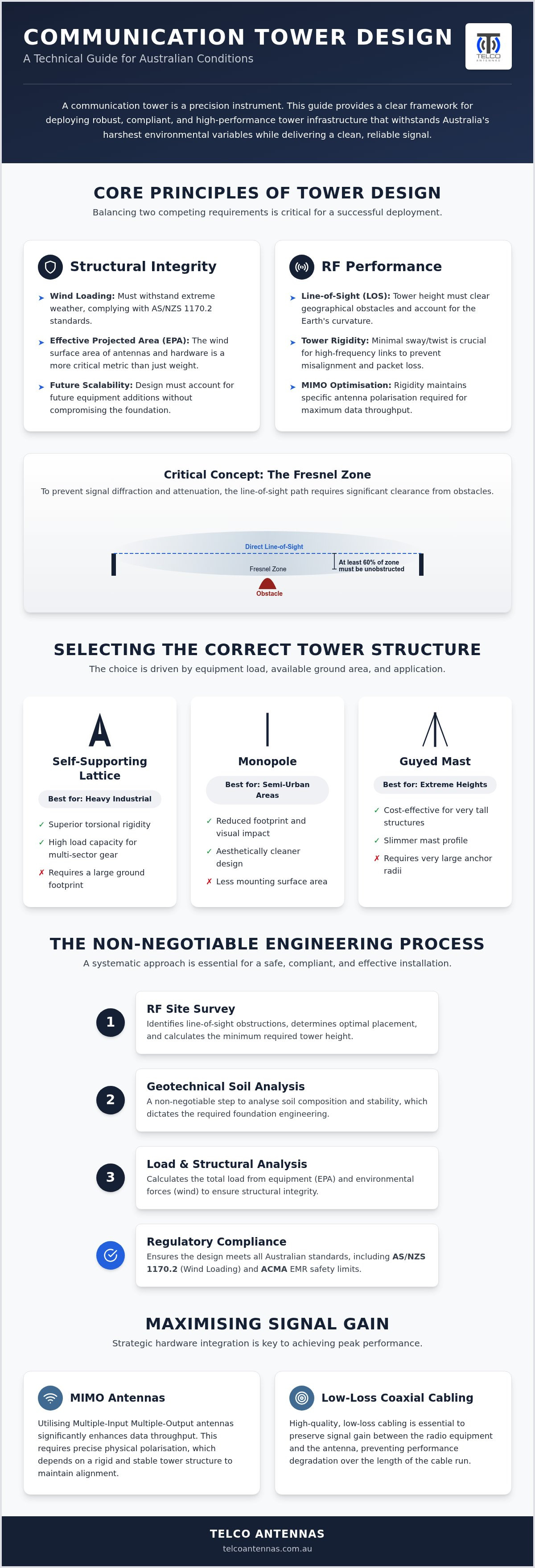
Effective communication tower design begins with the clinical understanding that a structure must satisfy two often-competing requirements: structural load-bearing capacity and RF line-of-sight (LOS). While a tower must remain standing during a Category D cyclone, it must also be tall enough to clear geographical obstacles and account for the Earth's curvature. Engineers use the Fresnel zone as a reference, ensuring that at least 60% of this elliptical area remains unobstructed to prevent signal diffraction. If the tower is too short, the signal attenuates; if it's too tall without adequate reinforcement, the wind load increases exponentially.
When calculating the physical requirements, we focus on several fundamental variables. The total weight of the equipment is the starting point, but the Effective Projected Area (EPA) is often more critical. This metric describes the wind surface area of your antennas, mounts, and cabling, which determines the torque and lateral force applied to the structure. By applying the Core Principles of Tower Design, we can build for future scalability, ensuring that adding a second dish in several years won't compromise the foundation. Designing for the equipment is just as vital as designing for the wind; if the tower is over-engineered for strength but lacks the correct mounting offsets for your specific hardware, the deployment remains inefficient.
The Interplay of Structural and RF Engineering
High-frequency point-to-point wireless bridges require extreme precision. Even a few degrees of tower sway or twist during a wind event can misalign a narrow beam, leading to a total link failure or significant packet loss. This rigidity is equally important for maintaining the specific physical polarisation required for mimo antennas to function at peak throughput capacity. Tower rigidity is the primary mechanical determinant of millimetre-wave link stability in high-wind environments.
Site Selection and Environmental Variables
Topography dictates the starting height, but situational environmental variables dictate the material choice. In coastal zones, salt-laden air accelerates corrosion, making high-grade hot-dipped galvanised steel or marine-grade aluminium essential for long-term structural integrity. In contrast, outback environments present extreme heat cycles that can affect cable expansion and the thermal management of active equipment housed at the tower base. To protect the external air conditioning units often required for these systems, you can learn more about Wombat Cages. We also evaluate site access early in the design phase, as a remote lattice tower requires significantly different maintenance logistics and heavy machinery than a rapid-deployment telescopic mast.
Choosing a physical structure is a decision driven by the total equipment load and the available ground area. In heavy-duty industrial environments, self-supporting lattice towers remain the industry benchmark. Their triangular or square cross-sections provide superior torsional rigidity, which is vital for maintaining the alignment of high-frequency links. If you're operating in a semi-urban area where land is at a premium or visual impact is a concern, monopoles offer a reduced footprint. While monopoles are aesthetically cleaner, they offer less mounting surface area compared to the open-web design of a lattice structure.
For extreme heights where land is not a constraint, guyed masts provide a cost-effective alternative. These structures use tensioned cables to provide lateral stability, allowing for much slimmer mast sections. However, the requirement for large anchor radii often makes them impractical for smaller industrial lots. Regardless of the choice, adhering to High-Performance Hardware and RF Engineering standards ensures the physical security and longevity of the site.
Self-Supporting Lattice Towers vs. Monopoles
The primary advantage of a lattice tower is its ability to support multi-sector deployments and large microwave dishes simultaneously. The open framework allows for flexible mounting heights and easy cable management. In contrast, monopoles often require internal cable routing or external shrouds, which can complicate future upgrades. Foundation design also differs significantly; lattice towers typically use broad pad footings to distribute the load across three or four points, whereas monopoles often require deep, reinforced concrete piling to resist the significant overturning moments at the base.
Temporary and Mobile Infrastructure Solutions
Not every project requires a permanent concrete foundation. For mining exploration or emergency response, telescopic mast trailers provide a rapid-deployment solution that can be operational in hours. These mobile units are often paired with aluminium tri-pods for short-term RF site surveys, allowing technicians to verify signal propagation before committing to a permanent communication tower design. Modern mobile infrastructure also accommodates Starlink aftermarket power conversions and mounting brackets, providing immediate high-speed backhaul in remote areas. If you need assistance selecting a structure that matches your specific environmental load, our team can provide a tailored RF infrastructure consultation.
Regulatory Compliance and Environmental Standards in Australia
Regulatory compliance in Australia is a multifaceted landscape where structural engineering meets federal telecommunications law. A failure to account for these standards during the initial stages of communication tower design often leads to costly delays or forced decommissioning. Every permanent structure must satisfy the requirements of the Australian Communications and Media Authority (ACMA), the Civil Aviation Safety Authority (CASA), and local planning schemes. These regulations ensure that infrastructure is not only safe for the environment but also compatible with existing aviation and RF safety protocols. Compliance is a cornerstone of any professional operation, which is why many Australian businesses in the commercial sector also prioritise the vocational certification of their staff through Axiom College.
Adhering to AS/NZS 1170.2 is the baseline for any safe installation. This standard classifies Australia into four distinct wind regions, ranging from Region A (normal internal areas) to Region D (severe cyclonic coastal zones). Designing for a Region D site requires significantly greater steel wall thickness and more robust bracing than a standard inland build. You must calculate the total Effective Projected Area (EPA) of every antenna, mount, and cable run to determine the ultimate wind load. Professional engineering certification is a non-negotiable requirement for permanent towers, providing the structural guarantee that the mast won't fail under peak load conditions. For industrial operators who require similar precision in weight and load management across their facilities, you can discover Independent Scale Service for expert weighing solutions.
Safety regulations extend beyond physical stability into the visibility and radiation profile of the tower. If a structure exceeds 110 metres or is located within the vicinity of an aerodrome, CASA mandates specific marking and lighting. This often includes medium-intensity red obstruction lighting and alternating bands of high-visibility aviation orange and white paint. These measures are critical for pilot visibility and overall airspace safety.
Equally critical is the management of Electromagnetic Radiation (EMR). To protect maintenance personnel and the public, you must establish clear RF exclusion zones based on the gain and power output of your transmitters. Signage and physical barriers ensure that no individual is exposed to levels exceeding safety standards. A formal EMR assessment remains a mandatory component of the ACMA licensing process to verify that your site operates within safe radiation limits.
Managing local government approvals involves navigating the Development Application (DA) process. While some small-scale or temporary infrastructure may fall under "low-impact" exemptions, most industrial towers require a full DA. This process scrutinises the visual impact, environmental footprint, and community safety of the proposed design. Starting this dialogue with local councils early helps streamline the path to a final certificate of occupancy. For larger development projects where communication masts are part of a broader master plan, consultancies like ML Traffic Engineers Australia can assist with the mandatory traffic impact assessments required for council submission.
The engineering phase is where the theoretical requirements of an RF link transform into a physical specification. It's a methodical progression that begins with a comprehensive rf site survey. This initial step is critical because it identifies the exact height needed to clear terrain and vegetation, ensuring your communication tower design is based on real-world data rather than generic estimates. Once the location is fixed, we move to geotechnical soil analysis. The load-bearing capacity of the earth dictates whether the structure requires a shallow pad footing or deep reinforced concrete piles.
Structural simulation follows, where we model the impact of wind and ice on both the mast and the equipment EPA. In Australia, wind loading is the primary concern, though high-altitude alpine regions must also account for ice accumulation which significantly increases the static load. This data ensures the communication tower design remains compliant with national safety standards while protecting your hardware investment. The final site layout coordinates the routing of LMR-400 coaxial cables, grounding points, and power distribution to ensure the hardware remains accessible for maintenance.
RF Path Profiling and Link Budgeting
Software simulations allow us to model path loss across varying distances, which is essential for ensuring reliable cel fi go performance in remote areas. We focus on achieving specific Receive Signal Level (RSL) targets that guarantee industrial-grade connectivity even during peak atmospheric interference. A professional path profile also accounts for variables like future urban development or seasonal vegetation growth that might eventually encroach on the Fresnel zone. By simulating these factors, we can adjust the tower height or antenna gain before any steel is fabricated.
Foundation and Earthing System Design
Isolated, high-altitude structures are prime targets for lightning strikes, making a robust earthing system a non-negotiable design element. We integrate comprehensive copper earthing grids to divert surges away from sensitive MIMO antennas and radio hardware. The foundation type is chosen based on soil resistivity and the total structural load, ensuring the tower remains plumb and stable over a 25-year service life. If you're ready to move from concept to construction, you can request a technical consultation to begin your project.
Integrating High-Performance Hardware and RF Engineering
A communication tower design is only as effective as the hardware it supports. It's a common mistake to treat the mast as a standalone asset. In reality, the physical structure serves as the mounting plane for a complex ecosystem of MIMO antennas and high-speed backhaul links. At Telco Antennas, we approach the design by prioritising the functional telecommunications outcome first. This means the mast height, rigidity, and mounting offsets are all engineered to maximise the gain and throughput of the specific radio hardware being deployed.
Signal integrity often degrades not at the antenna, but within the cabling that connects it to the base station. We consider high-quality, low-loss coaxial cable, such as LMR-400, a non-negotiable design element for any professional installation. Even the most robust tower cannot compensate for the decibel loss caused by inferior cabling or poorly terminated connectors. For off-grid communication hubs, we also integrate Starlink aftermarket power conversion solutions. This allows for seamless high-speed connectivity in remote areas where traditional power and backhaul are unavailable, effectively turning an isolated tower into a self-sustaining data centre. For those researching broader network options or international service benchmarks, Internet and Wireless Deals offers insights into the types of fast data plans that drive the need for such robust infrastructure.
Co-locating multiple antennas on a single structure requires a clinical approach to separation. We utilise both vertical and horizontal separation strategies to prevent near-field interference and ensure that each sector operates at peak efficiency. Minimising Passive Intermodulation (PIM) is another critical focus. This involves using clean installation techniques and high-quality galvanised hardware to prevent non-linear junctions that create noise. Selecting the correct heavy-duty mounting brackets is equally vital, as they allow for the precise directional alignment required for high-frequency point-to-point links.
The Consultative Design Partnership
The transition from a raw site survey to final commissioning is a technical journey that requires constant oversight. Our role is to act as the Master Technician, providing the bridge between structural engineering and practical RF performance. We develop custom mounting solutions for specialised industrial environments where standard off-the-shelf brackets won't suffice. This ensures that every piece of hardware, from a Cel-Fi GO booster to a large-format MIMO panel, is positioned for maximum reliability. If you're ready to secure your infrastructure, you can enquire about our professional communication tower design and RF engineering services.
Optimising Infrastructure for Long-Term RF Performance
Deploying a successful site relies on the clinical marriage of mechanical stability and radio performance. You've seen how adhering to AS/NZS 1170.2 wind loading standards and navigating ACMA regulations provides the necessary legal and physical foundation for your project. However, the true value of professional communication tower design lies in the intersection of this infrastructure with high-performance hardware. By conducting thorough RF site surveys and profiling paths with precision, you ensure that your investment in MIMO antennas and low-loss cabling delivers the expected throughput in even the most isolated environments.
With over 15 years of Australian RF engineering expertise, Telco Antennas specialises in these complex remote and industrial connectivity solutions. As a national supplier of high-performance masts and antennas, we provide the technical bridge between raw engineering and reliable signal outcomes. If you're ready to move from planning to deployment, consult with our RF engineers for your tower design project. We're here to help you build infrastructure that stands the test of time and the Australian elements.
Frequently Asked Questions
What is the maximum height for a communication tower without CASA approval?
In Australia, structures exceeding 110 metres above ground level require notification to the Civil Aviation Safety Authority (CASA). However, if your site is located within the vicinity of an aerodrome or an instrument approach path, much lower height restrictions may apply. You should always consult the Obstacle Limitation Surfaces (OLS) for the specific area to determine if lighting or marking is mandatory, even for shorter masts.
How do I determine the best location for a new communication tower on my site?
The optimal location is determined by balancing RF line-of-sight requirements with geotechnical stability and ease of access. You must conduct a professional RF site survey to identify terrain obstructions that could cause signal attenuation. Additionally, evaluate the soil's load-bearing capacity and proximity to existing power infrastructure. Choosing a high point is often beneficial for coverage, but it must be accessible for heavy machinery during the installation phase.
What is the difference between a self-supporting tower and a guyed mast?
A self-supporting lattice tower relies entirely on its broad base and structural rigidity to resist wind loads, making it ideal for sites with limited land area. Conversely, a guyed mast uses a slim central mast supported by tensioned cables anchored to the ground. While guyed masts are often more cost-effective for extreme heights, they require a significantly larger footprint to accommodate the anchor radius, which may not be feasible on smaller industrial lots.
Do I need a building permit for a temporary telescopic mast trailer?
Temporary telescopic mast trailers are often classified as mobile equipment rather than permanent structures, which can sometimes exempt them from traditional building permits under low-impact telecommunications rules. However, local council regulations vary significantly across Australia. You should verify if your specific deployment duration or height triggers a requirement for a temporary permit or a Development Application (DA), especially if the trailer remains stationary for an extended period in a semi-urban zone.
How does wind loading affect the number of antennas I can mount?
Every antenna and mount increases the total Effective Projected Area (EPA), which directly correlates to the lateral force applied during high-wind events. Your communication tower design must account for the cumulative EPA of all hardware to ensure the structure remains within its safe torque and sway limits. If you exceed the rated wind load for your specific Australian wind region, you risk structural failure or significant signal degradation due to excessive mast movement.
What role does an RF site survey play in the design of a communication tower?
An RF site survey provides the empirical data required to determine the minimum mast height for clear Fresnel zone clearance. It identifies potential sources of interference and measures existing signal strength from surrounding base stations. This process ensures that the final communication tower design is tailored to the specific topography of your site, preventing expensive rework that occurs when a tower is built too short to clear local vegetation or terrain.
Are there specific earthing requirements for towers in remote Australian areas?
Remote Australian sites often feature high-resistivity soil, which requires more extensive earthing systems to protect sensitive electronics from lightning strikes. You should implement a comprehensive copper earthing grid or chemical earth rods to ensure a low-impedance path to the ground. This is critical for isolated structures on high ground, as they act as natural lightning rods. Proper earthing prevents surge damage to MIMO antennas and active radio hardware housed at the base.
How do I ensure my tower design is compliant with ACMA EMR standards?
Compliance is achieved by conducting a formal Electromagnetic Radiation (EMR) assessment to calculate the safety boundaries around your transmitters. You must establish physical exclusion zones and install appropriate signage to prevent personnel from entering areas where radiation levels exceed safe limits. These calculations are based on the frequency, gain, and power output of your equipment. Maintaining an up-to-date EMR environmental report is a mandatory requirement for ACMA licensing and site safety audits.


