
Optimising your telescopic mast trailer deployment australia strategy requires more than just high-quality hardware; it demands a deep understanding of site-specific environmental engineering. You're likely aware that the Australian landscape doesn't forgive engineering shortcuts, especially when extreme heat and unpredictable wind loads threaten the stability of your remote infrastructure. Balancing the complexity of Starlink integration with traditional 4G or 5G MIMO systems requires a methodical approach to both RF engineering and physical site safety.
This technical guide provides the essential framework to master rapid-response cellular mast setups while ensuring full compliance with Australian engineering standards. You'll learn how to reduce deployment times without compromising on the structural integrity required by AS/NZS 1170.2:2021. We'll detail the precise configuration of LMR-400 coaxial cabling, the nuances of aftermarket Starlink power conversions, and the mechanical strategies needed to maintain a high-performance cellular link using heavy-duty aluminium masts in the most demanding environments. This ensures your setup remains stable, compliant, and operationally efficient throughout 2026.
Key Takeaways
- Understand how rapid-response masts eliminate communication black spots in remote sectors like mining and disaster recovery.
- Learn the engineering requirements for telescopic mast trailer deployment australia, focusing on high-tensile aluminium and galvanised steel to withstand extreme environmental conditions.
- Identify the mechanical differences between mobile trailers and skid-mounted systems to select the most stable platform for your specific headload requirements.
- Ensure your installation meets the 2026 AS/NZS 1170.2:2021 standards for wind loading and lightning protection in the Australian Outback.
- Discover how to integrate hybrid backhaul solutions, such as Starlink power conversions and MIMO antenna arrays, into a single cohesive infrastructure.
The Strategic Role of Rapid-Deployment Cellular Masts in Australia
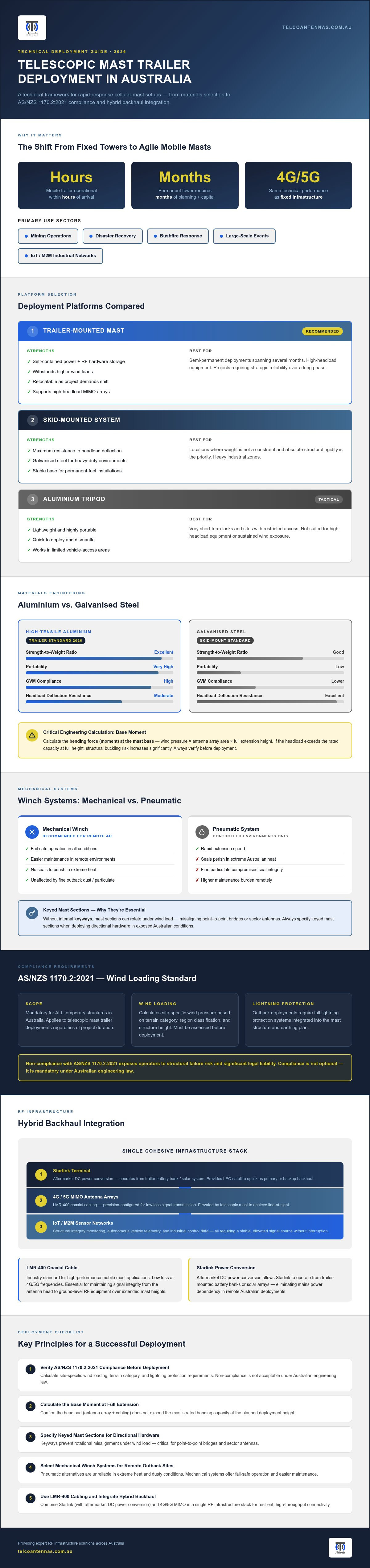
The requirement for robust, temporary RF infrastructure has intensified as we move through 2026. Industries such as mining, large-scale event management, and disaster recovery agencies now face higher data throughput requirements that fixed assets cannot always meet. A successful telescopic mast trailer deployment australia strategy allows for the rapid establishment of high-gain antenna arrays exactly where they are needed. This agility is critical when responding to bushfires or establishing a new pit in a remote mining operation. We've moved beyond the era where a site's connectivity was limited by the nearest permanent tower. Modern mobile cellular masts provide the same technical performance as fixed infrastructure but with the flexibility to relocate as project demands shift.
The transition from fixed communication towers to agile solutions is driven by the need for immediate ROI in industrial sectors. Building a permanent tower takes months of planning and significant capital expenditure. In contrast, a mobile trailer can be operational within hours. This speed does not come at the cost of performance. By using precision-engineered telescopic masts, operators can achieve the height necessary to clear local obstructions while maintaining the structural stability required for sensitive MIMO antenna arrays.
Bridging the Coverage Gap in Remote Australia
Remote workforces require reliable 4G and 5G services to maintain operational safety and productivity. When geographic features like ridges or dense vegetation create signal shadows, elevating the antenna is the only mechanical solution to achieve line-of-sight. Telescopic systems provide this elevation, effectively pushing the RF footprint into previously unreachable areas. This is not just about voice calls. It's about supporting a dense network of IoT and M2M sensors in industrial zones. These sensors monitor everything from structural integrity to autonomous vehicle telemetry, and they require a stable, elevated signal source to function without interruption.
Temporary vs. Semi-Permanent Deployment Scenarios
Choosing the right hardware depends on the expected duration of the project and the specific environmental variables. For very short-term tasks or sites with limited vehicle access, an aluminium tri-pod offers a lightweight, portable solution. However, when the requirement extends to several months or involves high-headload equipment, a trailer-mounted mast becomes the preferred option. These trailers provide a stable, self-contained platform that can withstand higher wind loads. They also offer integrated storage for power systems and delicate RF hardware. While a tripod is a tactical tool for quick setups, a telescopic mast trailer is a strategic asset for semi-permanent installations where reliability over a long project phase is non-negotiable.
Technical Specifications for High-Performance Telescopic Masts
The selection of materials for a telescopic mast is a balance between structural rigidity and portable weight. High-tensile aluminium is the industry standard for 2026 mobile applications. It offers a high strength-to-weight ratio which is critical for staying within trailer GVM limits. Galvanised steel is often reserved for heavy-duty skids where weight is less of a concern than absolute resistance to high-headload deflection. When planning a telescopic mast trailer deployment australia, you must calculate the "moment" at the base. This is the bending force generated by wind pressure against the antenna array at the mast's full extension. If the headload exceeds the mast's rated capacity at a specific height, the risk of structural buckling increases significantly.
Keyed masts are essential for maintaining the orientation of directional hardware. Without internal keyways, the mast sections can rotate under wind load, which misaligns point-to-point bridges or sector antennas. For deployment in the dusty conditions of the Australian Outback, mechanical winch systems often outperform pneumatic alternatives. While pneumatic masts offer rapid extension, they rely on seals that can perish in extreme heat or become compromised by fine particulate matter. Mechanical winches provide a fail-safe operation that is easier to maintain in remote environments.
Wind Loading and Environmental Survivability
Compliance with AS/NZS 1170.2:2021 is mandatory for all temporary structures. You must determine if your site falls within Region A or the cyclonic Region C to establish the required safety factors. This process involves calculating the Effective Projected Area (EPA) for all mounted hardware, including MIMO antennas and Starlink terminals. A high EPA increases the drag force, which may necessitate lower extension heights or additional guying. Stability is not just about the mast; it's about how the entire platform interacts with the ground surface during high-wind events.
RF Integrity and Signal Loss Mitigation
Maintaining signal strength across an extended mast requires high-quality feedlines. LMR-400 coaxial cable is the baseline for these installations because it balances low attenuation with the flexibility needed for repeated retraction. You must manage the cable's bend radius carefully to prevent internal fracturing of the dielectric. Protecting connectors with self-amalgamating tape or weather-shielding boots is a standard protocol to prevent moisture ingress in humid coastal zones. Consulting with a technician for bespoke RF infrastructure ensures your cabling and mast mechanics are perfectly synchronised for long-term reliability.
Evaluating Deployment Platforms: Trailers vs. Skids vs. Vehicle Mounts
Selecting the correct mechanical footprint for your RF infrastructure is as vital as the frequency planning itself. For most large-scale projects, a telescopic mast trailer deployment australia strategy represents the gold standard because it provides a self-contained ecosystem for power, electronics, and elevation. The choice between a trailer, a skid, or a vehicle mount hinges on the expected site duration and the accessibility of the terrain. If you're operating in off-road conditions, you must account for weight distribution and the Gross Vehicle Mass (GVM) of the towing vehicle to ensure the trailer doesn't become a liability on corrugated tracks.
Trailer-Mounted Masts: The Integrated Solution
Trailer-mounted masts are the primary choice for sites requiring 24/7 autonomous operation. These units allow for the integration of high-capacity solar arrays and deep-cycle battery banks, which are necessary for powering remote equipment without external mains. The internal layout often includes dedicated equipment racks for housing Cel-Fi GO boosters and core networking hardware. Security is another major advantage; lockable steel or aluminium enclosures protect sensitive electronics from both environmental ingress and potential tampering at unmanned locations.
Skids and Vehicle Mounts for Specific Use Cases
Skid-mounted masts are better suited for long-term mining exploration camps where the unit will remain stationary for several months. While they lack the immediate mobility of a trailer, they offer a smaller footprint and can be easily relocated via hiab or forklift. Vehicle-mounted masts, conversely, are tactical tools used for signal testing or "comms-on-the-move." Mounting high-gain antennas to a bull bar or roof rack presents unique engineering challenges, particularly regarding vibration dampening and wind resistance at highway speeds. When comparing setup times for a telescopic mast trailer deployment australia, a trailer can be fully deployed and levelled by a single technician in under 30 minutes, whereas a portable tripod system, while lighter, may lack the stability required for high-headload directional arrays.
Site Analysis and Safe Deployment Protocols
Before hardware ever arrives on site, a technical site analysis must be completed to ensure the installation meets specific performance targets. A successful telescopic mast trailer deployment australia requires rigorous site verification to mitigate environmental risks and RF interference. This phase isn't just about finding a flat patch of ground; it's about evaluating the physical and electromagnetic landscape to ensure the mast provides the required coverage without becoming a safety liability. Technicians must prioritise grounding and lightning protection, particularly in the Australian Outback where dry storms are frequent. Using dedicated earth stakes and surge arrestors is a non-negotiable protocol to protect sensitive MIMO arrays and power systems from high-voltage transients.
The Pre-Deployment RF Survey
Identifying the nearest carrier towers and calculating path loss is the first step in any remote setup. You need to determine if the terrain between your site and the base station allows for a stable connection. If geographic obstacles prevent a direct cellular link, we often deploy point-to-point wireless bridges to bring backhaul from a distant high-point. The survey also dictates the required mast height. Clearing the "Fresnel zone" is essential; even if you have a visual line-of-sight, signal degradation can occur if the mast isn't tall enough to clear local clutter like trees or industrial machinery. If you need assistance with complex path calculations, you can engage our professional RF engineering services to ensure your site design is accurate.
Safety protocols must also account for Occupational Health and Safety (OH&S) standards. This includes establishing clear exclusion zones around the trailer and verifying overhead power line clearances. A minimum clearance of 6 metres from power lines is generally required, though you should check local state regulations before starting the lift. Guy-wire configurations are equally critical; even heavy-duty trailers require secondary stabilisation to manage unpredictable wind gusts that can occur during afternoon thermal shifts in rural areas.
Step-by-Step Mast Erection Procedure
The physical erection process begins with levelling the trailer platform. Use integrated outriggers and spirit levels to ensure the mast remains perfectly vertical, as even a slight tilt increases the "moment" force and compromises stability. During sequential extension, cable management is the primary focus. You must ensure the LMR-400 feedlines and power cables have enough slack to move with the mast sections without snagging or exceeding their minimum bend radius. Once the mast is locked at the desired height, post-deployment testing begins. This involves Receive Signal Level (RSL) verification and fine-tuning the antenna alignment to maximise throughput. Don't consider the job done until the signal is stabilised and all mechanical locks are double-checked for security.
Customising RF Infrastructure with Telco Antennas
A successful telescopic mast trailer deployment australia project requires a transition from off-the-shelf components to a fully integrated RF system. Telco Antennas acts as the consultative expert in this process, providing the necessary engineering oversight to ensure that disparate hardware works as a single, high-performance unit. Whether you're deploying a single rapid-response trailer or managing a national fleet, the focus remains on reliability and technical precision. We specialise in bespoke engineering for high-headload directional antenna arrays, ensuring that every mechanical interface is rated for the specific environmental stresses of your site.
Integrating Starlink with Cellular Masts
Satellite backhaul has become a standard requirement for 2026 remote operations. We integrate professional Starlink accessories into our mobile trailers to facilitate hybrid connectivity. This often involves using 12V power conversion kits for the Starlink Mini, allowing the system to run directly from the trailer's battery bank without the efficiency losses of an inverter. For larger setups, we provide custom mounting solutions for Starlink Gen 3 dishes that sit alongside high-gain cellular antennas on the telescopic mast. This hybrid backhaul strategy ensures 100% uptime. If the cellular link is obstructed by terrain or network congestion, the satellite link maintains the data flow, providing a redundant path for critical telemetry and workforce communication.
Why Professional Engineering Matters
The risks of using uncertified or DIY mounting solutions are significant in high-wind Australian regions. A failure at the mast head can lead to expensive hardware damage and prolonged site downtime. Accessing Telco Antennas’ RF engineering expertise for site design allows you to mitigate these risks before the first mast is raised. We ensure that your configuration adheres to the 2026 AS/NZS 1170.2:2021 standards, focusing on the intersection of hardware specifications and real-world challenges. This methodical approach prioritises longevity through the use of high-quality RF components and low-loss cabling, ensuring your investment remains operational in the most demanding conditions.
Telco Antennas provides national support and wholesale supply for large-scale Australian deployments. Our specialist team is available to assist with everything from initial site surveys to complex communication tower design. By acting as a dependable partner, we provide the tools and technical knowledge required for successful connectivity in the most challenging terrains across the country.
Future-Proofing Your Remote RF Infrastructure
Successful telescopic mast trailer deployment australia requires a methodical integration of structural engineering and advanced RF planning. Maintaining compliance with the AS/NZS 1170.2:2021 wind loading standards is the only way to ensure equipment survivability in the Outback's unpredictable climate. By combining high-gain MIMO antenna arrays with hybrid backhaul solutions like Starlink, you can achieve the 100% uptime required for modern industrial operations. The transition from fixed towers to agile, mobile platforms allows your connectivity to move at the same pace as your project requirements.
Our team provides the technical depth needed to navigate these complexities. From specialist RF site surveys to professional communication tower design, we offer national Australian support for every phase of your installation. Contact our RF Engineering team for a custom mast deployment solution to ensure your remote site remains stable and high-performing throughout 2026. With the right hardware and engineering oversight, you can deploy with confidence in any terrain.
Frequently Asked Questions
What is the maximum height for a telescopic mast trailer in Australia?
Most commercial communication trailers in Australia offer mast heights ranging from 6 to 15 metres. While taller masts are available for specialised applications, 15 metres is generally the practical limit for a mobile platform to maintain stability under local wind conditions. Going higher usually requires more extensive guying and a larger trailer footprint to manage the increased "moment" force at the base, ensuring the structure remains safe and compliant.
Do I need a special licence to tow a mobile communication trailer?
You typically don't need a special licence if the Aggregate Trailer Mass (ATM) is under 4,500kg, as a standard C-class car licence is sufficient. However, you must verify that your towing vehicle's braked towing capacity exceeds the trailer's actual weight. If the trailer's ATM exceeds 4.5 tonnes, you'll need a Heavy Rigid (HR) or similar heavy vehicle licence. Always check the compliance plate before starting your journey.
How do I protect my cellular mast from lightning in the Outback?
Effective protection requires a combination of physical grounding and surge diversion. You should drive a copper-clad earth stake into the ground at the trailer base and connect it to the mast using heavy-gauge wire. Additionally, install lightning surge arrestors on all coaxial feedlines before they reach your boosters or routers. This setup is vital in the Outback, where dry electrical storms can easily damage sensitive MIMO antenna arrays and networking hardware.
Can I mount a Starlink dish on a telescopic mast trailer?
Yes, Starlink integration is a core component of a modern telescopic mast trailer deployment australia strategy. We recommend using custom-engineered mounting brackets to secure the dish at the mast head alongside traditional cellular antennas. To maximise efficiency in off-grid scenarios, many operators use 12V aftermarket power conversion kits for the Starlink Mini, allowing the system to run directly from the trailer's battery bank without the need for an inefficient power inverter.
What wind speed can a typical 10-metre telescopic mast withstand?
A standard 10-metre mast is usually rated for wind speeds up to 100km/h, provided it's correctly levelled and guyed. However, the actual survivability depends on the Effective Projected Area (EPA) of your mounted equipment. If you're deploying in cyclonic Region C areas, you must adhere to stricter AS/NZS 1170.2:2021 standards. This might involve lowering the mast height during high-wind alerts or using additional high-tensile guy wires to ensure structural integrity.
Is a site survey necessary for temporary mast deployment?
A pre-deployment RF site survey is essential to ensure your mast is positioned for maximum signal throughput. Without a survey, you might place the trailer in a signal shadow caused by local terrain or vegetation. A professional survey identifies the nearest carrier towers and calculates the precise height needed to clear the Fresnel zone. This data-driven approach ensures your 4G or 5G connection remains stable throughout the project duration.
What is the difference between a pneumatic and a manual telescopic mast?
Pneumatic masts use compressed air for rapid extension, which is useful for tactical setups but relies on internal seals that can perish in extreme Australian heat. Manual masts use a mechanical winch and cable system, offering superior reliability in dusty, remote environments. While manual masts take longer to raise, they don't require a constant air supply or a compressor, making them the preferred choice for long-term, unmanned remote sites.
How do I manage signal loss in long cable runs on a 15-metre mast?
Managing attenuation on a tall mast requires using high-quality, low-loss cabling like LMR-400. This cable is the industry standard for 15-metre runs because it balances low decibel loss with the flexibility needed for mast retraction. You should also minimise the use of adapters and connectors, as each junction introduces further signal degradation. For high-frequency 5G applications, keeping the feedline as short and direct as possible is critical for maintaining high data speeds.


