

A ten-metre tower that withstands a Category D wind zone but fails an ACMA audit is just as ineffective as a structure that buckles during its first coastal gale. You understand that successful deployment requires more than just mechanical assembly; it demands a precise alignment of structural engineering and legal adherence. Navigating the complex communication tower regulations australia has established for 2026 requires a firm grasp of the C564:2025 Industry Code and the latest ARPANSA EME standards. It's a high-stakes environment where a single oversight in council consultation or RF interference management can stall a project indefinitely.
This technical guide provides a definitive roadmap for navigating these requirements while ensuring your infrastructure delivers peak performance. We'll show you how to transition from initial site surveys to full operational status with clinical confidence. By examining the nuances of the Telecommunications (Low-impact Facilities) Determination 2018 and the technical specifics of LMR-400 cabling and MIMO antenna placement, we'll ensure your installation meets every safety and engineering benchmark. We'll cover everything from structural wind load calculations to the final apparatus licensing steps required for long-range wireless links.
Key Takeaways
- Learn how to select the correct structure by distinguishing between self-supporting towers and guyed masts based on your specific ground footprint and height requirements.
- Navigate the updated 2026 communication tower regulations australia mandates, ensuring full compliance with the C564:2025 Industry Code and ARPANSA EME standards.
- Determine the structural stability of your deployment by verifying wind loading requirements for your specific Australian wind region and analysing soil composition for foundation depth.
- Optimise RF performance through precise line-of-sight analysis and vertical antenna separation to mitigate the risk of Fresnel zone obstructions and co-site interference.
- Evaluate the benefits of rapid-deployment solutions, such as telescopic mast trailers, for sites requiring immediate connectivity while maintaining high engineering standards.
Understanding Radio Tower Fundamentals: Masts vs Towers
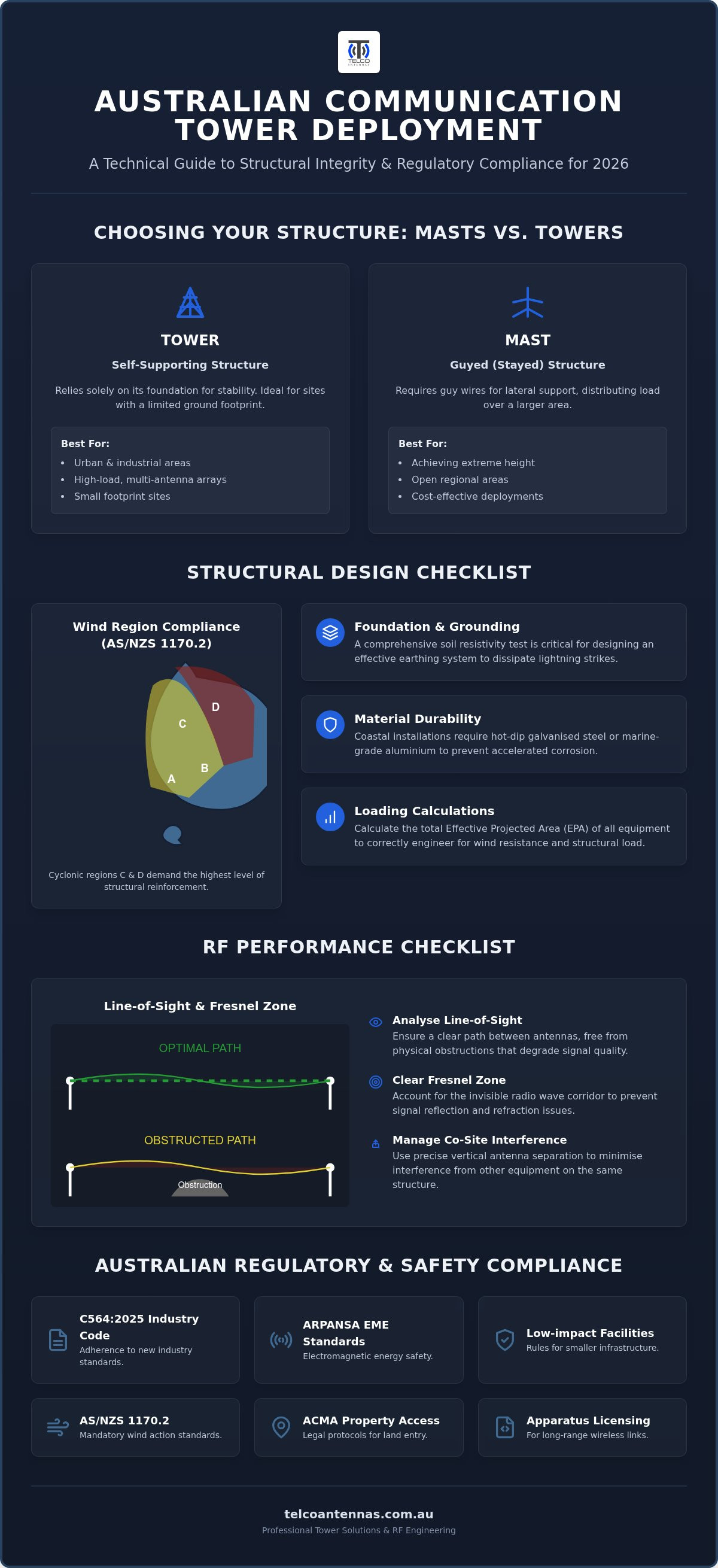
Selecting the correct vertical infrastructure begins with a clear distinction between Radio masts and towers. In the Australian engineering context, a tower is a self-supporting structure that relies solely on its foundation for stability; whereas a mast is a stayed structure that requires guy wires for lateral support. The choice between these two isn't merely aesthetic. It's a technical decision dictated by the available ground footprint, required elevation, and the environmental loads specific to the site. For 2026 deployments, including 5G backhaul and private IoT networks, the structure must be engineered to withstand rigorous conditions while remaining compliant with current communication tower regulations australia.
Classifying Structures by Engineering Type
Structural selection is driven by the physical constraints of the site and the intended payload. Lattice towers remain the primary choice for remote installations where high-load, multi-antenna arrays are necessary. Their open-frame design offers a high strength-to-weight ratio, which is vital for surviving the high wind speeds found in coastal or alpine regions. For urban or industrial environments where space is a premium, monopoles provide a space-efficient alternative. While they have a smaller footprint, their solid surface increases wind resistance, necessitating deeper foundations. Guyed masts offer the most cost-effective solution for achieving extreme height in open regional areas, provided the land area can accommodate the guy wire radius.
Selecting the Right Mount for Your Equipment
Successful deployment requires an accurate calculation of the total effective projected area (EPA) of all planned equipment. This metric accounts for how much wind resistance the antennas and cabling will add to the structure. If you're managing a lightweight, low-elevation installation, aluminium tri-pods often provide a versatile solution for roof-top or temporary ground mounts. However, for larger structures, you must evaluate site accessibility for heavy machinery during the installation phase. If the site cannot support a crane or concrete truck, your design might need to shift toward modular lattice sections or rapid-deployment telescopic systems. Ensuring the mounting hardware matches both the environmental variables and the structural capacity is a core requirement under communication tower regulations australia to maintain long-term site safety.
Structural Design Checklist: Materials and Stability
Engineering a structure that remains stable under peak load requires a meticulous assessment of the local environment. Australia is categorised into wind regions A through D, with cyclonic regions C and D demanding the highest level of structural reinforcement. Every deployment must align with communication tower regulations australia by adhering to AS/NZS 1170.2, which governs wind actions on structures. Beyond wind, soil composition determines the viability of your foundation. A clay-heavy soil behaves differently under tension than sandy loam, requiring specific concrete grades and pile depths to prevent structural failure. For coastal installations, material durability is paramount. High-salinity environments accelerate corrosion, making hot-dip galvanised steel or marine-grade aluminium essential for long-term integrity.
Foundation and Grounding Requirements
Establishing a secure foundation starts with a comprehensive soil resistivity test. This data is critical for designing an earthing system that can safely dissipate lightning strikes, protecting both the structure and the sensitive RF hardware. Before any excavation begins, you must verify the location of underground utilities to avoid service disruptions or safety hazards. While planning site entry, referencing the ACMA Property Access Rules ensures you follow the correct legal protocols for land entry and facility installation. The foundation design must specifically account for the overturning moment, which is the force exerted at the base when peak wind loads hit the top of the tower.
Structural Integrity and Loading Calculations
The stability of your signal is directly linked to the cumulative wind load of the installed equipment. You must calculate the total load of all dishes, mounting brackets, and mimo antennas to ensure they don't exceed the tower's rated capacity. In alpine regions, ice loading adds significant weight and surface area, which can lead to catastrophic failure if not factored into the initial design. The Effective Projected Area (EPA) of your hardware determines the amount of tower sway during high winds; excessive movement will cause signal misalignment in narrow-beam microwave links. If you're unsure about the specific requirements for your site, seeking a professional site survey and design consultation can prevent costly engineering errors while ensuring full compliance with communication tower regulations australia.
RF Performance Checklist: Antenna Placement and Cabling
Achieving high-performance wireless links starts with a rigorous line-of-sight (LOS) analysis. It's not enough for the antennas to "see" each other; the first Fresnel zone must remain at least 60% clear of any obstructions like trees, buildings, or terrain features to prevent signal diffraction. In the context of communication tower regulations australia, maintaining this clearance is vital for both link performance and ensuring the installation doesn't inadvertently interfere with neighbouring licensed services. You must also optimise the vertical separation between antennas on the same structure. This physical isolation is your primary defence against co-site interference, a scenario where high-power transmitters desensitise nearby receivers and degrade the overall noise floor of the site.
Transmission Line and Cable Management
Signal integrity is easily lost between the radio and the antenna if the transmission line is poorly selected. For any cable run exceeding 10 metres, you should prioritise high-quality coaxial cable like LMR-400. This low-loss cabling ensures that the power leaving your transmitter actually reaches the antenna with minimal attenuation. During installation, you must strictly follow the manufacturer's specified minimum bend radius. Forcing a cable into a tight corner can cause internal conductor damage or impedance mismatches, which lead to high Voltage Standing Wave Ratio (VSWR) readings. Using professional-grade cable hangers every metre prevents mechanical stress and keeps the cabling secure against wind-induced vibration.
Antenna Alignment and Azimuth Calibration
Precision is the hallmark of a professional installation. Relying on a standard compass is often insufficient due to local magnetic deviations or the presence of steel in the tower itself. Instead, use a GPS-based alignment tool to calibrate the exact azimuth and tilt of your directional antennas. This ensures the main lobe of the signal is perfectly targeted toward the remote station. You should also check for potential signal reflections from nearby terrain features or metallic structures, which can cause multi-path fading. Once the link is established, document the final Receive Signal Level (RSL) for each link. This establishes a performance baseline that is essential for future troubleshooting and ensures the site remains compliant with communication tower regulations australia regarding emission limits and spectral efficiency. Finally, implement rigorous weatherproofing using self-amalgamating tape and UV-rated boots for all RF connectors to prevent moisture ingress, which is the leading cause of long-term signal degradation in Australian environments.
Australian Regulatory and Safety Checklist
Achieving structural and RF efficiency is only half the battle; your deployment must satisfy a multi-layered framework of communication tower regulations australia. This involves federal oversight from the ACMA, health standards from ARPANSA, and aviation safety via CASA. Every site must undergo a formal Environmental Electromagnetic Energy (EME) assessment to ensure compliance with the Standard for Limiting Exposure to Radiofrequency Fields – 100 kHz to 300 GHz (Rev. 1) (2021). If your tower height exceeds specific thresholds, or if it's located within the vicinity of an aerodrome, you must notify the Civil Aviation Safety Authority (CASA) to determine if obstacle lighting or marking is required. A strictly controlled exclusion zone must also be established at the base of the structure to prevent unauthorised access during transmission periods.
ACMA Licensing and Compliance Steps
The first step in spectral compliance is identifying whether your application fits under a class licence or requires a specific apparatus licence. While many point-to-point wireless bridges operate in uncoordinated class-licensed bands, mission-critical links often benefit from the interference protection provided by a coordinated apparatus licence. You must ensure that all hardware, from the radio units to the power supplies, carries the Regulatory Compliance Mark (RCM). This mark confirms the equipment meets Australian standards for electrical safety and electromagnetic compatibility. If your site meets the criteria for public notification, it must be registered on the Radio Frequency National Site Archive (RFNSA) database to maintain transparency with the local community and other carriers.
Work Health and Safety (WHS) for Tower Sites
Safety at heights is a non-negotiable component of any professional deployment. All personnel involved in the installation or maintenance of the structure must hold current Rigger and Work at Heights certifications recognised under Australian WHS laws. Before any technician leaves the ground, a documented rescue plan must be in place, detailing the specific procedures and equipment required to recover an injured or incapacitated climber. When working in close proximity to active antennas, technicians are required to wear calibrated personal RF monitors to provide real-time alerts if exposure levels exceed safe occupational limits. To ensure your project meets all legal and technical benchmarks from the outset, you can book a professional RF site survey to identify potential compliance risks before they become costly liabilities.
Implementing Professional Tower Solutions with Telco Antennas
Navigating the intersection of hardware and communication tower regulations australia requires a partner capable of translating complex standards into physical infrastructure. Telco Antennas provides this bridge, offering specialised services that range from initial frequency coordination to the final structural sign-off. By consolidating your procurement of high-gain MIMO antennas and LMR-400 cabling with professional engineering support, you ensure that every component is matched for impedance and environmental durability. It's about moving from a collection of parts to a unified system that functions reliably in the field with clinical precision.
Rapid Deployment with Telescopic Mast Trailers
For scenarios requiring immediate connectivity, such as disaster recovery or remote construction sites, telescopic mast trailer deployment australia offers a compliant, mobile alternative to permanent structures. These systems allow for rapid elevation of RF payloads without the lead times associated with concrete foundations. You'll need to evaluate the stability of pneumatic winching systems, which offer precise control for sensitive equipment, versus manual winching systems that provide mechanical simplicity in harsh environments. These trailers are highly versatile for integrating specific technologies:
- Starlink after-market power conversions for high-bandwidth satellite backhaul
- Point-to-point wireless bridges for localised network extension
- Custom solar arrays for autonomous, off-grid operation
Selecting the right trailer configuration depends on your specific wind region and the total weight of the antenna array. Our team ensures that these mobile units are weighted and stabilised to meet the same rigorous engineering standards as fixed installations.
Custom RF Engineering and Site Surveys
The efficacy of your tower is ultimately measured by its spectral performance. Professional RF site surveys are essential for identifying the optimal tower location and height while mitigating the risk of interference in increasingly crowded spectrum environments. Through advanced communication tower design, our engineers utilise computer modelling to predict coverage patterns and signal propagation before a single bolt is tightened. This proactive approach ensures your infrastructure is future-proofed for emerging satellite-to-cellular technologies and evolving communication tower regulations australia. By identifying environmental variables early, you avoid the costly rework associated with signal shadows or structural misalignment. We act as a consultative expert, ensuring that your equipment functions correctly from the first day of operation.
Securing Your Infrastructure in the 2026 Regulatory Landscape
Deploying a communication tower in 2026 requires a precise balance between structural engineering and spectral compliance. You've seen that success depends on more than just choosing between a mast or a tower; it requires a deep understanding of wind loading regions, cable attenuation, and the strict communication tower regulations australia enforces. By prioritising rigorous site surveys and adhering to the C564:2025 Industry Code, you mitigate the risk of both mechanical failure and regulatory audits.
Telco Antennas has been Australian owned and operated since 2008, providing the technical authority needed for complex RF projects. We provide full structural and RF engineering support alongside national delivery of masts and towers to ensure your site is built to survive the Australian environment. Whether you're deploying a permanent lattice structure or a mobile telescopic mast trailer, our team ensures every specification meets the highest industry standards.
Consult with our RF Engineers for your next Radio Tower project to ensure your next deployment is stable, legal, and optimised for long-term performance. We're ready to help you build infrastructure that lasts.
Frequently Asked Questions
Do I need a council permit to build a radio tower on my property in Australia?
Whether you need a permit depends on if the structure is classified as a low-impact facility. Under the Telecommunications (Low-impact Facilities) Determination 2018, standalone towers are generally not low-impact. This means most private or industrial radio towers require a Development Application (DA) through your local council. It's essential to consult with a town planner or your local government authority before commencing any excavation or structural assembly to ensure full compliance with communication tower regulations australia mandates.
What is the maximum height a radio tower can be without CASA approval?
In most regional areas, structures under 110 metres don't require formal CASA notification unless they are located within the vicinity of an aerodrome or flight path. However, any structure that could be a hazard to aircraft must be reported regardless of its height. You should check the specific Obstacle Limitation Surfaces (OLS) for your area. If your tower is near an airport, even a 15-metre structure might require obstacle lighting or specific markings to ensure aviation safety.
How much does it cost to have a professional communication tower design completed?
The cost of a professional communication tower design is influenced by the complexity of the structural requirements and the site's environmental variables. Factors such as wind region classification, soil composition analysis, and the total effective projected area (EPA) of the antenna array all dictate the engineering hours required. While we don't provide a flat fee, investing in a professional design ensures the structure is safe and compliant, which prevents the far higher costs associated with structural failure or regulatory fines.
Can I install my own antennas on a radio tower or do I need a certified rigger?
While you can physically mount antennas at low levels, any work performed at heights requires a certified rigger with current Work at Heights accreditation. Australian WHS regulations are strict regarding the safety of personnel working on vertical infrastructure. A professional rigger ensures that antennas are mounted securely to withstand wind loads and that all cabling is managed correctly. Using certified professionals also ensures that your insurance remains valid and that the installation meets legal safety benchmarks.
What is the difference between a radio mast and a radio tower?
The primary distinction lies in how the structure achieves stability. A radio tower is a self-supporting structure that relies on its own foundation. This makes it ideal for sites with a limited ground footprint. In contrast, a radio mast is a stayed structure that uses guy wires for lateral support. Masts are often more cost-effective for achieving significant height in open areas. However, they require a much larger land area to accommodate the guy wire radius.
How do I ensure my radio tower is compliant with ARPANSA EME standards?
Compliance is achieved by conducting a formal Environmental Electromagnetic Energy (EME) assessment. This process calculates the predicted RF exposure levels at ground level and in surrounding areas to ensure they remain below the limits set by the ARPANSA RPS S-1 standard. For many sites, this involves generating an ARPANSA EME report. It's a critical step in the communication tower regulations australia framework, ensuring that the public and workers are not exposed to unsafe levels of radiofrequency fields.
What maintenance is required for a steel lattice radio tower in a coastal area?
Steel lattice towers in high-salinity environments require rigorous maintenance to prevent structural degradation. You should conduct annual inspections to check for signs of surface rust, particularly at bolted joints and weld points. While hot-dip galvanising provides significant protection, coastal sites may require additional marine-grade coatings. It's also vital to check the tension of guy wires if applicable and ensure that the earthing system hasn't corroded, as salt air can accelerate the decay of copper grounding rods.
Are telescopic mast trailers stable enough for permanent use in high-wind zones?
Telescopic mast trailers are primarily designed for rapid deployment and temporary use. While they are engineered for stability, their wind load rating is typically lower than a fixed lattice tower. If you intend to use one in a high-wind zone for an extended period, you must ensure it's correctly ballasted. You should also retract the mast during extreme weather events. For permanent mission-critical infrastructure, a fixed foundation structure is always the safer and more reliable choice.


