

A telescopic mast trailer is not merely a vehicle; it's a precision-engineered foundation where the slightest mechanical instability can compromise an entire RF link. Deploying a portable communication tower in the Australian outback presents challenges that go far beyond simple height. You likely understand the pressure of calculating headload weight against wind surface area, only to worry if your infrastructure will withstand a sudden gust on an unsealed remote track. It's a valid concern when equipment failure in a isolated location means a complete loss of critical data connectivity.
This guide provides the technical clarity needed to select and deploy mobile mast trailers that maintain high-performance communication in the harshest environments. We'll examine the engineering behind outrigger levelling, compliance with AS/NZS 1170.2:2021 wind loading standards, and how to integrate your existing RF hardware for a seamless, stable installation. By mastering these variables, you ensure your deployment is both structurally safe and technically functional.
Key Takeaways
- Learn why wind surface area is a more critical metric than simple headload weight when calculating mast sway and structural stability.
- Understand how to select the correct trailer chassis by comparing single and tandem axles for heavy payloads on unsealed roads.
- Identify the essential durability standards required for Australian environments, including the necessity of hot-dip galvanisation and UV-stabilised components.
- Discover how to configure a portable communication tower as a fully integrated hub using high-gain MIMO antennas and signal boosters.
- Ensure your deployment meets AS/NZS 1170.2:2021 standards to maintain structural integrity and safety in high-wind regions.
What is a Telescopic Mast Trailer and Why is it Essential?
A telescopic mast trailer serves as a mobile, rapid-deployment platform specifically engineered to support RF infrastructure in locations where permanent structures are impractical or cost-prohibitive. Unlike a fixed tower, which requires significant civil works and lengthy approval processes, or a static skid that necessitates a crane for relocation, the trailer-mounted system offers immediate mobility across unsealed roads. It functions as a What is a mobile cell site? by providing a stable, height-adjustable vertical axis for antennas, microwave links, and surveillance equipment. This versatility makes the portable communication tower an essential asset for operations requiring temporary but high-performance signal coverage in varied terrain.
The Mechanics of Rapid Deployment
The core advantage of these systems lies in their telescopic sections, which are typically driven by either high-pressure pneumatic systems or heavy-duty mechanical winches. Pneumatic masts offer rapid extension using compressed air, while winch-driven models provide a robust mechanical lock that is often preferred for long-term deployments with heavier headloads. These mechanisms allow the mast to retract into a compact form for transport. This design lowers the centre of gravity and reduces wind resistance while the vehicle is in motion. Once on-site, the trailer chassis acts as a critical counterweighted base. For remote Australian sites, we prioritise engineering that facilitates single-person operation. This allows a technician to level the chassis using integrated outriggers and deploy the mast without needing additional heavy machinery or a large crew.
Primary Applications Across Australian Industries
In the mining and resources sector, these trailers are indispensable for greenfield exploration and remote site expansion. When a project lacks existing infrastructure, a portable communication tower provides the necessary height for high-gain MIMO antennas to establish a reliable data link across vast distances. Emergency response teams also rely on these systems to restore cellular coverage or private radio networks following natural disasters. The ability to move the hardware quickly as conditions change is a significant operational benefit. Additionally, the construction industry utilises telescopic masts for temporary site surveillance and Wi-Fi backhaul. This ensures that site offices remain connected during the early phases of a project before fixed-line services are provisioned. The integration of such systems provides a reliable bridge between complex engineering and practical, on-the-ground communication needs.
Engineering Stability: Payload, Height, and Wind Loading
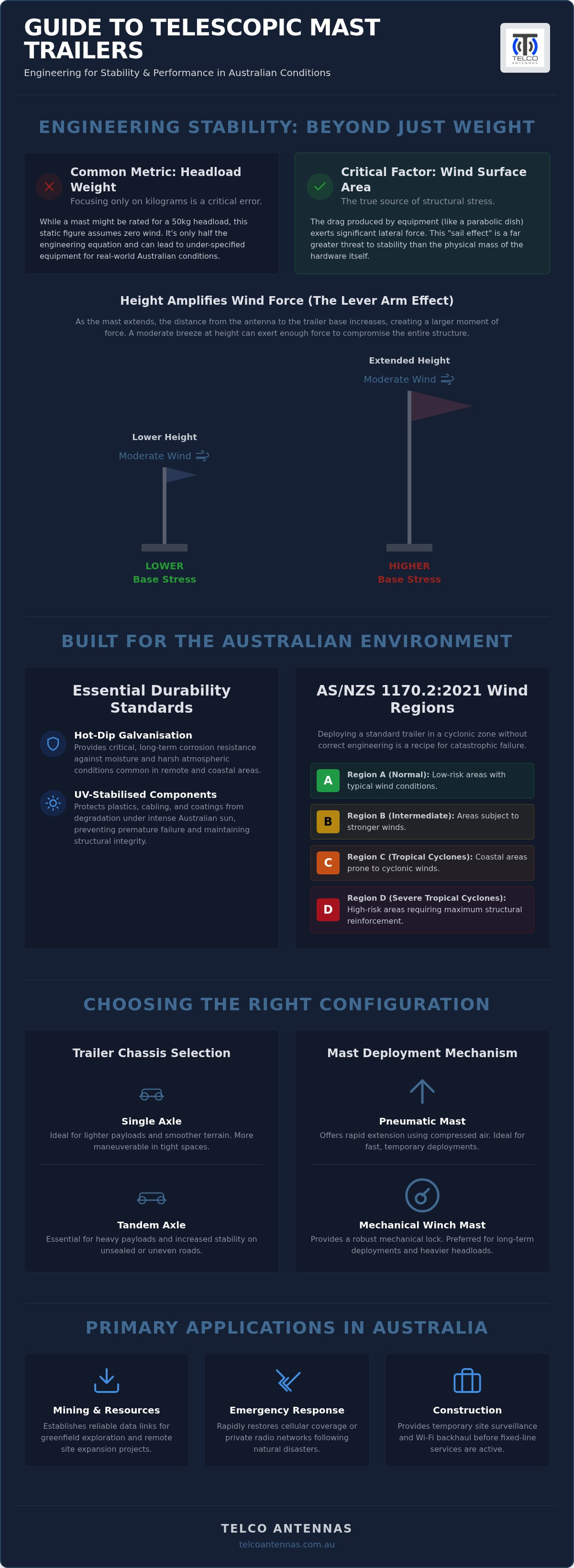
When specifying a portable communication tower, the "headload" metric is frequently the first specification technicians examine. However, static weight is only half the engineering equation. While a mast might be rated for a 50kg headload, this figure assumes a negligible wind surface area. In a real-world environment, the drag produced by your equipment often dictates structural success more than the physical mass of the hardware itself. We define this as the drag coefficient or Wind Surface Area (CdA). A large parabolic dish may weigh less than a compact omni-directional antenna, yet it exerts significantly higher lateral force on the mast sections during high-wind events.
The physics of the lever arm explains why height amplifies these forces. As the mast extends, the distance between the antenna and the trailer base increases, creating a larger moment of force. This means a moderate breeze at 10 metres height can exert enough mechanical shear to compromise the stability of the entire trailer if the outriggers aren't correctly deployed. This relationship is a core consideration in the strategic deployment of mobile cells, where maintaining a vertical axis is paramount for link reliability. For Australian sites, you must also cross-reference your deployment location with the wind region ratings defined in AS/NZS 1170.2:2021. Deploying a standard trailer in a Region C or D (cyclonic) zone without additional stabilisation is a recipe for catastrophic structural failure.
Calculating Your Required Payload Capacity
To determine your actual requirements, you must sum the weight of all components, including MIMO antennas, mounting brackets, and the vertical run of LMR-400 coaxial cable. You then calculate the Effective Projected Area (EPA) for the entire assembly. Standard engineering practice in the RF industry is to maintain a 20% safety margin. If your calculated wind load and weight reach 80% of the mast's rated capacity, it's time to consider a heavier-duty mast or a lower operating height. If you're unsure about your specific hardware configuration, our team can provide a professional RF site survey to validate your requirements.
Managing Wind Load and Vibration
Lateral rigidity is determined by the mast's diameter and wall thickness. Thinner sections are prone to "mast sway," which is particularly detrimental to high-frequency point-to-point microwave links. Even a few degrees of deflection can cause a complete signal dropout. If your deployment requires maximum stability at full extension, using guy wires is often necessary. These wires transfer the lateral wind load directly to the ground, bypassing the trailer's suspension and preventing vibration from reaching the sensitive RF hardware. This setup ensures that your link remains stable even when environmental conditions deteriorate.
Choosing the Right Chassis: Single Axle vs. Tandem Trailers
Selecting a chassis for a portable communication tower requires a balance between logistical mobility and structural ballast. While the mast provides the necessary elevation for your RF hardware, the chassis serves as the mechanical foundation that manages loads during both transport and deployment. The choice between a single or tandem axle configuration often dictates the maximum payload capacity and the environments where the system can be safely operated. It's not just about the weight of the trailer itself, but how that weight is distributed to ensure stability on the road and on-site.
Single axle configurations are best suited for lightweight, high-mobility requirements. These trailers are significantly easier to manoeuvre into tight positions by hand, which is a common necessity when site access is restricted by dense vegetation or existing infrastructure. However, they're generally limited in Gross Vehicle Mass (GVM) and can be more susceptible to trailer sway if the headload isn't perfectly balanced. For heavier payloads or taller masts, tandem axles are the professional standard. The dual-axle design provides a significant increase in towing stability, particularly on highways where crosswinds or passing heavy vehicles can induce dangerous oscillations. In the event of a tyre failure on a remote track, the second axle provides a critical safety buffer, allowing the vehicle to be moved to a safer location for repair without risking the mast's integrity.
Safety considerations also extend to the braking system. We recommend braked trailers for any mast system exceeding 750kg GVM to ensure compliance with Australian road regulations and to provide better control during off-road descents. While mechanical override brakes are functional, electric-over-hydraulic systems offer superior dampening and control, which is vital for protecting the internal sections of a portable communication tower from jarring forces during transit.
Outriggers and Stabilisation Systems
Stability on-site is determined by the trailer's footprint rather than its weight alone. Telescopic outriggers extend the base of the trailer, significantly increasing its overturning resistance against lateral wind loads. While swing-down stabilisers are sufficient for flat, hard-packed surfaces, telescopic outriggers provide the necessary levelling range for the uneven terrain typical of Australian work sites. We integrate spirit levels into the chassis frame because even a one-degree tilt at the base translates to a significant vertical offset at full extension. In soft outback soils, using wide base plates and sandbags is a standard precaution to prevent the outriggers from sinking over time, which could otherwise lead to mast misalignment.
Off-Road Capability and Terrain Considerations
Ground clearance is a non-negotiable requirement for unsealed Australian roads. We specify high-clearance axles and all-terrain tyres to ensure the trailer doesn't bottom out on rutted tracks or river crossings. Suspension choice is equally critical; while leaf springs are robust and easy to repair in the field, independent trailing arm suspension provides superior vibration dampening. This protection is essential for sensitive RF electronics, such as signal boosters and point-to-point bridges, which can be damaged by the high-frequency vibrations encountered during long-distance transit. Removable tow bars are another practical feature, as they reduce the site footprint and act as a theft deterrent once the trailer is positioned for long-term deployment.
Durability Standards for the Australian Environment
The Australian environment is uniquely hostile to mechanical and electronic hardware. When deploying a portable communication tower, durability isn't just about structural strength; it's about material longevity under extreme thermal cycling and high UV exposure. For the trailer chassis, hot-dip galvanisation is the non-negotiable standard. Unlike cold galvanisation, which is essentially a zinc-rich paint, hot-dip galvanisation involves immersing the entire steel frame in molten zinc. This creates a metallurgical bond that provides sacrificial protection against corrosion. This is vital for high-salinity environments, such as coastal regions or remote mine sites where ground minerals are highly reactive.
UV radiation presents a different challenge. High-intensity sunlight degrades pneumatic seals and cable jackets over time, leading to air leaks in pneumatic masts or signal loss in RF runs. We recommend powder coating over the galvanised base for additional protection and branding. This dual-layer approach adds a physical barrier against abrasion and chemical exposure, which is particularly useful for equipment frequently transported over unsealed, gravel-heavy roads. It's a pragmatic solution that extends the service life of the asset while maintaining a professional appearance in the field.
Material Science: Steel vs. Aluminium Masts
Choosing between steel and aluminium for the telescopic sections depends on your specific headload and deployment speed. Steel masts offer maximum structural rigidity and are the preferred choice for heavy industrial headloads or heights exceeding 15 metres. Their higher mass helps dampen vibration, though it requires a more robust trailer chassis. Aluminium masts are significantly lighter, making them ideal for rapid-deployment scenarios where a smaller vehicle is used for towing. The trade-off is that aluminium sections have more lateral flex in high winds, which may necessitate more frequent use of guy wires to maintain a stable RF link.
Maintenance Protocols for Longevity
Regular maintenance is the only way to ensure a portable communication tower remains operational over a long lifecycle. Dust is the primary enemy in the outback; it can enter telescopic sections and cause binding or scoring on the tubes. We advise cleaning and lubricating the sections with a dry silicone spray after every deployment in dusty conditions. Winching cables and pneumatic valves must be inspected for wear, as a snapped cable or a perished seal can render the system useless in the field. Protecting your coaxial cable runs is equally important. Ensure they are UV-stabilised and securely fastened to prevent wind-induced fatigue at the connectors. If you require a system built to withstand these specific Australian variables, you can explore our range of engineered mast trailers.
The Telco Antennas Advantage: Integrated RF Solutions
A trailer is essentially a mobile chassis until it's populated with the correct RF hardware. Deploying a portable communication tower is the first step toward establishing a robust network, but the hardware's true value is realised when it functions as an integrated communication hub. By integrating a Cel-Fi GO signal booster, you can transform a standard mast into a powerful cellular repeater that eliminates black spots in remote valleys or mine pits. We also frequently engineer these systems to support Starlink dishes for high-speed satellite backhaul, providing a complete data link where terrestrial infrastructure is non-existent. This integration requires more than just physical mounting; it involves managing potential RF interference between antennas and ensuring power stability across all active components to prevent system resets during peak loads.
Bespoke Trailer Configurations
Autonomous operation in the outback requires a reliable power source. We configure trailers with integrated solar arrays and high-capacity battery banks, enabling the system to run for weeks without manual intervention. Secure equipment cabinets are bolted directly to the chassis to house sensitive electronics, protecting them from both environmental ingress and unauthorised access. These cabinets provide a weather-shielded environment for routers, switches, and the power injectors needed for point-to-point wireless bridges. Custom mounting brackets are then engineered to ensure that these P2P links maintain precise alignment, which is critical for long-range microwave paths where even a few millimetres of movement at the base can result in a significant signal drop at the receiver.
Expert Consultation and Engineering Support
The difference between a successful deployment and a structural failure often lies in the pre-deployment phase. Our team applies over 15 years of industry experience to assist you in calculating complex wind loads for your specific gear, ensuring the mast's centre of gravity remains stable. We don't just provide the hardware; we provide the communication tower design expertise needed to ensure your portable communication tower remains within its safe operating envelope under local conditions. A professional site survey before deployment helps identify soil stability issues or RF interference that could compromise your link. If you're managing a project with unique technical requirements, you can consult with our RF engineers for a custom mast trailer solution to ensure your infrastructure is correctly specified and safely deployed.
Optimising Your Remote Infrastructure Deployment
Successful RF deployment in the Australian outback depends on the intersection of structural engineering and high-performance hardware. By prioritising metrics like wind surface area over simple headload weight and selecting a chassis with appropriate stabilisation for unsealed tracks, you ensure your portable communication tower remains a reliable asset rather than a liability. Durability is equally critical; choosing hot-dip galvanised steel and UV-stabilised components protects your investment against the harsh thermal cycling and high salinity found in remote industrial sites.
As seasoned RF specialists with over 15 years in the industry, we provide Australian-engineered solutions that integrate seamlessly with high-gain MIMO antennas and low-loss cabling. Our team is available to assist with technical specifications and tower design to ensure your next deployment is both stable and compliant. If you're ready to secure your remote connectivity, explore our range of professional telescopic mast trailers and skids. We look forward to helping you build a more resilient communication network.
Frequently Asked Questions
Do I need a special licence to tow a telescopic mast trailer in Australia?
In Australia, you typically don't need a special heavy vehicle licence to tow a portable communication tower provided the trailer's Gross Vehicle Mass (GVM) is under 4.5 tonnes. Most industrial mast trailers fall within the 750kg to 2,000kg range, meaning a standard Class C car licence is sufficient. It's critical to verify that your towing vehicle's braked towing capacity exceeds the trailer's GVM and that all safety chains and electrical connections meet local road standards.
What is the maximum height a trailer-mounted mast can safely reach?
Maximum heights for a trailer-mounted mast usually range between 6 and 30 metres. The safe operating height for any specific deployment is dictated by the mechanical limits of the telescopic sections and the environmental conditions at the site. As height increases, the wind surface area of your antennas creates more lateral force. We provide detailed wind loading charts to help you determine the maximum safe extension for your specific antenna payload and wind region.
Can these trailers be used for permanent installations in remote areas?
These trailers are engineered for rapid deployment, but they can function as semi-permanent infrastructure in remote areas. If you intend to leave a portable communication tower on-site for extended periods, you should implement a regular maintenance schedule. This includes inspecting winch cables for fraying and ensuring pneumatic seals remain lubricated. For permanent setups, we recommend using base plates and additional ground anchoring to ensure the outriggers don't shift during seasonal soil moisture changes.
How do I protect the mast and antennas from lightning strikes?
Protection involves a combination of structural grounding and inline surge protection for your RF equipment. Because the mast is a tall metallic structure, it's prone to attracting strikes. We recommend connecting the trailer chassis to a dedicated earth stake driven into the ground. Additionally, use high-quality coaxial surge protectors on all antenna leads to prevent high-voltage transients from damaging internal electronics like Cel-Fi boosters or wireless bridges.
What is the difference between a winch-up and a pneumatic mast?
Winch-up masts use a mechanical cable system to extend sections, offering high reliability for heavy headloads and long-term deployments. They don't require a continuous air supply to maintain height. Pneumatic masts use compressed air for rapid, effortless deployment, which is ideal for emergency response. However, pneumatic systems require more frequent seal maintenance in the Australian outback to prevent dust ingress and UV-induced perishing, which can lead to pressure loss over time.
How much wind can a telescopic mast trailer withstand before it needs to be lowered?
The maximum wind speed a mast can withstand depends on its extension height and the Effective Projected Area (EPA) of the mounted equipment. Most professional systems are designed to remain stable in gusts up to 100 km/h when correctly stayed or guyed. However, per AS/NZS 1170.2:2021 standards, we recommend lowering the mast if local weather forecasts predict severe storm activity or if you observe significant mast sway that could compromise your RF link.
Are the trailers hot-dip galvanised for mine site use?
Yes, our trailers are hot-dip galvanised to ensure they withstand the corrosive conditions found on Australian mine sites and coastal regions. This process involves immersing the entire steel chassis in molten zinc, creating a thick, metallurgical bond that is far more durable than standard paint or cold galvanising sprays. This level of protection is essential for preventing structural rust in high-salinity environments or where the trailer is frequently exposed to abrasive dust and moisture.
Can I mount a Starlink dish on a telescopic mast trailer using standard mounts?
You can mount a Starlink dish on a telescopic mast trailer, provided you use an appropriate adapter for the mast's top diameter. While the dish's standard mount is designed for residential use, we provide robust mechanical adapters that secure the hardware for industrial applications. We also offer aftermarket power conversion kits that allow the Starlink system to run directly off the trailer's DC battery bank, ensuring high-speed satellite backhaul without the need for inefficient AC inverters.


