

Your modem might show a full set of signal bars, yet your actual data throughput remains sluggish and unreliable during peak periods. This disconnect between perceived signal strength and real-world performance is a common frustration for professionals across Australia. If you've ever watched a video conference freeze despite having a supposedly strong connection, you've experienced the limitations of a poorly optimised RF environment. High-speed wireless internet isn't just about signal volume; it's about how that signal is managed through spatial diversity.
By mastering the technical principles of mimo antennas, you can significantly enhance your mobile data speeds and link reliability on modern Australian networks. We'll move beyond basic setups to explore the mechanics of X-polarised arrays and the critical role of low-loss LMR-400 cabling. This guide provides a clear deployment path for your specific site, explaining the transition to 4x4 configurations and the impact of the latest AS/CA S042.4:2025 standards. You'll gain the technical knowledge required to move from frustrating dropouts to a stable, professional-grade connection that delivers a genuine return on your hardware investment.
Key Takeaways
- Understand how MIMO technology leverages multipath propagation to multiply radio link capacity, providing a technical solution for slow data speeds even when signal bars are high.
- Identify the specific hardware requirements for 2x2 and 4x4 mimo antennas, including how spatial "layers" can be utilised to double system throughput in high-capacity Australian networks.
- Learn why precise ±45° slant polarisation is essential for maintaining signal isolation and preventing interference in modern 4G and 5G deployments.
- Discover the critical importance of using high-quality components like LMR-400 low-loss coaxial cables to prevent signal attenuation and protect your hardware investment.
- Gain a clear deployment path for complex sites, understanding when professional RF site surveys and communication tower design are required for industrial-grade reliability.
What is MIMO and Why is it Critical for Australian Networks?
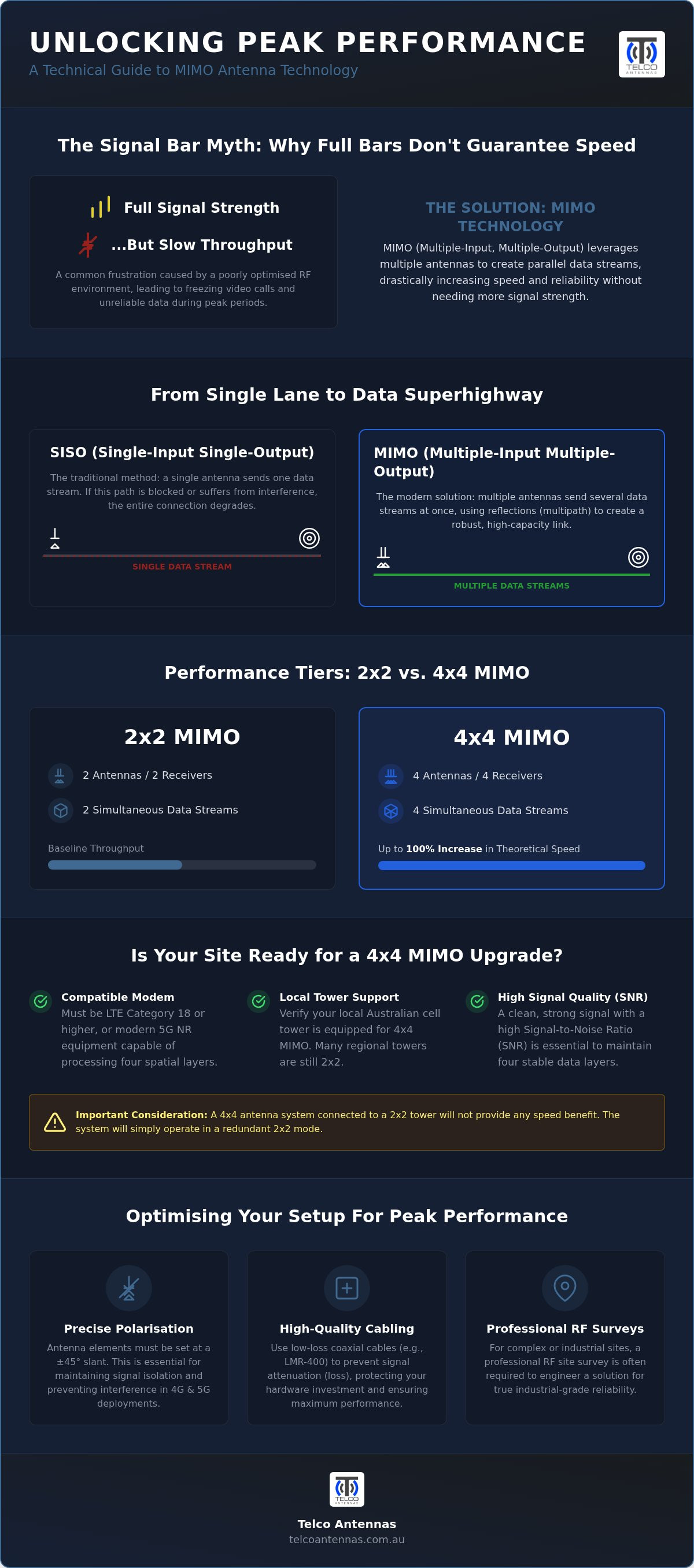
MIMO is a core radio technology designed to multiply the capacity of a wireless link without requiring additional spectrum. In traditional SISO (Single Input Single Output) systems, a single antenna at each end of the link limits data to a single stream. If that path is obstructed or experiences fading, the entire connection suffers. By utilising mimo antennas, Australian networks can transmit and receive multiple data signals simultaneously over the same frequency. This architectural shift is what enables the high-speed throughput expected on modern 4G LTE and 5G NR networks across the country.
The fundamental advantage of MIMO (multiple-input, multiple-output) lies in its ability to exploit environmental variables rather than being hindered by them. While older technologies struggled with interference and signal "bounce," MIMO requires a degree of signal decorrelation to function at peak efficiency. It's the technical backbone that allows mobile carriers to support thousands of concurrent users while maintaining the link stability required for professional applications.
The Role of Spatial Multiplexing
Spatial multiplexing allows a radio system to divide a high-rate data stream into multiple lower-rate streams. Each stream is transmitted from a different antenna element. Because these signals travel via different physical paths, they arrive at the receiver with distinct spatial signatures. The hardware then uses complex digital signal processing to untangle these layers, recombining them into the original high-speed data set. Spatial multiplexing is the simultaneous transmission of independent data layers. This process effectively doubles or quadruples the potential bandwidth depending on whether your hardware is configured for 2x2 or 4x4 operation.
Multipath Propagation in the Australian Landscape
In the varied Australian environment, signals rarely travel in a perfectly straight line. They bounce off hills, metal sheds, and dense vegetation, creating what is known as multipath propagation. While this usually causes interference in legacy systems, MIMO technology turns these reflections into a performance advantage. By using the slight time and phase differences between these bounced signals, the modem can distinguish between the multiple data streams being received.
MIMO performs exceptionally well in environments with high "clutter" or complex terrain. In these scenarios, the abundance of reflective surfaces provides the diverse paths necessary for the modem to maintain multiple layers of data. Without these reflections, the system might revert to a single-stream mode to maintain a stable connection, even if high-gain mimo antennas are installed. This makes the technology particularly effective for regional industrial sites where natural and man-made obstructions are a constant factor.
Comparing 2x2 MIMO vs 4x4 MIMO Performance
The jump from 2x2 to 4x4 MIMO represents a significant shift in how hardware handles data layers. While a 2x2 configuration uses two antennas to establish two independent data streams, 4x4 MIMO utilises four antennas to theoretically double that capacity. This isn't merely a matter of adding more mimo antennas to a roof; it requires a modem capable of processing four spatial layers and a cellular tower that supports the same configuration. In a 4x4 system, the modem and the tower negotiate four separate paths for data, which can lead to a 100% increase in theoretical download speeds compared to a 2x2 setup.
When to Upgrade to 4x4 MIMO
Hardware compatibility is the primary gatekeeper for 4x4 performance. To utilise four layers, your modem must meet specific LTE Category ratings, typically Category 18 or higher. Modern 5G NR (New Radio) equipment is designed with 4x4 as a baseline standard to handle the massive throughput required for high-density industrial sites. Before investing in a four-port antenna array, you must verify that your local Australian tower supports these higher-order configurations. Many regional towers are still capped at 2x2, meaning a 4x4 antenna system would simply operate in a redundant 2x2 mode without any speed benefit.
Throughput Expectations and Real-World Constraints
Theoretical peak speeds rarely translate directly to the field because MIMO efficiency is heavily dependent on the Signal-to-Noise Ratio (SNR). To maintain four stable data layers, the modem requires a very clean signal with minimal interference. If the SNR drops below a certain threshold, the system will automatically fall back to 2x2 or even SISO mode to preserve the link. In remote Australian locations, the distance from the tower often results in a lower SNR, which can lead to diminishing returns for 4x4 hardware.
Network congestion also plays a role. If the backhaul at the tower is saturated, having more MIMO layers won't bypass the bottleneck. For sites requiring maximum reliability, the focus should be on signal quality through precise antenna alignment and high-quality cabling. If you're looking to optimise a high-capacity site, the technical specialists at Telco Antennas can help determine the most effective hardware configuration for your specific RF environment.
The Importance of Antenna Polarisation and Diversity
Signal isolation is the cornerstone of effective MIMO performance. If the multiple data streams mentioned in previous sections "leak" into one another, the modem's digital signal processor cannot distinguish between them. This phenomenon, known as inter-symbol interference, occurs when the receiver is unable to resolve the individual data layers due to poor signal decorrelation. To prevent this, mimo antennas must be physically configured to ensure that each stream remains distinct. This is achieved through two primary engineering principles: polarisation and spatial diversity.
Without these physical safeguards, even the most expensive RF hardware will fail to deliver the promised throughput. In high-interference environments, poor isolation leads to a higher block error rate (BLER), forcing the system to retransmit data packets and effectively slashing your real-world speeds. Achieving high isolation is not just a theoretical goal; it is a mechanical requirement for any professional-grade installation across the Australian landscape.
Understanding Cross-Polarisation (X-Pol)
In Australia, the standard for commercial LTE and 5G deployments is ±45° slant polarisation. While older radio systems often utilised vertical or horizontal orientations, slant polarisation provides superior performance by reducing the correlation between signals in multipath environments. X-Pol antennas are specifically designed to house two separate antenna elements within a single enclosure, oriented at these opposing 45-degree angles. This integrated approach simplifies the installation process while ensuring the internal elements are locked into the correct relationship for maximum isolation.
When aligning directional mimo antennas, such as high-gain panels, the installer must ensure the face of the antenna is squared to the local tower. Even a slight deviation in the mounting angle can compromise the cross-polarisation discrimination (XPD). If the XPD is low, the signals "bleed" into one another, which forces the modem to drop back to a lower-order MIMO state or a single SISO stream to maintain the link.
Spatial Diversity for Remote Arrays
In scenarios where integrated X-Pol units are not suitable, spatial diversity becomes the primary tool for maintaining uncorrelated paths. This involves physically separating individual antennas by a specific distance. The technical rule of thumb is to separate elements by at least 10 wavelengths of the operating frequency. For the 700MHz to 900MHz bands common in regional Australia, this requires a separation of roughly 600mm to 1000mm. For temporary sites or mobile command centres, using aluminium tri-pods offers a stable and portable method for maintaining this precise separation.
Mounting height is equally important for diversity. Elevating the antenna array helps clear the Fresnel Zone, which is the critical elliptical area around the direct line of sight. If obstructions like buildings or dense scrub encroach on this zone, they cause phase shifts that can negate the benefits of spatial separation. Ensuring a clear, elevated path is essential for the modem to maintain the multiple data layers required for high-speed throughput.
Selection and Installation: Optimising Your MIMO Setup
Choosing the right hardware is a mechanical decision based on your site's geography and operational requirements. If you're in a fixed rural location with a known tower direction, high-gain directional panels are the standard choice. These units focus the radio energy into a narrow beam, which is vital for overcoming the path loss associated with long-distance links. Conversely, omnidirectional mimo antennas are better suited for marine or vehicular applications where the relationship between the receiver and the tower is constantly shifting. For complex industrial terrain where signal paths are obstructed by structures or landforms, it's advisable to utilise RF site surveys to identify the optimal mounting points before permanent installation.
While integrated MIMO units offer a compact footprint with pre-set ±45° slant polarisation, dual-antenna arrays allow for greater spatial diversity. If your modem supports 4x4 MIMO, you'll need to decide between two 2x2 integrated panels or four individual elements. The latter provides the flexibility to increase physical separation, which can be critical in low-clutter environments where signal decorrelation is harder to achieve. This flexibility allows the installer to find the specific "sweet spots" on a mast that provide the best isolation between data streams.
Minimising Feedline Loss
The performance of your antenna array is only as good as the cable connecting it to your modem. MIMO systems are particularly sensitive to signal attenuation and phase shifts. Using LMR-400 coaxial cables is essential for any run exceeding a few metres. Standard RG-58 cable can lose a significant amount of signal per metre at high frequencies, which quickly negates the gain provided by the antenna itself. In contrast, LMR-400 provides a much lower attenuation profile and maintains better phase consistency between the multiple leads required for MIMO. In harsh Australian conditions, you must also ensure all connectors are weatherproofed with self-amalgamating tape to prevent moisture ingress in coastal or desert environments.
Once the hardware is mounted, the array must be aimed with precision. While many users focus on RSSI (signal strength), the more critical metric for MIMO is RSRQ (Reference Signal Received Quality). This measures the "cleanliness" of the received signal and directly impacts your modem's ability to maintain multiple stable data layers. Small adjustments in the horizontal and vertical plane can lead to significant jumps in throughput even if the total signal volume remains unchanged. If you're ready to upgrade your hardware, you can browse our full range of professional MIMO antennas and low-loss cabling to secure a more reliable connection.
Professional RF Engineering for High-Capacity Sites
For enterprise-grade connectivity or remote industrial operations, the plug-and-play approach typical of consumer hardware often falls short. High-capacity sites require a holistic approach to RF design where every component is engineered to work in concert. This involves more than just selecting high-gain mimo antennas; it requires a deep understanding of the local RF environment and the structural requirements of the site. Engineered solutions prioritise reliability over convenience, ensuring that data throughput remains stable even during peak usage or adverse weather conditions.
A critical aspect of this process is communication tower design. Large MIMO arrays, particularly 4x4 or higher-order configurations, introduce significant wind load and weight to a structure. Professional engineering ensures that the mounting infrastructure can withstand Australian wind speeds while maintaining the precise antenna orientation necessary for signal isolation. A tower that sways excessively will cause the MIMO layers to fluctuate, leading to jitter and packet loss. These sites often integrate multiple wireless technologies, where high-speed mobile data through MIMO is paired with point-to-point wireless bridges to provide reliable backhaul to remote outposts.
Site Surveys and Signal Analysis
Before any hardware is bolted to a mast, professional site surveys are used to predict performance and identify potential bottlenecks. Engineers use specialised software to model signal propagation, taking into account terrain, vegetation, and man-made structures. This signal analysis involves spectrum monitoring to detect local interference sources that could degrade MIMO efficiency. In rapid-deployment scenarios, such as mining exploration or emergency response, industrial sites often require mobile solutions like telescopic mast trailers to achieve the necessary height for clear-space diversity. These custom mounting solutions allow for a repeatable, engineered deployment in areas where permanent infrastructure is unavailable.
Future-Proofing for 5G and Beyond
The transition to 5G NR and the eventual rollout of Massive MIMO deployments requires infrastructure that can handle a broader frequency range. Future-proofing your site means investing in wideband antenna systems that cover everything from 600MHz to 6GHz. This ensures that as carriers upgrade their local towers with new spectral layers, your on-site hardware is already capable of utilising the increased bandwidth. Taking an engineered approach today prevents costly rip-and-replace cycles when the next generation of mobile technology arrives. Contact Telco Antennas for a professional consultation on your mimo antennas deployment.
Securing Your High-Speed Wireless Future
Achieving peak performance on Australian networks requires a shift from basic hardware towards a system-wide engineering approach. The real-world effectiveness of mimo antennas depends heavily on precise slant polarisation and the physical isolation of signal paths. Without high-quality components like LMR-400 cabling and a clear understanding of your local tower's capabilities, even the most advanced 4x4 modem will fail to reach its theoretical potential. Prioritising signal quality over simple volume ensures your connection remains stable for critical video conferencing and large-scale industrial data transfers.
Telco Antennas has been Australian owned and operated since 2008, specialising in remote and industrial connectivity solutions. Our team provides professional RF engineering and site survey services to help you navigate the complexities of modern 4G and 5G infrastructure. Whether you're optimising a regional office or a remote mining site, we provide the technical expertise and hardware required for a dependable link. Browse our range of High-Performance hardware today to secure the throughput your operations demand. With the right configuration, you can transform your wireless environment into a high-capacity asset.
Frequently Asked Questions
Do I need two separate antennas for MIMO to work?
You require at least two antenna elements to establish a MIMO link. While these can be two separate directional antennas mounted on a mast, many modern mimo antennas house both elements inside a single enclosure. This integrated design simplifies the installation process and ensures the elements are correctly polarised at ±45 degrees. If your modem has two antenna ports, you must connect both to a MIMO-capable system to utilise multiple data streams.
Can I use a MIMO antenna with a standard mobile phone?
Standard mobile phones don't have external antenna ports, so you can't connect them directly to an external array. Most modern smartphones already utilise internal 4x4 MIMO configurations to manage data. To improve your phone's performance, you'd typically use a Cel-Fi GO Mobile Signal Booster. This device captures the signal through an external antenna and rebroadcasts it inside your vehicle or building, allowing your phone to benefit from the enhanced link and improved reliability.
What is the difference between 2x2 and 4x4 MIMO?
The primary difference lies in the number of spatial layers the system can transmit and receive simultaneously. A 2x2 system uses two antenna elements to manage two data streams, whereas a 4x4 configuration utilises four elements to manage four streams. If both the local tower and your modem support 4x4, you can theoretically double the data throughput compared to a 2x2 setup. This is particularly beneficial in high-capacity 5G environments where network congestion is a factor.
How far apart should I mount my MIMO antennas for best performance?
For optimal spatial diversity, separate individual antenna elements by at least 10 wavelengths of the operating frequency. On the 700MHz to 900MHz bands common across regional Australia, this equates to a physical distance of approximately 600mm to 1000mm. If you're using an integrated cross-polarised antenna, this separation is handled internally. Maintaining this distance ensures the signals remain uncorrelated, which is essential for the modem's digital signal processor to distinguish between the different data layers.
Does MIMO technology work with Starlink systems?
MIMO technology is a standard for terrestrial cellular networks and isn't directly compatible with the phased array systems used by Starlink. Starlink terminals use thousands of tiny elements to beam-steer a connection to satellites in low earth orbit. While you don't use cellular antennas with Starlink, we provide specialised Starlink after market power conversion kits. These allow you to integrate Starlink into robust, DC-powered remote communication setups alongside your existing cellular and RF hardware.
Will a MIMO antenna improve my upload speed as well as download?
Yes, a MIMO configuration can improve upload speeds, though the benefit is often less pronounced than on the download side. Most Australian carrier networks prioritise download throughput by allocating more spatial layers to the downlink. However, having two or four antenna elements improves the overall link budget and reduces the block error rate. This leads to a more stable upload connection, which is critical for smooth video conferencing and sending large files from remote industrial sites.
What type of coaxial cable is best for a MIMO antenna setup?
LMR-400 coaxial cable is the industry standard for high-performance MIMO installations. Because MIMO relies on maintaining phase consistency between multiple leads, using a low-loss, high-shielding cable is essential. Standard cables like RG-58 suffer from significant signal attenuation over long runs, which can negate the gain of your antennas. LMR-400 ensures the maximum amount of signal reaches your modem, protecting your hardware investment and maintaining high data throughput in challenging or remote Australian environments.
Can I use a signal booster with a MIMO antenna array?
You can use signal boosters like the Cel-Fi GO with external antennas to enhance coverage. However, most consumer-grade boosters in Australia operate in a SISO (Single Input Single Output) mode for the rebroadcast signal. To achieve true MIMO throughput, you typically need a direct connection between your mimo antennas and a compatible 4G or 5G modem. Boosters are best suited for improving voice calls and basic data stability in areas with very weak coverage.


