

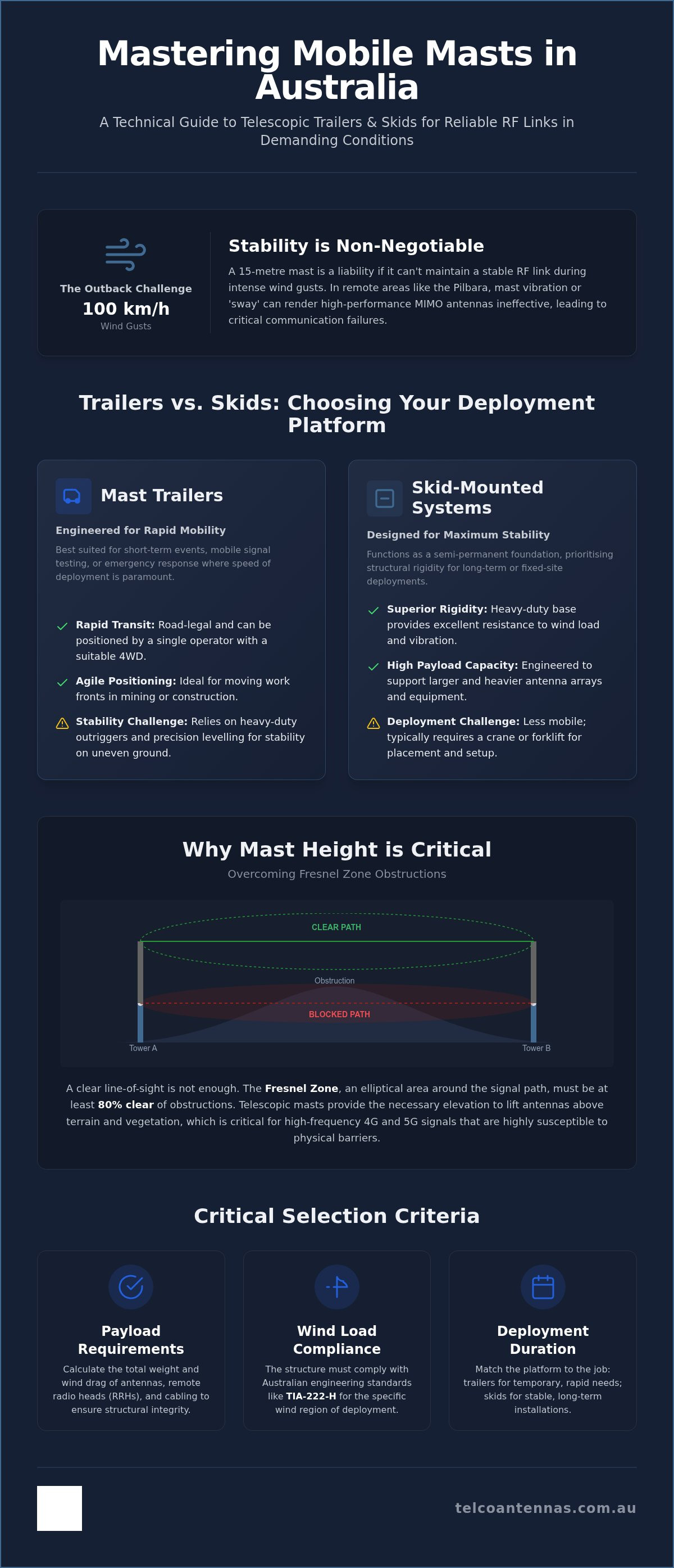
A 15-metre mast is essentially a liability if it cannot maintain a stable RF link during a 100 km/h wind gust in the Pilbara. For RF engineers and site managers, the challenge isn't just reaching the required height; it's ensuring the structure remains rigid enough to prevent signal oscillation in the face of relentless environmental variables. You likely understand the frustration of transporting heavy equipment to remote black spots only to find that mast vibration or poor grounding renders your high-performance MIMO antennas ineffective. This technical guide provides the expertise needed to master the selection and deployment of telescopic mast trailers and skids, ensuring your mobile infrastructure withstands the most demanding Australian conditions.
By focusing on the mechanical requirements for stability and compliance with standards like TIA-222-H, we'll help you achieve a reliable RF link with minimal on-site personnel. We will analyse the critical trade-offs between galvanised trailer-based mobility and the heavy-duty stability of skid-mounted systems. You will learn how to integrate hardware such as Cel-Fi GO boosters and Starlink power conversions into a cohesive, rapid-deployment solution that meets rigorous Australian safety and wind load specifications. This methodical overview moves from foundational structural requirements to specific hardware applications for the outback.
Key Takeaways
- Differentiate between the rapid mobility of mast trailers and the long-term stability of skid-mounted systems to match your specific deployment duration and terrain.
- Calculate precise payload requirements by accounting for the drag and weight of antennas, remote radio heads, and cabling to maintain structural integrity under Australian wind conditions.
- Learn the technical methods for deploying telescopic mast trailers and skids that mitigate mast sway and prevent signal fluttering in high-wind environments.
- Optimise your RF link performance by implementing cable management strategies that reduce signal attenuation and mechanical strain on LMR-400 coaxial lines.
- Streamline your site setup by integrating specialised hardware like Cel-Fi GO signal boosters for immediate, robust coverage in the most demanding remote locations.
The Role of Telescopic Mast Trailers and Skids in Modern RF Infrastructure
Rapid deployment infrastructure refers to the hardware and engineering protocols used to establish telecommunications or surveillance links in locations where permanent towers are absent or non-functional. These solutions bridge the critical gap between a total lack of connectivity and the long-term construction of fixed assets. In Australia, this often involves the use of Mobile cell sites to provide immediate coverage for mining operations, construction projects, or emergency services. The core of this system relies on telescopic mast trailers and skids, which provide the structural elevation required for antennas to function at peak efficiency.
A standard setup consists of three primary elements: the telescopic mast, the mounting platform, and the payload. The mast itself is typically a pneumatic or mechanical assembly that extends to a specific height. The mount, whether a road-legal trailer or a heavy-duty skid, ensures the mast remains vertical and stable under load. Finally, the payload includes the active RF equipment, such as MIMO antennas, remote radio heads, and the necessary cabling to interface with the base station.
Applications for Rapid Deployment Masts
In the resources sector, operational efficiency depends on reliable data links for autonomous machinery and site-wide safety communications. Establishing temporary cellular masts allows crews to maintain connectivity as the work front moves across a lease. These systems are also vital for deploying point-to-point wireless bridges, which enable high-capacity data transfer between remote site offices without the need for expensive fibre optic trenching. During disaster recovery or bushfire response, these masts serve as emergency hubs, restoring vital communication lines when local infrastructure is compromised.
Why Height Matters: Overcoming Fresnel Zone Obstructions
Signal integrity in the Australian outback is frequently compromised by topographical barriers and dense scrub. Achieving a clear line-of-sight (LoS) involves more than just a visible path between two points; it requires clearing the Fresnel zone. This is an elliptical area around the signal path that must remain largely unobstructed to prevent phase cancellation and signal loss. Telescopic mast trailers and skids provide the necessary elevation to lift antennas above local vegetation and terrain features. This height is particularly critical for high-frequency 4G and 5G signals. These bands suffer from higher attenuation and are far more susceptible to physical obstructions than lower-frequency transmissions. If the first Fresnel zone is more than 20% obstructed, the resulting signal degradation can render a high-speed link unusable.
Engineering Differences: Mast Trailers vs. Skid-Mounted Systems
The selection between telescopic mast trailers and skids is rarely about preference; it's a calculated response to deployment duration and the specific environmental stressors of the site. While both systems aim to provide elevation, their mechanical footprints dictate how they perform under load. A trailer is an agile asset designed for transit, whereas a skid functions as a semi-permanent foundation that prioritises structural rigidity.
Trailer-Mounted Versatility
Trailer-mounted masts are engineered for rapid transit and immediate deployment. Featuring integrated axles, braking systems, and standard tow hitches, these units are road-legal and can be positioned by a single operator with a suitable 4WD. The primary engineering challenge for trailers is maintaining mast verticality on the irregular, often reactive soils found in the Australian outback. To counter this, professional trailers utilise heavy-duty outriggers and precision levelling jacks. These components are vital; a mast that is only two degrees off-vertical can significantly misalign a narrow-beam point-to-point link. These units are best suited for short-term events, mobile signal testing, or emergency response where site changes occur frequently.
Skid-Mounted Stability and Security
Skid-mounted systems are the standard for semi-permanent remote installations, such as mine site communication hubs or long-term construction monitoring. Unlike trailers, skids lack wheels and are transported via hiab trucks or crane-loaded onto flatbeds. This lack of mobility is a deliberate engineering choice. By sitting flush on the ground or a prepared pad, the skid provides a much wider and more stable centre of gravity. This translates to superior resistance against wind-induced sway, a common cause of signal fluttering in high-capacity microwave links. If you're planning a long-term deployment, seeking professional communication tower design services can help determine if a skid-mounted solution is necessary for your specific wind region.
Security is another differentiator. RF assets are high-value targets in remote areas. A trailer, by its nature, is susceptible to unauthorised relocation if not heavily secured. Skids, however, require specialised lifting equipment to move, providing a natural layer of physical security. Additionally, the flat-base design of a skid allows for the integration of larger equipment enclosures. These can house more robust power systems, including large battery banks and Starlink power conversion hardware, without compromising the unit's balance or transport footprint. This makes the skid an ideal platform for sites where a permanent tower isn't feasible but high reliability is non-negotiable.
Critical Selection Criteria for Temporary Communication Towers
Selecting the correct hardware for a remote site requires a deep understanding of the mechanical forces at play. The total payload is not merely the weight of the antenna; it is the cumulative sum of the Remote Radio Heads (RRHs), mounting brackets, and the vertical weight of the cabling. For instance, a 20-metre run of heavy-duty coaxial cable adds significant mass and increases the surface area exposed to the wind. Material science also plays a decisive role in longevity. Galvanised steel is the industry standard for structural rigidity and long-term corrosion resistance in harsh Australian environments. Conversely, high-grade aluminium is often utilised to reduce the overall tare weight of the unit, which is a vital consideration if the towing vehicle has a limited capacity.
Payload Capacity and Wind Load Ratings
Every component mounted to the top of a mast increases its Effective Projected Area (EPA). This surface area determines the drag force exerted on the structure during high-wind events. In Australia, professional deployments must account for AS1170.2, the standard for wind actions, which provides the framework for ensuring a structure can withstand the gust speeds of its specific wind region. If you are deploying high-gain MIMO antennas, the mast must possess enough torsional rigidity to resist twisting. Even a minor rotation can cause a narrow-beam signal to misalign, leading to immediate packet loss or link failure. Ensuring the mast diameter is correctly matched to the EPA of the payload is the only way to maintain a stable RF link.
Mast Actuation and Deployment Speed
The mechanism used to extend the mast sections impacts both the safety of the site and the speed of the installation. Manual hand-crank winches are highly valued for their simplicity and reliability in remote areas where auxiliary power might be unavailable. While dependable, they require more physical effort for masts exceeding 10 metres. Pneumatic masts utilise compressed air to lift the sections, offering a high degree of precision and the ability to handle heavier top-loads with minimal manual intervention. These are often the preferred choice for rapid-response scenarios. Electric winch systems provide an automated alternative, allowing for frequent height adjustments via a simple interface. When evaluating telescopic mast trailers and skids, you must choose an actuation method that aligns with the technical skill and physical capabilities of your on-site personnel.
Deployment Best Practices: Ensuring Signal Integrity and Site Safety
Deploying telescopic mast trailers and skids successfully requires more than just mechanical extension. It involves a precise calibration of environmental factors to protect the sensitive electronics at the mast head. One of the most overlooked issues in temporary deployments is "signal fluttering," a phenomenon where mechanical vibration or mast sway causes rapid fluctuations in signal strength. For high-frequency microwave links, even a few millimetres of movement can disrupt the phase of the signal, leading to significant packet loss and reduced data throughput. Ensuring the mast is perfectly vertical and the outriggers are correctly tensioned is the first step in mitigating these oscillations.
Cable management is equally critical to the long-term health of the site. Using high-quality LMR-400 coaxial cables is essential for reducing signal attenuation over long vertical runs, as these cables offer a much lower loss profile than standard RG-series alternatives. However, if these cables aren't secured properly, wind-induced oscillation can cause mechanical fatigue at the connector interface. It's vital to ensure cables are strain-relieved and attached to the mast sections using UV-stabilised ties or specialised clips. This prevents the cumulative weight of the cable from pulling on the antenna ports, which can lead to water ingress or physical port failure.
Optimising the RF Environment
Before raising the mast, conducting RF site surveys ensures the selected height clears all topographical obstructions while identifying potential sources of local interference. If you're mounting multiple antennas on a single platform, you must maintain adequate vertical and horizontal separation to prevent co-site interference. This is particularly important when combining high-power boosters with sensitive receiving antennas. For expert assistance in planning your remote deployment and selecting the right hardware, consult with the technical team at Telco Antennas today.
Structural Safety and Maintenance
Grounding is a non-negotiable safety requirement for remote Australian installations. Temporary masts act as lightning rods in flat terrain, so you must install a dedicated earth stake and bonding system to protect your equipment from surge damage. Maintaining telescopic mast trailers and skids involves routine inspections of guy-wire tension and checking for wear on the mast sections. If wind speeds approach the structure's rated limit, clear protocols must be in place for immediate mast retraction to prevent catastrophic failure. Professional communication tower design principles should always inform these temporary setups to ensure they meet the same safety rigour as permanent assets, even in short-term applications.
Professional RF Infrastructure Solutions from Telco Antennas
Telco Antennas operates as a consultative partner, bridging the gap between high-level engineering and field-ready hardware. Our telescopic mast trailers and skids aren't generic imports; they're custom-engineered to withstand the mechanical stress of corrugated roads and the thermal expansion caused by extreme Australian temperatures. By focusing on the intersection of structural integrity and RF performance, we ensure that every deployment provides a stable platform for critical communications. We understand that in the outback, a equipment failure isn't just an inconvenience; it's a significant operational risk that can halt production or compromise safety.
A major advantage of our infrastructure is the seamless integration with existing active equipment. For sites requiring immediate mobile coverage, our masts are frequently paired with Cel-Fi GO signal boosters. This combination allows for a rapid "site-in-a-box" deployment where the mast provides the necessary height for the donor antenna while the booster stabilises the link for local users. This hardware synergy reduces the complexity of the installation and ensures that the system is operational within hours of arriving on-site. We provide the technical expertise to ensure that antenna separation and gain are optimised to prevent oscillation and maximise throughput.
End-to-End Infrastructure Engineering
Our engineering process begins long before the hardware leaves the warehouse. We provide comprehensive RF site surveys to determine the exact elevation and payload requirements for your specific topography. For long-term telemetry or remote monitoring projects, our custom skid designs offer a low-maintenance, high-security alternative to traditional towers. We also specialise in high-performance mounting solutions for Starlink accessories, ensuring that satellite terminals are positioned to avoid local obstructions while remaining protected from the elements. This end-to-end approach ensures that the mast, the mount, and the payload function as a single, cohesive unit.
Why Partner with Telco Antennas?
Choosing the right partner for remote infrastructure is about mitigating risk through experience. We have a proven track record supporting large-scale industrial projects across the mining, agricultural, and government sectors. Every component we supply is selected for its ability to survive high-UV environments and abrasive dust conditions. Our clients benefit from direct access to qualified RF engineers who understand the nuances of link budgets and antenna gain. This technical depth ensures that your telescopic mast trailers and skids aren't just structural assets, but high-performing components of a robust communication network. Whether you're managing a single remote site or a national infrastructure rollout, we provide the industrial-grade support and national supply chain necessary for success in the most demanding environments.
Advancing Your Remote RF Infrastructure
Establishing a high-performance communication link in the Australian outback requires more than just elevation; it demands a structural foundation that can withstand extreme environmental stressors. Whether your project requires the rapid mobility of a trailer or the semi-permanent stability of a skid-mounted system, the decision must be informed by precise payload calculations and wind load compliance. By prioritising mechanical rigidity and professional cable management, you mitigate the risks of signal fluttering and hardware fatigue that often plague temporary sites.
The successful integration of telescopic mast trailers and skids into your RF strategy ensures that your remote operations remain connected, even in the most isolated black spots. Telco Antennas provides the engineering-led design and specialised, high-reliability RF hardware required to meet these technical challenges. With national Australian support, we ensure your infrastructure is built for the specific rigours of the local landscape. Our team is ready to assist you in selecting a configuration that balances transport logistics with long-term site stability.
Contact our RF engineering team for a custom mast trailer or skid quote to begin planning your next rapid deployment project with confidence.
Frequently Asked Questions
What is the difference between a telescopic mast trailer and a skid-mounted mast?
The primary difference lies in the method of transit and the base stability. A trailer is an agile, road-legal asset equipped with wheels and a tow hitch for rapid site changes. In contrast, a skid is a flat-base platform designed to sit flush on the ground, requiring a crane or hiab for transport. While trailers offer speed, telescopic mast trailers and skids on flat bases provide a wider centre of gravity for better wind resistance.
How high can a portable telescopic mast safely go in Australia?
Most portable masts reach heights between 10 and 20 metres, but the safe limit is dictated by the payload's wind load and the site's wind region. In Australia, structural integrity must align with AS1170.2 standards. A mast extended to its maximum height becomes significantly more vulnerable to lateral forces. You must ensure the retraction protocols are followed if local wind speeds exceed the manufacturer’s rated safety threshold for your specific antenna configuration.
Do I need a special licence to tow a telescopic mast trailer?
In most Australian jurisdictions, a standard C-class driver's licence is sufficient for towing these units, provided the Aggregate Trailer Mass (ATM) does not exceed 3,500kg. It is essential to verify that your vehicle’s rated towing capacity and the Gross Combination Mass (GCM) can accommodate the trailer's weight. If the trailer is equipped with electric brakes, your towing vehicle must have a compatible brake controller installed to remain road-legal and safe during transit.
Can these masts support Starlink dishes for remote internet?
These platforms are highly effective for Starlink deployments, particularly when clearing local vegetation or topographical barriers that cause signal obstructions. By using a mast, you ensure a wide field of view for the satellite terminal, which is critical for maintaining high-speed data throughput. We often integrate these setups with Starlink after market power conversion kits to allow the dish to run directly off DC battery systems found on remote skids.
How do I calculate the wind load for my antenna payload?
Wind load calculation involves determining the total Effective Projected Area (EPA) of all antennas, Remote Radio Heads, and cabling. This figure is then multiplied by the design wind speed for your specific geographic wind region as defined by AS1170.2. It is a common mistake to ignore the drag produced by thick coaxial cables. A professional engineering assessment ensures the mast's torsional rigidity can resist the twisting forces generated by these payloads during high-wind events.
What maintenance is required for a pneumatic telescopic mast?
Pneumatic masts require a strict maintenance schedule to ensure the internal seals remain airtight and the sections extend smoothly. This includes lubricating the mast sections with specified oils and regularly draining moisture from the air compressor’s tank to prevent internal corrosion. You should also inspect the mast for abrasive dust or grit accumulation after deployment in desert environments. Failing to keep the sections clean can lead to scoring on the aluminium tubes and eventual air leaks.
Are these trailers suitable for off-road use in remote areas?
Standard trailers are often restricted to sealed roads, but our telescopic mast trailers and skids are engineered with off-road suspension and reinforced chassis for remote work. These units feature high-clearance axles and heavy-duty tyres to withstand the constant vibration and mechanical stress of corrugated outback tracks. When selecting a trailer for remote mining or agricultural sites, ensuring the frame is hot-dip galvanised is vital for resisting the abrasive and corrosive nature of Australian soils.
How do I ensure my temporary mast is properly grounded?
Proper grounding involves installing a copper-clad earth stake at least 1.5 metres into the soil and bonding it to the mast frame with high-conductivity wire. This is essential for dissipating static buildup and protecting sensitive RF equipment from lightning strikes. In the dry, high-resistivity soils often found in remote areas, you may need to use multiple earth stakes or soil conductivity enhancers to ensure the grounding system meets safety standards and protects your active hardware.


