

Why does your smartphone, a pinnacle of 2026 engineering, still struggle to maintain a basic voice call the moment you step inside your lounge room? Learning how to boost 4g signal at home australia isn't just about moving closer to a window. It requires a pragmatic understanding of the physics behind RF interference and the structural attenuation that prevents external signals from penetrating modern building materials.
It's frustrating when critical work calls drop out or data speeds crawl because your home acts as a literal shield against cellular frequencies. You've likely felt the anxiety of navigating conflicting advice regarding the legality of various signal repeaters in the Australian market. This guide provides the technical clarity you need to achieve consistent five-bar reception through ACMA-compliant hardware. We'll examine the engineering logic of capturing high-quality external signals with MIMO antennas, transporting that energy via low-loss LMR-400 cabling, and repeating it safely using Cel-Fi GO technology. This methodical approach ensures your indoor 4G and 5G connectivity becomes a reliable, set-and-forget asset for both professional and domestic use.
Key Takeaways
- Identify the specific structural materials in Australian homes, such as Colorbond roofing and foil-backed insulation, that create an "indoor coverage gap" by blocking external RF frequencies.
- Master the technical process of how to boost 4g signal at home australia by conducting a precise RF site survey to locate the highest quality external donor signal.
- Differentiate between passive MIMO antenna arrays for data-only needs and active Cel-Fi GO repeaters to ensure your hardware choice matches your specific voice and data requirements.
- Ensure long-term network stability and legal compliance by selecting only ACMA-approved hardware and professional-grade LMR-400 cabling to prevent signal loss.
- Understand the engineering advantages of high-gain Yagi and wideband LPDA antennas when customising a solution for regional or obstructed environments in 2026.
Understanding the Root Causes of Poor 4G and 5G Reception in Australian Homes
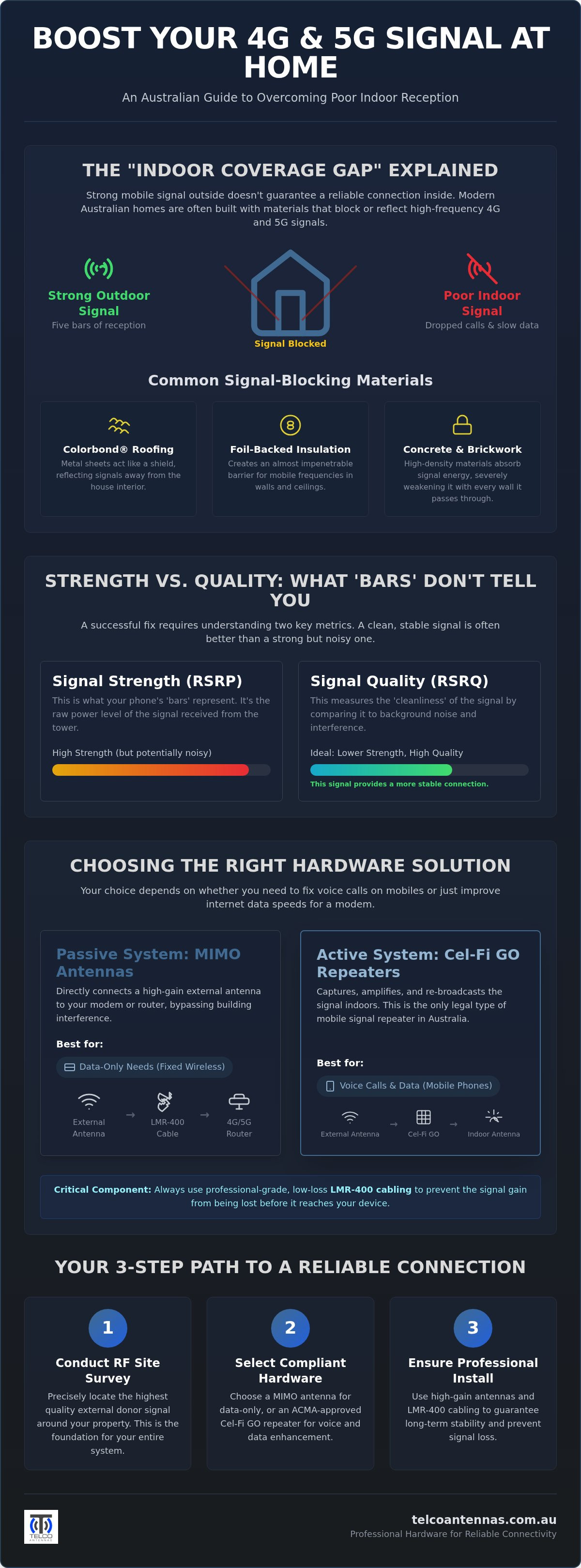
The "Indoor Coverage Gap" occurs when high-frequency radio waves, which travel efficiently through open air, encounter physical obstacles that attenuate or reflect their energy. In 2026, this issue has become more pronounced because the 3G network shutdown has forced all mobile traffic onto 4G and 5G bands. These higher frequencies offer greater data capacity but possess shorter wavelengths, which are inherently less capable of penetrating solid objects compared to the legacy 3G frequencies that previously provided a fallback for indoor voice calls.
Homeowners often begin their search for how to boost 4g signal at home australia after discovering that their five-bar outdoor reception disappears the moment they step through the front door. Distance from the nearest carrier tower, whether operated by Telstra, Optus, or Vodafone, is a fundamental factor; however, the physical composition of your home is frequently the primary culprit for a total loss of connectivity.
Australian construction heavily utilises materials that are particularly hostile to RF propagation:
- Colorbond roofing: These large sheets of metallic material act as a grounded shield, reflecting signal away from the interior.
- Foil-backed insulation: Commonly found in walls and roof cavities, these radiant barriers create a secondary layer that is almost impenetrable to mobile frequencies.
- Concrete and brickwork: High-density materials absorb RF energy, significantly weakening the signal as it passes through multiple walls.
The Role of Building Materials in Signal Attenuation
Metal roofing often creates a Faraday cage effect, where the conductive material distributes the electromagnetic charge around the exterior of the structure rather than allowing it to pass through. Modern energy-efficient glazing is another significant barrier; many high-performance windows contain microscopic metallic films designed to reflect heat, which inadvertently reflect mobile signals as well. Beyond the house itself, local terrain such as hills or dense stands of native bush can create signal shadows, preventing a direct line-of-sight to the tower and forcing your device to rely on weak, reflected signals.
Signal Strength vs. Signal Quality
Understanding the difference between signal quantity and signal quality is vital for a successful installation. Reference Signal Received Power (RSRP) is what most users recognise as the "bars" on their handset, representing the absolute power level of the signal. Reference Signal Received Quality (RSRQ), however, measures the cleanliness of that signal relative to background noise and interference. A weak but clean signal often provides a more stable data connection than a strong signal riddled with interference. Receive Signal Level (RSL) is the baseline metric for any enhancement, representing the total power received by the antenna system before any amplification or processing occurs.
High-Gain Antennas vs. Mobile Signal Boosters: Choosing the Right Hardware
Determining how to boost 4g signal at home australia requires a precise match between your hardware and your specific connectivity goals. The two primary categories of hardware are passive antenna systems and active amplification systems. Passive systems rely solely on the physical properties of high-gain antennas to capture and direct signal into a modem or router. Active systems, conversely, use electronic components to amplify the incoming signal before rebroadcasting it throughout the interior of the building.
If your primary requirement is stabilising a fixed wireless internet connection, a simple external MIMO antenna connected directly to your 4G or 5G router is often sufficient. This bypasses the structural interference of your walls and roof. However, if you need to resolve dropped voice calls on your mobile handset, an active signal booster is necessary. Regardless of the chosen path, the integrity of the signal depends heavily on the coaxial cable used to connect your components. Standard thin cables often lose the very gain provided by the antenna over just a few metres. Professional installations prioritise low-loss LMR-400 cabling to ensure that the maximum amount of captured RF energy reaches your device.
The Power of MIMO Antennas for Data
Multiple-Input Multiple-Output (MIMO) technology is the standard for modern high-speed data. By using multiple antennas to transmit and receive data streams simultaneously, MIMO can effectively double your throughput in ideal conditions. You can explore the mechanics of this in our MIMO Antennas: A Technical Guide. Visually, these systems utilise either directional antennas, such as Yagi models that must be pointed precisely at a tower, or omnidirectional antennas that capture signals from a 360-degree radius. Directional antennas are generally preferred for regional areas where distance is the primary challenge.
Active Amplification with Signal Boosters
Mobile signal boosters, or repeaters, function as a bridge between the external network and your indoor space. The system uses a donor antenna mounted on the roof to capture the carrier signal, which is then passed to the booster unit for amplification. This strengthened signal is then distributed via an internal service antenna. In the Australian market, the Cel-Fi GO is the recognised industry standard for residential applications due to its intelligent echo cancellation and network protection features. If you are unsure which configuration suits your property's topography, it is wise to review professional RF site survey options to prevent hardware mismatches.
How Unapproved Boosters Damage the Network
Unapproved boosters often suffer from a phenomenon known as "oscillation," which is a destructive feedback loop between the internal and external antennas. When this occurs, the booster emits high-power noise that can effectively "blind" a local mobile tower, causing dropped calls and slow data for every user in the vicinity. ACMA-approved repeaters are devices that "handshake" with the network, meaning they constantly communicate with the carrier's tower to adjust power levels and shut down immediately if interference is detected. This safeguard protects the broader community while providing you with a stable, high-quality indoor signal.
Identifying a Legal Australian Repeater
Confirming the legality of your hardware is a straightforward process if you know what to look for. Every legal device must display the Regulatory Compliance Mark (RCM) on its housing, which indicates it has passed rigorous Australian safety and technical standards. Additionally, the hardware must be locked to a specific carrier; a device that claims to boost all Australian networks simultaneously is a red flag for illegality. You can find more detail on these requirements in our Cel-Fi GO Signal Boosters: A Professional Guide. Ensuring your setup is compliant from the outset avoids the risk of government intervention and guarantees that your signal enhancement won't be shut down by carrier interference monitors.
A Step-by-Step Strategy to Organise Your Home Signal Enhancement
Implementing a reliable signal solution requires moving beyond guesswork. When addressing how to boost 4g signal at home australia, the first priority is establishing a quantitative baseline of the existing RF environment. This involves more than just observing the bars on your handset; it requires a systematic evaluation of the available signal power at the highest accessible point of your property. By following a structured "Capture, Transport, Repeat" workflow, you can ensure that the hardware you install performs to its maximum theoretical specification.
Conducting a DIY Site Survey
Before purchasing hardware, you must identify the location of the strongest and cleanest donor signal. Most smartphones have a hidden "Field Test Mode" that reveals the actual decibel-milliwatts (dBm) your device is receiving. On an iPhone, you can access this by dialling *3001#12345#* into the keypad. Android users can typically find this under "SIM Status" within the settings menu. You are looking for the RSRP (Reference Signal Received Power) value. A reading of -60dBm to -80dBm indicates an excellent signal, while anything below -110dBm suggests a near-total blackspot. It's critical to test multiple corners of your roof and at varying heights, as even a two-metre shift in position can significantly alter signal quality due to local obstructions or multipath interference.
Hardware Installation and Cable Management
Once the optimal donor location is identified, the physical installation must prioritise signal integrity. The external antenna should be mounted securely, often using aluminium tri-pods or existing masts to achieve a clear line-of-sight to the carrier tower. The connection between the antenna and the booster is a common point of failure. Using high-quality, low-loss LMR-400 coaxial cabling is essential; standard RG-58 or thin consumer cables can lose up to half of your captured signal strength over a 10-metre run.
A successful installation also relies on the "Antenna Isolation" rule. This is the physical or structural separation between the external donor antenna and the internal service antenna. If these antennas are too close, they can create a feedback loop similar to a microphone held near a speaker. This causes the booster to automatically reduce its power to protect the network, resulting in poor indoor coverage. Ensure there is significant vertical or horizontal distance, or a substantial physical barrier like a metal roof, between the two components to maintain maximum amplification.
If your site survey reveals complex interference or extremely low RSL, you should book a professional RF site survey to ensure your hardware configuration is technically sound before proceeding with a permanent installation.
Professional Hardware Solutions: Moving Beyond Consumer-Grade Fixes
When evaluating how to boost 4g signal at home australia, the distinction between consumer-grade retail kits and engineering-grade hardware is significant. A professional approach to how to boost 4g signal at home australia ensures that every component, from the antenna to the connector, is matched to the specific impedance and frequency requirements of the site.
Customising your hardware configuration is essential for overcoming unique topographical challenges. For example, a high-gain Yagi antenna is the preferred tool for long-distance, point-to-point links where you have a clear line-of-sight to a single carrier tower. Its narrow beamwidth allows for maximum gain over extreme distances. Conversely, a wideband LPDA (Log-Periodic Dipole Array) antenna is more effective in environments where you need to capture multiple 4G and 5G frequency bands or where the signal is reflected off nearby terrain. Choosing the wrong antenna type can result in poor signal quality (RSRQ) despite having a strong power level (RSRP).
In 2026, many regional properties utilise hybrid connectivity models. While Starlink has become a primary data source for many, it does not solve the problem of mobile voice coverage or SMS reliability inside the home. Integrating a Cel-Fi GO repeater alongside your satellite hardware provides a complete communications suite, ensuring that your mobile handsets remain functional even when the primary data link is dedicated to high-bandwidth tasks like remote work or streaming. To ensure your home workspace is just as efficient as your connection, check out Mega Office Supplies for a comprehensive range of professional stationery and office essentials.
Our technical philosophy centres on the elimination of signal bottlenecks. We treat LMR-400 coaxial cabling as a non-negotiable standard for professional installs because its low-loss properties are vital for preserving the decibel gains achieved by high-quality antennas. For extremely remote sites or temporary projects, we provide telescopic mast trailers and aluminium tri-pods to achieve the necessary height for signal clearance. If you are managing a complex remote setup, you may find our guide on the Best Starlink Accessories Australia useful for understanding how to integrate diverse communication technologies.
Final Checklist for a Blackspot-Free Home
Achieving a reliable signal requires adherence to the "Capture, Transport, Repeat" methodology. This involves capturing the cleanest possible donor signal, transporting it through low-loss cabling, and repeating it legally using ACMA-compliant hardware. Once your system is installed, it's important to perform occasional firmware updates via the Cel-Fi WAVE app to ensure your smart repeater is optimised for the latest carrier network configurations. If your property presents complex RF challenges that DIY methods cannot resolve, consult with our master technicians for a custom hardware recommendation to ensure your investment delivers a permanent solution.
Stabilising Your Long-Term Home Connectivity
Eliminating mobile blackspots within your property is an engineering challenge that requires more than a generic retail fix. By applying the "Capture, Transport, Repeat" methodology, you can effectively bypass structural interference like Colorbond roofing and foil insulation. Ensuring your hardware is ACMA-compliant and connected via high-performance LMR-400 cabling is the only way to achieve a stable, five-bar signal that supports both voice and high-speed data. Understanding how to boost 4g signal at home australia in 2026 means prioritising signal quality over mere amplification to avoid network interference and legal complications.
Success in regional or obstructed environments depends on selecting the correct hardware for your specific topography. Our professional kits include high-performance LMR-400 cabling and ACMA-compliant repeaters, supported by Australian-based technical support to help you navigate complex RF specifications with confidence. If you are ready to eliminate dropped calls and slow data for good, Browse Professional 4G and 5G Signal Boosters at Telco Antennas. You don't have to tolerate poor reception; a reliable, set-and-forget solution is well within reach.
Frequently Asked Questions
Is it legal to use a mobile signal booster at home in Australia?
Yes, provided the device is ACMA-approved. In Australia, unapproved boosters are illegal and can cause severe network interference. The Cel-Fi GO is the primary consumer-legal repeater because it is network-protection compliant. Using unapproved hardware can lead to significant fines from the ACMA. Always look for the Regulatory Compliance Mark (RCM) to ensure your equipment meets Australian standards for residential use. This ensures your installation won't be shut down by carrier interference monitors.
Will a 4G booster also improve my 5G signal at home?
This depends entirely on the hardware's frequency support. While legacy 4G-only boosters won't assist with 5G bands, modern smart repeaters like the Cel-Fi GO are designed to support multiple 4G and 5G frequencies. If you're looking for how to boost 4g signal at home australia while future-proofing for 5G, you must ensure your antenna and booster are wideband-compatible. This allows the system to capture and repeat the specific NR bands used by your carrier.
What is the difference between a Yagi antenna and an omnidirectional antenna?
The primary difference lies in the radiation pattern and gain. A Yagi antenna is highly directional; it focuses its energy in a narrow beam and must be pointed directly at a carrier tower to be effective. This makes it ideal for regional areas with long distances. An omnidirectional antenna captures signals from all directions (360 degrees). It is better suited for urban environments where signals might reflect off buildings or where you need to capture signal from multiple towers.
Can I install a Cel-Fi GO mobile signal booster myself?
Yes, the Cel-Fi GO is designed for stationary residential installation by homeowners. However, achieving optimal performance requires a methodical approach to antenna placement and isolation. You'll need to mount the donor antenna on your roof and run cabling to the internal unit. If your property has complex terrain or significant structural interference, engaging a professional for an RF site survey ensures the hardware is configured correctly to eliminate blackspots without causing feedback loops or oscillation.
Why does my signal get worse when I use a long coaxial cable?
Signal degradation occurs due to attenuation, which is the loss of RF energy as it travels through a conductor. Every metre of cable introduces a specific amount of decibel loss. Thin, consumer-grade cables have high attenuation rates, which can completely negate the gains provided by your antenna. This is why professional installations utilise low-loss LMR-400 coaxial cabling. It features superior shielding and a thicker core to preserve signal integrity over longer distances between the roof and the booster.
Do I need a different booster for Telstra, Optus, and Vodafone?
Yes, legal repeaters in Australia are carrier-specific to prevent network interference. While a single Cel-Fi GO unit can be switched between carriers using the WAVE app, it can only boost one network at a time. This is a mandatory ACMA requirement for consumer-installed devices. If your household uses different providers, you would need multiple units or a carrier-specific hardware configuration to ensure everyone receives a stable, high-performance signal throughout the home without compromising the local network.
How much signal do I need outside for a booster to work inside?
A booster requires a usable donor signal to function, typically a minimum RSRP of -110dBm at the mounting point. If you have no signal on your roof, the booster has nothing to amplify. The system's effectiveness is directly proportional to the quality of the external signal it captures. A cleaner outdoor signal results in a larger indoor coverage footprint. Performing a site survey with your phone's field test mode helps confirm if there is sufficient signal.
Can a signal booster help with slow NBN or fixed wireless internet?
A mobile signal booster is designed for cellular handsets and won't directly improve NBN or fixed wireless services. However, if you use a 4G or 5G modem for your home internet, adding an external MIMO antenna can significantly increase data throughput. While Telco Antennas doesn't provide consumer ISP plans, we supply the professional RF hardware required to stabilise the cellular link that your modem relies on. This reduces latency and improves speeds for remote work.


