

A high dBi rating on a specification sheet is not a measure of raw power, but rather a strategic narrowing of a signal's focus. For many professionals operating in regional Australia, the frustration of constant call dropouts and sluggish data persists despite investing in hardware that promises the world. You've likely realised that simply purchasing the largest high gain antenna for mobile reception doesn't automatically solve connectivity issues if the underlying RF principles are ignored. We recognise that confusion over marketing claims often leads to expensive, underperforming setups that fail when you need them most.
In this guide, we'll move beyond the retail jargon to help you master the technical mechanics required to eliminate mobile black spots and maximise data throughput. You'll learn how to distinguish between theoretical gain and real-world performance, ensuring your remote work or business operations remain stable and productive. We will examine the critical role of low-loss LMR-400 cabling, the necessity of MIMO configurations for 5G, and how to integrate these components into a reliable, carrier-approved system using Cel-Fi GO technology.
Key Takeaways
- Understand how high gain antennas redirect energy without adding raw power, using the 'balloon analogy' to visualise signal extension into remote areas.
- Identify whether a directional or omnidirectional high gain antenna for mobile reception is required based on whether your application is stationary or mobile.
- Learn to evaluate dBi ratings in the context of your local terrain to avoid choosing a beam width that is too narrow for your specific environment.
- Recognise the technical necessity of LMR-400 low-loss cabling to ensure the signal captured by your antenna actually reaches your hardware without significant attenuation.
- Master the integration of donor antennas with Cel-Fi GO systems to create a compliant and robust signal solution for regional black spots.
What is a High Gain Antenna and Why is it Essential for Australian Reception?
To understand What is a High Gain Antenna, one must first recognise it as a passive RF component. Unlike electronic devices that require a power source, an antenna does not generate new energy. Instead, it is designed to focus existing radio frequency energy into a specific direction or pattern. In the context of regional connectivity, a high gain antenna for mobile reception acts as a precision tool that gathers weak signals from a distant base station and directs them toward your modem or booster with greater efficiency than a standard internal antenna.
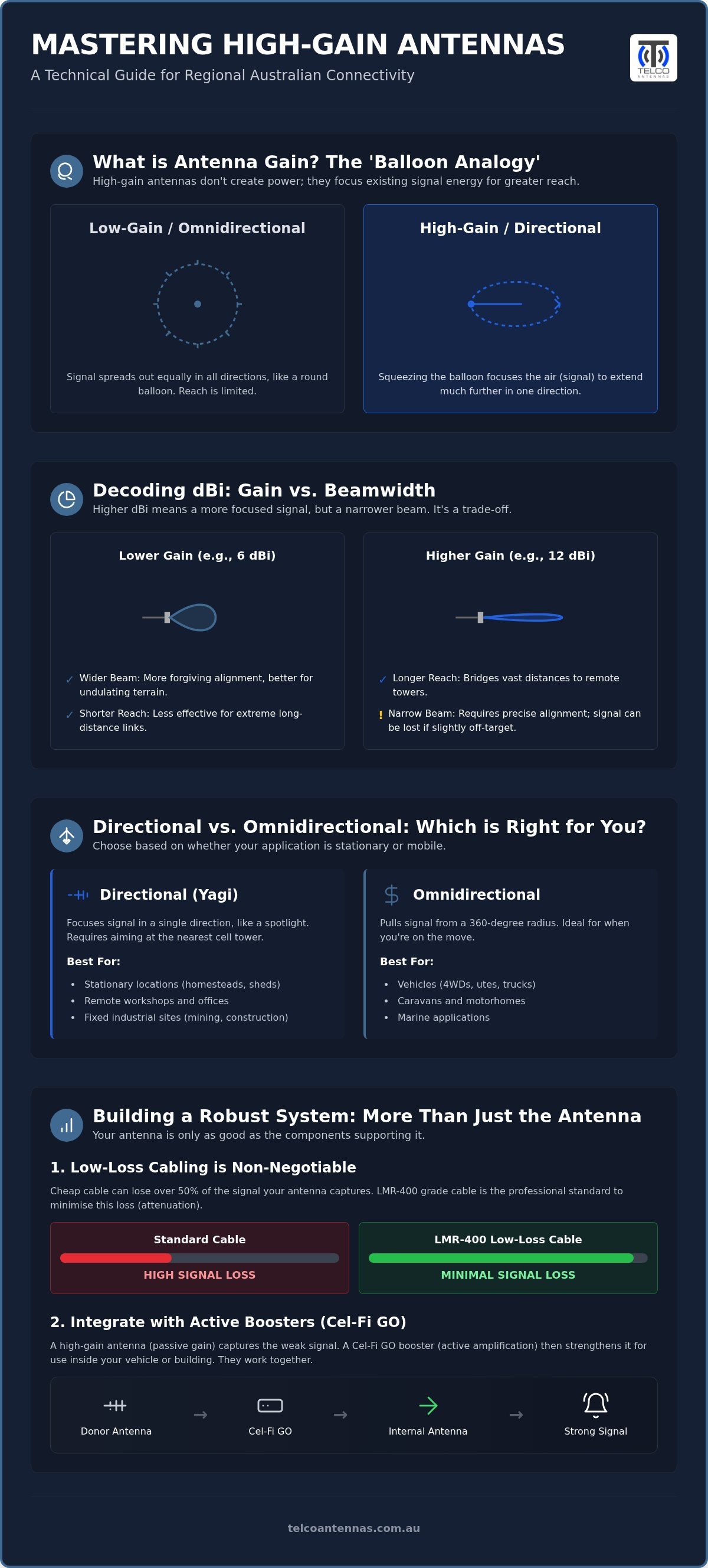
A useful way to visualise this is the 'balloon analogy'. Imagine a round, air-filled balloon representing the signal from an omnidirectional antenna, which spreads energy equally in all directions. If you squeeze that balloon, it flattens and extends further in one direction. You haven't added more air, but you've changed the shape to reach a more distant point. This is exactly how high gain works; it 'squeezes' the signal pattern to increase its reach, allowing it to bridge the gap between your location and a tower that might be dozens of kilometres away.
The standard internal antennas found in mobile phones or basic plug-and-play modems are designed for urban environments where towers are dense. These antennas are low gain and omnidirectional, meaning they waste energy looking for signals in every direction. In the Australian bush, where path loss is the primary enemy of connectivity, these small components simply cannot capture enough signal to maintain a stable link. A high gain antenna is essential because it overcomes this path loss by providing a larger 'capture area' and a focused beam that ignores interference from other directions.
Passive Gain vs. Active Amplification
It's vital to distinguish between the passive gain of an antenna and the active amplification provided by a signal booster. An antenna redistributes signal based on its physical geometry. There is always a trade-off: as the gain increases, the beamwidth narrows. A very high gain antenna requires precise alignment because its 'vision' is extremely focused. This is fundamentally different from an active system like the Cel-Fi GO, which uses internal circuitry to electronically boost the signal strength once it has been captured by the antenna.
Common Use Cases in the Australian Landscape
The application of a high gain antenna for mobile reception depends entirely on your environment. For fixed-site installations, such as regional homesteads or remote workshops, high-precision directional Yagi antennas are the standard. Mobile users, including those in 4WDs or caravans, typically opt for high gain omnidirectional bullbar mounts that can handle the changing orientation of a vehicle while still providing better reach than a factory-standard setup. In industrial sectors, we often see these antennas deployed on telescopic mast trailers to provide temporary, high-speed broadband for mining or construction sites in areas with zero existing coverage.
Understanding dBi: How Radiation Patterns Influence Signal Reach
The term dBi stands for Decibels Isotropic, which is a logarithmic measurement of gain relative to a theoretical point source that radiates energy equally in all directions. When selecting a high gain antenna for mobile reception, it is a common misconception that a higher dBi number always equates to better performance in every scenario. A 6dBi antenna offers a broader beamwidth that is more forgiving in undulating terrain, whereas a 12dBi antenna provides a much tighter focus. If your alignment is even slightly off with a high-gain unit, the signal will drop significantly because the 'sweet spot' is so narrow.
A clean radiation pattern is just as vital as the dBi rating itself. Poorly designed antennas often produce significant side lobes, which are secondary beams of energy that can capture unwanted noise or cause multipath interference. High-quality engineering in High gain planar antenna arrays ensures that the energy is concentrated exactly where it is needed, providing the stability required for high-speed data. In many regional scenarios, a high gain antenna for mobile reception is the only way to establish a usable link, but its effectiveness depends entirely on the precision of its radiation pattern.
Vertical vs. Horizontal Beamwidth
High gain antennas achieve their reach by 'pancaking' the signal. This reduction in vertical beamwidth means the signal stays low to the horizon. While this is perfect for flat plains, it creates a risk of overshooting towers if you are positioned in a deep valley or if the tower is on a high mountain range. You must match the antenna's gain to the specific topography between your site and the nearest Telstra or Optus infrastructure to ensure the main lobe actually intersects with the tower's coverage area.
Polarisation and Signal Alignment
Polarisation refers to the orientation of the radio waves as they travel through space. Most mobile signals are transmitted with specific polarisation, usually vertical or cross-polarised. If your antenna's orientation doesn't match the tower's, you can lose up to 20dB of signal strength, which effectively cancels out the benefit of the high-gain hardware. Cross-polarisation, where two antenna elements are mounted at 45-degree angles to each other, is critical for modern 4G and 5G MIMO systems because it allows for two independent data streams to be processed simultaneously on the same frequency. To confirm the exact requirements for your location, engaging professional RF engineering services can prevent costly installation errors.
Directional vs. Omnidirectional: Selecting the Correct Antenna Type
Selecting the appropriate high gain antenna for mobile reception requires a clear understanding of whether your application is stationary or in motion. While high dBi ratings are often the primary focus, the pattern in which that gain is distributed determines the success of the installation. In regional Australia, where the distance between base stations can exceed 50 kilometres, the choice between an omnidirectional and a directional antenna is a choice between flexibility and raw distance capability. When integrating these antennas with legal signal boosters, you must adhere to the ACMA guidelines on mobile repeaters to ensure your setup remains compliant with federal regulations.
When to Choose an Omnidirectional Antenna
Omnidirectional antennas provide 360-degree horizontal coverage, making them the standard choice for 4WDs, caravans, and marine vessels. Because the orientation of a vehicle to the nearest tower changes constantly as you drive, a directional antenna would be impractical for mobile use. These antennas perform exceptionally well in 'fringe' areas where signal is present but weak. Many travellers rely on low-profile 'puck' antennas, but these are often insufficient for regional travel because they lack the necessary height and ground plane interaction to capture signal in true black spots. A high-gain whip antenna mounted on a bullbar provides the necessary elevation and radiation pattern to maintain a link in challenging terrain.
The Power of Directional Yagi Antennas
For fixed residential or commercial sites, directional antennas, such as Yagi or high-gain panel designs, offer the highest possible precision. These units focus all captured energy into a narrow beam, often as tight as 30 degrees, to reach towers that are otherwise inaccessible. Achieving maximum range for fixed-point connectivity often involves utilising an RF site survey to identify the most reliable tower, which may not always be the geographically closest one. In areas without a direct line-of-sight, aiming these antennas becomes a logistical challenge, as you may need to rely on signal diffraction or 'knife-edge' refraction over ridges.
Determining your distance from the cell tower is the first step in hardware selection. A 5dBi solution is often preferable in hilly areas where the signal may come from multiple reflected paths, whereas a 15dBi Yagi is essential for flat plains where the tower is on the horizon. High-gain arrays are physically large and prone to wind loading, making rigid mounting solutions like aluminium tri-pods or permanent masts a technical necessity. Without a stable mounting platform, even a minor vibration can cause the narrow beam of a high gain antenna for mobile reception to drift off the target tower, resulting in intermittent data throughput and dropped calls.
The Critical Role of Low-Loss Cabling and Installation
The performance of a high gain antenna for mobile reception is often compromised not by the antenna itself, but by the transmission line connecting it to your hardware. Signal attenuation, which is the loss of signal strength as it travels through a cable, can easily erase the 10dB or 12dB gain provided by a high-quality antenna. If you utilise poor-quality coaxial cable or excessively long runs, you're essentially discarding the technical advantage you've just installed. This makes the selection of cabling a critical engineering decision rather than a secondary concern.
In RF design, shorter cable runs are always superior. Every additional metre of cable introduces more resistance and signal degradation. For regional Australian installations, where antennas are often mounted on high masts to clear vegetation, the choice of cable becomes the bottleneck of the entire system. You must also ensure that all external connections are protected against the harsh Australian climate. Weatherproofing with self-amalgamating tape is essential to prevent moisture ingress, which causes oxidation in connectors and leads to a gradual, frustrating decline in data speeds.
Coaxial Cable Selection: RG58 vs. LMR-195 vs. LMR-400
A technical comparison reveals why cable choice is so impactful. Standard RG58 cable, while common in basic vehicle kits, suffers from high attenuation. At 1800MHz, RG58 loses roughly 0.6dB per metre, meaning a 10-metre run would lose 6dB, effectively halving your signal strength. At 5G frequencies near 3500MHz, this loss is even more severe. For any professional installation, LMR-400 coaxial cable is the industry standard. It features a solid copper-clad aluminium centre conductor and superior shielding, providing significantly lower loss per metre. It's also built with a UV-stabilised jacket to withstand the intense solar radiation found in the outback without cracking or leaking.
Mounting and Physical Installation Standards
Physical placement requires more than just height; it requires a clear Line of Sight (LoS) to the tower. You must also account for the Fresnel zone, which is an elliptical area around the direct signal path. If trees or buildings infringe on this zone, even if you can 'see' the tower, the signal will be degraded by phase shifts and reflections. For those building permanent setups, grounding and lightning protection should be integrated into your communication tower designs to safeguard your equipment. If you're running multiple antennas, ensure there is adequate physical separation to avoid interference. To ensure your system operates at peak efficiency, you can source professional-grade LMR-400 cabling and mounting hardware specifically designed for Australian conditions.
Integrating High Gain Antennas with Cel-Fi GO and MIMO Systems
A high gain antenna for mobile reception serves as the critical 'front end' of any signal enhancement system. In regional deployments, the antenna acts as the donor, capturing the raw material—the electromagnetic signal—from a distant carrier tower and delivering it to a booster like the Cel-Fi GO. Without a high-quality donor antenna, even the most advanced booster has nothing to amplify. However, integrating these components requires careful management of RF isolation. This is the technical challenge of preventing the amplified signal from the internal service antenna from 'leaking' back into the external donor antenna, which creates a feedback loop that forces the system to reduce its power to prevent oscillation.
Future-proofing your installation is essential as Australian carriers continue to expand their 5G footprints following the 3G network shutdown. Modern systems should utilise wideband antennas that cover the full spectrum from 700MHz to 3800MHz. This range ensures compatibility with low-band 4G signals that travel long distances and the high-capacity mid-band 5G frequencies being rolled out across regional hubs. By selecting a wideband high gain antenna for mobile reception, you ensure that your hardware remains relevant as network operators re-farm spectrum for newer technologies.
Optimising the Cel-Fi GO for Remote Sites
When installing a Cel-Fi GO G41 or G51 system, the Cel-Fi WAVE app is an indispensable tool for the master technician. It allows you to monitor the Receive Signal Level (RSL) in real-time, which is a far more accurate metric than the 'bars' displayed on a smartphone. Achieving sufficient antenna separation is the most common hurdle in regional sheds or homesteads. If the WAVE app indicates low isolation, you may need to increase the physical distance between the antennas or utilise the building's structure as an RF shield. Upgrading to a higher gain donor antenna is often the most cost-effective way to improve downlink power, as it provides a cleaner, stronger signal for the booster to process while maintaining legal compliance with ACMA and carrier requirements.
Designing for Data: The MIMO Advantage
For users prioritising high-speed mobile broadband for remote work or industrial telemetry, a single antenna is often insufficient. MIMO (Multiple-Input Multiple-Output) technology uses at least two antenna elements to create independent data paths, effectively doubling or quadrupling potential throughput. In a 2x2 MIMO setup, two high gain antennas are typically mounted in a cross-polarised configuration, usually at +/- 45-degree angles. This spatial diversity allows the modem to distinguish between the two signals even on the same frequency, maximising spectral efficiency and providing a more stable connection in areas prone to multipath interference. If your requirements involve complex regional deployments or high-capacity data needs, contact Telco Antennas for a professional RF engineering consultation to ensure your system is designed for peak performance.
Optimising Your Regional Connectivity Strategy
Achieving reliable connectivity in regional Australia is an engineering challenge that requires more than just high-spec hardware. It demands a systematic approach where the high gain antenna for mobile reception is matched to the specific topography of your site. We've established that the gain must be supported by high-quality LMR-400 cabling to prevent signal loss and that modern data speeds depend on the strategic implementation of MIMO configurations. By prioritising technical precision over marketing claims, you can transform a marginal signal into a stable, high-speed link that supports both voice and remote operations.
As Australian RF Engineering Experts since 2008, we provide the carrier-approved hardware and specialised low-loss cabling required for professional-grade deployments. Whether you're future-proofing a homestead for 5G or equipping a 4WD for outback travel, the right combination of components ensures your communication remains uninterrupted. Explore our range of High-Gain Antennas and RF Solutions to begin your installation. With a correctly aligned and engineered setup, your regional connectivity will be robust and reliable for years to come.
Frequently Asked Questions
Is it legal to use a high gain antenna with a mobile signal booster in Australia?
Yes, it's legal provided you're using a carrier-approved booster like the Cel-Fi GO. Passive high gain antennas don't require specific authorisation, but the active booster they connect to must be approved by Telstra, Optus, or Vodafone. Using unauthorised boosters can lead to significant fines under ACMA regulations. Always ensure your hardware is compliant to avoid interfering with the mobile network's base stations and broader infrastructure.
What is the difference between dBi and dBd in antenna ratings?
The primary difference lies in the reference point used for measurement. dBi measures gain against a theoretical isotropic radiator that spreads signal in a perfect sphere. dBd measures gain against a standard half-wave dipole antenna. You can convert the two by adding 2.15 to a dBd rating to get the dBi equivalent. Most commercial specifications for a high gain antenna for mobile reception use dBi to provide a higher numerical value for marketing purposes.
Can a high gain antenna improve my 5G data speeds in rural areas?
A high gain antenna can significantly enhance 5G speeds by improving the signal-to-noise ratio (SINR). In rural areas, 5G often operates on lower frequency bands like 700MHz or 850MHz to achieve better range. By capturing a cleaner, stronger signal, the antenna allows your modem to maintain higher-order modulation schemes. This results in faster data throughput and lower latency, provided you're using a wideband antenna that covers the relevant 5G frequency spectrum.
Do I need a specific antenna for Telstra, Optus, or Vodafone?
Antennas are designed to operate across specific frequency bands rather than being locked to a particular carrier. Most professional-grade antennas are wideband, covering the 700MHz to 3800MHz range used by Telstra, Optus, and Vodafone. While you don't need a carrier-specific antenna, you must ensure the hardware supports the specific bands used at your nearest tower. Checking the local carrier frequencies is a vital step before finalising your hardware selection for regional deployments.
How do I aim a directional Yagi antenna if I can't see the tower?
Aiming a directional antenna without line-of-sight requires a methodical approach using signal diagnostics. You should start by identifying the tower location using standardised coverage maps or ACMA site data. Once the general direction is established, use the Cel-Fi WAVE app or a dedicated signal meter to monitor the Receive Signal Level (RSL). Rotate the antenna in small five-degree increments, pausing for several seconds at each point to allow the hardware to update the signal metrics.
Why is my signal still poor even though I bought a 15dBi antenna?
High gain is only one part of a total system. If your signal remains poor, the issue is likely signal attenuation in the cabling or a severe obstruction in the Fresnel zone. Using thin, low-quality cable can erase the 15dBi gain entirely. Additionally, if the antenna is overshooting the tower or misaligned by just a few degrees, the narrow beam will miss the target. Professional RF site surveys can identify these underlying mechanical failures.
What is the maximum cable length I can use without losing too much signal?
Cable length is limited by the acceptable level of signal loss for your specific frequency. For high-frequency 4G and 5G signals, we recommend keeping professional-grade cable runs under 20 metres to maintain performance. If you must exceed 30 metres, the signal degradation often becomes so severe that it cancels out the benefits of your high gain antenna for mobile reception. Always prioritise the shortest possible path between the antenna and the booster or modem to preserve signal integrity.
Do I need a lightning arrestor for my roof-mounted antenna?
Installing a lightning arrestor is a critical safety measure for any permanent roof-mounted or mast-mounted antenna. While it won't prevent a direct strike, it helps dissipate static build-up and diverts surge energy to the ground, protecting your expensive boosters and modems. In the Australian landscape, where dry storms and lightning are common in regional areas, this small investment in your RF infrastructure can prevent a total system failure and safeguard your internal communication hardware.


