

Can your Starlink Mini survive a 100km/h headwind combined with the relentless, high-frequency vibrations of a corrugated Gibb River Road? While the hardware is a marvel of compact engineering, the standard kickstand is rarely sufficient for the mechanical stresses of serious Australian touring. You're right to be concerned about a dish blowing off at highway speeds or internal components succumbing to vibration fatigue. A reliable starlink mini mount is a critical piece of infrastructure that protects your investment and ensures maximum signal uptime when you're operating in a remote black spot.
We understand a professional installation must address the intersection of hardware security and electrical efficiency. It requires clean 12V power integration and weather-sealed cable entry that maintains the unit's IP67 rating without compromise. This 2026 roundup explores the most robust mounting solutions on the market, from ruggedised 4WD roof rack brackets to heavy-duty telescopic mast integrations. We'll examine the technical specifications of each option to help you select a permanent or semi-permanent setup that handles the corrugations and keeps your mobile operations online across the continent.
Key Takeaways
- Identify why the factory-supplied kickstand is unsuitable for the high-frequency vibrations of corrugated Outback roads and extreme highway wind loads.
- Compare the structural integrity of permanent roof rack brackets against the situational flexibility of a magnetic starlink mini mount to suit your specific touring style.
- Understand the technical requirements for 12V DC power integration to eliminate the energy loss associated with using 240V inverters in off-grid environments.
- Learn professional cable management techniques, including the use of high-grade conduits to protect your connection from UV degradation and physical abrasion.
- Discover how to combine your satellite hardware with Cel-Fi GO signal boosters and MIMO antennas to ensure maximum communication uptime in remote black spots.
Why the standard Starlink Mini kickstand is insufficient for Australia
The Starlink Mini is an impressive addition to the Starlink satellite constellation, offering high-speed data in a compact form factor. However, the integrated plastic kickstand is designed for stationary, domestic environments rather than the harsh variables of the Australian bush. For a user parked at a suburban caravan park, the stand works. But once you cross into the corrugated territories of the remote outback, the mechanical limitations of a temporary setup become a liability. A standard stand lacks the structural rigidity to withstand the environmental forces unique to our landscape.
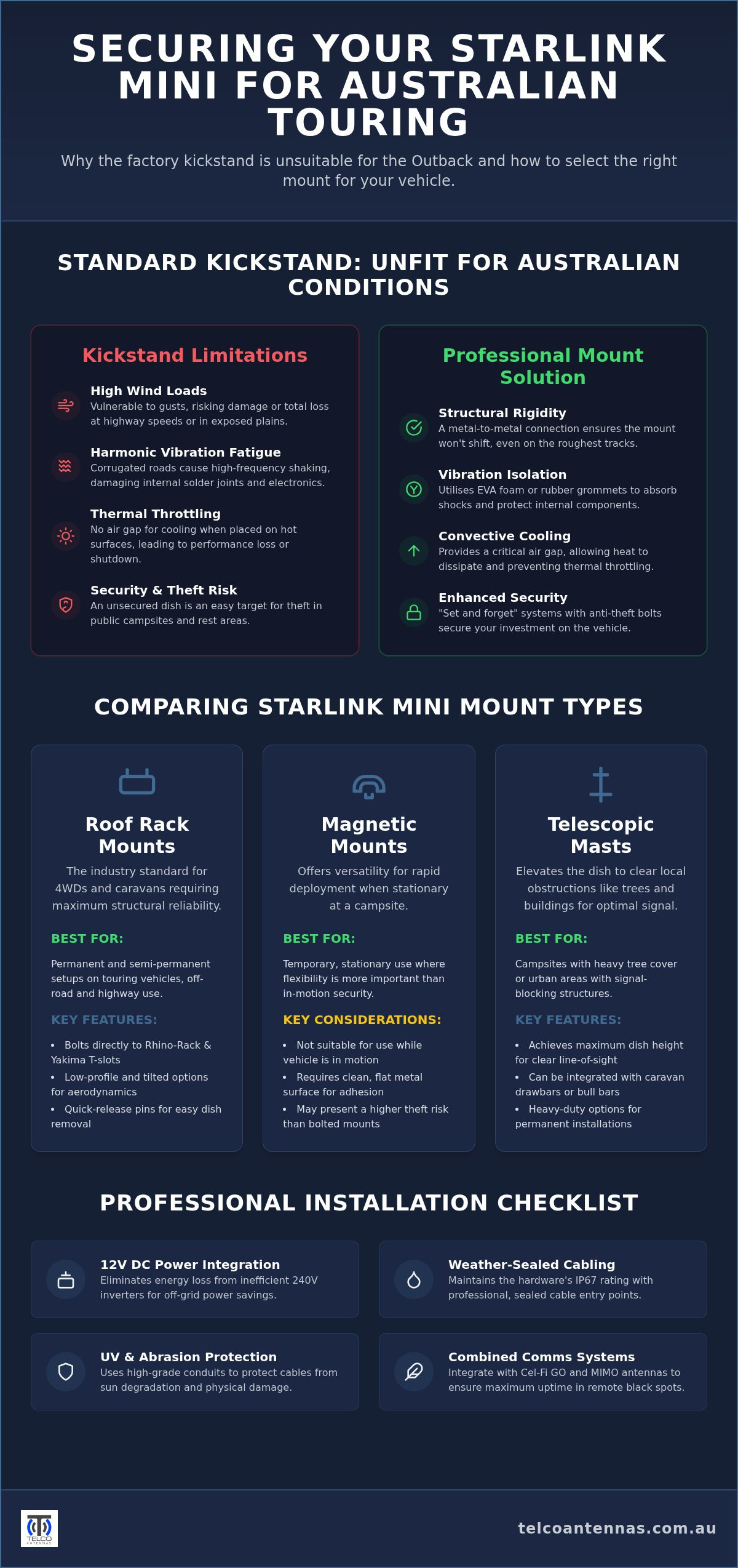
High wind loads represent a significant risk. In open desert environments or exposed plains, sudden gusts can easily exceed the stability threshold of a lightweight, unanchored dish. If the unit isn't secured by a dedicated starlink mini mount, you risk the hardware becoming a projectile, potentially causing damage to your vehicle or losing the connection entirely. Additionally, placing the dish directly on a hot vehicle surface like a bonnet or a dark-coloured roof rack can lead to thermal throttling. A professional mount provides the necessary air gap to allow for convective cooling, preventing the hardware from reaching its thermal shutdown limit during a harsh Australian summer.
The impact of vibration on satellite hardware
Harmonic vibration is the silent killer of remote electronics. When driving on corrugated roads, the constant high-frequency shaking can fatigue internal solder joints and delicate PCB components. A rigid, plastic-on-metal connection transfers every jolt directly into the hardware. Professional mounting solutions utilise vibration isolation techniques, such as high-density EVA foam inserts or rubber dampening grommets, to absorb these shocks. Effective vibration isolation for remote travel must decouple the dish from the vehicle's chassis to prevent mechanical resonance from compromising the internal circuitry.
Security and theft prevention in public campsites
Leaving a five-hundred-dollar piece of technology sitting on the ground or a folding table makes it an easy target in busy rest areas or public campsites. Unsecured gear is vulnerable to both opportunistic theft and accidental damage from wildlife or other campers. Transitioning to a permanent starlink mini mount allows for the use of anti-theft bolt kits and lockable cradles. By integrating the dish into a permanent vehicle roof centre, you create a "set and forget" system that remains secure whether you're at the steering wheel or away from the vehicle on a hike.
Comparing Starlink Mini mount types: Roof, Magnetic, and Mast
Selecting the right starlink mini mount requires a pragmatic assessment of your specific operational environment. While the Australian Communications and Media Authority (ACMA) monitors the broader regulatory landscape for satellite services, the physical security of the installation remains the user's responsibility. For most Australian tourers and industrial operators, the choice falls between permanent roof integration, flexible magnetic bases, or elevated mast systems. Each method offers distinct advantages depending on whether your priority is aerodynamic efficiency, rapid deployment, or clearing local signal obstructions.
Roof rack mounts for Rhino-Rack and Yakima systems
Flat-surface mounts have become the industry standard for 4WDs and caravans due to their structural reliability. These brackets are engineered to bolt directly into the T-slots of Rhino-Rack Pioneer Platforms or Yakima LockNLoad systems, ensuring a metal-to-metal connection that won't shift on rough tracks. You must choose between a low-profile mount, which sits flush for better clearance, and a tilted mount. While flush mounts are more aerodynamic and reduce the risk of snagging on low-hanging branches, a slight tilt can improve throughput by aligning the phased array more effectively with the satellite arc. Most professional-grade brackets now incorporate quick-release pins. This allows for easy removal when the vehicle is parked under cover or when you need to move the dish to a clearer patch of sky away from the vehicle.
Magnetic mounting offers versatility for temporary stationary use, but you should be aware of technical trade-offs. Placing a dish too close to a large metal roof skin can cause signal reflection issues that degrade performance. If you use magnets, select high-pull-force neodymium options with a rubber coating to protect your vehicle's paint. These are excellent for quick setups at a campsite, yet they should never be used on the move. The unpredictable nature of wind shear at highway speeds makes a magnetic starlink mini mount a stationary-only solution for professional users.
Professional mast and pole adapters
In heavily timbered rural areas or industrial site offices, ground-level placement often results in constant signal obstruction. Adapting the Starlink Mini to fit standard 38mm to 50mm antenna poles allows you to clear the tree line and achieve a true line-of-sight. For rapid deployment in mining or emergency services, integrating the dish with telescopic mast trailers provides the necessary elevation for a stable connection. Using a mast-based adapter is often the only way to bypass local obstacles that would otherwise cause frequent dropouts. If you're managing a remote hub, this elevation is essential for maintaining the high-speed throughput required for professional applications.
Selecting a Starlink Mini mount for your specific application
Selecting a starlink mini mount is not a universal process; it requires matching hardware specifications to the environmental stresses of your specific industry. The recent Regional Telecommunications Review highlights the growing dependency on satellite services for safety and productivity across the Australian interior. Whether you're a solo tourer or managing a commercial fleet, your mounting strategy must account for both physical durability and electrical integration to ensure the hardware survives the diverse climates found across the country.
Off-road and touring considerations
For utes and 4WDs, the priority is minimising aerodynamic drag while maintaining a clear view of the sky. A low-profile starlink mini mount should be positioned carefully to avoid signal shadowing from solar panels, spare tyres, or roof-mounted swags. Cable management is equally critical for vehicle longevity. We recommend routing cables through dedicated roof glands or even up through a snorkel to prevent water ingress during deep river crossings. Integrating a 12V power conversion system at this stage is essential for mobile setups, as it removes the inefficiency of running a large inverter for a small DC device, preserving your auxiliary battery capacity for longer stays in remote camps.
Caravan and motorhome owners often require a hybrid approach that balances security with flexibility. A detachable mounting system allows the dish to remain secured to the roof during transit but permits manual relocation to a tripod if you're parked under dense tree cover. This flexibility ensures you don't have to choose between a shaded campsite and a high-speed connection. By using a quick-release bracket, you can move the hardware to a clearer patch of sky in seconds without needing specialised tools, ensuring your phased array is always optimised for the best available satellite pass.
Fixed wireless and industrial site deployment
In commercial environments like mining camps or remote site offices, the focus shifts to 24/7 uptime and wide-area coverage. These installations often utilise permanent mast mounts fixed to site huts or existing communication towers to clear local obstructions. For larger sites, integrating the satellite feed with long-range wireless bridges allows you to distribute high-speed Wi-Fi across multiple buildings or work zones without the cost of laying fibre. In coastal or tropical areas, these mounts must be engineered for high wind ratings to ensure stability during the severe weather seasons.
Agriculture and AgTech applications present unique challenges, particularly when mounting hardware on pivot irrigators or broadacre machinery. These setups require extreme vibration dampening to protect the phased array from the constant mechanical stress of heavy equipment. A fixed mount on a tractor or harvester must provide a reliable real-time data flow for precision farming, requiring a secure, vibration-isolated foundation that can handle thousands of hours of operation in dusty, high-vibration environments across the agricultural belt.
Technical installation: Cable protection and 12V power
A secure starlink mini mount provides the structural foundation, but the longevity of your remote connection depends on the technical integrity of the cabling and power supply. In the Australian environment, standard PVC cable jackets are prone to rapid UV degradation and physical abrasion from wind-whipped grit. We recommend encasing all exposed cable runs in heavy-duty corrugated conduit or UV-stabilised nylon braiding. For waterproof entry into vehicle cabins or site huts, the use of high-quality IP67-rated cable glands is non-negotiable. These glands maintain the environmental seal of your structure while preventing the cable from chafing against sharp metal edges during transit.
Power management is the second pillar of a professional installation. Standard Starlink kits ship with AC power bricks designed for 240V wall sockets, which are highly inefficient when running from a battery bank. Using an inverter to step 12V DC up to 240V AC, only for the power brick to step it back down to DC, results in significant energy loss through heat. Integrating a dedicated 12V DC power system allows you to bypass this conversion cycle, extending your off-grid runtime. For high-current delivery, Anderson connectors provide a far more reliable mechanical connection than standard cigarette lighter plugs, which often vibrate loose on rough tracks.
Optimising power for the Starlink Mini
Before finalising your battery sizing, it's vital to review the actual Starlink power consumption metrics in real-world Australian conditions. While the Mini is more efficient than its predecessors, it still requires a stable voltage supply to maintain the phased array's performance. Most 12V vehicle systems fluctuate between 12.2V and 14.4V, which can lead to instability. We utilise voltage boosters to provide a consistent 48V supply to the dish regardless of the battery's state of charge. To ensure reliable phased array performance, the total voltage drop from the power source to the dish must be restricted to less than 5% of the nominal supply voltage under peak load conditions. You can find engineered Starlink after market power conversion solutions that simplify this integration.
RF interference and signal clearance
The placement of your starlink mini mount must account for the hardware's 100-degree field of view, often referred to as the "Keep-Out Zone." Any obstruction within this cone, such as a nearby UHF antenna or a roof-mounted spare tyre, will cause signal attenuation and increased latency. You should also consider the risk of multipath reflections. When a dish is mounted too close to a large, flat metal surface like a white van roof, the radio frequency signals can bounce off the metal and interfere with the primary signal path. Positioning the mount at least 300mm away from other high-gain antennas, such as those used for Cel-Fi GO or VHF radios, helps prevent cross-channel interference that can degrade your overall data throughput.
Professional Starlink Mini solutions from Telco Antennas
While a robust starlink mini mount ensures the hardware remains physically secure, professional connectivity requires a holistic approach to RF engineering. At Telco Antennas, we view the satellite dish as one component of a broader communication ecosystem. Our range of Starlink accessories Australia is curated to address the specific failure points identified in earlier sections, such as vibration fatigue and thermal management. We provide the technical support necessary to transition from a consumer-grade kit to a reliable industrial-strength installation that functions across the entire continent.
For many remote operators, satellite data is only half the requirement. Combining Starlink with Cel-Fi GO signal boosters creates a comprehensive coverage solution. This hybrid approach allows you to use the satellite phased array for high-speed data while the Cel-Fi system ensures reliable mobile voice and SMS connectivity within the vehicle or site hut. This redundancy is vital for safety in regions where satellite handovers or local obstructions might otherwise leave you without a lifeline. We specialise in custom RF engineering for commercial deployments, ensuring every part of your communication trailer or site office is optimised for maximum uptime.
Beyond the mount: The complete connectivity kit
The quality of your auxiliary cabling often dictates the final performance of your system. We exclusively recommend LMR-400 coaxial cables for any external antenna integrations. Standard RG-58 cables suffer from significant signal attenuation over even short distances; LMR-400 provides the low-loss characteristics required to maintain signal integrity in high-interference environments. Integrating your satellite feed with high-gain MIMO antennas can also provide a secondary data path, ensuring your operations don't grind to a halt if the primary dish view is temporarily obstructed. For large-scale remote operations, our team conducts professional RF site surveys to determine the optimal placement for towers and masts before any hardware is bolted down.
Why technical authority matters
With engineering expertise in Australian RF environments since 2008, we understand that hardware must be over-engineered to survive the bush. We don't just sell components; we provide the tools for successful, long-term remote operations. Our focus remains on hardware that survives the harshest environments, backed by a team of master technicians who understand the mechanics of the industry. Whether you need a single starlink mini mount for a touring ute or a fleet-wide rollout of telescopic mast trailers, we provide national shipping and expert technical support to keep you connected.
View our professional Starlink mounting and power solutions here to secure your remote data connection with engineered reliability.
Securing your remote connectivity for the road ahead
Transitioning from a temporary setup to a professional-grade installation is the only way to ensure your hardware survives the mechanical stresses of the Australian Outback. A secure starlink mini mount acts as more than just a bracket; it's a critical component that provides essential vibration isolation and ensures your phased array maintains a clear field of view. By integrating 12V DC power and UV-stabilised cable protection, you eliminate the energy losses of inverters and protect your investment from the harsh environmental variables found across the continent.
Telco Antennas has been Australian owned and operated since 2008, providing ruggedised hardware specifically tested for local conditions. Our RF engineers offer the expert technical support required to design a reliable communication system, whether for a solo touring ute or a large-scale industrial site. We invite you to browse our range of professional Starlink Mini mounts and 12V conversion kits to find an engineered solution for your next deployment. With the right foundation in place, you can move forward with the confidence that your high-speed connection will remain stable across every kilometre of your journey.
Frequently Asked Questions
Can I mount my Starlink Mini flat on a roof rack?
You can mount the Starlink Mini flat on a roof rack, provided you use a dedicated starlink mini mount designed for Australian conditions. While a flat orientation is more aerodynamic and reduces the risk of snagging on scrub, it may slightly reduce throughput compared to a tilted position. It's critical to ensure a sufficient air gap between the dish and the rack to prevent thermal throttling on hot vehicle surfaces during summer.
Will an aftermarket mount void my Starlink warranty?
Using an aftermarket mount doesn't inherently void your warranty, but any physical damage caused by a poor installation or non-standard modification might not be covered. We recommend using engineered brackets that utilise the existing mounting points to maintain the unit's IP67 rating. Ensuring the dish is secured without drilling into the hardware's chassis is the best way to maintain your warranty while improving the structural integrity of your mobile setup.
How do I power my Starlink Mini from a 12V dual battery system?
To power your unit efficiently, you should use a 12V DC power conversion kit rather than a standard AC inverter. This method bypasses the energy loss associated with multiple conversion stages. A voltage booster is required to provide a stable 48V output to the hardware, ensuring the phased array performs consistently even when your battery voltage fluctuates. We recommend using high-current Anderson connectors for a reliable mechanical connection on rough tracks.
Do I need a special mount for off-road driving on corrugated roads?
Standard mounts are often insufficient for the high-frequency vibrations found on corrugated Outback roads. A specialised starlink mini mount for off-road use should incorporate vibration isolation materials, such as high-density EVA foam or rubber dampening grommets. These components decouple the dish from the vehicle's chassis, preventing harmonic resonance from fatiguing internal circuitry and solder joints. Without this protection, the hardware is at a much higher risk of premature mechanical failure.
What is the best way to route the Starlink cable into a vehicle?
The most reliable method for cable entry is through an IP67-rated waterproof cable gland installed in the roof or a side panel. This ensures a weather-sealed seal while preventing the cable from rubbing against sharp metal edges. For additional protection, we suggest encasing the exposed cable in UV-stabilised corrugated conduit. This prevents the harsh Australian sun from degrading the cable jacket and protects the connection from physical abrasion during remote travel.
Can I use a magnetic mount while driving at highway speeds?
We strongly advise against using a magnetic mount while the vehicle is in motion at highway speeds. While high-pull-force neodymium magnets are excellent for stationary setups at a campsite, they cannot reliably withstand the unpredictable wind shear and upward lift generated at 100km/h. For transit, a permanent bolt-on bracket is the only safe solution. Magnetic mounts should be reserved for quick deployment scenarios where the vehicle remains completely stationary.
Does the mount affect the signal quality or speed of the Starlink Mini?
The mount itself doesn't degrade the signal, but its placement is crucial for performance. Any mount that positions the dish too close to obstructions like solar panels or UHF antennas will cause signal attenuation and increased latency. Additionally, mounting the dish too low on a metal roof can cause multipath reflections that interfere with the phased array. Ensuring a clear 100-degree field of view is essential for maintaining maximum data throughput and signal stability.
Is there a mount that allows for quick release of the Starlink Mini?
Many professional mounting solutions now feature quick-release mechanisms that allow you to remove the dish in seconds. These systems typically use spring-loaded pins or lockable cradles, enabling you to move the hardware to a tripod if your vehicle is parked under dense tree cover. This flexibility is particularly useful for caravan owners who want the security of a roof mount during transit but require the ability to relocate the dish for better signal acquisition at camp.


