
Relying on a standard 240V AC inverter to power your satellite internet while stationary in the remote scrub is essentially discarding thirty percent of your stored energy as wasted heat. Most off-grid travellers recognise that every Amp-hour is a finite resource, yet the standard out-of-the-box configuration for most hardware remains fundamentally inefficient for nomadic Australian applications. You likely find that the constant fan noise and thermal dissipation of an inverter are poor trade-offs for a connection that should be seamless and reliable.
This professional guide provides the technical framework to master starlink power consumption australia by integrating the Starlink Mini directly into your vehicle's 12V DC system. We will move beyond the unreliable cigarette lighter sockets that frequently fail on corrugated tracks to establish a robust, hardwired connection that maximises your off-grid runtime. By the end of this article, you will understand the precise voltage tolerances of the Mini hardware, the mechanical requirements for a secure installation, and the calculated Amp-hour draw required to maintain reliable communications across the continent.
Key Takeaways
- Identify why the Starlink Mini’s native DC input is superior for vehicle use, allowing you to bypass the significant energy losses of traditional 240V AC inverters.
- Compare the mechanical reliability of standard accessory plugs against professional hardwired kits to ensure your connection remains stable on corrugated outback tracks.
- Master the calculations for starlink power consumption australia to accurately predict daily Amp-hour draw and protect your dual-battery system’s longevity.
- Determine the required cable gauges and installation paths to eliminate voltage drop, ensuring consistent performance for your hardware in remote locations.
- Learn how to combine satellite data with Cel-Fi GO mobile boosters to establish a comprehensive and energy-efficient communication hub for your 4WD or caravan.
Understanding the Starlink Mini Power Architecture for Vehicles
The Starlink Mini introduces a fundamental shift in hardware architecture by incorporating a native DC input, a feature previously absent from the residential and high-performance dishes within the Starlink satellite constellation. This design choice is particularly relevant for the Australian market, where vehicle-based off-grid travel is the primary use case for mobile satellite internet. While the unit arrives with a 240V AC power brick, this component is essentially a compromise for domestic compatibility rather than a tool for field efficiency. In a professional mobile installation, the car adapter or DC conversion kit shouldn't be viewed as just a plug; it's a critical power management tool that bridges your vehicle’s electrical system with sensitive communication hardware.
The Efficiency Gap: AC Inverters vs. Native DC Power
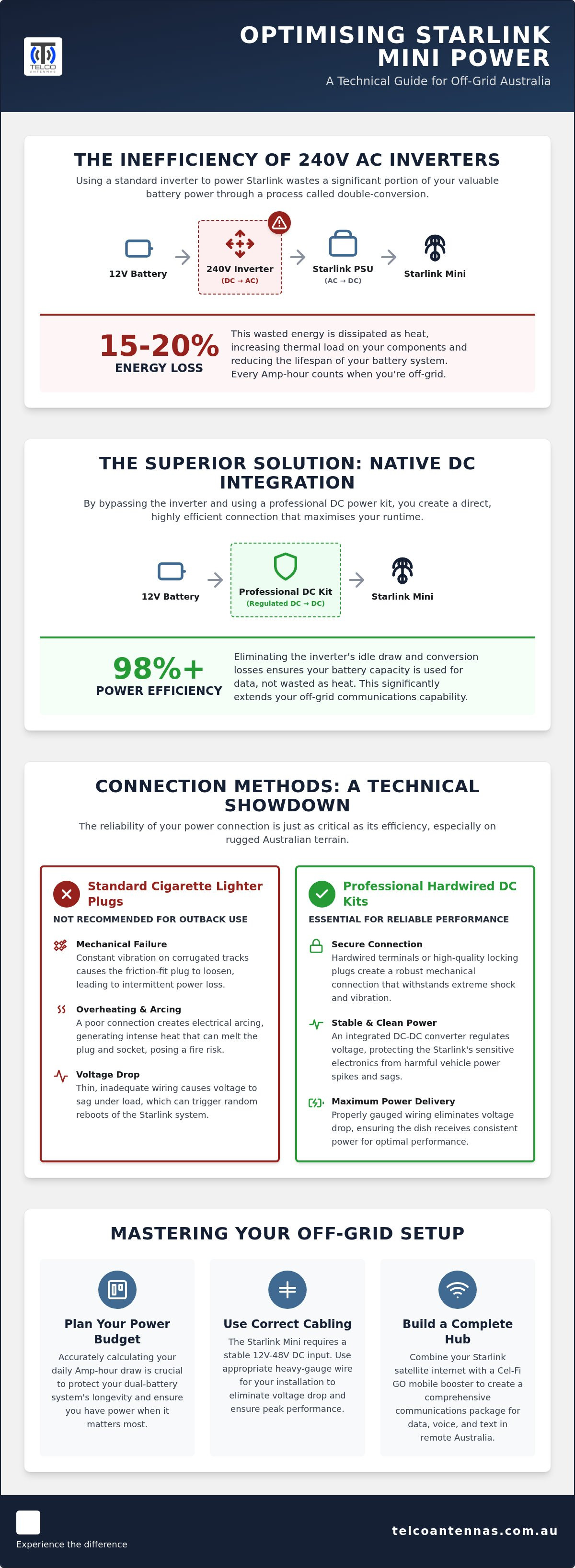
Converting power from a 12V house battery through a 240V inverter, only to have the Starlink power supply convert it back to DC, creates a measurable energy overhead. This double-conversion process typically incurs a 15% to 20% loss in efficiency. In the context of starlink power consumption australia, these losses manifest as wasted Amp-hours and unnecessary heat. When hardware is mounted inside a sealed canopy or a compact battery box, this thermal dissipation can accelerate the degradation of nearby electronic components. Eliminating the inverter's "idle" draw is the most effective way to extend your off-grid stay, ensuring your battery capacity is used for data transmission rather than keeping an inverter's cooling fan spinning.
Starlink Mini Voltage Requirements
The Starlink Mini is engineered to accept a wide input range, typically between 12V and 48V DC. While this flexibility is an advantage, it doesn't mean the hardware is immune to the realities of vehicle electrical systems. Modern alternators often output up to 14.4V during charging cycles, while voltage can drop significantly when high-draw appliances like 12V winches or compressors engage. To maintain a consistent satellite link, the phased-array electronics require a stable and filtered voltage. Using a regulated DC-to-DC power kit protects the dish from these fluctuations and "dirty" power spikes, providing the clean electrical environment necessary for high-speed performance in the harsh Australian Outback. Relying on unregulated connections can lead to intermittent dropouts or, in extreme cases, permanent damage to the Mini’s internal power management circuitry.
Technical Comparison: OEM Plugs vs. Professional Power Kits
While the factory-supplied cigarette lighter lead offers a convenient plug-and-play solution, it often fails to meet the rigorous demands of the Australian interior. For many users, the primary concern regarding starlink power consumption australia isn't just the total wattage, but the reliability of the delivery mechanism over thousands of kilometres of corrugated tracks. Consumer-grade connectors are designed for domestic environments; they aren't engineered to withstand the mechanical stress and thermal loads found in a 4WD canopy or a caravan's external locker. Standardising your setup with professional-grade hardware is the only way to ensure your connection remains active when you're hundreds of kilometres from the nearest service centre.
The Problem with Cigarette Lighter Adapters
Cigarette lighter sockets rely on a simple friction fit and a small spring-loaded pin to maintain electrical contact. On a sealed highway, this interface is generally acceptable. However, once you hit corrugated roads, the constant vibration causes the plug to shift minutely within the socket. This movement creates intermittent contact, or arcing, which generates localised heat and can eventually melt the socket housing or blow the internal fuse. Beyond the mechanical risks, thin consumer cables are prone to significant voltage drop. When the dish demands peak power during a satellite handoff, a substandard cable can cause the voltage to sag below the hardware's operational threshold, resulting in an immediate reboot of the system.
Benefits of Dedicated DC-DC Conversion Kits
A dedicated DC-DC conversion kit does more than just provide a secure mechanical connection. It acts as a buffer between your vehicle's fluctuating battery voltage and the dish's sensitive electronics. Even when your house battery drops below 12.2V under the load of a fridge or lighting, a high-quality converter maintains a steady, regulated output. According to Starlink power consumption data, the hardware's draw varies significantly based on network demand and environmental factors. A hardwired kit ensures that cable resistance doesn't cripple your performance during these peak periods.
These kits also allow for integrated fuse protection that is specific to the communication loop, isolating your expensive satellite hardware from the vehicle’s main electrical loom. When you integrate these power solutions with a Starlink pole mount adapter, you create a permanent, engineering-grade comms hub that is ready for immediate deployment. For those seeking the highest level of remote reliability, upgrading to professional aftermarket power conversion hardware is a pragmatic step towards a failsafe off-grid setup.
Optimising Power Efficiency for Long-Stay Remote Camping
For travellers planning extended stays in remote regions, understanding the daily energy budget is a prerequisite for system reliability. The starlink power consumption australia users experience typically falls between 25W and 40W during active use. On a 12V system, this equates to a continuous draw of approximately 2.1 to 3.3 Amps. Over a 24-hour period, a Starlink Mini left powered on will consume between 50Ah and 80Ah of battery capacity. By using a native DC-to-DC conversion kit instead of an inverter, you effectively reclaim up to 15Ah per day, which is energy that can be redirected to critical appliances like your fridge or lighting.
Environmental factors also dictate power requirements. During heavy cloud cover or rain fade, the dish increases its transmission power to maintain a link with the satellite constellation. Similarly, if the dish is partially obstructed by timber or terrain, the hardware works harder to find a stable signal, leading to a measurable spike in current draw. Integrating your Starlink power supply into a modern DCDC charger or a Voltage Sensitive Relay (VSR) setup allows you to prioritise charging from the alternator while driving, ensuring your house battery is at maximum state of charge before you reach your campsite.
Battery Chemistry and Discharge Rates
The constant draw of satellite internet affects battery chemistries differently. Traditional AGM batteries are sensitive to deep discharge cycles; a continuous 3-Amp load can quickly pull an AGM battery below its ideal 50% state of charge, leading to premature capacity loss. In contrast, Lithium (LiFePO4) batteries maintain a flatter voltage curve and can be safely discharged to 10% or 20%, making them the professional choice for powering high-bandwidth comms. To manage this effectively, we recommend installing a smart shunt. This device provides real-time data on your remaining capacity and helps you set low-voltage disconnects to ensure the system never drains your vehicle's starting battery.
Solar Integration for Indefinite Connectivity
To achieve indefinite off-grid connectivity, your solar array must be sized to exceed the daily consumption of the Mini. A 200W solar blanket is often sufficient to offset the 50-80Ah daily draw in most Australian conditions, provided you have clear sky access. High-efficiency DC adapters pair perfectly with portable solar blankets because they eliminate the "phantom load" associated with running an inverter throughout the day. By removing the need for double-conversion, a direct DC integration ensures that every watt harvested by your solar panels is utilised with maximum efficiency to maintain your connection.
Installation Guide: Hardwiring a Starlink Mini Car Adapter
A successful installation relies on mitigating voltage drop, which is the primary cause of system instability in 12V mobile setups. Because DC voltage decreases over the length of a wire, a cable run from a canopy battery to a bull bar or roof rack can result in insufficient power reaching the dish. To manage starlink power consumption australia effectively, you must select an appropriate cable gauge. For runs under three metres, 12AWG is often sufficient, but for longer runs common in 4WDs and caravans, we recommend 10AWG or 6mmB&S automotive cable. This ensures that when the Mini demands peak current during satellite acquisition, the voltage remains well within the hardware's operational threshold.
The routing process should begin at your dual-battery system, incorporating a high-quality fuse holder as close to the power source as possible. We suggest a 10A or 15A fuse to protect the circuit. Route the cable through existing grommets, avoiding sharp metal edges and high-heat areas like exhaust components. When terminating your connections, avoid simple crimp joiners. Use heavy-duty copper lugs or waterproof Deutsch connectors to ensure the circuit remains conductive despite the dust and moisture encountered on Australian tracks. Mounting the DC conversion hardware in a ventilated area of the canopy or behind a trim panel will prevent thermal throttling during mid-summer operation.
Cable Selection and RF Interference
High-speed satellite data is sensitive to electromagnetic interference, so cable management is a technical necessity rather than just an aesthetic choice. If you're also running cellular boosters or UHF radios, keep your Starlink power cables separated from signal looms where possible. While using LMR-400 coaxial cables for your antenna leads is the industry standard for reducing signal attenuation, the power supply itself must also be "quiet." Cheap, unbranded DC converters can emit significant RF noise that degrades the dish's signal-to-noise ratio, leading to lower download speeds and increased latency.
Permanent vs. Removable Vehicle Setups
Many Australian travellers require a hybrid approach where the dish can be removed from the vehicle for use at a campsite. In these scenarios, installing a weatherproof external power port, such as a recessed Anderson plug or a marine-grade socket, is the most reliable solution. This allows you to deploy the Mini on a tripod away from the shade of your vehicle while maintaining a secure, low-resistance connection. Before finalising the installation, always perform a load test. Use a multimeter to verify the voltage at the dish end of the cable while the system is actively transferring data. If the voltage sags significantly, it indicates a high-resistance joint or an inadequate cable gauge that needs addressing.
To achieve a professional-grade finish that survives the harshest conditions, consider upgrading to professional Starlink power conversion hardware designed specifically for the Australian environment.
The Complete Remote Comms Package: Starlink and Cel-Fi GO
Establishing a reliable communication hub in the Australian bush requires more than just a single data link. While Starlink provides high-speed internet, it doesn't replace the need for dedicated cellular voice connectivity, especially in emergency situations where satellite acquisition might be hindered by dense canopy or hardware failure. Integrating a Cel-Fi GO signal booster alongside your satellite dish creates a redundant system that ensures you remain reachable via standard mobile networks. This approach allows you to use Starlink for bandwidth-intensive tasks while relying on the booster for clear voice calls and SMS, which are often more reliable in fringe reception areas.
Managing the combined electrical load of these devices is a matter of professional circuit design. Instead of multiple loose cables, we recommend using a single DC distribution block or a dedicated fuse box located within your vehicle's canopy. This centralises the power management for your comms suite, making it easier to monitor the total starlink power consumption australia alongside the 15W to 20W draw of a signal booster. By hardwiring both systems into a regulated 12V supply, you eliminate the clutter of multiple adapters and ensure that each piece of hardware receives a stable voltage, even when the vehicle's engine is off.
Redundancy Planning for Remote Australia
Strategic power management is vital when your battery reserves are low. A Cel-Fi GO is significantly more power-efficient than a satellite dish, making it the preferred choice for maintaining basic contact when solar harvest is limited. If you're managing a stationary site or a long-term camp, the use of portable communication towers or telescopic masts can further enhance your cellular reach, allowing the Starlink hardware to be powered down during periods of inactivity to conserve energy. Reviewing the latest Starlink accessories in Australia will help you identify the mounts and cabling required to consolidate these technologies into a single, efficient deployment.
Consulting Telco Antennas for Custom Solutions
For industrial fleets or specialised off-grid explorers, a generic off-the-shelf setup often falls short of the required durability standards. Professional RF engineering ensures that your hardware is not only powered correctly but positioned to avoid signal interference between the satellite dish and cellular antennas. We specialise in designing custom power looms and mounting solutions that adhere to Australian electrical standards, providing a level of reliability that survives thousands of kilometres of corrugated tracks. Consulting with a specialist allows you to build a comms package tailored to your specific vehicle architecture, ensuring your equipment operates at peak efficiency in the most demanding climates on the continent.
Securing Your Remote Connectivity Infrastructure
Transitioning to a native DC power architecture is the most effective method for ensuring your satellite link remains stable while traversing the Australian interior. By eliminating the efficiency losses of AC inverters and replacing fragile cigarette lighter plugs with hardwired connections, you protect both your hardware and your battery reserves. Managing starlink power consumption australia requires a methodical approach to cable selection and voltage regulation, especially when operating in high-vibration environments that characterise our outback tracks.
A professional installation provides the peace of mind that your communication hub will perform reliably when you're hundreds of kilometres from the nearest service centre. Our team provides the specialist Australian RF engineering and hardware designed for remote and off-road conditions that modern off-grid setups demand. We offer technical support from seasoned experts to help you navigate the complexities of power management and signal interference in the field.
Explore our Starlink Aftermarket Power Conversion Solutions to finalise your vehicle's technical specification. With a robust 12V integration, you can maintain seamless connectivity across every track and campsite in the country.
Frequently Asked Questions
Can I run the Starlink Mini directly from a 12V cigarette lighter socket?
You can use a standard 12V cigarette lighter socket for temporary use, but it's generally discouraged for off-road travel. These sockets rely on a basic friction fit that frequently vibrates loose on corrugated tracks, causing intermittent power and hardware reboots. A hardwired connection or a high-quality Anderson plug provides the mechanical security required for the harsh Australian environment, ensuring your connection remains stable while the vehicle is in motion or stationary.
Does the Starlink Mini require a specific voltage regulator for car use?
A voltage regulator is highly recommended because vehicle electrical systems are rarely a stable 12V. Alternators can output up to 14.4V during charging, while heavy loads like winches or fridges can cause significant voltage sags. The Starlink Mini requires a clean, consistent voltage to maintain its sensitive phased-array link. Using a regulated DC-to-DC converter protects the hardware's internal electronics from these spikes and fluctuations, ensuring long-term reliability in the field.
How much power does the Starlink Mini draw from a vehicle battery?
The real-world starlink power consumption australia users experience typically averages between 25W and 40W during active data transmission. On a 12V system, this translates to a current draw of approximately 2.1 to 3.3 Amps. If you leave the unit powered on for a full 24-hour period, you should budget for a total consumption of 50Ah to 80Ah from your house battery, depending on the network load and environmental factors like rain fade.
What is the advantage of a hardwired DC conversion kit over an AC inverter?
The primary advantage is energy efficiency. Using an AC inverter involves a double conversion process where DC is turned into 240V AC and then back into DC by the power brick, wasting 15% to 20% of your energy as heat. A hardwired DC kit bypasses this overhead, allowing your battery to last significantly longer. Additionally, hardwiring eliminates the noise and bulk of an inverter, providing a more compact and silent installation for vehicle canopies.
Will using a third-party car adapter void my Starlink warranty?
Starlink’s official policy generally states that damage caused by unauthorised third-party accessories is not covered under warranty. However, using a high-quality, regulated DC power source that matches the hardware's specified voltage range (12V to 48V) is electrically safe. Most professional installers prioritise engineering-grade components to ensure the hardware is protected. If you're concerned about potential warranty claims, always retain your original AC power brick for testing purposes or for when you return the unit.
Can I use the same car adapter for Starlink Gen 3 and Starlink Mini?
No, you cannot use the same adapter because the Starlink Gen 3 and the Starlink Mini have different physical power connectors and electrical requirements. The Gen 3 dish typically requires a higher wattage and a specific proprietary connector, whereas the Mini is designed with a native DC input that accepts a wider voltage range. You must ensure your power kit is specifically compatible with the Mini hardware to avoid damaging the internal circuitry of the unit.
What cable gauge is recommended for a 5-metre 12V power run to the dish?
For a 5-metre cable run at 12V, we recommend using at least 10AWG or 6mmB&S automotive cable to minimise voltage drop. Thin consumer-grade wiring will cause the voltage to sag under load, which can lead to connection dropouts or hardware reboots during peak transmission. Investing in a heavier gauge ensures that the full potential of your battery reaches the dish, maintaining a reliable high-speed link even when the battery's state of charge begins to deplete.
Is a DC car adapter necessary if I already have a 2000W inverter in my canopy?
While you can technically use your 2000W inverter, it is significantly less efficient for managing starlink power consumption australia. Large inverters have a high "tare" or idle draw, often consuming 1 to 2 Amps just to stay turned on before you even plug in the dish. A dedicated DC car adapter allows you to power your internet without the massive overhead of a large inverter, making it the superior choice for long-term off-grid camping.


