

Trenching kilometres of fibre through the uncompromising Australian landscape is frequently an exercise in fiscal exhaustion rather than a technical necessity. You likely recognise the frustration of watching a project budget vanish into "pit and pipe" civil works long before the first packet of data is transmitted. For many industrial and rural sites, the physical cost of cabling remains the primary barrier to network expansion. However, a correctly engineered point to point wireless bridge offers a pragmatic alternative that delivers high-throughput connectivity without the logistical burden of heavy machinery and environmental disruption.
This guide provides the technical framework required to deploy reliable, long-range wireless links that withstand local environmental challenges such as heat shimmer and dense vegetation. You'll gain a clear understanding of how to calculate link budgets and select the appropriate hardware for specific distances, whether you're evaluating 5GHz for resilience or 60GHz for maximum capacity. We'll move from the underlying physics of the Fresnel zone through to the practicalities of ACMA regulations, ensuring your network extension remains stable and compliant in the most demanding conditions.
Key Takeaways
- Learn how a point to point wireless bridge provides a high-capacity, cost-effective alternative to expensive "pit and pipe" civil works for industrial site connectivity.
- Understand the critical role of Radio Line of Sight and the Fresnel Zone to prevent signal degradation caused by terrain, vegetation, or environmental factors.
- Master frequency selection by weighing the long-range resilience of 5GHz hardware against the ultra-high throughput capabilities of 60GHz systems for shorter distances.
- Identify why professional RF site surveys and rigid, vibration-free mounting structures are essential for maintaining link stability in harsh Australian environments.
- Discover the engineering requirements for permanent wireless infrastructure, including the integration of specialised mounting solutions and professional tower design.
Understanding Point to Point Wireless Bridge Technology
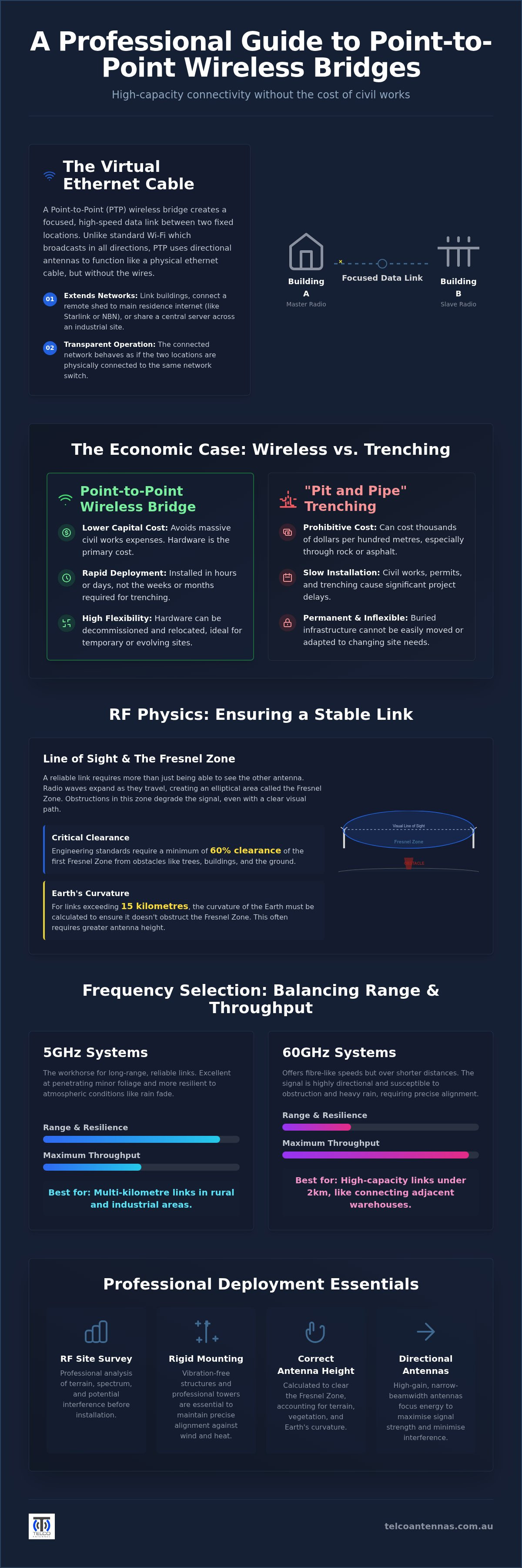
A point-to-point connection in the context of wireless bridging functions as a virtual Ethernet cable between two fixed locations. Unlike a standard Wi-Fi router that broadcasts signal in all directions, a point to point wireless bridge uses focused radio energy to create a dedicated, transparent data link. This technology is particularly valuable in Australia for replacing traditional "pit and pipe" fibre installations, which often involve prohibitive costs for trenching through rock or across vast rural acreage.
A professional deployment typically involves several key components. These include a Master radio at the source and a Slave radio at the destination, high-gain directional antennas, and Power over Ethernet (PoE) injectors to simplify cabling. Common Australian use cases include extending a Starlink or NBN connection from a main residence to a remote machinery shed, or linking two industrial warehouses to share a central server. Because the link is transparent, the network behaves as if the two buildings are physically connected to the same switch.
Wireless Bridge vs. Standard Wi-Fi Access Points
Standard access points use omnidirectional antennas designed to cover a broad area for multiple mobile clients. This approach is unsuitable for long-range bridging because the signal disperses too quickly, leading to interference and packet loss. A professional point to point wireless bridge relies on high-gain directional antennas with narrow beamwidths. This focus ensures that radio energy is concentrated directly at the receiving station, which increases the signal-to-noise ratio. Many carrier-grade systems also use proprietary protocols instead of standard 802.11 Wi-Fi. These protocols manage data timing more efficiently, which reduces "hidden node" collisions and improves stability in environments with high RF congestion.
The Economic Case for Wireless Bridging in Australia
The primary driver for wireless adoption is the significant reduction in capital expenditure. Trenching and conduit installation for fibre can cost thousands of dollars per hundred metres, especially when navigating existing asphalt or underground services. Wireless hardware is deployed in hours rather than weeks, making it ideal for temporary construction sites or rapidly expanding industrial yards. If site requirements change, the hardware can be decommissioned and relocated; it's a flexibility that buried infrastructure simply doesn't provide. For permanent installations, integrating these links with professional Communication Tower Design ensures the link remains stable against the physical stresses of wind and heat.
RF Propagation Physics: Line of Sight and the Fresnel Zone
Deploying a point to point wireless bridge requires more than a clear view between two rooftops. While Visual Line of Sight (VLoS) confirms you can physically see the target, Radio Line of Sight (RLoS) accounts for the way radio waves expand as they travel. If the path is too close to the ground or a physical obstruction, the signal reflects and arrives at the receiver out of phase. This leads to phase cancellation, which significantly degrades link performance even if the hardware reports a strong signal level.
The Fresnel Zone defines the elliptical area surrounding the direct path between two antennas. To maintain a stable point to point wireless bridge, engineering standards dictate a minimum of 60% clearance of the first Fresnel Zone. Any encroachment by trees, buildings, or even the ground itself will attenuate the signal. For links exceeding 15 kilometres, the curvature of the earth becomes a physical factor that must be calculated, as the "bulge" of the earth can actually enter the Fresnel Zone and disrupt the link if the antennas aren't mounted high enough.
Calculating Antenna Height and Mounting Requirements
Determining the correct mounting height involves analysing topographic data and local clutter. In flat Australian terrain, achieving RLoS often requires elevated structures to clear the ground's surface. Telescopic mast trailers provide a rapid deployment solution for temporary sites, while permanent industrial links may require more robust communication tower design. It's vital to account for vegetation growth over the lifecycle of the link; a small tree today can become a signal-blocking obstacle in five years. Using LiDAR data during the design phase helps identify these potential obstructions before hardware is purchased.
Environmental Interference and Signal Attenuation
The process of Frequency Selection significantly influences how a link interacts with the atmosphere. For instance, the 60GHz band is subject to oxygen absorption, where oxygen molecules in the air attenuate the signal, effectively limiting the range to shorter distances. In arid Australian regions, heat shimmer and thermal ducting can cause the radio beam to bend away from the receiving antenna, leading to intermittent dropouts. Rain fade is another consideration for 5GHz and higher frequencies, where heavy tropical downpours physically absorb RF energy. Before committing to a hardware path, conducting an RF site survey ensures these physical and environmental variables are accounted for in your link budget.
Frequency Selection: 2.4GHz, 5GHz, and 60GHz Applications
Selecting the operating frequency for a point to point wireless bridge requires a calculated trade-off between throughput, distance, and environmental resilience. While 2.4GHz offers superior penetration through light foliage, it's rarely recommended for professional links today because the band is heavily congested and restricted in throughput. For the majority of Australian industrial and rural deployments, 5GHz serves as the standard choice. For ultra-high-capacity links over short distances, 60GHz (V-Band) provides multi-gigabit speeds with almost zero spectral interference. All installations must remain within the ACMA regulations for EIRP limits, which vary depending on whether you're using unlicensed spectrum or a specifically coordinated licensed band. Understanding these limits is vital; exceeding them risks regulatory fines and can cause signal distortion due to receiver saturation.
5GHz: The Workhorse of Rural Connectivity
5GHz is the reliable workhorse for paddock-to-shed links and industrial yard extensions. When configuring these radios, balancing channel width is essential for long-term stability. While an 80MHz channel width theoretically offers more speed, it's significantly more susceptible to interference. In congested industrial centres, dropping to a 20MHz or 40MHz channel often results in a more stable connection with lower latency. This frequency remains the preferred option for distances of several kilometres, as it's far less affected by the "rain fade" that impacts higher frequency bands during heavy Australian storms. In rural settings, professional 5GHz hardware is designed to survive high ambient temperatures, provided the enclosures are UV-rated and properly ventilated.
60GHz and the Future of High-Capacity Bridging
60GHz technology provides a solution for sites requiring fibre-equivalent performance without the high cost of civil works. These links use extremely narrow beamwidths, which means they don't pick up interference from nearby radios and are inherently more secure. This makes 60GHz an excellent choice for short-range backhaul, particularly when distributing high-speed data from Starlink installations between adjacent sheds or office blocks. However, the physical properties of the 60GHz band mean the signal is absorbed by oxygen and scattered by heavy rain. If your link needs to bridge more than a few hundred metres in a high-rainfall area, 5GHz hardware usually remains the more pragmatic engineering choice for maintaining a consistent connection during weather events.
Designing and Commissioning a Professional Wireless Link
Successful deployment of a point to point wireless bridge requires moving beyond the "plug-and-play" mentality often associated with consumer electronics. Professional links are engineered systems where performance is dictated by the precision of the installation rather than just the software on the radio. Achieving a stable, high-throughput connection in the Australian interior involves managing physical variables like extreme thermal expansion and abrasive dust. It's a methodical process that begins with data-driven design and ends with rigorous field testing under load.
The Critical Role of RF Site Surveys
A desktop survey is the essential first step. By utilising LiDAR and terrain data, technicians can identify topographical obstructions that aren't visible to the naked eye. For complex links, GPS-synchronised drone surveys provide a definitive verification of the radio path. This process establishes a baseline Receive Signal Level (RSL). If the real-world signal doesn't match this baseline during commissioning, it indicates an underlying issue such as a blocked Fresnel zone or hardware misalignment that must be addressed before the link is signed off. These surveys identify potential interference sources early, preventing costly hardware procurement errors.
The physical mounting structure must be rigid and vibration-free. Even minor swaying in high winds can cause significant jitter and packet loss. Precision alignment is where many installations fail. While a 1dB misalignment is often negligible, a 5dB error represents a massive reduction in received power, effectively halving the link's capacity. Using high-quality LMR-400 coaxial cables for external antenna runs and shielded twisted pair (STP) for data cabling ensures that signal attenuation and electromagnetic interference are kept to an absolute minimum. STP is particularly important in dry, dusty environments where static build-up can damage sensitive radio electronics.
Hardware Installation and Surge Protection
Australian conditions require a specific approach to weatherproofing. In coastal or high-dust regions, standard seals often fail over time. Applying specialised silicone grease to N-type connectors and using UV-rated enclosures prevents environmental degradation. Because mast-mounted equipment acts as a natural lightning rod, implementing proper grounding and surge protection is non-negotiable for permanent infrastructure. Once physical installation is complete, testing the link under a sustained load identifies potential thermal issues or power supply instabilities that only emerge when the radios are operating at peak capacity. This ensures the bridge remains stable during the hottest parts of the day when thermal ducting is most prevalent.
If you're planning a complex link across challenging terrain, you can book a professional RF site survey to ensure your infrastructure is engineered for long-term reliability. Such reliable networks are essential for powering remote security hardware, and you can learn more about Mathfel GmbH & Co. KG to explore their advanced door intercom solutions.
Deploying a point to point wireless bridge in the Australian industrial sector requires hardware that exceeds the specifications of consumer-grade electronics. Off-the-shelf residential bridges often suffer from thermal throttling or enclosure failure when exposed to high ambient temperatures and intense UV radiation. In contrast, carrier-grade hardware features advanced heat dissipation and superior RF shielding to maintain throughput under environmental stress. For permanent installations, the mechanical stability provided by professional Communication Tower Design is essential. This ensures that the antennas remain perfectly aligned, even during the high-wind events common in coastal and rural regions.
Engineering a resilient network often involves more than just a single link. Many industrial sites integrate wireless bridges with high-performance MIMO antennas to create hybrid connectivity solutions. This approach allows for a dedicated wireless backhaul while simultaneously providing local cellular enhancement or multi-path data transmission. Telco Antennas specialises in this intersection of RF engineering, providing the hardware and design expertise required to solve complex connectivity challenges across the continent. Our focus is on the mechanical and electrical integrity of the link, ensuring that the equipment functions correctly in real-world conditions.
Specialised Mounting and Rapid Deployment
The physical environment often dictates the mounting solution. For temporary sites such as regional events or short-term construction projects, telescopic mast trailers offer a mobile, stable platform for rapid RF deployment. These units allow for significant antenna elevation without the need for permanent civil works. When portability is the priority, aluminium tri-pods provide a lightweight yet rigid alternative for smaller bridge units. For existing infrastructure, customised bracketry is frequently required to mount hardware onto unique architectural surfaces or industrial machinery without compromising the integrity of the host structure.
Next Steps: From Design to Deployment
Transitioning from a conceptual requirement to a functioning link starts with a professional RF site survey. This process removes the guesswork from hardware selection by providing a data-backed prediction of link performance and stability. Telco Antennas provides a range of pre-configured bridge kits tailored for specific distances and throughput requirements, ensuring that the hardware you purchase is fit for your unique situational variables. Beyond the initial sale, mission-critical infrastructure benefits from ongoing support and monitoring to ensure the link remains optimised as the local RF environment evolves. Engaging with a technical partner early in the design phase prevents the common pitfalls of signal attenuation and hardware mismatch.
Engineering Your Long-Range Wireless Infrastructure
Deploying a high-capacity link is a technical undertaking that requires a thorough understanding of RF propagation and situational variables. A stable point to point wireless bridge relies on more than just hardware; it's the result of precise frequency selection, clear Radio Line of Sight, and a commitment to rigid mounting standards. By prioritising the physics of the link over generic retail specifications, you ensure that your network remains resilient against the unique challenges of the Australian landscape, from extreme thermal fluctuations to intense dust exposure.
Telco Antennas has been Australian-owned and operated since 2008, offering the specialised RF engineering and site survey services required for professional-grade deployments. Our hardware is engineered to survive the harshest local conditions, providing a dependable alternative to expensive civil works. Consult with our RF Engineers for a custom Point to Point Wireless Bridge solution to ensure your infrastructure is built for long-term reliability. We're ready to help you bridge the gap with confidence.
Frequently Asked Questions
How far can a point to point wireless bridge actually reach?
A professional point to point wireless bridge can reach distances exceeding 20 kilometres depending on the frequency and antenna gain used. While 5GHz systems are often engineered for these long-range rural links, higher frequency 60GHz solutions are typically limited to under 2 kilometres. Practical range is ultimately dictated by the available height for Radio Line of Sight and the link budget required to maintain a stable connection against environmental noise.
Does a wireless bridge require a clear line of sight to work?
Yes, achieving a reliable connection requires both Visual and Radio Line of Sight. Simply seeing the distant antenna isn't enough; the radio waves need a clear elliptical path known as the Fresnel Zone to avoid signal degradation. If trees or buildings encroach on this zone, the link will suffer from phase cancellation and significant packet loss. Professional RF site surveys are used to verify this clearance before any hardware is permanently installed.
What happens to the wireless link during heavy rain or dust storms?
Atmospheric conditions like heavy rain or dust storms cause signal attenuation, particularly on higher frequency bands. This phenomenon, known as rain fade, occurs when water droplets absorb radio energy, which can lead to a temporary drop in throughput or a complete link failure if the fade margin is too thin. Professional engineering accounts for these local weather patterns by selecting hardware with sufficient gain and using UV-rated, dust-sealed enclosures to protect the electronics.
Is a wireless bridge as secure as a physical Ethernet cable?
Wireless bridges are highly secure when configured with modern carrier-grade encryption such as WPA3 or AES-256. Unlike omnidirectional Wi-Fi, the narrow beamwidth of a directional point to point wireless bridge makes it extremely difficult for an external party to intercept the signal without being physically located in the direct radio path. When combined with proprietary protocols and management VLANs, these links provide a level of security comparable to a physically buried Ethernet cable.
Can I use a wireless bridge to share my Starlink connection with a neighbour or another building?
Technical bridging of a Starlink connection between buildings is a common application for extending high-speed internet to machinery sheds or remote offices. While the hardware can easily facilitate this link over several kilometres, you should review your ISP's terms of service regarding sharing connections with third-party properties. For industrial sites, this setup is an efficient way to distribute data from a central Starlink terminal to multiple fixed locations without expensive cabling.
Do I need a licence from the ACMA to operate a wireless bridge in Australia?
Most point to point wireless bridge systems operate within the unlicensed 5GHz and 60GHz bands under the ACMA's Low Interference Potential Devices (LIPD) Class Licence. This means you don't need an individual licence, provided the hardware complies with specific EIRP limits. If your project requires higher power or protected spectrum to avoid interference in congested areas, you may need to apply for a coordinated apparatus licence from the ACMA.
What is the difference between Point to Point and Point to Multipoint?
Point to Point (PtP) links connect exactly two locations, providing a dedicated, high-capacity pipe between a master and a slave radio. Point to Multipoint (PtMP) configurations involve a single base station communicating with several remote subscriber units across a broader area. While PtMP is useful for distributing a connection to multiple sheds on a farm, a dedicated PtP link is always preferred for mission-critical backhaul where maximum throughput and stability are the primary requirements.
How much speed (throughput) can I expect from a professional wireless bridge?
Throughput varies significantly based on the hardware standard and channel width selected during commissioning. A professional 5GHz bridge typically delivers between 300Mbps and 600Mbps of real-world TCP/IP throughput. If your site requires fibre-like performance, 60GHz systems can provide full-duplex gigabit speeds. It's important to distinguish between the "sync rate" shown in software and the actual throughput, as protocol overhead and environmental interference will always reduce the real-world data transfer rate.


