

A single bar of signal on your handset is rarely enough to sustain a professional remote office or a modern agribusiness. If you're struggling with constant drop-outs during critical video calls or data speeds that fail to reflect your "available" signal, you're likely battling signal attenuation and path loss. Selecting a high-performance 4G antenna for rural areas Australia is the first step in converting a weak, unusable signal into a stable high-speed connection. It's a technical challenge that requires more than just a taller pole; it requires a systematic approach to RF engineering.
We understand the frustration of navigating conflicting advice and the legal complexities surrounding signal boosters. This guide provides a professional framework for mastering your local connectivity. You'll learn how to select high-gain MIMO antennas that match your specific terrain and why low-loss LMR-400 cabling is non-negotiable for preserving signal integrity. We'll also clarify the role of ACMA-approved hardware like the Cel-Fi GO, ensuring your setup is both high-performing and fully compliant with Australian regulations. By the end of this article, you'll have a clear blueprint for the hardware required to achieve reliable 4G/LTE data in the most demanding environments.
Key Takeaways
- Understand how path loss and local topography dictate your Receive Signal Level (RSL) and overall link stability in the Australian bush.
- Learn why a high-gain directional 4G antenna for rural areas Australia is superior to omnidirectional alternatives for maximising performance in fringe coverage zones.
- Discover how MIMO technology utilises spatial multiplexing to significantly increase data throughput for remote work and farm management.
- Identify the critical role of low-loss LMR-400 cabling in preventing signal attenuation between your external antenna and internal hardware.
- Recognise when professional RF site surveys and predictive modelling are necessary to overcome difficult terrain and ensure a reliable connection.
Understanding the Physics of Rural 4G Signal Loss
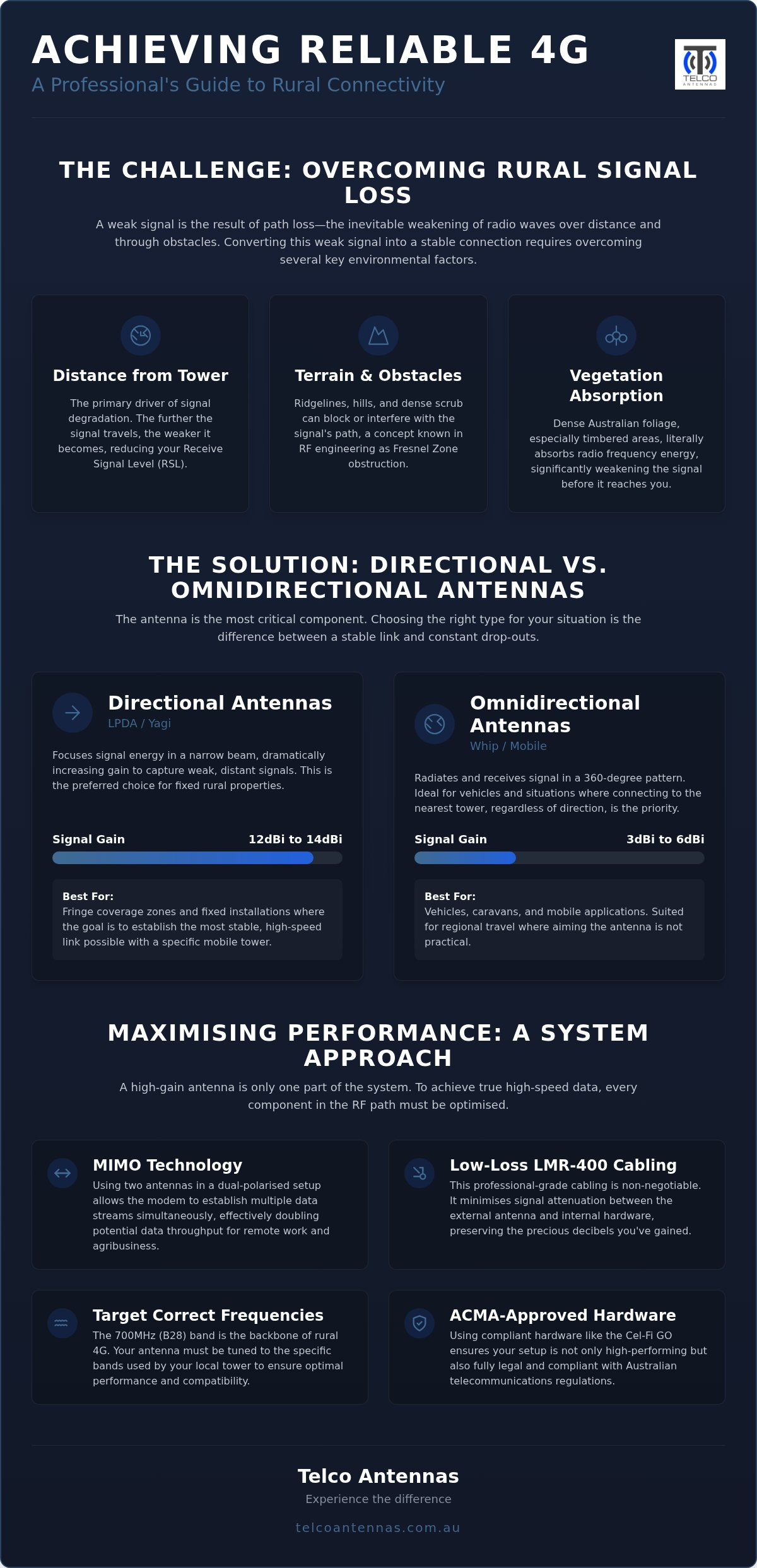
Achieving a stable connection in the Australian bush starts with a fundamental engineering reality: path loss. This term describes the inevitable reduction in signal power density as radio waves travel from a carrier tower to your property. While distance is the primary driver of this degradation, it's rarely the only factor. When you deploy a 4G antenna for rural areas Australia, you're effectively attempting to recover the decibels lost during this transit. Before the data even reaches your modem, it must survive significant signal attenuation caused by atmospheric conditions and physical obstacles that interfere with the Receive Signal Level (RSL).
The Impact of Terrain and Vegetation
Reliable data throughput requires more than just a visual line of sight. RF professionals focus on Fresnel Zone clearance, which refers to the elliptical volume of space surrounding the direct path between two antennas. If dense scrub, timbered areas, or ridgelines encroach upon this zone, the signal experiences destructive interference. While some signals can exhibit diffraction, where they bend over the crest of a hill, dense Australian foliage typically causes absorption. This is where the physical matter of the trees literally soaks up the radio frequency energy. It's also why the "bars" shown on a standard handset are a poor metric for performance; they often reflect raw signal strength without accounting for the quality or "cleanliness" of the data stream.
Frequency Bands and Propagation
The 700MHz frequency band, known as B28, serves as the backbone of rural 4G coverage across Australia. Its lower frequency results in a longer wavelength that can travel vast distances and penetrate obstacles more effectively than mid-band frequencies like 1800MHz or 2100MHz. While these higher bands offer more capacity, they dissipate rapidly and are often unusable on fringe properties. To ensure a professional installation, your hardware must be tuned to the specific bands used by your local carrier's tower. Modern regional networks also utilise MIMO technology to coordinate multiple data paths, which helps maintain stability even when the environment is less than ideal. Receive Signal Level is the baseline measurement for any rural RF site survey. Without an accurate RSL reading, it's impossible to calculate the necessary gain required for your specific terrain.
Directional vs. Omnidirectional Antennas for the Bush
Selecting a 4G antenna for rural areas Australia requires a choice between two distinct radiation patterns: directional and omnidirectional. The primary differentiator is gain, measured in dBi (decibels isotropic). A standard omnidirectional whip typically offers between 3dBi and 6dBi, radiating signal in a 360-degree horizontal pattern. In contrast, a high-gain directional antenna can provide 12dBi to 14dBi by focusing its energy into a narrow beam. For properties in "fringe" coverage zones where the Receive Signal Level is critically low, this concentrated gain is often the only way to establish a stable link. The trade-off is beamwidth; as gain increases, the "window" through which the antenna can see the tower narrows, making the installation more sensitive to physical movement.
High-Gain LPDA and Yagi Antennas
Log-Periodic Dipole Array (LPDA) antennas are the preferred choice for fixed rural installations. Unlike a traditional Yagi, which is often tuned to a single frequency, an LPDA supports a wide spectrum of bands. This multi-band capability is vital for modern networks where carriers like Telstra or Optus aggregate multiple frequencies to boost speeds. Because these antennas are highly directional, precise alignment is mandatory. A deviation of just a few degrees can result in a significant drop in throughput. For those seeking the highest possible speeds, deploying MIMO Antennas in a dual-polarised configuration allows the modem to utilise multiple data streams simultaneously, effectively doubling the potential bandwidth compared to a single antenna setup.
Omnidirectional Solutions for Regional Travel
While directional hardware excels at fixed sites, omnidirectional antennas are the standard for mobile applications and regional travel. For vehicles traversing corrugated outback roads, a heavy-duty radome with a thick stainless steel spring base is essential to withstand constant mechanical vibration. However, omnidirectional designs are more susceptible to interference. In areas where multiple weak signals from different towers overlap, an omni antenna may struggle to maintain a clean connection to a specific cell. There are rare scenarios where a lower-gain 6dBi omni outperforms a 12dBi directional unit, particularly in deeply undulating terrain where signal reflections are more reliable than a blocked direct line of sight. If you're unsure which hardware suits your specific terrain, you can browse our range of high-performance cellular hardware to find a solution tailored to your location.
The Necessity of MIMO Technology for Rural Data
While raw signal strength is vital, the speed of your connection is ultimately dictated by how your hardware handles the data stream. MIMO (Multiple-Input Multiple-Output) isn't an optional upgrade; it's the core architecture of modern 4G LTE networks. By utilising multiple antennas, the system employs spatial multiplexing to send separate data streams over the same frequency at the same time. If you use a single antenna (SISO) in a remote location, you'll likely experience "buffer bloat." This occurs when the connection becomes congested, causing latency to spike even if your signal bars appear full. Relying on a single path for data is often the primary cause of sluggish performance during video calls or large file transfers.
Polarisation and Signal Decorrelation
Achieving high-speed data requires signal decorrelation, which is managed through cross-polarisation. When you install a 4G antenna for rural areas Australia, you should mount two LPDAs at 90 degrees to each other, typically in a ±45-degree "X" configuration. This technical alignment allows the modem to distinguish between two independent signal paths, reducing interference and drastically improving the Signal-to-Noise Ratio (SNR). Without this physical separation, the modem can't effectively split the incoming data, which negates the benefits of the carrier's MIMO-enabled tower. Proper spacing on the mounting pole further ensures that the two paths remain distinct, providing the modem with the clean data it needs for maximum throughput.
MIMO Hardware Configurations
Most regional modems are currently designed for 2x2 MIMO, necessitating two distinct antenna feeds to function at peak capacity. While 4x4 MIMO offers even higher potential, the physical footprint of four separate high-gain antennas on a standard roof mount is often prohibitive for the average property. For users who need to stabilise mobile reception alongside their data, these antenna arrays work seamlessly with the Cel-Fi GO. This integration ensures that while the booster handles voice clarity, the dual-antenna system provides the wide bandwidth necessary for intensive tasks like farm management software or high-definition video conferencing. Choosing the right configuration depends on your modem's ports and the specific performance requirements of your remote office or homestead.
Optimising the RF Path: Cables, Height, and Connectors
Even the highest-gain 4G antenna for rural areas Australia is only as effective as the coaxial cable connecting it to your modem. In professional RF engineering, we focus on the entire signal chain to prevent unnecessary attenuation. Attenuation is the reduction in signal strength that occurs as the radio frequency energy travels through a conductor. Every centimetre of cable adds resistance, and in remote environments where the incoming signal is already weak, using the wrong grade of wire can render an expensive antenna useless. Managing this "RF path" is a critical step in ensuring your hardware delivers the data speeds it's capable of.
Minimising Signal Loss with LMR-400
Standard RG-58 cable, often found in low-cost consumer kits, is generally unacceptable for rural installations where cable runs exceed five metres. At the 700MHz band, and especially at higher frequencies like 1800MHz, the loss profile of RG-58 is too steep for fringe areas. We recommend LMR-400 grade coaxial cable for all regional fixed sites because of its superior shielding and lower loss characteristics. For instance, at 1800MHz, LMR-400 loses significantly less signal per ten metres compared to thinner, standard-grade alternatives. Every 3dB of cable loss effectively halves your signal power. To maintain this performance, we utilise high-quality N-Type connectors and professional-grade weatherproofing to prevent moisture ingress from degrading the copper over time.
Mounting and Elevation Strategies
Height is often the most cost-effective way to improve a rural signal profile. Elevating an antenna can clear local obstructions and bring the hardware closer to achieving the Fresnel Zone clearance required for a stable link. For permanent structures, roof-mounted masts provide the necessary elevation, though they must be installed with proper grounding and lightning protection to safeguard your internal hardware. In scenarios requiring temporary connectivity or rapid deployment on expansive properties, telescopic mast trailers offer a versatile solution. These units allow for significant elevation without the need for permanent civil works, making them ideal for seasonal farm management or remote exploration sites. If you need to ensure your installation preserves every decibel of gain, you can find our full range of low-loss LMR-400 cabling and mounting hardware here.
Professional Engineering for Remote Australian Sites
For properties with extreme topographical challenges, an off-the-shelf kit often falls short of expectations. We use predictive modelling software to simulate signal propagation across your specific coordinates, accounting for terrain data and existing carrier infrastructure. This data-driven approach allows us to calculate a precise decibel budget before any hardware is bolted to a mast. By identifying the exact RSL required to overcome local path loss, we can recommend a specific 4G antenna for rural areas Australia that is tailored to your site's unique requirements. This engineering-first mindset guarantees a level of connectivity that trial-and-error installations simply cannot match.
Compliance with Australian law is another critical factor for any professional installation. The ACMA has strict regulations regarding the use of active repeaters to prevent interference with carrier networks. Unapproved boosters can cause significant disruptions to local mobile towers, leading to heavy fines and equipment seizure. We only deploy ACMA-approved hardware like the Cel-Fi GO, which is engineered to interact safely with the network while providing the necessary gain for deep-rural black spots without compromising network integrity.
Redundancy is becoming a standard requirement for regional businesses and primary producers. Many of our clients now integrate a high-gain 4G antenna for rural areas Australia with Starlink solutions. This hybrid approach ensures that if one system fails due to atmospheric conditions or network congestion, the property remains connected for essential operations and safety. It's a pragmatic way to ensure 100% uptime in environments where connectivity is a business-critical utility.
Custom Site Surveys and Tower Design
For expansive farms or remote commercial sites, a single roof mount might not provide the necessary line of sight. We specialise in communication tower design, allowing hardware to be placed at the optimal height and location on your property. This infrastructure often supports point-to-point wireless bridges, which extend the 4G signal from a primary receiver to outbuildings or remote telemetry sensors several kilometres away. By analysing carrier tower locations and current sector loads, we ensure your local RF infrastructure is built for long-term reliability.
Choosing the Right Solution for Your Property
Before investing in hardware, it's essential to evaluate your specific environmental variables. A successful rural setup requires a clear understanding of your distance from the nearest tower, the frequency bands in use, and the physical obstacles in the signal path. Consider the following checklist for your site:
- Identify your primary carrier and the specific frequency bands they use in your region.
- Assess the terrain for Fresnel Zone obstructions that could cause signal absorption.
- Determine your bandwidth needs for tasks like high-definition video or remote farm management.
- Ensure all cabling is low-loss LMR-400 and that every connection is professionally weatherproofed.
Our team provides Australian-based technical support and seasoned engineering expertise to help you navigate these technical requirements. If you require a bespoke solution to solve your connectivity challenges, contact Telco Antennas for a professional consultation on your rural connectivity needs.
Engineering a Robust Future for Regional Data
Overcoming the technical barriers of the Australian landscape requires more than just high-gain hardware. A successful 4G antenna for rural areas Australia depends on a holistic approach that accounts for path loss, Fresnel Zone clearance, and the preservation of signal through low-loss LMR-400 cabling. By prioritising MIMO technology and precise directional alignment, you can transform a borderline connection into a robust asset for remote work or farm management.
Telco Antennas has been Australian owned and operated since 2008, establishing ourselves as ACMA-approved hardware specialists with deep expertise in remote industrial telecommunications. We understand that every property presents a unique RF profile that generic kits often fail to address. If your current setup doesn't deliver the stability your operations require, moving to an engineered solution is the most pragmatic path forward. Consult with our RF Engineers for a custom rural signal solution to ensure your property remains connected, regardless of the terrain. Reliability in the bush is possible when you apply the right technical standards to your specific environment.
Frequently Asked Questions
Do I need a license to use a 4G antenna or booster in Australia?
Passive 4G antennas do not require a license for installation or operation on your property. However, active signal boosters are strictly regulated by the ACMA. You must only use ACMA-approved devices like the Cel-Fi GO, which is legally authorised for use on Australian carrier networks. Using unapproved boosters is illegal and can lead to significant fines for interfering with mobile network infrastructure.
What is the best 4G antenna for Telstra regional coverage?
The most effective 4G antenna for rural areas Australia on the Telstra network is typically a high-gain Log-Periodic Dipole Array (LPDA). These antennas are designed to support the 700MHz (B28) band, which is the backbone of Telstra’s regional coverage. For data-intensive applications, a dual-polarised MIMO configuration is recommended to maximise throughput. This setup ensures your hardware maintains a stable connection even at the extreme edges of a tower's broadcast range.
Can a 4G antenna improve my NBN Fixed Wireless connection?
A standard 4G antenna cannot be directly connected to NBN Fixed Wireless hardware, as these systems operate on different frequencies and proprietary NBN infrastructure. However, if your NBN service is underperforming, a professional 4G antenna system can serve as a high-speed alternative or a redundant backup link. Many regional users find that a well-engineered 4G MIMO array provides lower latency and more consistent speeds than congested Fixed Wireless sectors in certain locations.
How far can a high-gain antenna reach from a 4G tower?
A high-gain antenna can establish a connection with a tower up to 50 kilometres away, provided there is a relatively clear line of sight. This range is highly dependent on the frequency band; lower frequencies like 700MHz propagate much further than 1800MHz or 2100MHz signals. Physical obstructions like hills and dense timber will significantly reduce this distance. Accurate reach is best determined through a professional RF site survey and predictive signal modelling.
Is it better to use a 4G antenna or switch to Starlink for rural internet?
The choice depends on your specific data requirements and budget. Starlink offers high raw speeds but comes with higher monthly costs and hardware fees. A professional 4G antenna for rural areas Australia often provides lower latency and is more cost-effective for users within reach of a carrier tower. Many remote operations now implement a hybrid model, using 4G as a primary low-latency link and Starlink for high-volume data redundancy to ensure constant uptime.
What happens to my 4G antenna after the 3G shutdown is complete?
Your 4G hardware remains fully functional as the 3G network shutdown in Australia is already complete. Modern antennas are designed to support the LTE and 5G frequency bands that now carry all voice and data traffic. If your current antenna was specifically tuned only for older 900MHz 3G signals, you might notice improved performance by upgrading to a wideband MIMO antenna that supports the full spectrum of current 4G and 5G frequencies.
Can I install a rural 4G antenna myself or do I need a technician?
While a basic DIY installation is possible, achieving professional-grade results often requires technical expertise. Precise alignment of a high-gain directional antenna is critical, as a few degrees of error can drastically reduce your data speeds. Additionally, working with heavy-duty LMR-400 cabling and N-Type connectors requires specific tools and weatherproofing techniques. For complex sites or multi-building setups, engaging a technician ensures the system is correctly grounded and optimised for your specific terrain.
How much does a professional rural 4G antenna system cost?
The total investment for a professional system varies based on the complexity of your site and the specific hardware required. A standard setup typically includes high-gain MIMO antennas, low-loss LMR-400 cabling, and robust mounting hardware. More advanced solutions involving communication towers, telescopic masts, or active boosters like the Cel-Fi GO will increase the initial outlay. We recommend focusing on the quality of the components, as sub-standard cabling or low-gain antennas often lead to higher long-term costs through lost productivity.


